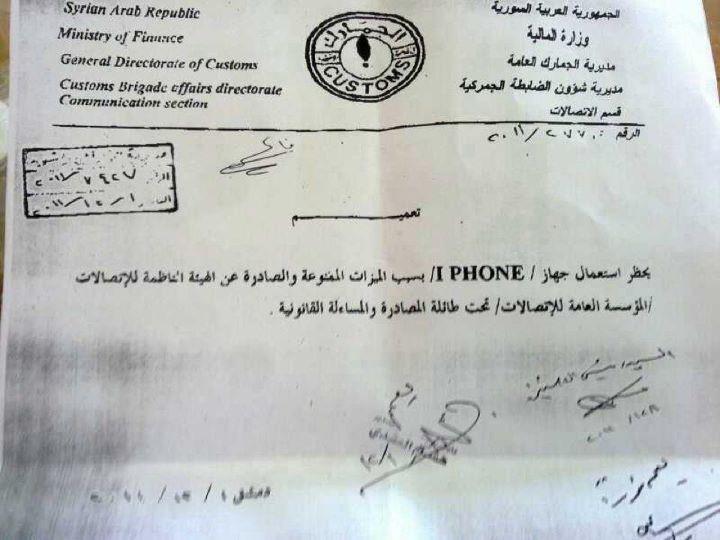
The iPhone is Banned in Syria

It looks like one of the new threats to burden the “lovely” Syrian regime is Apple’s iPhone. As if killing 4000 people, torturing countless more and terrorizing their whole country (and a neighboring country too) wasn’t enough.

But yes, according to this memo from the Syrian General Directorate of Customs, the iPhone has been banned because of its many features. I fail to see how a phone can threaten a political regime but I guess when you’re that insecure, anything goes. Or perhaps the iPhone has some hidden: Topple Regime app.

Check out the memo for yourself.

Dear Patriarch Raï, Enough… from a Lebanese Maronite.

I won’t lie and tell you I wasn’t happy when Beshara Al Raï was elected as the successor Maronite Patriarch to Nasrallah Sfeir, a man I believe is truly one of the greatest Lebanon has ever had.

Nasrallah Sfeir was berated, ridiculed, attacked, mocked and bashed for having very staunch views regarding the political situation of the region, his congregation and country. He never wavered. He was never afraid of speaking his mind, regardless of the repercussions. With Nasrallah Sfeir, I, as a Maronite, was proud of my Church. I was proud of the liberty walk the Maronite Church was pioneering across Lebanon.

It was the Maronite Church that called for Syrian troops withdrawal in 2000. It was the Maronite Church that was the staunchest anti-Syrian entity in the country when every single politician inside Lebanon was busy playing house with Bashar Assad’s men. It was the Maronite Church that ignited the first spark for the Cedar Revolution in 2005. And it was all because of one man: Nasrallah Sfeir.

Many Aounists do not like Sfeir. They’re the ones who ridicule, attack, mock and berate him, calling him senile, demented, etc…. And one of the main reasons I cannot take Aounists seriously is because when Sfeir supported their electoral campaign in 2005, whilst their leader Michel Aoun had not gone the deep bend yet, they loved Sfeir. He was one of the main reasons they got high number of votes in crucial Christian areas. But when Michel Aoun changed his views and started making love to Hezbollah, Sfeir remained firm. Aounists flipped with their leader and Sfeir became their focus of hatred. Excuse me for not taking you seriously.

But I digress. This is not a post to speak about the qualities of Nasrallah Sfeir. This is a post to talk about the shortcomings of his successor: Beshara Al Raï.

This will not be a post of me bashing the Maronite Patriarch. I try not to be a hypocrite and as such, I will try to avoid falling to hypocrisy over here. I hated when the Aounists cursed Sfeir and I’d hate myself for cursing Raï.

But Mr. Raï, you really need to be careful about what you say.

First, you support the oppressive regime in Syria, a regime that you personally fought against while it was ruling you in Lebanon. You adopted the mentality that many Christians in Lebanon and the region have: protection comes through an alliance of minorities. Well, I think this is simply cowardly. Have you forgotten Mr. Raï what that Syrian regime did in Lebanon in the years that it ruled the country? In case you forgot, here’s an extensive reminder. Have you forgotten the people that lost their lives at the hand of that regime? Have you forgotten the Maronite priests who were murdered or kidnapped by that regime? How can you fathom asking your congregation to accept allying themselves with the killer who tore at their souls for over fifteen years? Being afraid is not the solution Mr. Raï. Assuming responsibility, fighting for human rights and democracy is. 

Second, you support Hezbollah’s arms. I understand your motto for your patriarchal campaign was “love and partnership.” The notion of partnership, Mr. Raï, invokes equality. And there’s no way that an armed militia, terrorizing those that do not support it, is in a partnership with the rest of the country. And there’s no way supporting its arms and giving it extra Christian-support can be a sign of seeking partnership. It’s also hard for me to believe someone like you, who actively championed against these weapons before you became patriarch, can so easily change his mind. It’s not a switch of a button Mr. Patriarch.

Third, calling for love and partnership does not warrant you asking Christian convents and churches not to hire any non-Christian foreign workers, soon after the murder of Myriam Achkar. Her murder, Mr. Raï, was not sectarian. It was a sick, twisted man killing an innocent woman. If your message had been for churches and convents not to hire any foreign workers, it would have been greatly more understandable. Even if you had asked them to hire only Christian Lebanese, it would have been somewhat understandable. But not at the moment. Sometimes saying things just because the situation is still boiling, just to score a few points, is not the best strategy for someone in your position. As the head of the Maronite Church, your job at times like these is to get people to cool down, not fuel their hatred. Perhaps in a month or two you could have issued a private decree to Maronite convents with this particular order. Just not today. Besides, what’s the fault of the many Lebanese Muslim families already employed at convents and churches? Is their fault someone they share a sect with turned out to be a raging psychopath? Why are they the ones who have to assume responsibility for something they didn’t do?

I’m pretty sure Mr. Raï that if the tables had been turned and a Maronite had killed someone named Fatme Achkar and the Shiite/Sunni clergy asked their mosques to fear Christians the way you are asking now, you would have been throwing a fit.

Ever since you became patriarch, Mr Raï, the amount of paranoia and fear among Maronites has been exponentially increasing. It’s not us against our fellow countrymen. It’s all of us together against the foreign entities that want to mess with our country. It’s not Maronite VS Sunnis, it’s not Maronite VS Shiites. It’s Maronites and Shiites and Sunnis together to build a country. I understand the fear of having land owned by Christian be spread around. Perhaps asking Christians not to sell their land now is understandable – at least until this tricky phase the region is going through subsides. But in a country where economical woes are spreading, why don’t you help these Christians keep their land, Mr. Raï? Doesn’t the Maronite church have enough money? Can’t it hire those Lebanese in need to work in the many, many, many hectares it owns?

I’m proud of my heritage as a Lebanese Maronite and the sacrifices my Church has gone through over the years to build the country I live in. It saddens me, however, to see the person representing my church go to this extent against the natural current that has helped build this church. It saddens me to see the Maronite Church losing its sense of nationalism and its sense of patriotism.

Some might say it’s not my place to write this. At the end of the day, I did not vote for Mr. Raï nor could I have voted for him. So unlike a politician whom you can hold accountable, the Maronite Patriarch is someone out of your reach somehow because his time as patriarch only ends with him resigning or passing away. I do not wish any of those on Mr. Raï. What I hope to accomplish is perhaps, by having a voice of his congregation voice concern, I wouldn’t seem like an “outsider” intruding. It would be like a group within a big family debating. And when the faults the patriarch is committing are all across the news, a harmless blog post doesn’t seem such a disgrace, I guess. At the end of the day, I feel obliged as a Maronite to express my concerns about anyone who says they represent me, whether they truly do or not.

Christmas is coming up soon. Perhaps Mr. Raï you should consider this time of prayer to look at all that you’ve done in your first few months in the patriarchal office. Hopefully your gift to us will be a back to basis.

Lebanon’s Independence Day

Most countries around the world celebrate their “Independence Day” with ecstatic joy. To all of those countries, it is a reminder of their struggle to break free from superpowers that were using their land, their people, their resources…

In Lebanon, November 22nd has become a national mourning day of some sorts. What are the people mourning? The French citizenship that could have been.

What is the notion of Independence and why do many Lebanese find it easy to ridicule the independence of their country? Contrary to popular belief, I feel proud on November 22nd, just as I feel proud about Lebanon any day. My country has grave flaws but regardless of those flaws, it exists.

The reason it’s so hard for many Lebanese to see their country as independent is because the notion of independence is grossly overestimated. No country in the whole world is truly independent from other countries. Example? The USA has a national debt of over $14 trillion, a big chunk of which is to China. Why do you think the US is struggling to fix its national budget nowadays? To fix the economy? Partly yes. But mostly to lessen this national debt and its dependence on other countries, such as China.

The difference between people in the US and Lebanon is that they have national pride that does not waver while we have a national pride as firm as water. The difference between us and them is that, even though they do have poverty and even though some of their States have horrible internet and even though the 3G provided by many of their carriers is not good, they feel proud to call themselves American. How many of us feel proud to call ourselves Lebanese?

You do know that the problems in countries such as the US, France, Switzerland, etc… are very similar to our problems? You have villages in the United States whose only source of livelihood is the production of crystal meth. You have places in France, like Lebanon, where it’s so corrupt that the police doesn’t dare enter. And then you have Switzerland, a country that, despite the great diversity of its people, managed to find a way to get them to coexist.

The problem in Lebanon? Our problems are magnified because of our country’s small size.

Some of us blame our politicians. We say they got us into this predicament. But simply put, our politicians arise from our society – they are inherently part of us. We voted for them and got them where they are today. But our “Independence” day is not our politicians’ to take. It is for all of us as a nation to celebrate: the sacrifices of our forefathers against the French Mandate to establish the Republic of Lebanon.

Others still call for a French (or any other “decent” country) mandate, wishing we were still under one. You know, if our forefathers found the situation under the French to be absolutely peachy and happy, I’m pretty sure they wouldn’t have fought to get Lebanon out of the mandate. Perhaps you should contemplate what all these superpowers are secretly doing in African countries where their influence is much more penetrating, where they still control national resources and lead the people of those countries to kill each other?

At the end of the day, it is hard for many to see Lebanon as independent because we live in a very, very difficult region. I look around and see Syria where Bashar Assad is killing his people left and right. I look to the South and see Israel/Palestine, both of which want a piece of my land as well and both of whom tried to get it as some point. And then I consider all those Arab countries and see that for a small country like mine, I’m sure of utter importance to them. Why is that? Why is it that many countries around the world can’t wait to get their hands on something related to my country? No, it’s not overwhelming pride. It’s an observation. Perhaps because they know that, as divided as we are, it makes it much easier for them to put their hands on our resources, our people and our land?

Our Independence is wasted by none-other than us: the people who let other countries wage their wars on our land. And amid everything that’s happening in the region around us today, perhaps we should be less critical and more vigilant against all of these countries with messed up systems that are ready to move their fights inside our borders.

You don’t want to call it independence, fine. Call it Lebanon’s National Day. But regardless of terminology, you should at least feel a stinge of pride that you have a country and, despite all its problems and the problems thrust upon it, it exists.

Lebanon’s Syrian Occupation – A Persistent Matter That Should Never Be Forgotten

April 26th, 2005. As those last trucks carrying those Syrian soldiers left our land, many Lebanese drew a sigh of relief. Many thought that chapter of their present was finally going down to the history pages of the books in which it was going to be written. They also wished it would stay there, indefinitely.

What those people didn’t think of, however, was that their struggle with those Syrian soldiers and regime that occupied their land for over thirty years would be forgotten a few months after those soldiers physically left their land. Those people never thought that whenever they spoke about a Syrian occupation of the country, they’d be ridiculed by people. “There’s no such thing as a Syrian occupation. They’re a fellow Arab nation,” is many of the things you’d hear being said. As if them Arabs can never do wrong to Lebanon.

Those who say the Syrians never occupied Lebanon refer to the Israeli occupation of the Lebanese South and suggest that as a model of occupation. So let’s dissect the Israeli occupation of the South, based on what a Shiite Southern friend of mine told me on numerous occasions of what went on with the lives of the people.

Once upon a time, there lived a certain part of the Lebanese populace under the tyranny of a Zionist Israeli regime. They were afraid to go out of their houses after 6 pm because of patrol vehicles that the Israeli army would deploy. The vehicles didn’t usually do anything to them but the idea of them hovering there was unnerving and frightening. Many were forced to work for Israeli companies and, eventually, using the products made by those companies as their source for food, water, etc…

Their cars had special license plates that they removed as they got to Lebanese-Israeli checkpoints and replaced with Lebanese ones to avoid any reactions on the Lebanese side. Those license plates were reversed as they came back through the three hour checkpoint to avoid any repercussions on the Israeli-occupied side. Men, upon turning eighteen, were forced into joining the Israeli army, causing their families to get them to flee to Beirut or other non-occupied areas of the land mostly out of fear of how their sons would be seen after the South was liberated and because they didn’t want their sons serving the enemy’s army.

Their biggest fear was not of the Israeli army per se, but the idea of occupation and having those foreigners be your boss on your land. They were afraid, however, of the Lebanese people who joined the Israeli army and, to signal their power, treated the sons and daughters of their country badly. Israel ran the hospitals, school, etc… that existed in the South, simply because there was no Lebanese State down there. In a way, the occupiers were the people’s providers. The Southerners naturally and justifiably hated that.

The main fear of those Southerners after the Israeli withdrawal from their land was how other Lebanese would perceive them: would they be seen as traitors or would they be welcomed with open arms? Would those Lebanese know that it was really out of their hands or would they think that they were happy with the status-quo of the occupation?

Even after withdrawal the Israeli army kept breaching Lebanese sovereignty via their airplanes, army men, etc…  The Israeli withdrawal was not left as is after 2000 but was tarnished by many displays of force by parties on both sides: Hezbollah on the Lebanese side and the Israeli army on the other one, culminating in the 2006 Lebanon war, of which a friend tells her story here.

And as any occupier does, the borders of “their” territory were planted with landmines and other explosive weapons to deter “outsiders” from approaching.

As you can see from the little anecdote I wrote, the info in which are almost verbatim what my Southerner friend told me, the Israeli occupation can be described as follows: it was a psychologically exhausting experience where you had outsiders ruling your land, taking your men and women to enroll in their army and work in their factories. They took over the hospitals, threatened you via their Lebanese proxies and the combination of every aspect of the situation put the Southern Lebanese into a dilemma of whether they would be welcomed or not.

Now let me tell you what I lived through over fifteen years of the Syrian army occupying my hometown, district and every other part of the country except the Lebanese South.

Once upon a time, as the Southern Lebanese populace struggled with their occupation, another part of the population had a struggle of its own. And I was part of that population. We were afraid to speak out against that army. I remember finding their presence around very peculiar, especially that I rarely saw Lebanese army personnel at the time. But I was repeatedly told not to express my opinion regarding the issue by my parents and every family member who had heard my instinctive self speak out. We also couldn’t formulate honest political opinions, first and foremost because politics was rarely discussed in households mostly out of fear and second because those political opinions were mostly against the army present in your land. Syrian workers, present in a substantial majority all around you, held a power that no foreign worker should have. They walked around as if they owned the place, fueled by the protection they got from having a member of their country’s army present almost everywhere.

We were allowed to roam more or less freely  but we had to go many Syrian army checkpoints along the way to our destination. Now how is that normal? I find Lebanese army checkpoints to be out of place today. How about checkpoints made at more frequent intervals by an army that doesn’t belong there? My grandfather’s ambulance was stopped at a Syrian army checkpoint back in 1987 and didn’t let it pass. My grandfather ended up not arriving to the hospital alive. He was 45.

Many of the Lebanese who lived where Syrian influence was god found it better to leave Lebanon to countries where freedom ruled. This immigration is key to understanding the demographic differences many speak about in the country today: the big Christian minority and the dismal Muslim majority. Christian numbers were decreased through the influence of Syrian occupation over the course of its existence until their say in the country’s affairs was rendered minimal, something we’re still paying the price of today.

Whenever a leader emerged as counter-Syrian, he/she was either thrown in jail, exiled or eradicated. The oppression was so high that most newspapers ran formulated news about how peachy things were. TV networks were not allowed to speak up. Elections were rigged up to points where a dismal 10% Christian participation in the 1992 parliamentary elections was considered by the Syrians to give unearned jurisdiction for their appointed parliament. The political scene of Lebanon was stripped down from any politician who dared speak up. Those who went with the status-quo were given power. Those who did not were silenced. One way or another.

Whenever someone spoke up, they found security personnel knocking their doors down, taking them inside army trucks and taken to Anjar where the Syrian-Lebanese proxies did their work. Till this day, many Lebanese men and women are still missing after being kidnapped by Syrian forces and unlike the Lebanese-Israeli prisoner situation where all the prisoners have been liberated, no one knows where these prisoners are or if they’re even still alive. Many activists were killed for speaking up.

The only breach of Lebanese sovereignty that people speak about is the Israeli one. When Syrian army members cross the border to kidnap Syrians from inside your borders and take them to Syria, no one thinks of that as a breach of jurisdiction. But when an Israeli warplane crosses the Lebanese atmosphere some ten thousand feet up in the air, we throw fists about how that is a breach of our land. Call me old fashioned but I don’t care about an airplane hovering over my land when you have a foreign army crossing into your land on very frequent basis to do military operations and kidnap members of their country’s opposition, which came to Lebanon’s democratic atmosphere seeking refuge. This Monday, November 14th, the Syrian army entered our land and kidnapped a Lebanese citizen. The government said nothing.

As we speak, the Syrian army is putting landmines on its border with Lebanon, especially in the North, to secure those borders. This is happening without approval from the Lebanese authorities and these landmines are being placed inside the neutral region of the border. Lebanese authorities can’t do anything about it.

While Southerners were worried more about Lebanese proxies for the Israeli occupation forces, the same applied for people who lived under the atrocity of  the Syrian authorities in Lebanon. In North Lebanon, Sleiman Frangieh’s Marada ruled supreme. They complemented the Syrian army’s ruling of the land by making up the rules as they want. Their members carried out personal vendettas against people and made it all seem “legal.” My mother almost had a miscarriage when she was pregnant with me when a Marada member entered my dad’s shop and held the gun to his head. No one could have done anything had he pulled the trigger.

As you can see from that little companion to the first anecdote, the other side of the occupation of Lebanon in the later part of the 20th century (and beginnings of the 21st) was very similar to what the Israelis did in the South. The only difference between story A and story B is what my friend Elia eloquently described in a note she wrote as part of a dysfunctional family.

She comes up to her mom, in tears, more afraid of her reaction than she is of the devil that just tormented her. With her choked up voice, she said she was hurt, really hurt. Her mom was concerned, genuinely protective of that teenage spirit. Once mom knew that someone so close, her own brother, had raped her daughter, her mind went blank. Instantly, her motherly instinct was tearing her insides apart. She crumbled in a way she never thought possible, with her mouth open, and her looks hollowed out.

How can someone so close hurt this way?

Furious anger waves soon came over her crashing. She was shouting, boiling. Hot and cold emotions invaded her being so violently that she barely made sense of them. She wanted to voice out her pain, free her weeping daughter from this misery, find the culprit and strangle him with her bare hands…

But her hands were somewhere else. One was holding the poor creature so tight her shoulder went numb. The other was covering the once opened mouth. She wanted her to stop, stop crying, stop telling, stop hurting. She wanted her to be quiet, quiet about her story, her agony, her fault.

You see, the Lebanese population that was under the Syrian occupation is that little girl, the helpless person whose struggle is rarely understood and often ridiculed. After all, how can those Arabs who speak Arabic and eat tabboule hurt a people similarly to those Zionists who speak Hebrew and eat sabich. But what people don’t get is that those Arabs with whom many like to identify as brethren in a cause that knows no identity have done as much. They have killed, tortured, imprisoned, assassinated, terrorized, controlled the way of life and worked at the economic decimation of the region they were occupying – All of Lebanon, minus the South.

For many, the Syrian occupation of Lebanon is not seen as an occupation because many of our politicians (many of which are still active today) were accomplices to their agendas. After all, the president was assigned by an order from Damascus, executed via Anjar, and relayed to the parliament. Parliament members had imaginary ballots cast for them in order for them to hail a previously known victory a few minutes after the polls close.

For many also, the Hariri dynasty is to be blamed for our economic woes. What is not known, however, is that our economic woes start with the political instability that was residual from our civil war and kept floating by the Syrian regime who tore at our every foundation as a nation, taking whatever income the country generated and using it to make their country one of the few on Earth with no debt to any foreign entity.

There are some who said – to my face that is – that “Christians deserved what the Syrians did to them for their betrayals. We need to ally ourselves with the Assad regime like Michel Aoun is suggesting, against the sunni extremists of the region” This post is to that person and everyone who thinks like him. This is to tell him that the Syrians were the one who forced Aoun to stay in France for over fifteen years. But yet again, our working memory as a nation is shorter than that of a fish. How can you ask for an alliance with a leader who’d kill a thirteen year old and send his mutilated body to his parents? How can you hope for the protection of a president who turned one of his country’s major cities, Homs, into a near dead zone and is still wreaking havoc to it? How can you ask to be under the moral auspices of someone whose morality does not stop him from killing over 3500 of his people just because they opposed him? How can you ask for the protection of a ruler whose regime was thrown out of the Arab League by countries whose legacy of political dormancy is their tell-tale?

You see, I’m not saying we suffered more than the Southerners. That is not the point I’m trying to make – not even close. I’m hoping that somehow those who think we had it easy know that it wasn’t the case. They need to know that the Lebanese who suffered under the Syrian rule were as badly hurt as those who suffered under Israeli occupation. There are no superlatives to be used. It is a matter of equality in suffering.

Here’s hoping for a day where, upon writing the history of Lebanon in hope of reaching a state of national conscience, we can look in an objective eye at what everyone suffered and say: we’ve been to hell and back – all of us as a nation, that is. It is only then that we can attempt to consider a solution to our political system. What’s the solution to our political system? Federalism. But that’s for another post altogether.

Christians, The Middle East and a Whole Lot of Hypocrisy

I am not a Christian who would like to think I am of a persecuted religion in the Middle East. In fact, I’d much rather think that the situation I’m in is a byproduct of the political situation of the region, more so than a simple manifestation of hate.

But simply put, that is not the case.

It’s very easy to look at the situation at hand and say: Oh, it’s not that bad. But it is.  Recently a Pew Poll (one of the most highly regarded research polls) showed that about half of the Egyptian population have negative views towards Christians. But no it can’t be the truth that in Egypt, where Arabism has sprung from, has sectarian problems and practices discriminatory policies. It just can’t be that sectarian hatred exists in a country with so called “revolutionary youth.” Or is it that we can’t accept that Arab youth can have discriminatory feelings and that discriminatory policies are carried out in their own backyards?

I am not an atheist. And even though I am definitely understanding and tolerant to all other religions, there comes a point where, upon seeing people getting killed for protesting against their church getting burned down, you start to boil inside.

And that’s what happened to me on Sunday evening as I watched Egyptian Copts get murdered on the banks of the Nile, after a peaceful protest against the governor of the Aswan province for issuing an order to tear down what they called a church.

Many people think their struggles extend only for a brief period in time, not knowing that the Coptic existence in modern day Egypt has become synonymous with persecution.

Do any of you know that Coptic schools were nationalized by Gamal Abdul Nasser and never given back to them? Imagine Armenians in Lebanon being forced to give up their schools and not being able to teach their language.  And for reference, the Coptic language is one of the oldest languages in the world.

Do any of you know that Copts are not allowed to build churches except by going through drawn out bureaucratic hoops, most of which end up failing? Contrast this with an Egyptian law that states having a Muslim house of prayer in your building exempts you from paying taxes on that building.

Do any of you know that Copts have witnessed many massacres at the hands of fundamentalists, most of which people outside their community have no idea about?

Do any of you know that in Egypt you must write your sect on your ID card, which can lead to discriminatory policies?

It’s very easy to look at the predicament of the Copts in Egypt and turn a blind eye. But turning a blind eye is no longer acceptable.

When the Copts were protesting on Sunday and they started getting killed for doing so, Arab news outlets portrayed them as terrorists. They were portrayed as low lives whose only cause of existence is to stir trouble, which is far from the case. As people who have been burned, killed, tortured… all for the sake of their religion, they sure have put up with a lot. But there’s just so much that a people can take.

And if you thought the portrayal of Al Arabiya and Al Jazeera was bad and thought it might be justified due to their overwhelming ignorance, why don’t we look at how those Copts were portrayed in their country’s state TV. The reporter compared them to the Israeli army and called upon Muslims to defend their country against “them.”

But who are “them”? Aren’t those Copts the reason those Muslims actually have a country to defend?

I don’t want to go into history. But there’s something that is quite simple and clear. Copts are the heart of Egypt. They are the founders of that nation. They are the people that gave Egypt its name and a direct link to its past. Copts are the Ancient Egyptians. That is a fact that cannot be debated.

Yasmine Rashidi, an Egyptian journalist, tweeted the following on Sunday: “Insulted for being Copt. I’m not, but with hair uncovered I’m a target. There is blatant persecution here. Never seen it in this way before.”

She may not have “seen it in this way before” but it was always there.

The problem, however, is not confined to Egypt.

Christians all around the region have been persecuted for a long time just because of their religion. And in the 21st century, is that really acceptable? Is it really also acceptable for everyone to act as if nothing was happening?

If we take a very quick glimpse at Iraq today, it’s very easy to see who is the greatest victim of the country’s current situation: the Christians.

Persecuted and decimated, only very few remain in their country today. The rest of them? Stranded in the land of nowhere, hoping to return to the country they cannot call home anymore.

It is also very easy to look at what many Syrian Christians consider as arguments to keep their political system the way it is and be “persuaded” into thinking it is really the best thing for Christians in the region.

But I respectfully, categorically, utterly and totally disagree.


It is strange though how so many people in the region are silent about such important issues like that of Christian persecution.  For many so called “leftists” and “activists” in the Arab world, and outside, the trend is to fight the big bad evil “West” which is seen as “Christian”, constantly stating it is they who oppress.  Yet many of them fail to bring up the Middle Eastern Christians’ plight because it is shows hypocrisy in their own cause: Arab society also carries out oppression.  “Leftists” and “activists” hold rallies in support of Palestinians, brandishing flags and slogans, yet when Iraqi Christians were driven from their homes “activists” remained silent.

When Copts watched their churches burned and their people massacred, why did they not cry out for them?  Why were there not huge rallies in support of these people demanding their equality?  Aren’t they suffering the same as Palestinians? Being driven from their homes and their places of worship being destroyed?

People cry and curse every time an Arab is treated poorly in the West, but when people in our own backyard have their houses destroyed or families killed we remain silent. In the West many shout in protest about their Arab identity, yet in the Arab world it is near blasphemy for Copts and other minorities to identify as the way they wish.  Western societies are not the only xenophobic or discriminatory societies in the world.

One thing, however, is clear. The ONLY source of protection for Christians in the Middle East – in any country of the Middle East – is political power. There is no way us sitting around waiting for some dictator to protect us, for some tyrant to give us mercy, is a good enough measure of self-preservation.

As a Lebanese Christian, I have seen what the Syrian regime has done to me. I have seen how its tanks ran over our men and women just because they defied it. I have seen how it killed everyone that spoke up against it. I remember how, with my most basic instincts I realized that having this foreign army in my land is wrong, and my parents telling me not to say so in front of anyone. I remember it as if it were yesterday.

And I also remember that it was us, Christians, who asked for their protection – not knowing that it would be the reason we are in our predicament today, not knowing that their greed in our land would take away of our political power and turn us into weaklings.

But the time to regain our political power is here. We cannot accept any politician who thinks that our best interest is with that of a tyrant just because that tyrant is of a minority. We, as Christians, cannot accept the status quo of things anymore because it is obviously not working.

The Copts in Egypt had their say on Sunday. It was bloody. But their word is out there. And it sure feels much better, I’m sure, than to bottle yet another burned church in like it’s nothing. The time to act is now.