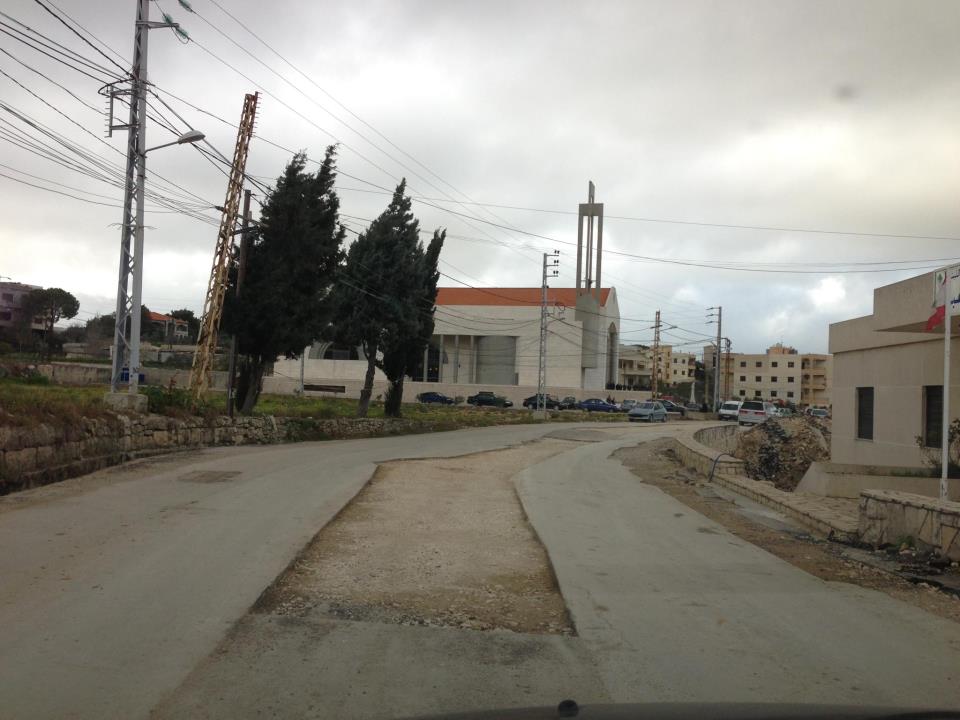
Taxing The Syrian Refugees

Self-imposed curfews were not enough for some municipalities in Lebanon when it comes to the growing presence of Syrians in the country and within their bounds.

Some are now considering the possibility of taxing those Syrians as well with amounts that are simply nonsensical for a poor refugee who can barely afford his or her rent: 100,000LL for just seeking residence inside the town.

The rationale behind these taxes is that these Syrians are treated like Lebanese citizens in those municipalities, by which they probably mean their garbage being collected occasionally. Except that those Syrians cannot even take out their garbage after 9 pm or a policeman would force them back to whichever door they came out from because they’re definitely up to no good if they’re walking the streets past their imposed “bedtime.”

I’m not against foreigners paying municipal taxes if municipalities are providing those foreigners, regardless of their nationalities, with the basic rights it’s providing to its voting citizens. I hardly think my and the potential tax money of Syrian refugees is going to any development. Municipalities are, more often than none, only a tool for political parties to flex their muscles every six years and for people not to get over it until the next election cycle rolls by.

However, are the Syrian foreigners – refugees or not – being treated the same as Lebanese citizens? I can already hear the laughter. At least I can make plans and go out past 9 pm. And isn’t the timing of said-taxes highly inappropriate, inhumane and downright despicable?

Municipalities, starting with mine, keep on coming up with ways to make the lives of people who don’t want to even be here a living hell. What’s their limit in tightening the noose on the Syrians who live within their jurisdiction when the perceived security threat of those Syrians is exaggerated to say the least? As long as mayors feel like they’re flexing their muscles and their citizens get a sense of fake-safety, anything goes.


The Myth of All Terrorists Are Muslim

Bad luck Muslims: they drew a deep sigh of relief when the Boston bombings turned out not to be done by a Saudi citizen… it turns out they were European Muslims who, ironically, are literally Caucasian. I guess racial profiling is out the question now?

I didn’t know that a simple comment on a BuzzFeed article from yours truly would spark a debate of over 50 comments and a hundred “likes.” The article in question was simply about the Islam leaning-Youtube page of one of the bombers. My comment was: how is this relevant?

Many sided with me. Many called me overly politically correct. Many others said that even though not all Muslims are terrorists, all the terrorists are Muslims.

If you ponder on that last statement, you are sure led to believe it’s true: the Boston Bombings, 9/11, etc…. However, it turned out to be the furthest thing possible from the truth.

There’s a hypocrisy when it comes to the categorization of “terrorism” in American media. For instance, the Aurora and Newton shootings were not carried out by a “terrorist” but by someone who was mentally unfit. If in a hypothetical scenario that person worshipped Allah instead of God, the “terrorist” label would have been used. Labels tend to stick.

The American and international media have been doing a “fantastic” job at highlighting select bits of acts of human violence and throwing them as representative of an entire sociological or religious aspect. Their portrayal of any violence that happens to come from Muslims tends to be sensationalized à la Middle Eastern way of reporting and, since their extent of knowledge regarding Islam and Muslims is very limited, it also comes off as ignorant. But not to those who take that media as scripture.

Moreover, the numbers to back up the “all terrorists are Muslim” claim is simply not there.

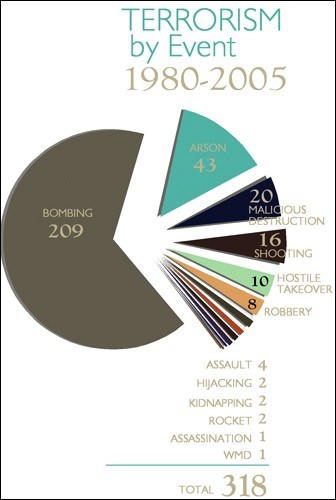
A study published by the FBI – could you get a better US-centric reference? – about the acts  of “terror” on US soil from 1980 till 2005 revealed approximately 318 terrorist attacks that varied in magnitude which break down in the following way:

Terrorism by event USA 1980-2005

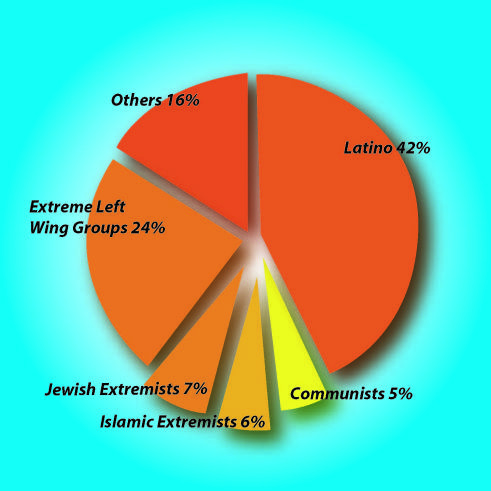
Luckily enough, the numbers and data in that study have been turned into a pie-chart (here) that categorizes all the terrorist attacks by religion/ethnicity/background:

Terrorism Islam USASure, many things happened since 2005. But not all of those things were from Muslims. The above percentages may have fluctuated slightly but they’re still representative. For instance, Jewish extremism has over a period of 25 years committed more acts of terror in the United States than Muslims had. Now isn’t that interesting? Did any American know about this or is it hail-Israel and bomb-the-Muslims all the way?

To back this up even further, CNN published a study about the threat of Muslim-American terrorism. The study was done by Duke University and the University of Chapel Hill and found that the supposed danger of the radicalizing of Muslim-Americans post 9/11 has been severely exaggerated. The level is “small compared to other violent crime in America, but not insignificant.”

Violence Begets Violence:

The more societies across the world shut out, categorize and work against people just because they wear a headscarf or pray in a different way, the more these people will find refuge in doctrines that may not represent their true beliefs. The actively-fueled verbal, moral or even social violence only serves to increase the physical violence of those on the other side of the equation. There could be a linear relation there. Sure, the aforementioned premise is an over-simplification but talking about Saudi or Qatari policies of exporting radical Islam coupled with American policies in the region which help fuel this export will take forever.

Is there a growing trend of radicalizing in Islam? I only need to look at samples across my country to say the answer is yes. But fighting this growing radicalization doesn’t happen by clumping those who haven’t fallen prey to erroneous indoctrination with those who have anti-American, anti-West or anti-non-Islam agendas.

The whole point is: political correctness is perhaps something that we need in a time when it’s very easy to judge and lump people in a batch of stereotypes just because we think we know everything there is to know about them, especially when said-political correctness isn’t really coming from a higher moral ground as much as it’s emanating from actual reality.

Empathy isn’t a one-way street. Those terrorist Muslims are the ones dying in the tens and hundreds daily across the world today and it’s not only because they’re fighting among each other.

So next time someone wants to “kill all the Muslims,” know this: not all Muslims are terrorists and it’s a certainty that not all the terrorists are Muslims – not even half of them.

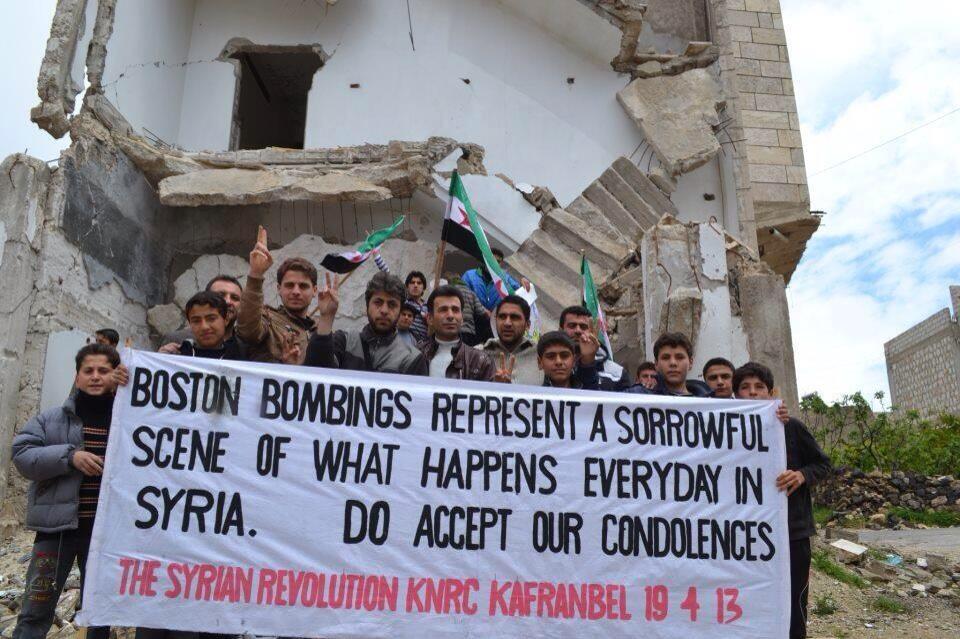
PS: A note from all those big bad Muslims to the people of Boston:

Boston Bombings Syria

Racist Lebanese Municipalities or National Policy Against Syrians?

My uncle was shot and killed 14 years ago today, March 26th 1999.

His killer’s name was Tony Rouhana. He was from my hometown, Ebrine. He was Lebanese. He was an active wartime member of one of North Lebanon’s well-known parties. They call themselves “Marada.”

May 2008. My mom enters our house and finds a hooded-man there. She shouts and runs after him. He was going through her jewelry. He makes a quick escape through our window. A couple of weeks later, his identity is known. He is also from my hometown. A Lebanese. He was only reprimanded – never arrested. Why should they ruin his future?

March 2013. A member of our municipality has his motorcycle stolen by a gang from Tripoli. They chase the thief, are on the phone with our security forces at all times, but are unable to catch him. The theft happened in broad daylight at noon. You can check more details here.

March 2013. I’m sitting with my family as we bid farewell to my uncle who was going back to his home in the United States after a short stay. We hear the sound of a four-wheel drive rolling by. They say it’s our municipality policeman’s new car. Why was he driving around at 10:30 pm?
Because my hometown, Ebrine, is now enforcing a curfew on Syrians. I expressed outrage and was told I oppose things way too often, way too much.

No, my town is not, like other places, hiding behind the shroud of “foreigners” when they mean one thing and one thing alone. There are no fliers being posted around the place. There are no banners to welcome you with the news. It’s all under the radar, hoping it would go unnoticed: a subtle regulation that won’t affect my life because I am Lebanese, from Ebrine and there’s absolutely nothing bad that I can do.

I didn’t want to write about this issue until I made sure it wasn’t simply townspeople gossip. I went to the municipality and asked. They confirmed. Their explanation? We got an order from the ministry of interior affairs recently to organize the Syrians inside our town and to have them listed – as per orders of Lebanon’s intelligence. They didn’t say anything about a curfew but, believing I was worried about the Syrians in my town, they went on further: “you don’t have to worry. A curfew was enforced on Syrians. The policeman is also patrolling the streets from 8 pm till 12 am. The town will stay safe.”

How beautiful and reassuring is that? I should look into extra safety measures against Ethiopians, Egyptians – basically anyone whose skin color or clothing style is too inappropriately poor for my taste.

I also find it hard to believe that such an order would come from the ministry of interior and would go unnoticed everywhere, especially that Marwan Charbel, our current minister of interior affairs, said municipalities who enforce curfews are committing illegal acts (link).

So which is it? Is our government or entire Lebanese administration, now that we don’t have a government, relying on vigilante justice in Lebanese municipalities to regulate the Syrian influx in the country? Are all our municipalities and circumscriptions now limiting the movement of “foreigners” just because the situation in the country is worrying?

Last time I checked, it wasn’t Syrians who were fighting in Bab el Tebbane and Jabal Mohsen nor were the Syrians fighting in May 2008 when all hell broke loose in Beirut.

Should the Syrians in Lebanon be regulated? Sure. Is their influx worrying? I think so. But turning their forced stay here into that of people living in an emergency nation will help things how exactly?

Let’s call it a temporary fix – a plug in a collapsing dam.

Do we have a lot of Syrians in my hometown? Frankly, I don’t see any huge numbers that were not there in 2008, 1999, etc. We are not that affected. Those Syrians are renting apartments here, buying stuff from the shops that even our townspeople don’t go to anymore (going to buy groceries in Batroun is much cooler. They get to use a trolley and pay 10,000 in gas in the process). And yet, somehow, those new Syrians are now posing such a big security threat that our municipality decided to do something for the first time since it was formed in 2010.

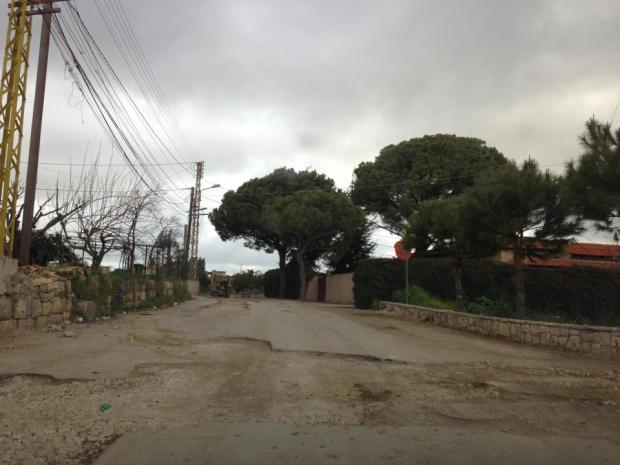
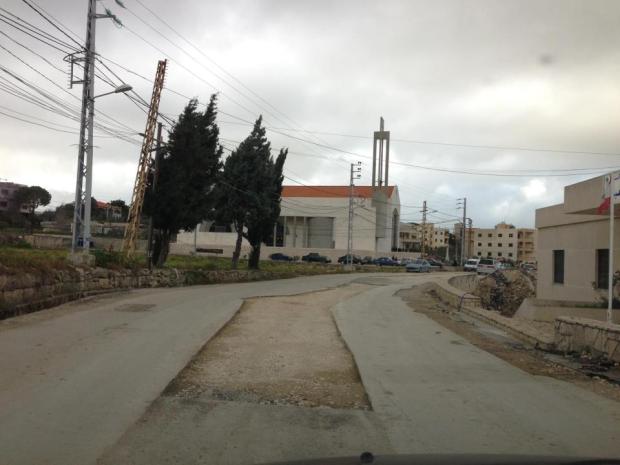
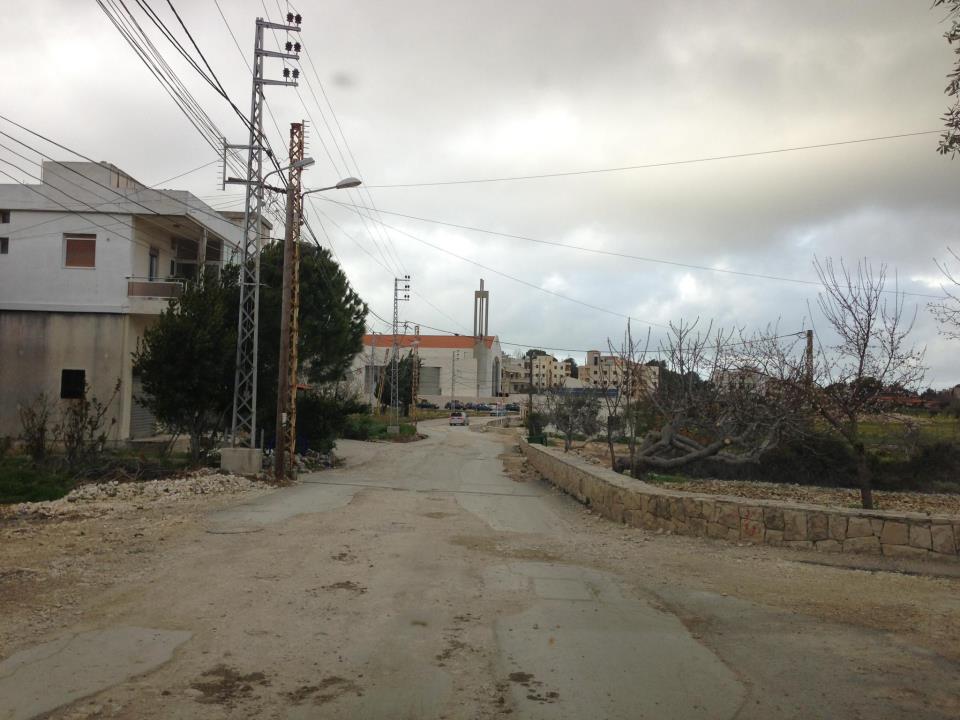
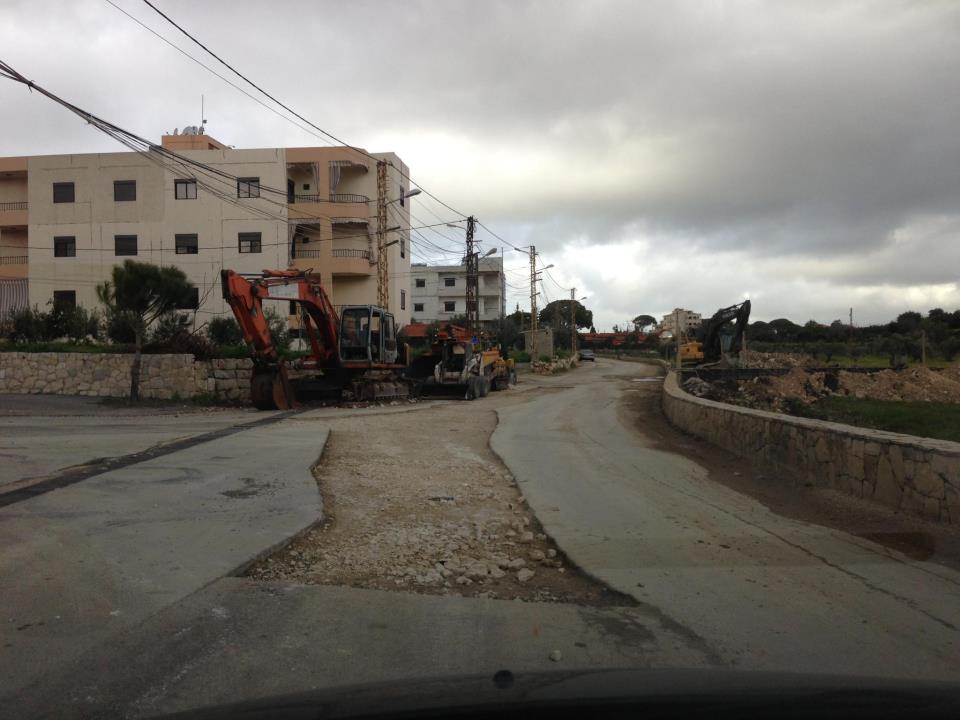
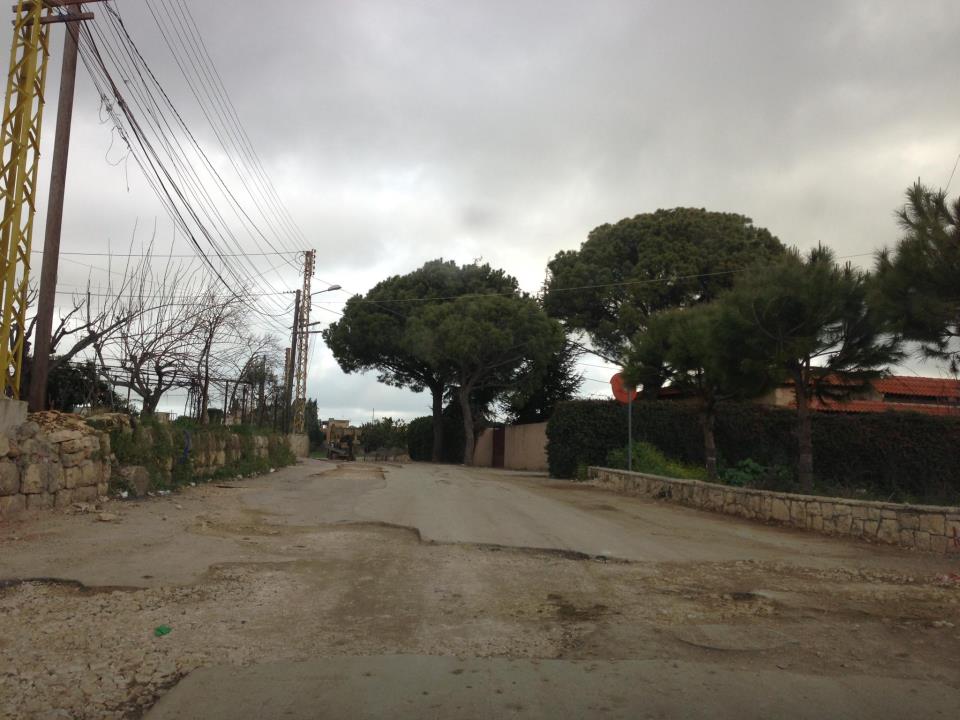
Our municipality, which left our roads go as the below pictures show, for over 2 months, which didn’t say anything and even sent a thank you letter for Gebran Bassil (who in all fairness was later outraged and called them out on it) is acting out, protecting us, making us feel safe, as part of a developed country. What’s worse is that this could possibly be some form of national policy.
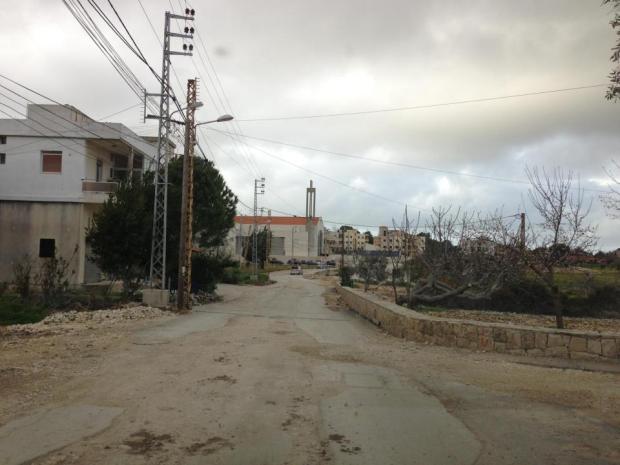
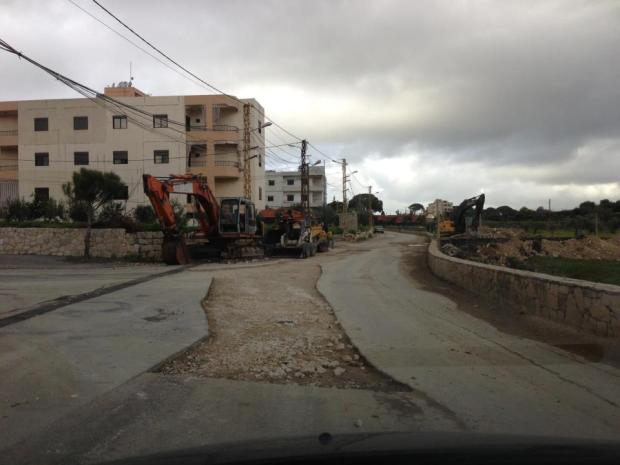
Roads Ebrine Batroun Roads Ebrine Batroun - 3 Roads Ebrine Batroun - 4 Roads Ebrine Batroun -2

The Lebanese Anti-Syrian “Racism”

“I am apprehensive about the situation of the Syrian refugees in Lebanon.”

The aforementioned sentence is enough to get a baggage of racism be thrown on your shoulder by people who believe you are not allowed to address the refugee issue in any way whatsoever unless it is to say they are more than welcome here without anything affixed to that.

The recent surge against all those racist Lebanese comes after an online Annahar video which you can watch here:

The report is very poorly done. Are they seriously filming a ten year old and asking him what he thinks of the Syrian refugees in the country and taking what he said as relevant enough to actually be included?

The way many of the people in the above video formulated their opinion regarding the refugees is unacceptable. But what is also unacceptable is for others to say that the concerns these people tried to convey are 1) racist and 2) invalid. Because, you know, Lebanon is very new to refugees. Those Syrians are obviously the first people we host and their problems are so new we cannot even begin to think dealing with them because of their novelty factor.

It is not only normal to have concerns regarding the refugee situation in Lebanon, it is, in my opinion, the sane thing to do. We cannot keep pretending that 1,000,000 Syrians in the country (Or 300,000 according to UN) is a walk in the park, with no prospective effects and no current effects in any way.

If you mention the Lebanese people who lost their rented homes because their landlords got better offers from Syrians, you are racist. If you mention the jobs that skillful Syrian physicians, accountants, architects and whatnot took out of Lebanese people, you are racist. The list goes on. It is obviously not the Syrians’ fault but it is an effect that some people don’t want to allow us to discuss. Because racism, racism everywhere.

When does this categorization of Lebanese who are critical of the current situation stop?

On the other hand, the categorization against the Syrians is unacceptable as well. Our country’s problems are not dependent on them and them alone. Not feeling safe while walking on a street is not because of the Syrians but because Lebanon is not a safe country with or without them. You can read this story that a friend of mine had to go through while walking in Gemmayze (link). The economical situation in the country is less the fault of the refugees and more the fault of politicians who are perpetuating the current political instability.

The borders should not and will not be closed for they are non existent and it would be grossly inhumane. The Syrians don’t want to come here. They are forced to come here. There is no way to regulate their influx as I had said before (link). They are here knocking at our doors with a riffle in their backs. If we don’t let them in, they get shot. There is no Syrian civilian entry to Lebanon that is not an emergency. The only thing that we, as Lebanese, can do regarding the refugees is have discussions.

The Syrians hosted some of our people in 2006. Of course they did. And we are thankful. But them hosting us back then is akin to a billionaire giving a poor person $100 and asking him to be eternally grateful for that. They were able to handle the thousands of Lebanese that entered their territory for a period of about three weeks.

Lebanon, a country that can’t even handle someone like Ahmad el Assir or even the poverty of people in places like Bab el Tebbane and Akkar and the South, cannot handle one million extra person who need help.

It is a Lebanese’s right to be wary and worried and apprehensive. The way that worried Lebanese formulates his or her worry and apprehension may differ and it may be unacceptable but those who don’t feel this way are similar to an ostrich with its head so far down the sand it can’t even manage to get it out anymore.

Now cue in those will call me racist. They wish….

Could Patriarch Raï Become The Next Pope?

The conclave of Cardinals in charge of electing the new pope to replace Benedict XVI is currently underway at the Sistine chapel in the Vatican. You’re out of luck if you are a Roman tourist at this time of year – you can blame Benedict’s old age for that.

As it is with papal elections, there is no clear frontrunner as of this point. The myth goes that the cardinals leave their choice to the holy spirit through copious amounts of prayers and holiness. That is if you believe the holy spirit is a combination of politics, geographic, demographics and whatnot.

Eventually, any Pope nowadays is chosen based on one premise only: strengthening the position of the Catholic Church around the world. The late pope John Paul II led one of the biggest developments the Catholic Church had seen when it comes to the Youth, especially in popularity. Benedict’s undeclared job was to contain this surge that John Paul caused in a more Christian, usable, framework.

Today, the Catholic church is stuck at the edge of a steep cliff with the following predicaments:

  1. Decreasing worshippers across the world,
  2. Rise in Christian persecution in certain parts of the world,
  3. Sex-related scandals that plague Catholic priests more often than none,
  4. Corruption scandals that always seem to find a foothold,
  5. The issues of abortion, same-sex marriage and other thorny issues.

Seeing as the Catholic church is firm in its position regarding abortion, same-sex marriages (despite some recent breakthroughs in that regard), stem cell research and the like, I believe point #5 is not even an option in the voters’ mindset. Corruption and sex-related scandals are issues that Cardinals feel should be best kept in-house, not influencing the decision of choosing a Pope who will lead a Church not only based on those two criteria. The stances of the Catholic church regarding the many sex abuse cases that were revealed is a testament to that – if anything, it reminds me of typical elderly Lebanese women whose job in life is to cover up any wrongdoing in their family and showcase it to the world in positive light. Cardinals are similar to those elderly women in that regard.

The most important framework for Cardinals voting today is the following: help Christians around the world stay Christians and lessen the numbers of Christians who are deciding not to be so anymore. There’s little that a Pope can do when it comes to decreasing worshippers – after all, how do you convince people who lack faith that they should have it? It’s impossible. But what the papal conclave of Cardinals can affect is the persecution of Christian minorities across the world, notably in the Middle East.

Pope Benedict’s XVI’s visit to Lebanon back in September – his last major visit to any country before his resignation – was not out of the blue. Him demanding Patriarch Raï to go to Syria and hold mass there, which sparked an insane reaction, was also not out of the blue. Small steps they may be, sure, but for the faithful who still cling to their belief despite the hardships, a patriarch or a Pope acknowledging their strife is some very important business.

The question, therefore, asks itself: Could Patriarch Raï be the dark horse to be elected as the upcoming Pope?

Many Lebanese have already set Facebook pages to that effect, out of enthusiasm mostly, as if a liking a Facebook page to demand our patriarch be instated as Pope is actually beneficial or worth it. But that’s how things are with us – we always take things to Facebook.

However, I have thought about it lately and come to conclude that Mr. Raï could have a decent, albeit slight chance, at becoming the world’s next Pope for the following reasons:

  1. If the main focus is to target the persecution of Christians in the world, what better option than the head of the Christian majority in the location where Christians are targeted the most? The Middle East.
  2. Former pope Benedict’s XVI’s visit to Lebanon was, in part, to sign the Post-Synodal Apostolic Exhortation (text) in which the Vatican goes on and on about the crucial importance of the Church in the Middle East.
  3. A Pope from the Middle East would set the wheels for true Muslim-Christian dialogue, which is what this deeply religious and troubled region needs and the Vatican knows this.
  4. Patriarch Raï is age appropriate to be pope. He is only 73. He also speaks several languages fluently, as is required of Lebanese bishops.
  5. Patriarch Raï does not come from a country where priest sex scandals are aplenty and being relatively unknown to the vote has a rather “cleaner” slate than his counterparts. He was also elected as an assistant to the interim Pope over the past week.

The reasons may not be supremely compelling to have someone become Pope, sure. But they’re still viable enough to put Mr. Raï on the papal map. I’m not even sure if Mr. Raï can be a good pope but he might become one.  And frankly, him getting elected sort of scares me.