How Tripoli Didn’t Sleep Last Night

What happens in Tripoli stays in Tripoli – at least that’s what Lebanese media and politicians want.

The battles currently taking place in the city aren’t registering except with those who are affected. It could be because Tripoli’s politicians are the masterminds behind them. It could be because Lebanese media knows it will never spillover outside the city’s confines.

What is certain, however, is that the following video illustrates the worst night in Tripoli since the civil war whereby the city was shelled with over 1200 mortars.

This is Lebanon too. I was starting to doubt anything existed beyond Madfoun.

Why The Lebanese Government Is Silent On Tripoli

Every once in a while, the city I once referred to as “3enna” by mistake becomes a place I force myself to go the extra mile to recognize.
The last time such heavy fights broke out in the city, we were all in outrage at how media couldn’t care less about the people dying and the innocent lives in danger. Today, the outrage over Tripoli’s worst night since the Civil War is gravitating towards a government that is as apathetic as apathy goes.

However, are we supposed to expect anything more from our government? Tripoli’s Ministers and MPs go on air to voice their disdain and condemnation over what’s going on. What’s actually happening, though, is that in the other side of the room is one of their henchmen waiting on a phone to issue further instructions to the fighters on both sides of the battles.

Najib Mikati feigns peace. But he probably has men fighting. Mohammad el Safadi feigns innocence. But he probably has men fighting too. Have you ever seen how Bab el Tebbane worships Kabbara? Why do you think that is? You don’t have to over think it really.

The solution for Tripoli isn’t political. If it were, all those politicians asking for calm and peace would have succeeded by now. The problem is that those same politicians want to perpetuate the status quo, because this status quo works and does wonders for them and their careers.
It keeps the city poor for them to do their “charity” work.It keeps the city relevant politically for them to make a “political” dent and remain in the country’s political spotlight.

Perhaps the solution for Tripoli is for a side of the battle to actually win. Perhaps the problem in this country is that we have never had a clear winner and a clear loser in anything, not elections, not the war and not even those sporadic battles in Tripoli which we’ve gotten used to.

Until then, my thoughts go to all the people spending their days and nights in absolute terror in the city I’ve come to love, a place that doesn’t deserve the hand it’s dealt.

The Tripoli You Don’t Get To See

I can go to Beirut today and take my camera with me. I can go to Hay el Sellom and take as many pictures, film as much footage as my heart pleases and broadcast them online with one tag only: THIS. IS. BEIRUT.

Am I doing Beirut a disservice in the process? Perhaps so. Is my portrayal of Beirut’s poorest neighborhood as representative of the entire city accurate? Perhaps not.

But isn’t that exactly what Lebanese media and people are doing to this Northern city?

I went to a cafe the other day named “Ahwak Ben Tafesh.” I can safely say it’s probably my favorite cafe in all of Lebanon. Starbucks and other generic places, move over. The place had charm and served the best carrot cake I ever had, which was actually homemade. As I sat there, observing the people walking in and out, I saw some of the most gorgeous women wearing tight jeans and revealing shirts, guys talking about going out to a pub somewhere with their girlfriends, a couple holding hands with the guy’s hand on his girlfriend’s thigh.

But most importantly, people we chatting and laughing and making plans. Just like normal Lebanese youth do everywhere else.

Then I went to the bathroom at Ahwak and saw this:
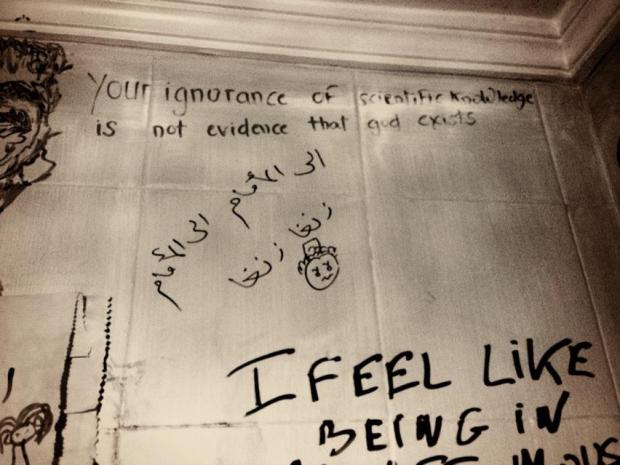
Ahwak Ben Tafesh Tripoli Lebanon

A stone’s throw away from Ahwak is a restaurant called La Plaka. I have yet to try out things beyond the salad part of its menu – blame the diet – but that place served one of the best chicken caesar (don’t worry, I made some sauce-modifications) that I ever had. The place was spacious with very nice interior decorations – huge armchairs, flat screen TVs everywhere, chandeliers dropping down from the ceiling – and better yet, they actually abide by the smoking ban.

All of what La Plaka offered me came at a cost of… 10,000LL. Yes, for the entire salad that normally costs double that much at any Beiruti place. Then I remembered a similar incidence in Gemmayzé when I ordered a salad that comprised of only lettuce and cucumber sticks and ended up paying about $20.

On the same street as La Plaka is a newly opened burger shop called Ten Burger which is trying to bring the Classic Burger Joint experience to Tripoli. Their burgers are excellent. They also come with french fries and coleslaw. And a soft drink. All for less than $10.

Tripoli is also famous for “Le Palais” or as we all like to call it “Al Hallab,” which offers the best Arabian sweets you can find probably anywhere. You can ask for a tour of the place’s kitchens where you see how they make all the delicious food you end up gorging on later. I witnessed how they do the famous “7lewet l jeben,” got to taste their self-made ice cream and gateaux. The place is beautiful and extremely distinctive. If you thought you are getting the “Hallab” experience by visiting some of the franchises in Beirut or Jounieh, you thought terribly wrong.

But Tripoli isn’t only about food. I go there very often. My best friend is from there. I go to class about five minutes away from that city. My father buys some supplies for his shop from Bab el Tebbane. A lot of our paperwork has to go through some offices there. Throughout my visits to that city, even during the now-distant times when I had a one pound golden Cross dangling from my neck, I never felt threatened or not at ease – even last December when Tripoli was, at least to most Lebanese, a war zone.

A couple of days ago, I got invited to an impromptu birthday party for my friend’s nieces. I was the only “outsider” there. The place was filled with family members. It took me five seconds to feel at home due to the overwhelming hospitality I received. It’s not just typical Lebanese hospitality – it’s people who are genuinely happy to have you there and take care of you and even wish you happy Easter.

In fact, most of my friends who are from Tripoli are not the people Lebanese media wants you to think they are. They are kind and friendly and great. Some of them are quite religious. Others are not. You know, exactly like Lebanese people everywhere else.

Is Tripoli in its best days? I don’t think so. Was it more lively, more upbeat, more receptive and less cautious a few years back? Definitely. Is it hurting because of the mass exodus of the Christians from it? Definitely – but they’re not leaving because of the city’s Muslims. They are leaving because of the dismal economic prospects.

For a city that houses some of Lebanon’s wealthiest people, it sure doesn’t show. The explanation is simple. Those wealthy people all have political aspirations but no foresight. They spend their money getting votes by giving food to needy people instead of investing that money in projects that would bring outside business to the city and help the people buy their own food. But that wouldn’t benefit them electorally.

Tripoli barely sees any development. There are no “Sama Tripoli” or “Le Mall Tripoli” projects that go on here. The second largest city of Lebanon has next to no investments coming into it and it’s not all because of the current security situation. This has been going on for years now. After all, as I had said before, Lebanon’s centralization isn’t only bureaucratic, it’s also economical. No other area outside Beirut is supposed to get the money Beirut and its suburbs get and this shows the most in big cities that need such money the most.

Tripoli is changing and not for the better. Anyone who tells you the opposite is bluffing. But that’s the case everywhere in this country. After all, extremism is a separate state of mind – no pun. However, this city isn’t the big bad monster that many have come to believe it is. It’s a place that’s trying its best given the hand it is dealt. It’s probably time we give it some slack.

The General Situation in Lebanon

The people of Bab el Tebbane and Jabal Mohsen live off less than $4 per day. They cannot afford bread. They cannot afford food. They cannot afford basic accommodations. But they can fire missiles at each other and use weaponry that cost thousands of dollars.

Weapons > food.

———————————————

Security forces, including our lovely army, can serve as the best moviegoers ever. We should enlist them to break some form of Guiness record. After all, wasn’t movie watching what they were doing yesterday as Tripoli witnessed its heaviest clashes in months?
The Malek el Tawou2 branch in Gemmayzeit was especially busy I heard.

———————————————

Those wage increases have been approved. Rejoice. The syndicates are victorious. ALL of those poor people will not have more money in their pockets. ALL of the injustice in the country is now behind us… Celebrate small victories, rejoice for the struggles of the weak, the proletariat are here to take their natural place in the circle of governance.**

** disclaimer: this comes with an increase to 15% in VAT on phones, car parts, caviar, increase in stamp prices for bills, increase in stamp prices for phone-related transactions, real-estate related taxes, marine property taxes, enforcing taxes on water wells, decreasing tax returns to tourists, increasing taxes on alcohol, increasing travel taxes and will soon follow with an overall increase in the price of goods.

But hurray for the beautiful selsle.

———————————————

Elections are, theoretically, in slightly more than 3 months. June 9th is how the myth goes. The reality is that elections are, in fact, postponed but no one wants to admit this. In fact, you can obtain your healthy dose of comedy from politician holding press conferences to announce their resolve to “hold election on time.” – I’ve probably never used this in a post before but here it goes: LMAO.

The reality is that with almost 3 months to go, we don’t have a functional law on which the elections will happen and no prospects for an agreement on a law in the first place.
In other news, did you hear about the law championed by those who want to bring back “Christian rights” that involves turning Lebanon into one proportional circumscription? K.

Meanwhile, some people are already searching for airplane tickets in exchange for their votes in the 2013 elections – at least that’s what my blog’s stats tell me.

———————————————

Imagine the following scenario: Israel rallies troops near our border. They charge up their tanks, ready their missiles and shoot. Lebanese towns are bombed, people die, our sovereignty – or whatever remains of it – is breached. Lebanon, however, decides to take the “high road.” Our minister of foreign affairs does not complain to the UN. Our army and government decide that not addressing the issue is the way to go. After all, why the melodrama?
Pretty far-fetched right? Except that such a scenario is happening almost verbatim… If you substitute Israel for Syria. But Syria doesn’t count. Because na2i bl nafes that’s why.

———————————————

Over the past few days, I realized that the amount of people who live bl khassé as the saying goes is way too high. From people who think most people in the country are not extremist towards people from other sects and that addressing the issue is unnecessary to those who think there’s basically nothing wrong whatsoever in the general situation to those who don’t allow us to address the issue of the Syrian refugees because – gasp – racism… And the list goes on.

———————————————

If all of the above depresses you, albeit slightly, I recommend you take 20mg of paroxetine or fluoxetine daily. Side effects include nausea and possible ejaculatory delay but you’ll feel so elated in 3 weeks and your spouse will be so happy, you’d think Lebanon became some form of utopia. K?

Tripoli’s Gang of Thieves & Lebanon’s Police

A friend of mine parked his motorcycle yesterday in front of a house he was visiting in my hometown only to hear the engine ignite a few minutes later.

He ran outside and saw a stranger driving his bike away. He frantically tried to chase him but there was no car. He was fortunate enough to have a family member be in Batroun at the time of the theft. That person immediately called the police hotline 112 as he chased the motorcycle driver on the Lebanese highway.

The police informed him that he was not allowed to ram his car into the motorcycle and that he should let them know where he was driving at all times. So he told them when he passed the Mseilha Citadel. He told them when he passed Chekka. He told them when he passed Anfeh.

He kept his phone to his ear and spoke to the policemen on the other end thinking or maybe hoping that they’d do something. Slightly south of Tripoli, at the Punto Alto side street, the biker disappeared.

The drive from Batroun to Tripoli took about 20 minutes during which the police was more than informed about the chase taking place. And they still didn’t set up an impromptu checkpoint on the highway to stop the thief, which we would all agree is not highly unusual given their Beiruti practices at random hours of the A.M.

As a result of our super qualified policemen, the $7000 motorcycle is now in the hands of some gang in Tripoli who, I’m sorry to disappoint you, is not made up of Syrian nationals.

How do I know this? Well, the plot thickens.

During the past week, more than eighteen similar motorcycles were stolen in the coastal Batrouni town of Kfaraabida which many of you know for its beaches and Pierre & Friends. The police were, obviously, informed of the grand theft. After all, we were talking about eighteen motorcycles. But they obviously didn’t do anything about it.

However, not all of those motorcycles remained stolen. Some people whose bikes had been taken away got in contact with people in Tripoli who had contacts in those gangs. They set up an exchange: a decent sum of money for their motorcycle. So they kind of purchased back their bike.

The man whose bike was stolen went on the same route. He hasn’t gotten back his bike yet but he’ll know soon enough if there’s a chance to retrieve it or if it has already been shipped to Syria.

Of course, this isn’t new when it comes to our police. A few years ago, my physician uncle woke up in the middle of the night in our Achrafieh apartment to a ruckus in the street. He went to the balcony to see someone breaking into a store at the base of our building.

My uncle’s knee-jerk reaction was to call the cops. A few attempts later, a sleepy person replied and asked my uncle to call again if the thief came back. Because that obviously makes perfect sense. So as the thief filled up his car with whatever he could find in that store, there was nothing my uncle could do. What if the thief had a knife or a gun? It’s not our job to do what policemen should have been doing at that point.

I don’t expect anything from our policemen. Maybe a checkpoint that actually serves a tangible purpose. Or trying to intercept one of those money-for-bike exchanges so maybe, just maybe, we could feel safer. Until then, which should be until forever, hide your cars, hide your bikes, hide your precious belongings. It’s the wild wild west over here. But no matter what you do, don’t call the cops. It’s only 1) a waste of your time, 2) a waste of your precious minutes and 3) another thing to make you infuriated and angry.