Despite many attempts to get my lovely Lebanese compatriotes off their high horse regarding many aspects of our beloved country, it seems I have fallen short somehow. The high-horse is too high for some people to actually see that not everything is out there to get them and not everything “good” that goes on with their country needs to be torn apart.
Let me start with one simple thing. Even IF N7W was a scam, it still doesn’t discredit the immense positive attributes this will bring Lebanon as a whole if Jeita ends up winning. Sure, it won’t end our national debt as some people suggested, nor will it be a solution to our political system. But come on, anyone comparing Jeita winning with a solution to the national debt is not only delusional, they also have some logical fuse in their brain short-circuiting. No offense that is.
The N7W campaign, which has been going on for almost four years now, will have millions upon millions of votes cast – and that was before SMS votes started. That was when people voted with emails and only those very enthusiastic voted with more than one email.
But I digress.
Recently, I’ve had the “pleasure” of reading an “interesting” post by my friend Gino Raidy who immediately stamped the word SCAM all over the N7W process, as well as a picture to go with it.
When I first clicked on the link to read Gino’s post, which was immediately picked up by BeirutSpring, I expected to read something interesting. I expected to find something new. Not something rehashed, over and over again, by the same people.
I shall be addressing every point Gino made in his article, with lesser emphasis on increasing font size and such.
Multiple Voting:
First, multiple votes is not a reason for the N7W competition to be a scam. Far from it, actually. Most competitions involving email voting let people vote once per email. And when it comes to SMS voting, you can vote more than once. You are allowed to vote for your favorites to win as many times as you want. Let’s look at two trivial examples. American Idol. You can vote either by telephone as much as you want, or you can text the number of your desired candidate as much as you want. The final tally of votes ends up nearing 500 million. I don’t see anyone screaming scam about that. Or is it only a scam when the theme of the vote is different?
A second example of competitions with voting are award shows such as the ACM, or Academy of Country Music Awards. If you thought American Idol was a “silly” example, at least the most prestigious country music award show is not. And for that awards show, the public gets to vote for the highest honor that can be bestowed upon a country artist. Yes, you guessed it. They can vote as many times as they want.
Voting Since 2009 2007:
We’ve been voting since 2007, not 2009. But we’ve been voting for different phases of the competition since 2007. Four years ago, the Cedar Forest in North Lebanon was nominated with Jeita. And we were voting for both sites. Then came a time where the nominated sites had to be cut down to about seventy and each country can only have one representative. So the Lebanese committee chose to have Jeita represent us onwards and pulled the plug on support for the Cedars. You might disagree with the decision. Some people argued that the Cedars are more symbolic of Lebanon. But in all fairness, Jeita has a much higher chance of winning. The second phase of the vote was to get all the sites that qualified into groups based on the nature of that site. Jeita was in the group of natural caves. And so, yet again, we voted for Jeita in its group and got it to qualify to the final stage of voting that is taking place today.
Phase voting is a natural thing in all competitions. It’s also a very natural thing in elections. I would give the American Idol example or any award show example again but let me illustrate this with something else. US presidential elections. It starts with democratic and republican primaries taking place for over a year all across the United States. Each party ends up voting for a nominee that represents it in the general elections. Then, those two candidates go head to head and one winner emerges. Another example is the French presidential elections. Each party goes through a series of voting to choose their nominee. Then all appointed nominees go through a first round of voting, by all the people of France, which ends up narrowing down the choice to only two candidates before the president is ultimately chosen in a final round of voting.
How is sequential voting since 2007 a mark of scam, I have no idea. You can check out the steps of the vote here.
UNESCO Does Not Support It
Fine, UNESCO does not support it. I fail to see how the N7W committee asking UNESCO to back it up and them refusing reflects negatively on N7W. After all, aren’t there many things that UNESCO did not support? Wasn’t it up until very recently (Monday to be exact) that Palestine was granted full membership to UNESCO?
Besides, UNESCO already has a list of World Heritage Sites, including the Lebanese Kadisha Valley, which is threatened to be removed off the list. Now I wonder, what good did the tag of “world heritage site” do the Kadisha Valley? How known is the valley even among Lebanese? I can’t begin to tell you the number of people I know who hadn’t heard of the valley until I mentioned it.
UNESCO might not support N7W but that doesn’t reflect negatively on the competition in any way whatsoever. It just means that. A committee where political play is key decided not to back up a committee where political play is to a lesser key. Simple as that.
The Maldives Withdrew Themselves From The Competition:
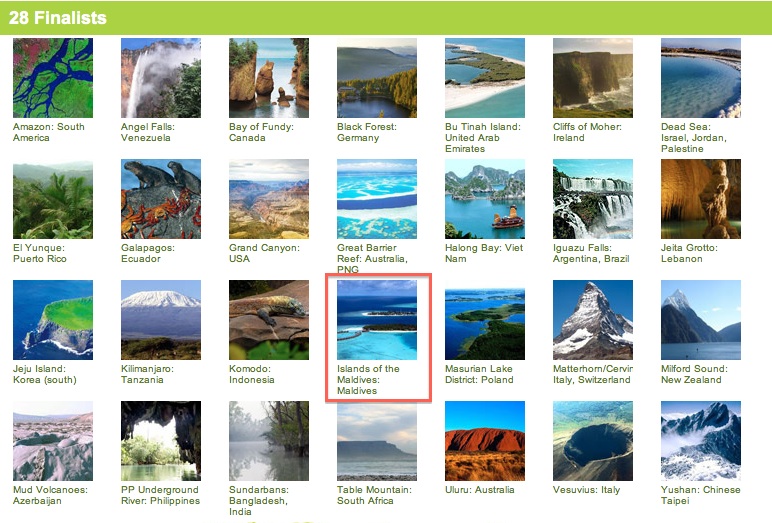
Yes, I have read that same article, back from May 2011, that the Maldives decided to withdraw themselves from the vote because the N7W organization asked for copious amount of money and financial engagements. Simple question, which I will illustrate with a breathtaking image of the Maldives:
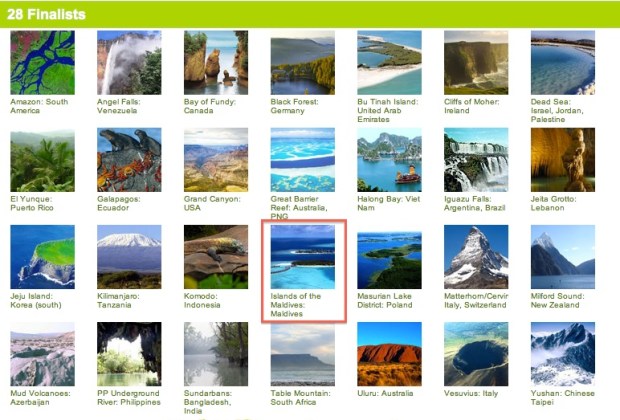 Surprise, surprise… The Maldives are still in the competition. Their government pulled off support for the participation? It’s hard for me to believe that a flimsy Switzerland-based organization can overtake a government. I’m just saying.
Besides, to be eligible to be part of the final 28 participants, no fee had to be paid. N7W is, at the end of the day, a non-profit organization. But to be non-profit, you need to balance out your expenses. In order to do so, they offered sponsorship rights, which are elective, for the final phase of the vote, in return for a certain amount of money. In Lebanon’s case, according to officials from the Jeita Grotto committee from whom I got a statement, no such fees were paid. Jeita doesn’t have sponsors.
But let me ask this: is $500,000 too much to be paid for the amount of advertisement they’re getting from being part of this competition? Could Jeita have gotten the exposure it’s getting had it not been competing? I hardly think so. Odds are Jeita would have forever remained a landmark visited mostly by the Lebanese and a fraction of the couple million tourists we get every year.
More Tourists:
Yes, more tourists. There’s no way in hell having millions of millions of people (multiple voting included) visiting a website and voting for seven different sites without it sparking at least a curiosity to visit, with many of those acting out of it and actually visiting. Take me for an example, I really want to visit the Cliffs of Moher in Ireland, a landmark I did not know existed before the competition. Say I do go to Ireland. I won’t end up visiting the Cliffs of Moher and going back to Lebanon. I’ll stay there for at least a week, visiting other landmarks and helping out their local economy.
To assume that “NO ONE” is falling for this is absurd. Tourists who are interested in visiting a country will search for related info about their country. If Jeita ends up winning, odds are that will be one of the main points they will encounter in their search and they will most definitely want to visit it if they end up coming to Lebanon. At the end of the day, Lebanon is a country driven first and foremost by its tourism sector, which is helped immensely by such exposure. To assume that such exposure is nonsensical would be nonsensical in itself.
National Pride:
Yes, national pride. Shouting national pride from the rooftops that is. And yes, that does make me – or any other Lebanese – proud of what we have accomplished with the Jeita vote, how for one rare time in our history we’ve forgotten our differences – at least for a minute – and all voted for one common thing. Yes, that is something that makes me proud. It makes me proud to see a landmark from my country be part of a competition on such an international level, just as I would be proud to see, for example, Riyad Salameh picking up an award for excellent skills in managing our Central Bank and helped us weather the international financial meltdown. It makes me proud to see some great Lebanese icon, like Fairuz, being honored at an international level – regardless of whether I think she needs that honor or not. Sure, we need to preserve our natural sites. We need better laws. We need to take better care of our country. But I fail to see how all of that is logically deterring us from supporting the Jeita vote in any way?
At the end of the day, scam or not, official or not, N7W is doing most of the countries that have reached the finals a huge favor. When I look at their live voting map and I see someone from Vietnam or Chinese Taipei voting for Jeita, it makes me happy. Not because they voted for Jeita, but because someone, somewhere, now knows that there’s a country called Lebanon in the Middle East with a breathtaking landmark that, win or no win, is now known.
It’s clear though that some Lebanese need to stop it with the conspiracy theories and relax. If you don’t find enough reasons to vote for Jeita, then don’t vote. Don’t berate those who find the reasons to. And also, fellow Lebanese, you shouldn’t be angry people are urging everyone to vote. It will all end in nine days.






 A Separate State of Mind | A Blog by Elie Fares