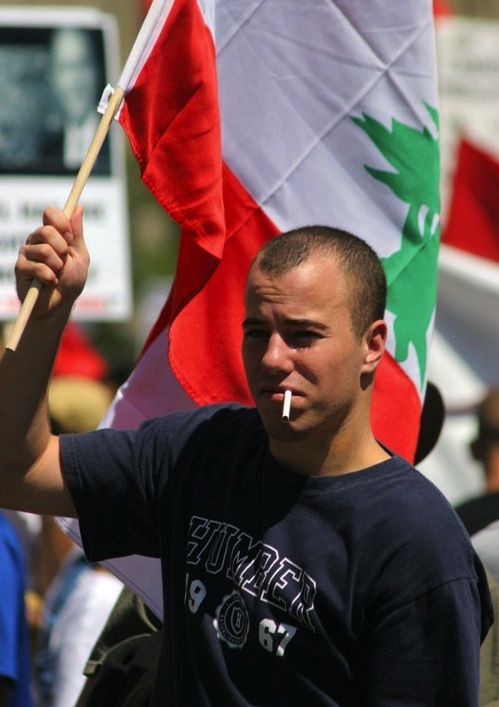
I always wondered why so many Lebanese smoke. We’ve all been through an educational system with more than one picture of a smoking-ruined lung in our biology textbook. We’ve all been through more than one lecture about the bad effects of smoking. We’ve all been through a phase where we were afraid of what our parents, some of whom smoke, would think of us if we do.
Despite all of that, many people ended up as smokers.
I am not talking here about our parents’ generation. They are the war generation to whom smoking might have been a way to cope with the stress of everyday life. But to our generation, one which is supposedly more aware than previous ones, the rates of smokers is just too high. You only need to go out with a group of people your age to notice this. My medical school class has 68 students. At least half of those are smokers. Less than half of them actually admit it when asked.
Fact. Nicotine is the most addictive substance known to man. No, not heroin. Not cocaine. Yes, nicotine. So when a smoker tells you they are not “addicted” to smoking, they are simply delusional.
Fact. Talking about lack of willpower when it comes to stopping smoking is nonsensical. Smokers have willpower the same as everybody else. It takes them way more effort, however, to be able to stop. Them not being able to stop smoking doesn’t mean they don’t have the will for it.
Fact. The more smokers you have in a given community, the higher the chance for non-smokers to fall into the habit: Peer pressure, imitation, call it whatever you want.
Fact. The easier it is to have access to cigarettes, the easier it’ll be for a non-smoker to become a smoker.
Let’s examine the situation in Lebanon. A regular shop in any given neighborhood has a stand for cigarettes displayed next to the cashier. That stand has a sticker that says cigarette packs are never sold to those less than eighteen years of age. This sticker is a formality. A fifteen year old enters said shop. This fifteen year old has an allowance of about $20 per week. Of those $20, he finds it very easy to dispose of $2 for a pack of cigarettes. This teenager goes back home and hides his pack. Later that evening, he meets up with a couple of his friends and they smoke it. The following day or week, another one of them volunteers $2 to “try” smoking until it’s no longer trying and their bodies develop a need for nicotine.
A study conducted by Jad Chaaban, Nadia Naamani and Nisreen Salti at the American University of Beirut (AUB) has found that 40.3% of people in Lebanon smoke, at a rate of 12.4 packs per month. This consumption is among the highest in the world, three times higher than Syria. To make things even “worse,” the balance for tobacco revenue and costs has our economy losing more than $55.4 million a year.
Last August, a non-smoking law was voted and its implementation was theoretically supposed to be gradually carried out. The reality, as with most Lebanese laws, is drastically different from theory. Some places, such as ABC mall, have borderline conformed to the ban. The absolute majority, however, has not. So when a smoker goes to almost any place in Lebanon, they will be inundated with cues for them to smoke, which have been proven psychologically to be the greatest trigger for smoking behavior. Those cues trigger the need in the body for nicotine. Example: a cigarette between classes, with coffee, with a drink, etc…
A few years ago, AUB banned smoking on its campus except for few select areas. This has caused many smokers to decrease their consumption. They simply didn’t have time to smoke between classes, on their breaks, on their tight schedules. What AUB did was to considerably suppress the aforementioned cues.
For the current smokers in Lebanon, it may be too late. Some have gone cold-turkey and failed. Others have succeeded. But it remains true that quitting smoking is one the most difficult things to do for smokers.
For the non-smokers, the story is much different and it is there that we must work to lessen smoking in our society. How? By making it drastically more difficult for these youngsters to access cigarettes. You know shops will not conform to the 18-year old limit. If a 15 year old doesn’t get his fix from this place, he’ll go to the next and the next until a pack is sold to him.
The first thing would be to put the cigarette stand in a place where it’s not very evident and easy for anyone to pick up a pack on a whim and make cigarette boxes a standard form: no special fonts and colors for a specific brand. Make them all the same, along with a pictorial warning covering most of the box about the dangers of smoking.
The second thing to do would be to drastically increase the price of cigarette packs. I don’t know why this is not a conceivable approach in a country where gas prices are half consisted of taxes. Meanwhile, cigarette packs have barely any taxes on them. Why not decrease the taxes on gas and increase them on cigarettes? Gas is a lively need for all of the Lebanese population. Cigarette is not. Gas should not be a privilege as it’s slowly becoming. Cigarettes should become a privilege. They currently are not.
Higher prices (say $8 a pack) and a decrease in the “cue” to buy a pack would lead to a drastic decrease in the up and coming generations to have high number of smokers. A higher price would also reflect on current smokers with a decrease in consumption. This leads to an easier implementation of smoking ban at various restaurants, pubs, public venues, etc.
When it comes to smoking in Lebanon, we tend to victimize the smoker for doing something “wrong.” Some smokers rationalize their behavior by saying that “everyone does it.” The “everyone does it” argument is faulty. Just because the majority does something doesn’t make it a good thing: just because the majority of the people in Beirut were exposed to violence in the 1980s does not make it a healthy experience. The fact remains that smoking is bad for smokers and for non-smokers. I, for one, cannot stand the smell. I am near repulsed by seeing the smoke going out of almost every bodily opening the smoker has. But it remains that it’s not a smoker’s fault as it is the system that has made it way too easy. So instead of dreaming big, like we always do in Lebanon, with a comprehensive smoking ban that reaches all the corners of the country, how about we start with baby steps for once and actually get somewhere?












 A Separate State of Mind | A Blog by Elie Fares