The Lebanese Celebrities Running For Parliament

Even though Nathalie Fadallah running and Myriam Klink not running made the biggest splash (not the TV show) when it comes to the celebrities choosing to take on political life, Beirut.com has compiled a list of other famous people who decided to run as well.

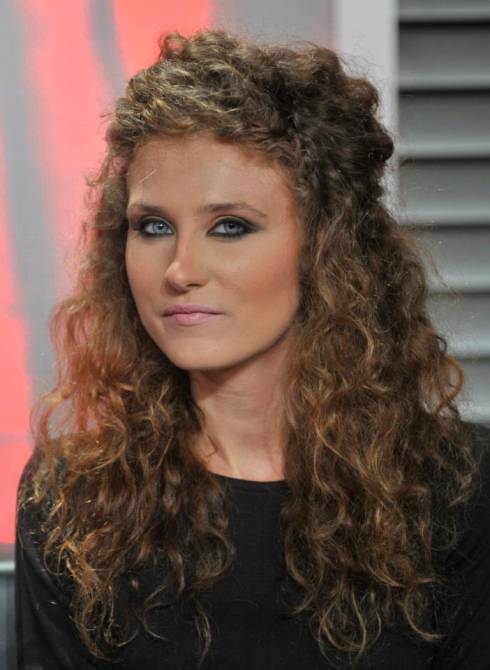
Nathalie Fadlallah

Nathalie fadlallah parliament

As established, she is running for one of the Maronite seats in Tripoli. She runs a modeling agency and was a former model herself. She wants to bring her “revolutionary” ideas to parliament. If you know what I mean.

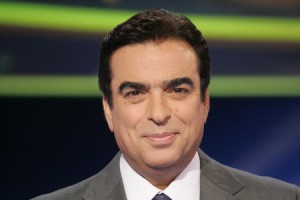
George Kordahi

Georges Kordahi

He used to be (not sure if he still is) the presenter of Who Wants To Be A Millionaire and he’s running for one of the Maronite seats in Keserwan. His use of the Arabic language gives me the creeps. No one simply pronounces those letters that accurately. No one.

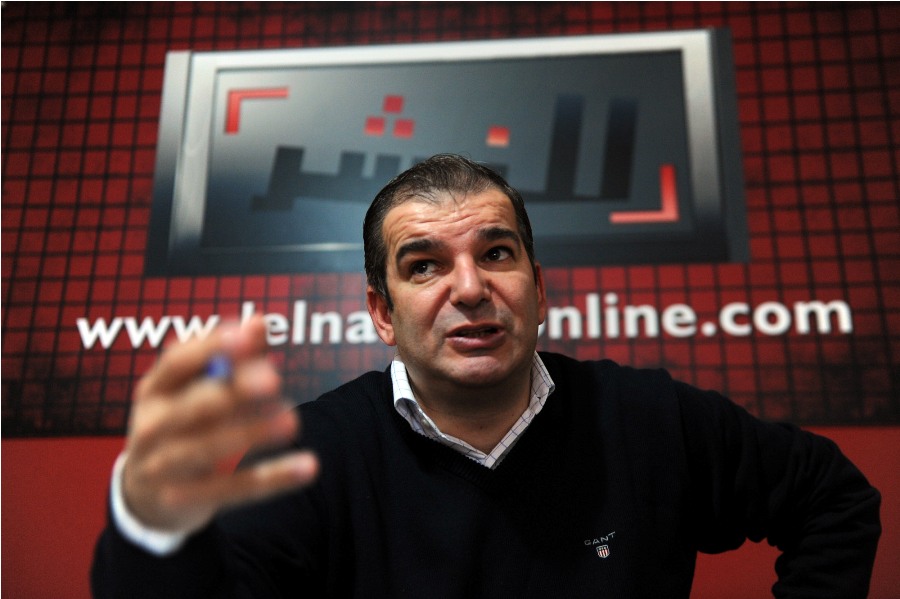
Toni Khalifeh

???????????????????????????????????????????????????????

The TV presenter who ridiculed the Ethiopian maid who committed suicide after abuse, who led a campaign against a Lebanese physician and accused him of malpractice leading to the death of a woman and whose show is a prime example in journalism is seeking the Maronite seat in Tripoli.

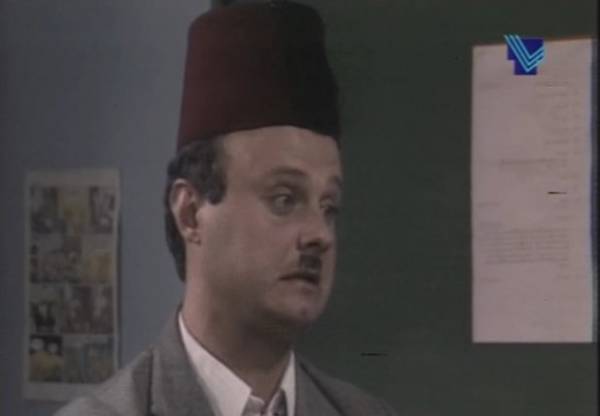
Jean Khoudeir

Jean Khoudeir

Despite reading the list of nominees in Tripoli, his name didn’t ring a bell at all. He’s running for the Maronite seat there (there’s something about that seat, no?) and is more known by our parents since he was more active around the time they were our age.

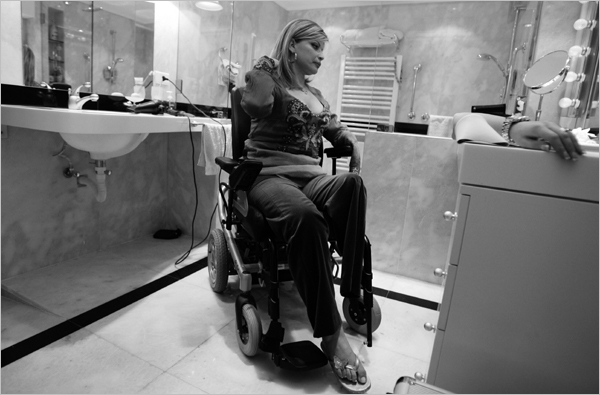
May Chidiac
May Chidiac

Not sure if she qualifies as a celebrity as she has been doing politics for a long, long time and is a staunch and outspoken supporter of the Lebanese Forces. She was the victim of an assassination attempt in 2005 and multiple slander campaigns recently targeting her disability. I may not agree with her rhetoric all the time but I personally like her. She is running for the Maronite seat in Keserwan.

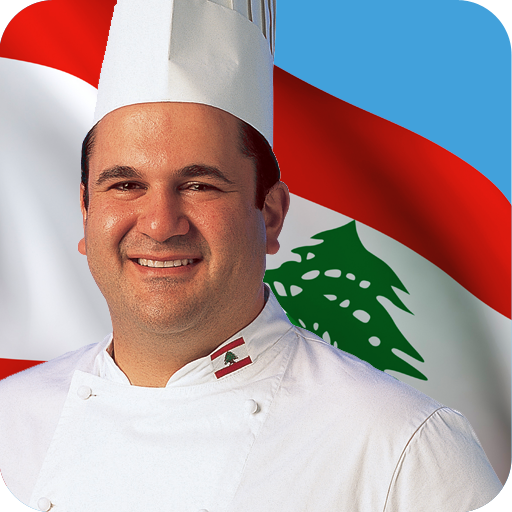
Chef Ramzi

Chef Ramzi

I’m pretty sure most parliament members would kill to have him win. Except the ones he’s running against for the Orthodox seat in Metn obviously. But yes, the famous cook who made a name for himself through his cookbooks, cooking show and through a brief stint on Celebrity Duets wants to be part of parliament too.

Maya Terro

Maya Terro

Maya Terro deservedly won New TV’s Al Za3im and is simply a breath of fresh air among all the nominees and among the “celebrities” who are nominated as well. She’s our age and I really feel this could be a person who truly represents our voice. She’s running for the Sunni seat in Beirut. Too bad I cannot vote for her under any of the proposed laws, if any actually see the light of day. But here’s hoping for an electoral law that would one day empower the Maya Terro’s and help them get to office.

Other:

Other Al Za3im candidates who did not win are also running. Malek Mawlawi is vying for one of the Sunni seats of Tripoli.

——————————————————————————————————————————————————–

Now on to more “serious” things. I’m not sure what it is about that Maronite seat in Tripoli that keeps attracting people. Is it a rule of thumbs now that any Maronite who cannot find a seat anywhere can run for that Tripoli seat? None of those candidates, however, can beat the one named Claude Julius Ceasar Rizk. He’s not a celebrity but with a name like that, he should be.

Our parliament is extending its mandate tomorrow. I don’t know how it makes sense for a depute to extend for himself without referring to the entity that asked him or her to represent them (the people). I don’t know how this is fits under democracy, rotation of power, etc. I’m not even sure how the security that our MPs and their political parties worked on destroying for the past few months in order to reach this day can be used as a viable argument for the extension. And you want to know what’s the epitome of the irony at hand? Our only hope to revoke the extension, Lebanon’s constitutional council, has also had its mandate extended.


It’s a great time to live in the Parliamentarian Democratic Republic of Lebanon.


The Neo-Dictatorship of Hezbollah: Rami and Marwa Olleik

Hezbollah’s practices towards Lebanese citizens, whose protection theoretically justifies the party’s entire existence, have been nothing short of unacceptable lately, especially against Lebanese Southerners who became outspoken against some of the party’s practices.

Imagine the following scenario: you live in a town in Lebanon with a predominant political affiliation. The party in question decides to do something with which you don’t agree and you decide to speak out. The next thing you know, you are thrown out of your house and forbidden from returning to your hometown or even attacked on your way home.

This is Hezbollah’s did with two Lebanese Southerners Shiites who dared speak against its involvement in Al Qusayr or against the party in general.

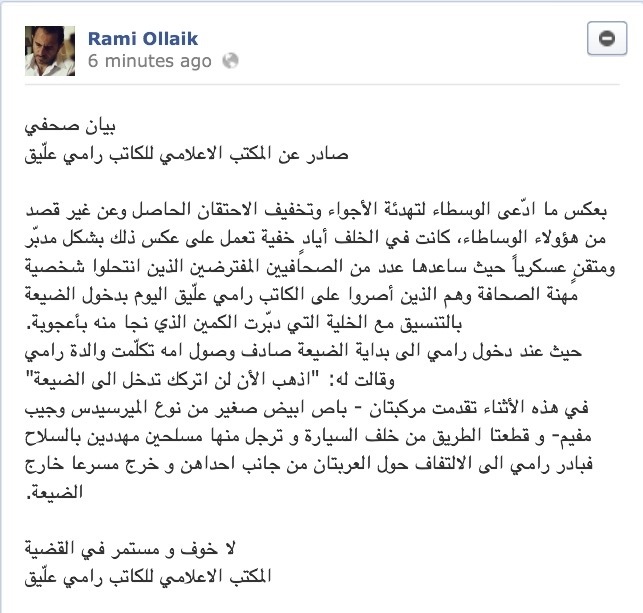
The case of Rami Olleik was always baffling to me. He was a militant Hezbollah member, swiftly rising among the party’s rank, until he came to believe that the party’s entire ideology is wrong. He wrote a book about it, which I’ve read, and is now teaching at AUB. I always wondered how Hezbollah let Rami Olleik run wild for so long. Well, not anymore.

On his way back to his Southern town, Rami Olleik’s car was attacked by military men and he barely escaped to return to Beirut.

20130529-205127.jpg

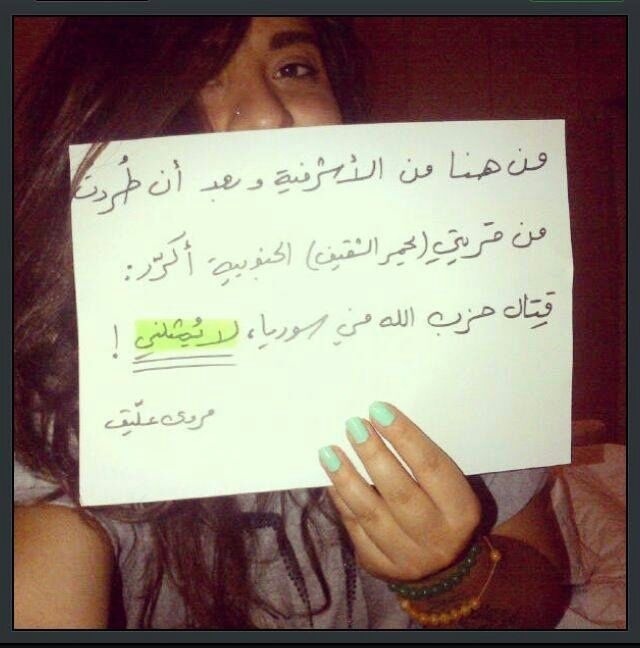
Rami isn’t the only Olleik who was targeted recently. Marwa Olleik is a young 20 year old girl from the South who was banned from returning to her town by the same party that her some of her family members support and are even active in. All because she wrote on Facebook how she wasn’t represented by the party’s actions in Qusayr.

20130529-205305.jpg

She woke up to find the furniture on her house’s balcony burned. Fliers started spreading around town to boycott her dad’s business. Meetings went on till 3AM in order to get her to apologize took place. Facebook pages were started to tarnish her reputation. Slander against her started, all revolving around her and “Al Sayyida Zaynab.” Once she left her town, she got phone calls to stop criticizing Hezbollah and the Syrian regime so she could return home. This girl is afraid to go back home to see her parents. She’s even afraid to go back to class due to her university’s location.

And I’m sure there are some Lebanese out there who can only think one thing now: Kharjon.

It seems it is now forbidden for Lebanese Southerners to have an opinion that breaks away from the mold in their part of the country. It is forbidden for Lebanese Southerners to tell off Hezbollah’s practices in Qusayr for what they think they are. It is forbidden for Lebanese Southerners to have an opinion that isn’t supportive, glorifying, loving, adorning and forever grateful of the party of Allah. It is apparently also forbidden for Lebanese Shiites to have an opinion that is not conforming with the predominant opinion of their sect.

And what’s worse, there’s no one to really fight for the rights of Rami and Marwa Olleik because there’s no entity in this country that can really stand up for Hezbollah’s hegemony and power.

Your freedom of speech in Lebanon is contingent upon many things. Let’s add Hezbollah to the list of entities that Lebanese Southerners specifically, the same people this party liberated from Israeli occupation, cannot speak out against or else they’d have no home to return to. Behold the neo- dictatorship (as to not use the word terrorism) of the party of Allah against fellow Lebanese whose only fault was to speak their mind. How is this any different, exactly, from the practices of foreign armies occupying lands that isn’t theirs?

It doesn’t matter where you stand regarding Qusayr. It doesn’t matter whether you think what Hezbollah is doing there is resistance against المؤامرة على المقاومة or that it’s simple murder. It doesn’t matter if you think Hezbollah is the best there is or the worst form of existence in Lebanon today. What matters is your right not to have your life and sanctity threatened just because you have your opinion.

Here’s hoping the Hezbollah’s next liberation is that of its mentality. Allah sure knows how much that is needed today. And here’s to every single Lebanese Southerner who is forming his or her own resistance, a resistance for thought and freedom.

Neither Aoun Nor Geagea Is Defending Lebanese Christian “Rights”

Preamble:
The following is what the LF, FPM, Kataeb and Marada agreed upon in Bkerke:

“The parties convening have decided not to run based on the 1960 law and consider the law at hand as one that consecrates the injustice towards Christians. The parties convening have also agreed on the need to take a firm stance against the 1960 law in fear of having this law forced as a reality when the nomination window is open. It is also important to affirm that this law is rejected and is non-viable as a reference to run for elections.”

The electoral reality today:
As the nomination window for the 1960s law closes, the ministry of interior has tabulated 706 nominees, which contain more than 20 candidates for each of parties that agreed upon the above preamble. Talk about “not running” and taking a stance against the “unjust” law at hand.

Let’s talk electoral laws:

This isn’t the only part as to why these politicians are doing a terribly bad job but it’s the most current and as such deserves being dissected in grosso modo to draw a frame for the discussion.

Michel Aoun started out against the Orthodox Law and supportive of the law proposed by the government (13 districts with proportional representation). He later on switched stances to support the Orthodox Law because other Christian parties jumped on the bandwagon (the LF were the first to support this law publicly), effectively becoming the law’s main defender despite him fully knowing that the law will never, ever see the light of the day. If by some miracle the Christian consensus around it were to make it to parliament, the law wouldn’t pass the president. And if the president ended up signing it, the constitutional council might have probably found it unconstitutional. Aoun knew this and knew it well. He also knew that the only reason he was getting support from Hezbollah over the law was because Hezbollah didn’t lose any Shiite seats with it and would use it to boost him among Christians, not because they are deeply concerned for the rights of Christians. He also knew that the support Nabih Berri gave the law was lukewarm at best. That’s why he kept his options open and gave us another electoral option: one proportional representation district. All other laws were rejected, as was obvious by his party’s practices and as is their right.

Samir Geagea started out with the neatly-cut 50 district laws which makes sure his party gets a majority in parliament. When that law received no outside support, he switched to the Orthodox Law and became a prime defender of that law… until he hit the roadblack set forth by his allies regarding the law and for a while it seemed he was taking on the Future movement and Jumblat by marching on with the Orthodox Law. At one point, Geagea’s breathing space came in the form of a Bkerke agreement to put the Orthodox Law on hold and to find a law that brings more consensus. So he effectively killed off the Orthodox Law and started running a campaign against it, only to be “surprised” by an anti-Geagea campaign from FPM supporters and a bishop who obviously went beyond his jurisdiction. Shouldn’t they stick to masses and baptism?

The problem with Christians and the electoral law is two-fold.

  1. In the most optimistic of scenarios, we are 40% of the voting population which has to vote for 50% of parliament.
  2. Lebanese Christians are the only sectarian component of Lebanese society which have a true form of “democracy” whereby despite their numbers, the 50-50 division between Aoun and Geagea renders them meaningless.

Parliamentarian representation has two components as well. Let’s call them a horizontal and a vertical factor. The horizontal factor is an MP’s sect and the vertical factor is his region. The Orthodox law tackles one but not the other. The question, therefore, asks itself: How is Aoun defending “my” electoral rights when he supports a law he knows will not pass and when the other law he supports is one that basically makes “my” vote irrelevant (not that I personally care), effectively not allowing me to make the decisive choice in ANY of the Christian MPs?

And how is Geagea defending “my” electoral rights when his support of electoral laws is almost always apparently contingent upon what his allies believe is best, despite his best attempts not to make it look that way? And how is it defending “my” rights to be a staunch supporter of a law one day and have your media work staunchly on portraying it the “best” for “Christian rights,” effectively convincing most Christians of this, only to trash it when the wind blows differently?

How are both Geagea and Aoun defending “my” rights when they both refused a Kataeb proposal of personal electoral districts which effectively fixes the two-fold problem I have presented earlier? How are they defending “my” rights when the probable reason of their refusal is because personal districts limits their parties’ influence? How are they defending “my” rights when they don’t really care for “my” parliamentarian representation as much as their parliamentarian share?

I Liked Geagea:

I would be lying if I said my mind doesn’t lean one way in the Aoun-Geagea dichotomy. There’s nothing wrong in supporting any of these two men. In fact, I personally believe that between 2005 and 2010, Samir Geagea had a near parcours-sans-faute in Lebanese politics. His discourse was Lebanon-centric. He was moving his party away from the common misconception (at least back then) that it was a Christian party by the Christians for the Christians. They even actively worked to kill off the Lebanese Forces typical symbol of that cut cross. But not today.

Nowadays, the discussion of both men is as Christian-centric as it gets. The more Christian-centric one of them gets, the more Christian-centric the other goes. And I may be a minority in thinking this but I really don’t believe “my rights” are best served in the rhetoric being spewed by both men and their supporters all over the place and even some priests and bishops.

“My” rights are also not served, in my opinion, when the rhetoric being employed is one that is only leading to increase the divide in the country and not work towards trying to fix things. When Aoun completely ignores the fact that his ally Hezbollah is fighting in support of the Syrian army in Al Qusayr, how is that defending “my rights?” How is it defending “my” rights when a politician such as Aoun is completely silent, effectively supporting, the practices of Hezbollah in defending an army and a regime whose main purpose was to destroy my rights as a Christian in Lebanon for years and years? How is it defending “my” rights when the only arguments used on the matter are ones revolving around Jabhet el Nusra and the rise of Sunni extremism while completely ignoring the equally dangerous Shiite extremism and political brainwashing at hand?

On the other hand, how is it “right-defending” for Geagea to completely ignore the rise of the Ahmad el Assir phenomenon or at least not actively work towards decreasing it? What about is his silence regarding the Future Movement’s involvement in fueling the Syrian crisis with his support of the rebels? What about his silence on the Lebanese Sunni extremists who are entering the fights in Syria in support of one of the sides, effectively becoming the same version of Aoun on the other side of Sunni-Shia divide?

Both Aoun and Geagea are taking parts in the Sunni-Shia problem that Lebanon is facing today and their parts are not healthy, not even in the least. Instead of making Christians a form of link between those two components of Lebanese society, our politicians are working on getting those components further apart with their near-blind support of whatever they do and whatever they commit to. It’s not in our best interest as Christians to take either position from the Sunni-Shia struggle at hand. It’s not in our best interest to take the sides we’re taking. It’s also not in our best interest to stand on the sidelines and cheer. The best way to fight for “our” rights is to take the right stance at the right time. At the current time, that stance is the following: get the parties involved not to drag the Syrian war into Lebanese territory, which will lead to more degradation of Christian rights.

A Lack of Vision?

With Aoun coming out against the extension of parliament’s mandate (at least until now) and Geagea possibly announcing his stance in a few hours, I have to wonder: are our politicians truly out of imagination or resources to succumb to the status quo this way? And how is it defending “my” rights when, in one way or another, they both don’t take the fight the long way home and contribute to transforming this country from a growing democracy to a growing dictatorship? That’s the only way really to categorize our parliament extending its mandate for itself.

Is there any guarantee that, in case parliament extends its mandate for two years, our politicians will actually reach a new electoral law? No.

Is there any guarantee that, in case parliament extends its mandate for two years, the security situation will become better enough to hold elections? No.

Why not, for instance, ratify the 1960 law in the following way: divide Akkar in two districts, bring the Maronite seat of Tripoli to Batroun, move a few seats from Beirut 3 to Beirut 1, move a few seats from West Bekaa (where 20% of the population is Christian and gets 4 seats out of 6) and put them somewhere else?

Why not run elections based on that ratified 1960 law, upon which Christians might be able to choose around 50 of their representatives, with an agreement to have parliament work day in and day out in order to reach an electoral law after which it dissolves and we hold new elections? It even has the same guarantees as the extension scenario.

The democratic process in this country has to be upheld. Any talks about modifying it because (insert any form of non-viable argument) does nothing to defend “my” rights as a Lebanese first and foremost.

People Like Us:

I believe or at least I hope that this sentiment is shared by many Lebanese Christians today. It baffles me how Lebanese politicians somehow believe they talk on behalf of every single Lebanese when there are people like us who don’t agree with almost any of their practices nowadays.

I, for one, believe no one represents me today and I kindly request them all to back off “my rights.”

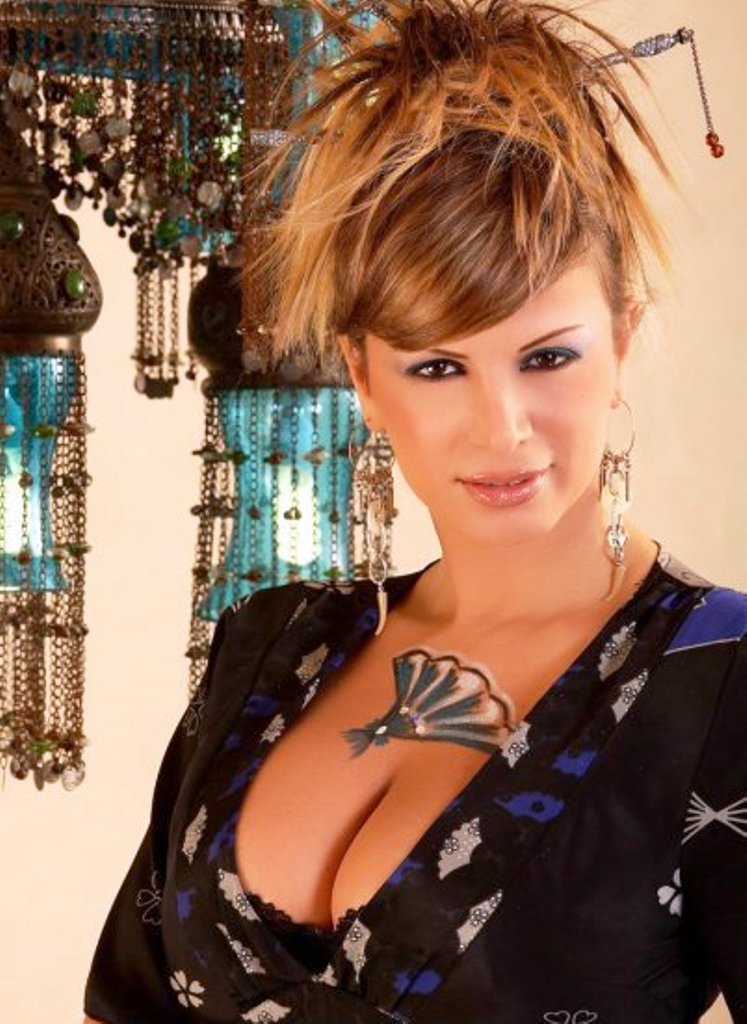
“Sad” Lebanese News: Myriam Klink Doesn’t Run For Elections

20130528-142129.jpg

I can hear you weeping all the way over here. But after much talk on the matter, all with a brief stint on a reality TV show devoted for the matter, Myriam Klink hasn’t run for Lebanon’s upcoming elections, if they will happen to begin with.

Her name is not among the list of Orthodox candidates for Metn (link) and she has denied running as well via a statement (link).

Of course Klink not running wasn’t her choice. She pulled up in her pink hummer in front of the ministry of interior and had all the necessary papers ready when she received a phone call from someone who threatened her with the electoral boogeyman also known as “teshtib.” At that point, her manager decided that the political situation in the country is too unsafe and dirty for Klink to run so he took the papers and money and ran out of the car with Klink running after him.

Now THAT is something I would have loved to see. If only the 706 people that ran for elections had a “Johnny” to take away their money and papers and get them to chase after him. For those who are disappointed Myriam Klink’s legs won’t make it to parliament, fear not. Nathalie Fadlallah is keeping your hopes alive with her running for the Maronite seat in Tripoli, which is odd since she had declared she was running for the Orthodox seat in Koura earlier (link). I guess she doesn’t know which way she prays, not that she would win anyway.

I, for one, would have liked to see Myriam Klink in parliament. At least she’d serve as some change from the likes of Abdul Latif Zein, who at 81 has served in parliament for 53 years and is running again this time around.

Touch’s Network Not Working & No Fix In Sight

You’d be kidding yourself if you said you could live without your phone nowadays. Now imagine that you had full reception and thought there was nothing wrong with your phone… except people had been trying to call you for hours and all they got was a busy signal or line blocked notification.

I’m not a Touch user. But a friend of mine is one of the many Touch users affected. And her story is one that needs to be told, hopefully someone out there decides to expedite attempts to fix the problem, if any attempts are actually underway.

Here is the story.

2 months ago, several people tried to call my friend’s phone only to get a signal that her line was off. However, she wasn’t notified of any calls even though her phone was active, 3G and all. It wasn’t a constant problem, it would appear sporadically and she didn’t know about it until the people that tried calling her met up with her in person.

She then called Touch’s support center. The employee decided that it was a problem with her brand new iPhone 5. I guess blaming the phone is the way to go. So in order to make sure it wasn’t a sim-card issue, she went ahead and replaced it with a nano sim straight out of Touch, hoping it was cutting the sim part that posed the problem. The employee there said it will definitely solve her problem.

Things were working for a while. It could have been the nano sim or that no one reported problems trying to contact her. The trouble-free duration lasted for a week. So when she started having trouble again, she decided to visit the Touch center again and went through several supervisors, the last of which told her the following:

  • It was a problem they’ve been having for the past 3 months and they didn’t know about it if it weren’t for the huge amount of complaints they received.
  • It doesn’t affect all Touch customers (she gave a 40% figure) and is device independent, meaning the iPhone 5 is not to blame.
  • The supervisor automatically assumed my friend is jobless and told her that other people with jobs have it worse. Because your phone matters are only important if you have a job.
  • When asked what my friend can do to fix it, the supervisor suggested to try calling someone every two hours in order to keep her line “registered” on the network. Then keep doing as such every two hours.
  • When asked if Alfa is having such issues, the supervisor said she doesn’t know. What she knows is that her network is affected.
  • When asked when the issue will be fixed, she said: we don’t know.
  • How is it acceptable for such a problem to be taking place for over 3 months with no fix in sight on Lebanon’s biggest network, I don’t know.