Welcome to Jebla. People are happy here.

Thank you Mr. Sakalaki.

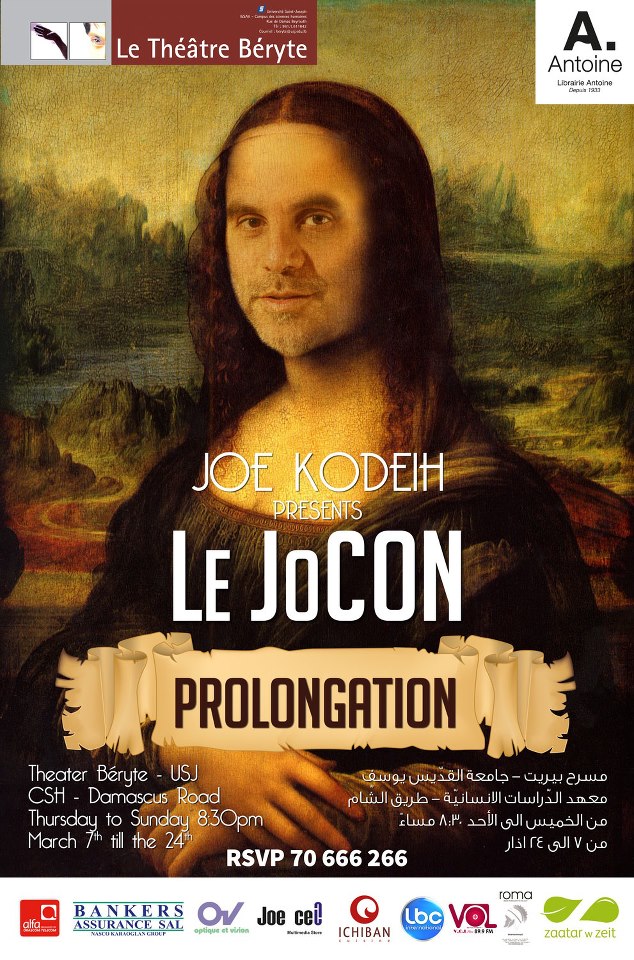
Lebanese comedian Joe Kodeih’s latest offering is Le Jocon, a play whose title is a play off the french name of DaVinci’s Mona Lisa.
Le Jocon starts with Kodeih visiting a psychatrist who immediately subjects him to hypnosis and asks him about his mother. Running for approximately 60 minutes, Le Jocon is a more or less autobiographical portrayal of some key moments in Kodeih’s life – all of which are given a comedic twist, obviously: from his moment of conception to his first days of school to growing up and going to Paris for a few days of vacation.
Those events are all done to the backdrop of a Lebanese life in Achrafieh, which makes the play very concentric. If you haven’t spent time in that part of Beirut or are not familiar with the many stereotypes associated with the people of Achrafieh, there are many jokes that you will miss.
Moreover, one of the key moments in the play which takes the biggest fraction is Kodeih’s visit to Paris which is told in three parts stretching over the three days of his visit. I personally found it hilarious because I had been to Paris but for someone who doesn’t know what Châtelet-Les Halles is (a subway station the size of Beirut’s airport) or what happens on the many different streets of Paris that he mentions, the jokes will come off flat or how difficult it is to take that infamous schengen visa picture: don’t smile, head at a 90 degrees angle, let the sadness erupt from your depth. Hilarious. Unless, of course, you were never submitted to a schengen visa picture.
My main problem with Le Jocon, however, is – and I understand this is overly analytical from my part – the stereotyping of the psychiatry experiment which Kodeih uses as a vessel to tell his story especially that it only serves to reinforce the misconceptions that many people have about the field, one which is more or less a taboo in Lebanon still. Of course there will be hypnosis. Of course the psychiatrist will ask about his mother. Of course he will turn out to have issues with his mother. I don’t feel we are at a point where that field should be an open field for comedy yet.
In general, though, Le Jocon is an entertaining short play. Tickets are for 20,000 and 30,000LL. Only two shows remain next weekend. It will make you laugh. So why not?
3.5/5

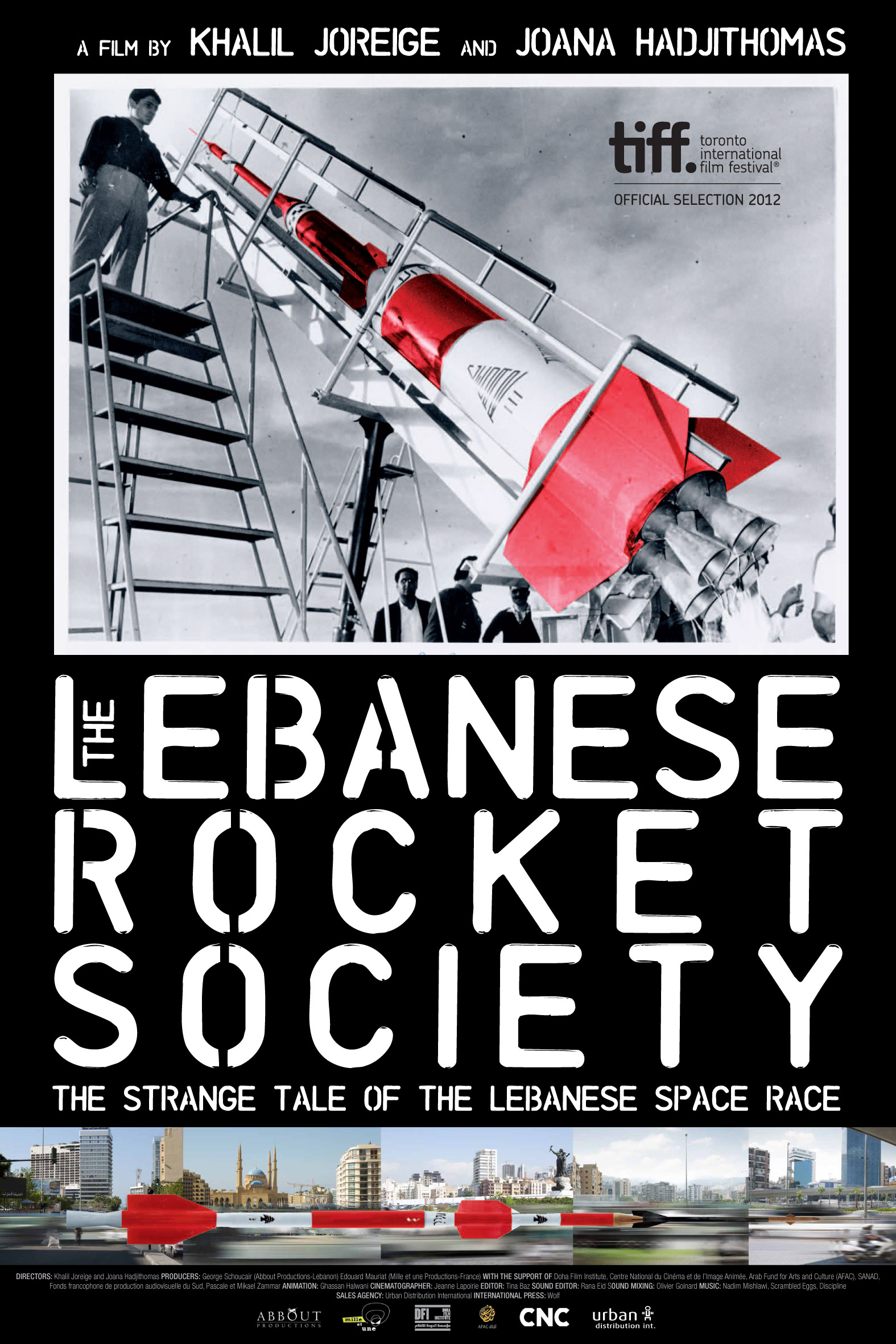
Brought to us by Joana Hadjithomas and Khalil Joreige, The Lebanese Rocket Society is a documentary about a phase of Lebanese history that exists between both of our civil wars, from 1960 to approximately 1966, in which a group of Lebanese students at Haigazian University launched rockets as part of a series of scientific experiments.
The above is not science fiction, as I had thought on many occasions when many blogs and newspapers wrote about the society over the past few months, despite it being quite difficult to believe given where we are technologically in Lebanon today.
The Lebanese Rocket Society‘s premise is bittersweet. For its main purpose, it makes you proud that these students not only decided to build a rocket, but also chemically made the fuel the rocket is supposed to use because only superpowers possessed it and were not going to dispense quantities of it to Lebanon. The students even built the radar sensors that they equipped the rockets with after a brief miscalculation which sparked a UN-debaccle with our neighboring Cyprus. Yes, we haven’t been nice neighbors all the time apparently. The Lebanese Army eventually helped them in their scientific experiments for the students were heading into financial difficulties with their ambition growing bigger.
The mere fact that the Cedar-named rockets were all built from scratch is a testament to the ingenuity and the creativity of these young Lebanese students. Too bad such advances are purely science fiction not because such brains are lacking but because of our country’s circumstances.
The most interesting parts in the documentary were, without a doubt, the sections where real-life footage from the many launches that took place were incorporated. The archive is unimaginably great and seeing it is worth the price of admission alone. It’s always interesting to dig up 20th-century material about Lebanon that is not of tanks bombing buildings and of a torn-out Holiday Inn hotel.
The documentary seeks out Manoug Manougian, the student who started it all, currently a math professor at a university in Florida. Manougian shares the archive he kept of what he calls one his life’s proudest moments. You can check out his personal page here.
The directors also find Harry Koundakjian, the photographer who documented the Lebanese Rocket Society’s experiments, as well as former Haigazian president John Markarian. However, even though the other participants in the society’s experiments are mentioned, nothing is said about them nor are they mentioned again beyond the movie’s opening scene, which I thought did their work a disservice.
Moreover, The Lebanese Rocket Society goes off-topic often, notably with an entire sequence about the importance of the Arab Spring, as well as many other political subtle messages passed on notably about the importance of the Arab unity under Abdel Nasser. I still have no idea how the entire documentary’s premise fits in the mood of revolutions and freedom and whatnot spreading across Egypt, Libya, Tunisia and Syria but the notion is present.
I also felt it was very misleading that – despite their army source telling them the army had a panel discussing the possibility of turning the rockets into weapons by having one floor of the rocket filled with bombs – the directors were adamant that these rockets were a scientific experiment and build the entire documentary on that premise. It was quite clear that the rockets couldn’t have been possibly done if the army hadn’t helped and if the army wanted to make weapons out of them, they would have been turned into weapons.
The Lebanese Rocket Society ends with a 10 minute or so animated sequence which asks the question: what if Lebanon hadn’t stopped the rocket experiment?
To answer the question, the directors believe we would have a metro network running under Beirut, oil rigs off our shores, an entire space program rivaling that of the U.S.A. (down to basically ripping off Nasa’s logo), etc.
The sequence, in my opinion, did the movie a grave injustice and it shouldn’t have been included at all. It was already established that the rocket experiment was stopped because Lebanon was asked to by higher authorities in countries North, South, West and East. One of the documentary’s strongest scenes was one where a drafting compass drew a circle from Lebanon to where our rocket would have reached. Sinai was accessible. It was already established as well that the rockets were not, eventually, a mere scientific experiment as the students involved kept repeating. Those students didn’t know any better, obviously, but the army did. How does that set up for a future as bright as the one they tried to portray?
Nothing is better than some Lebanese future pick-me-up every once in a while, but at least don’t have it that separate from all the facts the documentary had presented over the course of the previous 80 minutes, especially that the presentation of those scientific facts was very systematic and documented.
I personally recommend people watch The Lebanese Rocket Society when it’s released in cinemas on April 11th despite its shortcomings because it is a documentary that showcases a different side of the Lebanon that we thought we knew, one that has been erased from the collective memory of the country as a whole – all supported by some old footage that will leave you baffled.
3.5/5

We have locusts! At least that’s what news agencies are saying because I haven’t seen any nor do I want to see any.
For the first time in a long time Lebanon is being hit by “el jarad” being brought up our way from the Southern neighbor we love to hate. Cue in the theories of this being a zionist agenda.
And with that, memories of a not-as-distant past popped in my head again. In case you didn’t pick up on it yet, those memories are from 9th and 12th grade when we were taught the exact same history of our country, three years apart.
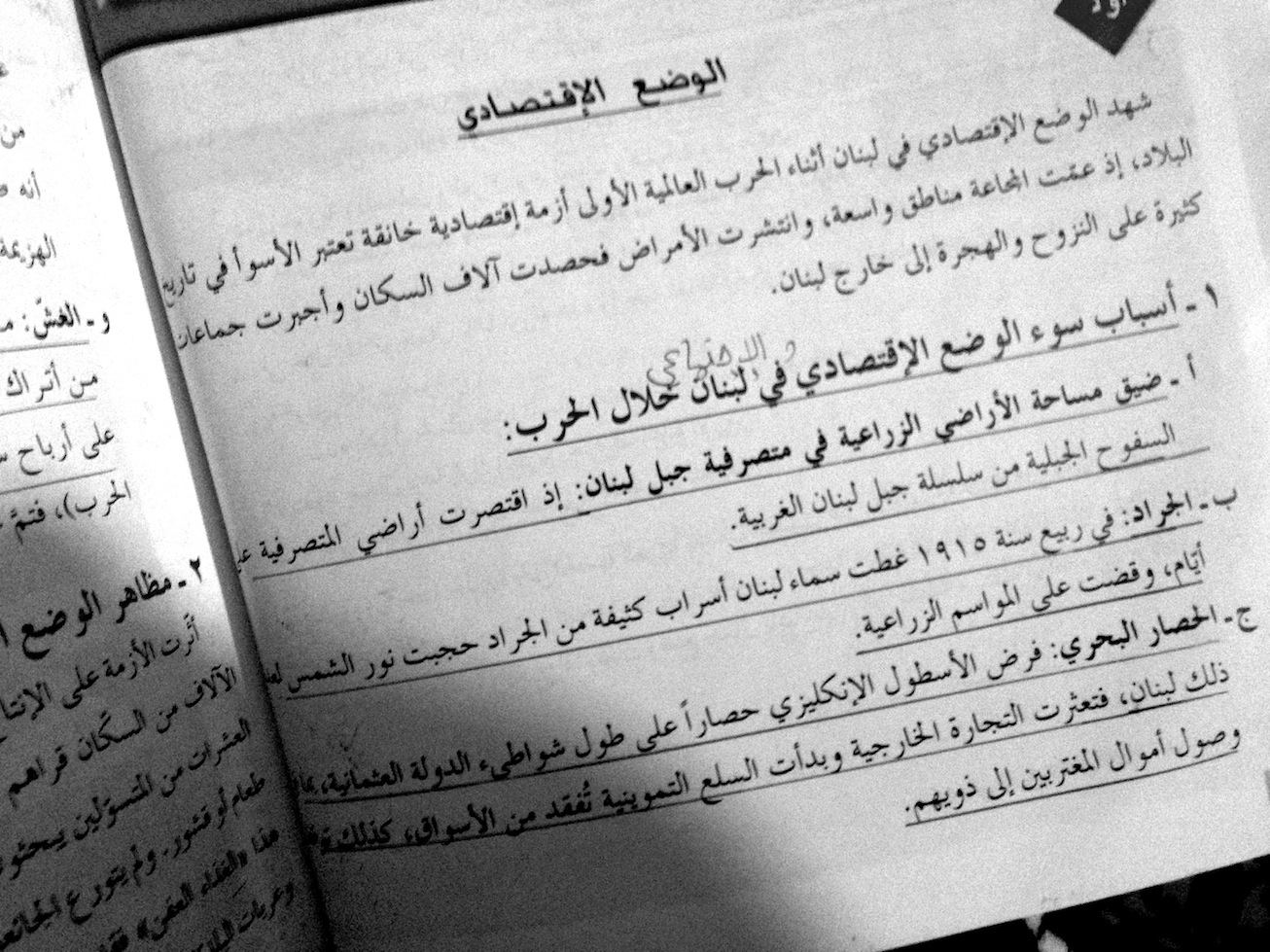 All we need to recreate a WWI scenario in 2013 is the following:
That’s a little difficult to do seeing as those pesky insects are invading areas which have more buildings than crops and Englishmen are busy drinking tea. Locusts are in for one major disappointment this time around.
But students who have their official exams this year are lucky. For the first time ever, the history they are being taught is, at least partially, witnessing some practical applications in our daily lives. Shame on any of them who doesn’t get 27/30 on their exams.

Popsci has recently published, off of a website called PornMD, an aggregation of every country’s porn habits based on the search items users who are located in that country use while accessing some porn websites.
Some interesting observations that the aforementioned website noticed are the following:
Some observations regarding the Middle East that I noticed are the following:
Naturally, I figured I’d look at Lebanon’s part of the info-graphic. It’s sad to say we are not very creative, although slightly nauseating (shit orgy? Really?), in our porn browsing habits:

You can access the entire infographic, which contains no pornographic material, here.


 A Separate State of Mind | A Blog by Elie Fares