2013 Oscar Predictions

The 85th Academy Awards are held tonight so I figured I’d throw in my predictions as to who will win and who should win some major categories. It’s not Oscar night without a few predictions to go wrong, am I right?

I’m glad this year’s Oscars fall on the unpredictable side – there’s no absolute frontrunner in most of the categories so the night should be interesting to say the least.

Without further ado, let’s begin.
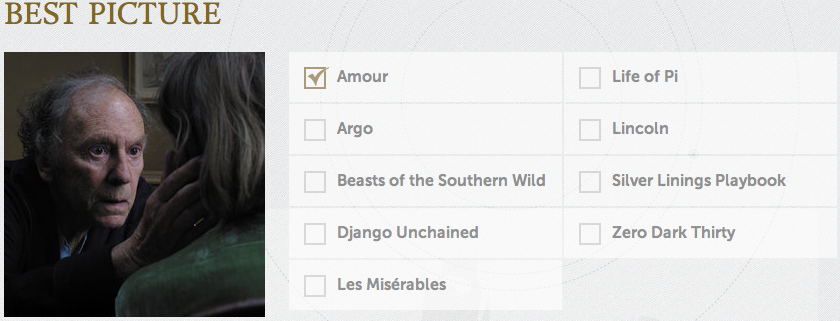
Best Picture Academy Awards Oscars 2013

  • Who Will Win: Argo
  • Who Should Win: Amour

Amour (review) is, hands-down, the best movie of the year. It won’t win because of the way the Oscars are run. So we are left with the movie that has been picking up best picture awards here and there: Argo (review). I don’t get it really. There are two other movies on that list that I believe are more deserving (Lincoln and Silver Linings Playbook) but you cannot underestimate momentum.
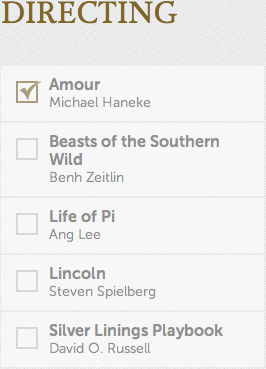
Best Director Academy Awards Oscars 2013


  • Who Will Win: Steven Spielberg
  • Who Should Win: Michael Haneke

Out of all the nominated directors in this category, Haneke managed to turn a simple story of old age into a spellbinding movie that captured everyone’s heart and mind. With little special effects, a Parisian apartment, his camera and two great leads, Haneke created Amour. But seeing as his nomination was a surprise by itself, expecting him to win what he deserves is far-fetched. So Academy Award-darling Spielberg with what is arguably his best movie in years will take it.
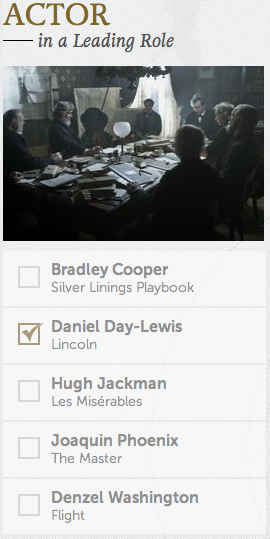
Best Actor Academy Awards Oscars 2013


  • Who Will Win: Daniel Day Lewis
  • Who Should Win: Daniel Day Lewis

I don’t believe this needs any explanation. What a brilliant performance.
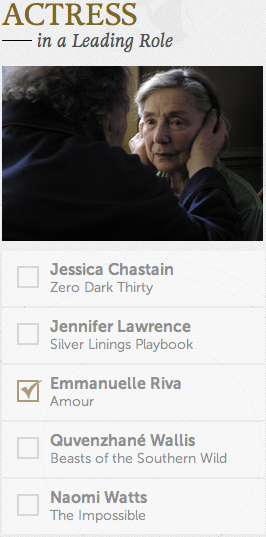
Best Actress Academy Awards Oscars 2013


  • Who Will Win: Emmanuelle Riva
  • Who Should Win: Emmanuelle Riva

Next to the Best Picture race, this will be the night’s most interesting. What started out as a two-horse race with Jessica Chastain and Jennifer Lawrence battling it out for coveted awards soon turned into a three-way race as veteran actress Emmanuelle Riva took the BAFTA and later on the French César. At an age of 85, many voters will probably go for Riva because it’s now or never for her. Chastain and Lawrence will get their shot one day. The mere fact that Emmanuelle Riva is present on that list means there are enough Academy members who want her. It’s also her birthday today. HAPPY BIRTHDAY EMMANUELLE!
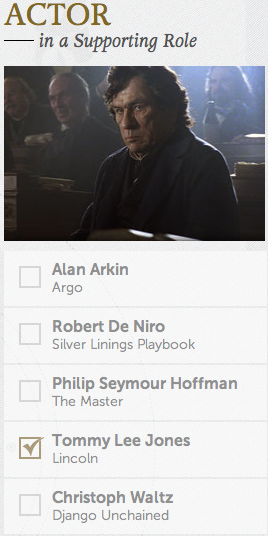
Best Supporting Actor Academy Awards Oscars 2013


  • Who Will Win: Tommy Lee Jones
  • Who Should Win: Tommy Lee Jones

Tommy Lee Jones gave what is, in my opinion, the best performance out of the bunch. Pre-Oscar awards have been spread around this bunch of nominees in a balanced way so no clear frontrunner has emerged but I think Lincoln‘s (review) momentum will help Jones take another Oscar. Every single nominee in this list has won before.
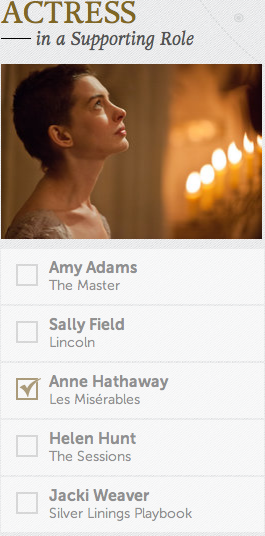
Best Supporting Actress Academy Awards Oscars 2013


  • Who Will Win: Anne Hathaway
  • Who Should Win: Anne Hathaway

There’s no denying Hathaway deserves this. She owned the entire Les Misérables (review) with her chilling performance of “I Dreamed A Dream.” The movie starts dying when her character dies. No one else in this category is as deserving and she has basically won every single pre-Oscar award there is.

Original Screenplay Academy Awards Oscars 2013

  • Who Will Win: Quentin Tarantino
  • Who Should Win: Michael Haneke

There’s something understated about turning a simple story into a work of art, which is what Haneke did with his story in Amour. But unfortunately, that’s not the kind that usually triumphs. I expect Tarantino to come out triumphant for Django Unchained (review).

Adapted Screenplay Academy Awards Oscars 2013

  • Who Will Win: Argo
  • Who Should Win: Silver Linings Playbook

Argo has the momentum. Silver Linings Playbook (review) has the superior quality and the charm. Momentum wins.
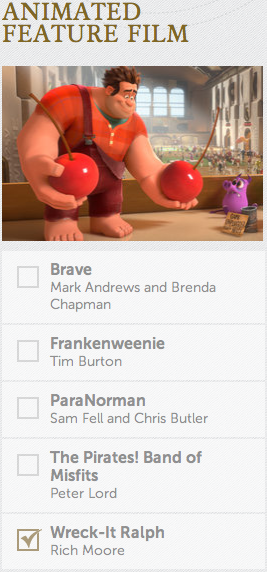
Animated Film Academy Awards Oscars 2013


Who Will Win: Frankenweenie

Who Should Win: Wreck-It Ralph

I found Wreck-It Ralph to be one of the most charming – and best – movies of the year. It is what I expect from an animated movie to be. Frankenweenie, on the other hand, is what plays on the Academy’s strings: homage to classics, daring technique, etc. It’s obvious who’d  win in such a match-up.
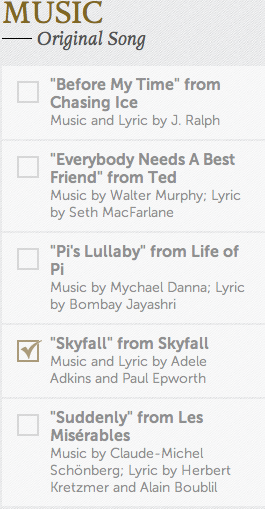
Original Song Academy Awards Oscars 2013

  • Who Will Win: Adele
  • Who Should Win: Adele

I can’t wait to hear her acceptance speech.
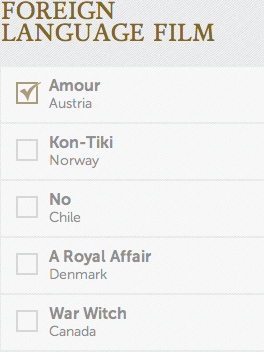
Foreign Language Film Academy Awards Oscars 2013

  • Who Will Win: Amour
  • Who Should Win: Amour

The fact that it’s nominated for best picture, best actress, best director and best original screenplay is hint enough.

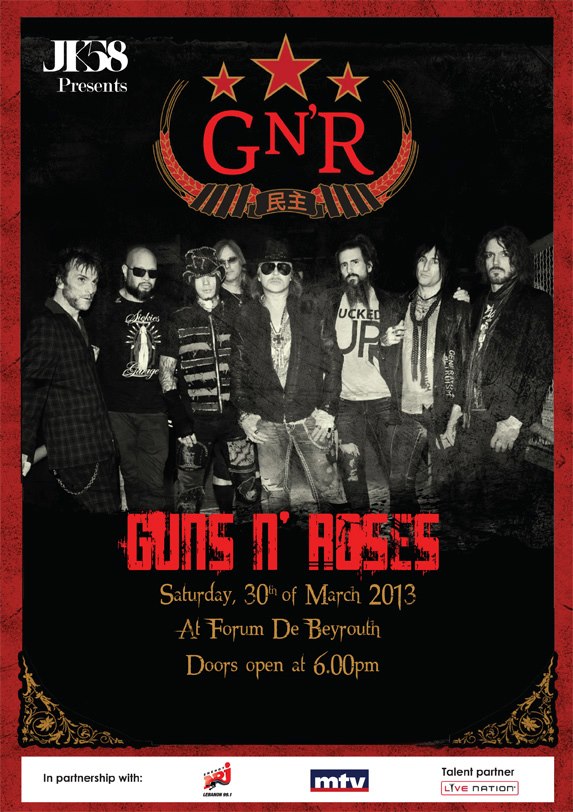
Details On The Guns N’ Roses Concert in Lebanon

Guns N' Roses concert Lebanon Beirut

You all know that one of the world’s best rock groups is coming to Lebanon. Well, I’ve got some extra details for the concerts that you might be interested in.

  • Location: Forum de Beyrouth
  • Date: March 30th,
  • Ticket prices: General Admission: 55$ or 82,500 LBP, zone A and B (Green): 100$ or 150,000 LBP, zone A (Blue): 120$ or 180,000 LBP, golden Circle: 150$ or 225,000 LBP, zone A and B (Pink): 200$ or 300,000 LB, lounge Access: 200$ or 300,000 LBP.
  • Ticket sale: Begins February 25th (tomorrow) from Virgin Ticketing Box Office
  • Bande’s lineup: Axl Rose, Dizzy Reed, Chris Pitman, Frank Ferrer, Richard Fortus, Tommy Stinson, Ron Thal, DJ Ashba.
  • Doors open: 6 pm.

A presale for those of you who are very interested is currently available through this website (click). You can call 70488170 or e-mail them on Info@Presella.com.

You can now buy the tickets from Virgin by clicking on this link.

This is the link for the Facebook event.

Thank you Frodo’s blog (link) for the info.

Ossit Sawani (Blind Intersections) [2013] – Movie Review

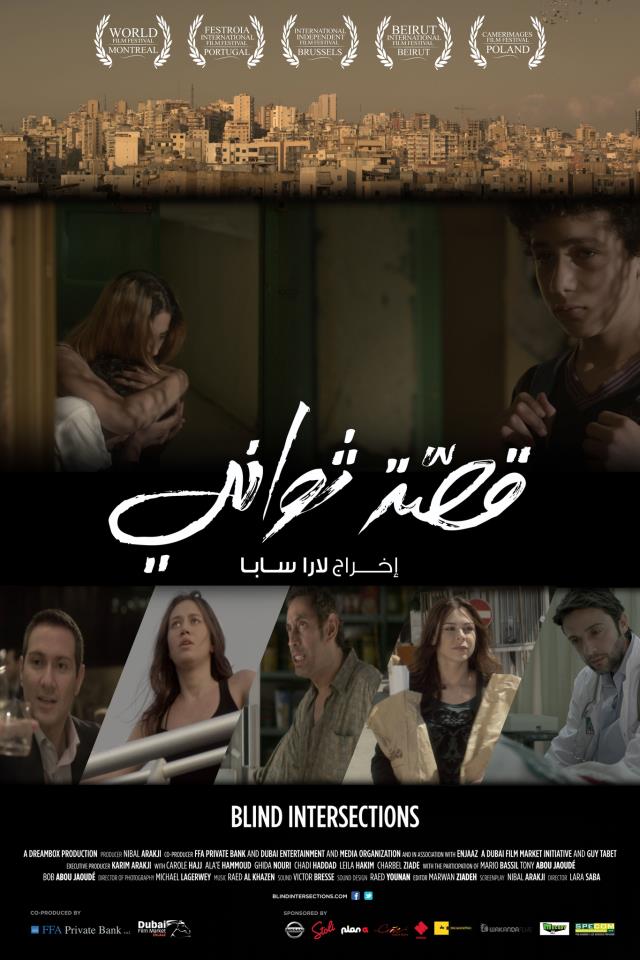
ossit-sawani-blind-intersections movie poster

Never since Nadine Labaki’s first movie Caramel have we had a decent Lebanese movie that doesn’t dwell on the Lebanese Civil War and Lebanon’s religious diversity. Some moviemakers tried to branch out and portray other aspects of society but their handling of the issue was either too shallow, too pretentious or downright silly. Until this came along.

Ossit Sawani – its English title being Blind Intersection – is not a movie about religion or the civil war. Thank God for that. It is the cross examination of the lives of three main people in Beirut as they go about key moments of their lives. Nour is an engineering student who is about to graduate when she loses both her parents in a car accident. She is left to take care of her elderly grandma with no financial means to do so. Karim is a young schoolboy who is the victim of maternal abuse and repeated child molestation as his body is sold for the next door grocer. India is a well-off western-mentality woman trying to conceive while attempting to give back to her community by teaching needy students at one of Lebanon’s government-run schools.

The movie is the story of how the lives of these characters intersect without them realizing – how the actions of one affect the other and shape their lives indefinitely. It is not a plot device that you haven’t seen before but it is the first time it’s used in a Lebanese movie. The scenes are jumbled and do not fall in chronological order. In a way, each character’s story has its own timeframe and you need to situate yourself accordingly in order to understand what’s happening.

Some of the scenes were a little dragged out or unnecessary. Other scenes felt out of the place but once you get into the mindset of what the movie is trying to say, it flows rather smoothly despite a few hiccups after an admittedly strong opening sequence with Nour going to the hospital where she finds out both her parents had passed away.

In a way, Ossit Sawani may not feel like a Lebanese movie at all because of what we have come to associate Lebanese movies with. But it is one. The city is Beirut. The dialect is Lebanese (I still don’t get why they feel like they need to give us English subtitles). The people are relatable. From a child trying to block out the sound of his mother having sex in the next room to shower sex scenes to subtle portrayal of the act of child molestation, Ossit Sawani is quite daring for what we have come to assume Lebanese movies are limited for. The extent that this movie goes to with regards to sex is proof enough that other movies such as Beirut Hotel were not banned because of nudity but because of their underlying political message.

Ossit Sawani is enjoyable enough for it to be worth the admission price but it eventually falls off very flat as the stories never seem to find a way to be resolved, open-endedness being another plot device employed. While that worked in Nadine Labaki’s Caramel as you felt the story arcs had sufficient material to feel substantial enough, the three stories in Ossit Sawani never feel complete or resolved, leaving you feeling let down as the credits start rolling.

Is it the Lebanese movie to bring the masses to the cinema? I doubt. At the end of the day, it attempts to be a gut-wrenching portrayal of modern Lebanese society woes but comes short. It tries to infuse a little humor here and there with some characters but the story is too grim to have that work as well. Ossit Sawani could have been much more than it turned out to be. However, it is a good sign that some Lebanese filmmakers have decided to branch out from the mold and actually do a decent job at it. Give Ossit Sawani a chance – you might be positively surprised.

3/5

My Article for Annahar: بلاد الضحايا الدائمة

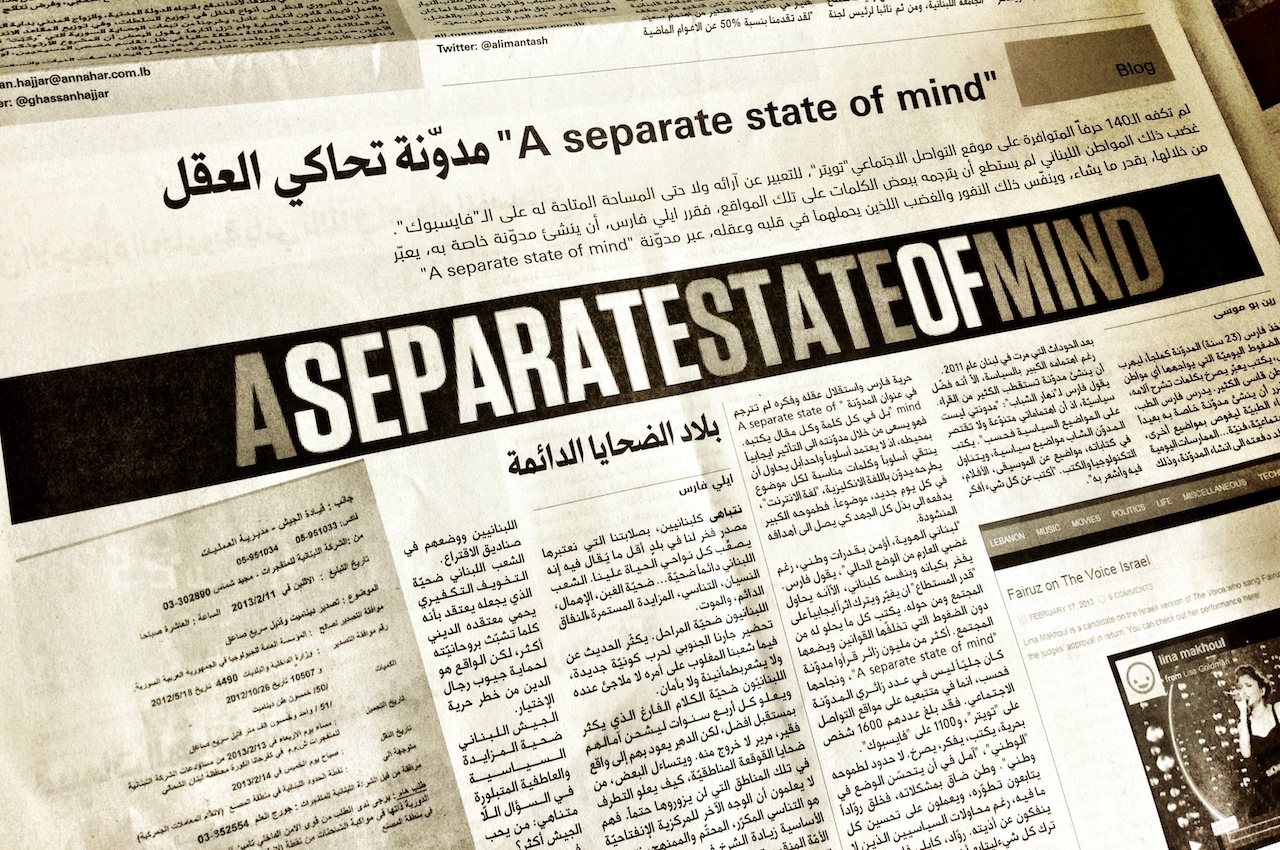
Annahar A Separate State of Mind blog interview article

I was approached recently to be interviewed for renowned Lebanese newspaper Annahar regarding my blog. I obviously agreed and was also asked to write an article – in Arabic. After a brief moment of panic because I hadn’t written in Arabic since 2008, I gathered my thoughts and came up with the following, which I believe is decent:

نتباهى كلبنانيين، بصلابتنا التي نعتبرها مصدر فخر لنا في بلدٍ أقل ما يُقال فيه إنه يصعِّب كل نواحي الحياة علينا. الشعب
اللبناني دائماً ضحيّة… ضحيّة الغبن، الإهمال، النسيان، التناسي، المزايدة المستمرة،النفاق الدائم، والموت.

اللبنانيون ضحيّة المراحل. يكثُر الحديث عن تحضير جارنا الجنوبي لحرب كونيّة جديدة، فيما شعبنا المغلوب على أمره لا ملاجئ عنده ولا يشعربطمأنينة ولا بأمان.

اللبنانيّون ضحيّة الكلام الفارغ الذي يكثر ويعلو كل أربع سنوات ليشحن آمالهم بمستقبل افضل، لكن الدهر يعود بهم إلى واقع فقير، مرير لا خروج منه. ويتساءل البعض، من ضحايا القوقعة المناطقيّة، كيف يعلو التطرف في تلك المناطق التي لن يزوروها حتماً. فهم لا يعلمون أن الوجه الآخر للمركزية الإنفتاحيّة هو التناسي المكرّر، المحتّم والممنهج، نتيجته الأساسية زيادة الشرخ في كل مكوّنات هذه الأمّة المنقسمة على ذاتها، دائماً وأبداً. الشعب اللبناني هو ضحيّة خوف مستمر هدفه الأساسي سياسي، ويصوّرونه له بأنه للحماية. الخوف على الوجود، الخوف على أشباه الحقوق، الخوف على الذات، على الهواجس والخصوصيّات. كل هذه الأمور تؤدي إلى اقتناع راسخ في صلب الكيان الفردي، بصحة هذا الطرح السياسي أو ذاك. والحقيقة الواضحة أن أصحاب تلك الطروحات هدفهم واحد: جمع أكبر عدد من اللبنانيين ووضعهم في صناديق الاقتراع.

الشعب اللبناني ضحيّة التخويف التكفيري الذي يجعله يعتقد بأنه يحمي معتقده الديني كلما تشبّث بروحانيّته أكثر، لكن الواقع هو لحماية جيوب رجال الدين من خطر حرية الإختيار.

الجيش اللبناني ضحية المزايدة السياسية والعاطفية المتبلورة في السؤال اللّا متناهي: من يحب الجيش أكثر؟
فيعدد البعض أسماء شهداء جيشنا، متناسين أسماء أخرى لا تخدمهم، فيما تنقلب معادلة الأسماء عند آخرين ويبقى جيشنا رهن المتغيّرات العائليّة، الطائفيّة والسياسيّة التي تحمي الجميع، إلاّ أفراده. فلتسترح أنفس شهداء الجيش أجمعين، من أبطال نهر البارد مروراً بسامر حنا، فرانسوا الحج، وصولاً إلى بيار بشعلاني وإبرهيم زهرمان برحمة الله والسلام.

يكثر الكلام عن صعوبات اللبننة الحياتيّة ولا يكفّ. في استطاعتي أن أسترسل في الحديث الى أبد الآبدين، ولن يكفيّ!
الحق يقال، إن شعبي يلتقي في كونه ضحية معاناة مشتركة ويتشرذم إلى قطع صغيرة متى ذكرت له تلك المعاناة الّتي لا يراها كفيلة برفعه من حدود الإنتماء المناطقي والطائفي، ليتلاقى باللبناني الآخر المُفترق عنه قسرا
.

You can read the Annahar article about my blog here (click) and find the above article also on Annahar here (click).

The Lebanese Electoral Law No One’s Talking About

Orthodox law here, orthodox law there. It’s all about the Orthodox law and the myth of its improvement of “representation.”
In the very narrow sense of things, the Orthodox Law makes sense given what the country is all about. Those who suddenly woke up and panicked about the law being sectarian: where were you living exactly?
You may not like what that sense is and you may be absolutely in love with it. In broader terms, however, the Orthodox Law is a disaster – not because it “improves” Christian power as some claim it will, but because it doesn’t really tackle the foundation of the issue which necessitated such a law to be present in the first place.

The problem with Christian representation in its current form in parliament is the following: democracy.

Let’s examine 3 different scenarios.

Caza A: has 40,000 Shiite voter and 60,000 Christian voter. Christians usually vote 50-50 between both politics camps. Shiite voters vote with about 90% for one camp. Half of the Christian voters feel their voice has been stripped.

Caza B: has 40,000 Druze voter and 60,000 Christian voter. Christian votes get divided almost equally. Druze votes are beyond one-sided. The Druze voter has now chosen for the Christian voter.

Caza C: 40,000 Sunni voter and 60,000 Christian voter. Repeat same scenario as in A or B.

The above scenarios are in play in Lebanon today in several districts of which I note:
– Aley: has 50,000 Christian voter who, the propaganda, goes cannot choose their own MP because of the Druze majority.
– Jbeil: has 10,000 Shiite voter whose votes make the election result look very lopsided while it isn’t.
– Zahle: A sizable Sunni population was key in the victory of whoever won in that area.

Don’t worry, I am not defending the Orthodox Law’s premise. The above examples are to illustrate the following:
The “problem” in Lebanon today isn’t that Christians are too few demographically or that they are given a greater voice in parliament than they should have or that their only solution is for a separation from everyone else in choosing their representatives. It is that there is a true democratic condition among Christian communities which is beyond nonexistent in all of the other sects in the country – and any electoral law which doesn’t lead to the growth of an opposition to the key leaders of each of the landslide-sects is not a law which can actually be used for a sustainable development of Lebanese society. This is nowhere near guaranteed with a law such as the Orthodox Law or any of the laws currently discussed.

Another major shortcoming that politicians seem to ignore in order to communicate the rhetoric of “defending Christian rights” is the following: how is it logical and acceptable for a Maronite voter in Akkar to vote for a Maronite MP in the deep end of the South? How can they fathom it is a “right” for the Sunni in Saida to vote for the Sunni MP of Tripoli? How is it logical for the Shiite in Tyre to vote for the Shiite MP of Hermel?

But there is a law that takes in consideration both regions and proper representation. It is a law which is not even discussed around the round tables of our MPs as they fight over their prospective seats in parliament: individual districts (El daweyer l fardiye): voters can vote for one MP in a small district of a few thousand voters.

To illustrate this, let’s examine a real life example: my district, Batroun, which has only two MPs – one of the fewest per district in Lebanon.

If my entire district is considered as only one electoral circumscription, the results are pretty well known: the current MPs will be re-elected. The votes coming in from the Mountains overtake whatever votes are coming from the Coast. If any third party candidate wants to run, they have to communicate their message – or try to at least – to over 60,000 voter. And parties rule by having a sizable base spread across the district which can vote for whichever candidate their party endorses.
Now with individual electoral districts, my district is split in half corresponding to each of the MPs it gets. The lesser number of voters per district means higher effect for those whose votes bordered on the irrelevant in a bigger district: the 1000 Sunni vote of Rasenhash and the 500 Shiite vote in Rashkida become something that whoever wants to run needs to win in order to have a chance at winning. By lessening the number of potential voters, any third party candidate will also have a higher chance at communicating their message to the voters. Instead of having an Antoine Zahra-Gebran Bassil face off in the coast and a Boutros Harb-Whatever face off in the mountains, we could have a three-way race with a viable alternative candidate. Said candidate may not win but at least people would have another option to vote for and express their disappointment with the current political establishment.
By decreasing the overall number of voters per circumscription, the bulk-voting effect of political parties is also decreased.

This electoral model, when applied to bigger and more diverse districts, leads to a more substantial weight for minorities, less effect for political parties and a room for centrists to take office.

Individual electoral districts, however, will never see the light of the day for the following reasons:
– It decreases Hezbollah’s influence by cutting his bases into pieces.
– Can you imagine the seizure Jumblat will have if this law is proposed and he won’t be able to get every single Druze seat in the Lebanese Republic? The only law he accepts is the law everyone refuses. They call this in Lebanese slang: “7ajar el dema.”
– The Future Movement will also lose a few MPs because of a decreased effect of the voters which constitute his base and an increased power of those who don’t.

The individual districts electoral law means that the current political establishment receives a drastic makeover. Do any of our politicians want this? Absolutely not. They preach about change, reform, proper representation. But anything that doesn’t bring them back to power with absolute certainty isn’t something they can accept.

True representation isn’t, in my opinion, sects voting for themselves and themselves alone. If Maronites vote for Maronites alone, how can we expect to accept Sunnis and Shiites voting for the president? If Sunnis vote for Sunnis alone, then why should the Christians and Shiites vote for the prime minister? If Shiites vote for Shiites alone, why should Christians and Sunnis vote for the speaker of the house?

A Maronite MP isn’t an MP that represents Maronites only. He is an MP who represents the voters of the district he comes from in order to transcend that and become a representative of the entire country and as such, it is shameful that an MP of a given sect who has to represent everyone has no chance of getting the votes of the other part of the country which he/she should represent.

Our votes as Lebanese of different sects are not and should not be confined to the sects that we are born into. It is saddening that some people want to summarize us with whatever’s written in the sect box of our IDs and are beyond convinced with this.

I refuse to be just another Maronite number.