Mashrou’ Leila Getting Banned In Jordan Is The Ultimate Validation Of Their Art

Mashrou' Leila - Jordan

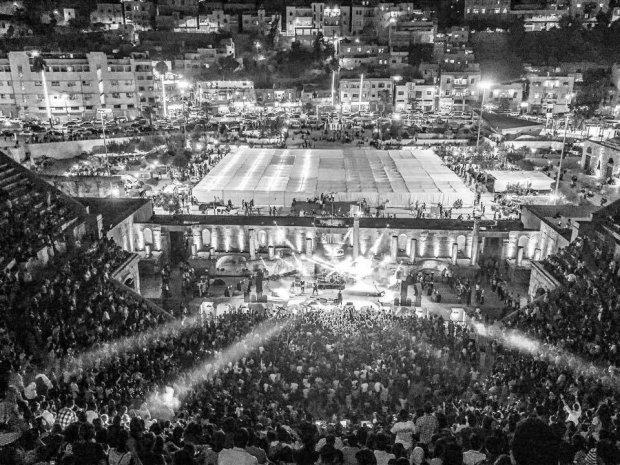
Lebanon’s most prominent indie band Mashrou’ Leila, who were embarking on a tour to promote their most recent and exquisite album Ebn El Leil, had a concert planned for April 29th at Amman, Jordan’s Roman Hippodrome.

Today, only a few days prior to the concert, they were informed that their concert was canceled for, as “official” reasons cite “[their] performance would have been at odds with what the Ministry of Tourism viewed as the “authenticity” of the site.” In other, more hidden words, the Jordanian authorities view Mashrou’ Leila’s progressive message, by Arab standards at least, as an agenda they don’t want to advance on their territories. Obviously, that scary message is one of sexual equality transcending genders and orientations. How frightening.

Mashrou’ Leila issued a lengthy statement on their Facebook page which you can check here (link), of which I quote the following:

We denounce the systemic prosecution of voices of political dissent.
We denounce the systemic prosecution of advocates of sexual and religious freedom.
We denounce the censorship of artists anywhere in the world.
We apologize for having thus far failed at creating a cultural environment that allows our children to speak their minds. We believe whole-heartedly that we have only ever acted with the intention of making our world a more equal, and just place, even if “only through song.” We pledge to our audience that we will continue to place the integrity of our art as our foremost priority, and to never succumb to the pressure to compromise our message, or to waive our freedom to speak. We promise to continue to write out of love, and with the desire to spread love. We will fight, as we have always done, for our right to freely play our music and speak our mind.

The ironic thing is that Mashrou’ Leila had been allowed to perform in Jordan, at that specific site, before. Their Jordanian concerts serve as a vehicle for their fans in that country to watch them perform and, more importantly, for many Palestinians to make their way into Jordan in order to attend those concerts.

Not only have Mashrou’ Leila been stopped from holding this particular concert, but they’ve been banned from performing in all of Jordan at all times.

Of course, for the feisty Lebanese who will proclaim Jordan as a backwards-thinking land because of this, please remember how Zouk Mikhayel had a problem with Mashrou’ Leila performing there only two years ago simply because their lead singer Hamed Sinno was openly gay. Leila getting banned in Jordan is not a reflection of Jordan, but about the collective Arab culture that favors oppression over acceptance.

I have to wonder though, how is this reflective of a country whose king and queen proclaim to be champions of modernity and progression in a regressing region?


It’s a shame that Jordanian and Palestinian concert goers won’t get to watch the awesome Mashrou’ Leila in concert. I’m terribly sorry that Arab governments are so scared of music imbued with messages that challenge what they know, in a way that they can’t really fight because, ultimately, progression is inevitable whether it takes a year, ten or a hundred.

In being banned from ever performing in Jordan, Mashrou’ Leila are not just winners. They are triumphant.

In being banned, they’ve reached the echelons of those entities in the Arab world that challenge the status quo so profoundly with what they do that they’re shaking governments, systems and belief foundations to their core.

In being banned, Mashrou’ Leila have proven that their music is not just an assortment of notes strung together to construct a catchy phrase, but rather a message for Arab youth to rise above what they know, what they’ve been brought up to believe and accept that diversity in the heart of their own culture is to be embraced not feared. Today, Mashrou’ Leila are victorious because their message of no fear is causing governments to be afraid.

Mashrou’ Leila’s music will not be silenced if their concert is stopped. In them being forced to be silent, they’re louder than ever, and their music will gain more audiences than they’ve dreamed possible. Today, they are victorious. Today, they should be proud of the walls they’ve broken and of the boundaries they will break with every note they sing.

Meet The Candidates Of Beirut Madinati

Beirut Madinati Candidates

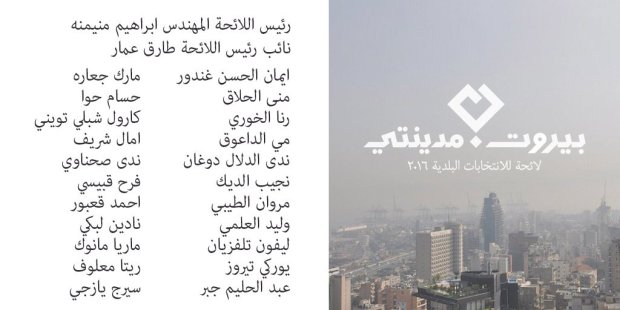
Beirut Madinati, the independent and refreshing campaign overtaking the Beirut political establishment, has just announced its list of candidates for the upcoming Municipal elections of the city, set to be held on May 8th.

As I wrote yesterday, the work to get to this list at hand was not, in typical Lebanese fashion, a who’s who along the echelons of a political party. It was more than 80 active participants in the movement gathering and discussing for months on ends the wide array of possibilities that they could offer the city. The result is as follows: a list that is equally men and women, 12 members each, representative of all the city’s neighborhoods and communities, and consisting of people who have made a name for themselves in their respective domains.

Not only is the list equally balanced between men and women, but 6 out of 24 are considered of the youth group, 16 are middle aged candidates and 2 are seniors. Compare this with an average age of more than 60 in our cabinet, and the contrast is striking.

The candidates are as follows:

Ibrahim Mneimneh: president, architect and urban planner (Mazraa).

Tarek Ammar: vice president; He’s the CEO of a researching company with over 16 years of experience in the field. (Achrafieh).

Iman Ghandour: Private sector worker, former deputy head of the “IC alumni association,” member of the board of many festivals around Beirut and Lebanon (Bashoura).

Mona Hallak: Architect, Executive committee member of the Association for the Protection of Sites and Old Buildings in Lebanon. Was an activist in the protection of Rawcheh movement and the reason behind “Maison Barakat” being saved. (Mazraa).

Rana Khoury: Advertising creative director and a board member of the Samir Kassir Foundation (Bashoura).

Nada Doghan: Historian and member of the Civil Society. CEO of the Arab project “Kitab fi Jarida” in cooperation with UNESCO. (Msaytbeh).

May Daouk: Interior architect, supporter of Skoon and the Samir Kassir foundation, as well as activist for women rights in Lebanon. (Msaytbeh).

Najib el Dik: Head of the Beirut fishers associations in Ain el Mreisseh and former head of Beirut’s fisherman syndicate, (Minet el Hosn).

Marwan Al Taibi: Journalist, head of the “Al Yawm” newspaper and consultant (Bashoura).

Walid El Alami: Cardiologist who graduated from AUB, the University of Oklahoma and Baylor. He returned to Lebanon in 2012 and is part of the “IC alumni association.” (Ras Beirut).

Levon Telvizian: Architect, professor at the Lebanese University, was head of the urban planning program there. He’s currently an advisor for multiple development NGOs and works with UNESCO for housing in Lebanon. (Rmeil).

Yorgui Teyrouz: Phamacist and founder of Donner Sang Compter (Rmeil).

Abdul Halim Jabr: Architect and urban design expert, as well as part time university professor. Activist against the Fouad Boutros highway and in many other conservation fights in Beirut. (Msaytbeh).

Mark Geara: Real estate developer (Achrafieh).

Houssam Hawa: Agriculture engineer, AUB graduate with a Masters degree from Holland. Activist in many environmental causes. (Achrafieh)

Carole Tueini: Media sector, was an anchor on MTV before joining Disney MENA, where she eventually became an executive producer. (Achrafieh).

Amal Cherif: Art director and advocate for people with disability (Zkak al-Blat).

Nada Sehnaoui: an artist and painter, founding member of the Civil Center for National Initiative (Achrafieh).

Farah Kobeissy: Political science expert and human rights activist (Zkak al- Blat).

Ahmad Kaabour: Renowned singer, songwriter and composer (Mazraa).

Nadine Labaki: Leading Lebanese director, behind movies such as “W Halla2 la Wein” and “Caramel” (Achrafieh).

Maria Manok: Lower school head of division at Ahliyyah School (Msaytbeh).

Rita Maalouf: Expert in forensics, returned to Lebanon from the United States in 2008. She’s the first forensics expert in Lebanon’s Ministry of Justice. (Ras Beirut).

Serge Yazegi: Architect, urban planner and lecturer at ALBA (Achrafieh).

Good luck to these people on May 8th. Change is possible. Change needs you – if you can vote in Beirut – to go down to your precint on May 8th and choose those that have fought for you for years, choose those who know how it is to lead the city in the proper direction, choose those who are not the status quo.

Write down their names.

Beirut Madinati: Giving Meaning To The Municipal Elections & Hope For A Better Future

Beirut Madinati

Over the past several weeks, a true grassroots movement has been overtaking the streets of Beirut as a new movement trying to reclaim the city it calls home began its rise; Beirut Madinati was doing something that Beirutis hadn’t seen in a very long time, if ever: they were holding gatherings in different neighborhoods across the city to talk to the city’s own people about their woes, to tell them that we are not a Hariri-appointed list of people who believe they are entitled to your vote, we will work for it and this is us doing so.

Of course, the work of Beirut Madinati did not start when our Municipal Elections became an inevitability. Over the past years, the same supporters and people behind this robust youthful movement were orchestrating many of the protests we’ve all been supporting and advocating for. They called to have Horsh Beirut re-opened and succeeded in it being as such on Saturdays. They fought against the demolition of many of Beirut’s culturally important landmarks. They are fighting against the Fouad Boutros Highway that will destroy any remnant of Achrafieh as we know it.

Today, they are giving their fights a name and it is aptly called: Beirut, my city.

Giving Meaning To The Elections:

Over the past several years, the municipal elections of the city of Beirut were everything but “democratic.” The city’s key parties, mostly the Future Movement, appoints a list of the city’s candidates, without any inkling of equality, and that list ends up winning by near acclamation. No one stands a chance. Correction, no one stood a chance. Until now.

Beirut Madinati is a group of men and women, of all ages and backgrounds, fighting to reclaim the city they call home and let it become the place they know it can be. Their composition is breaking the boundaries of Lebanese politics itself. Instead of having only 3 women on the Municipal board, Beirut Madinati is reportedly submitting the candidature of 12 women – exactly half. One of those women is brilliant Lebanese director Nadine Labaki. One of the men nominated is Yorgui Teyrouz, the founder of Donner Sang Compter, the NGO that has saved thousands of lives since its inception.

The names of Beirut Madinati’s candidates have not been fully announced yet. However, the list was obtained not because someone is something up the echelons of a given party, without any consideration to that person’s qualifications, but through a rigorous process that involved more than 80 members of the movement. All opinions were heard. Even the head of municipality promised by that list will be an engineer because their plan needs someone with that background to implement it.

This is not the politics of Lebanon which has almost always emanated from the dark ages, but rather citizens of this city trying to do things the way they should be done: with a modern inclusive approach, and a futuristic look at how things need to be. Today, Beirut Madinati is giving meaning to Beirut’s municipal elections. They are giving us a choice.

Giving Hope To The City:

Beirut Madinati giving the people of Beirut the possibility of having a voice come May 8th does not come without them being aware of the responsibility that entails. As such, for the first time in years as well, the people of Beirut have a set of candidates who are running to work for a platform that is conceived through careful and scientific assessment of Beirut of 2016, with what they hope for Beirut to become by 2022 when their term ends.

The platform is divided into 10 main entities, which I will summarize below, but you can read the full 30 pages program at this link (click):

  1. Better public transportation to encourage people to rely less on private cars (today’s rates are 70%), and enable more use of bikes and walking, thereby reducing traffic substantially as well as pollution.
  2. Increase Beirut’s green spaces from 1 squared meter from person to at least 5 squared meters by 2022 with at least one public garden per local community.
  3. Work on decreasing the price of apartments in Beirut so they can become more affordable to its people. The average today is $570,000 per apartment.
  4. Start recycling programs in the city where garbage goes at rates of 90% to landfills, to a goal of 40% recycling by 2022.
  5. Protect Beirut’s heritage. No more random demolitions for buildings that hold value to the city’s past and history.
  6. Increasing the number of public libraries and community spaces available. The city currently has only THREE public libraries.
  7. Adjust taxation rates in the city to enable better equality and better job opportunities. 1 in 4 of Beirut’s youth are currently unemployed.
  8. Make governmental buildings in Beirut more eco-friendly.
  9. Improve health in the city by addressing the water pollution, monitoring its quality, and improving air quality by, for instance, removing the open air waste bins (those giant green Sukleen ones).
  10. Better training for municipality staff to better address concerns of citizens.

Not only will this program, if implemented, bring Beirut head on into the 21st century city it should be, but it would also boost the quality of life of millions of Lebanese who call the city their home, whether they actually vote there or not.

By bettering public transportation, access to the city becomes easier. You’d no longer need to spend ninety minutes in your car stuck at Nahr el Kaleb every morning. With less traffic, more people would find it easier to live in the suburbs or areas around Beirut, bringing real estate prices down. With better governance, citizens of the city would have better accountability. They’d know who messed up and how. It would no longer be the time for murky politics. The examples and ramifications are endless.

They are also running without politicians backing them. They rely on regular people like us for support and donations to keep their campaign going. So donate at the link (here) if you can.

Your Choice On May 8th:

I may not be a Beirut voter, but I’ll be damned if I weren’t going to use this platform to advocate for such a group. Winning is, obviously, Beirut Madinati’s goal but the showing they will have on May 8th, regardless of numbers, will be substantial enough to tell the entrenched Beiruti establishment that the city’s people are no longer subdued to the demented politics bringing about the same municipality over and over again, different people perhaps, but same useless agenda every time.

Your vote for Beirut Madinati on May 8th is telling those politicians that have taken you for granted over and over again that you are not just another number they can move and calculate however they please, but a citizen who knows he or she is entitled to a municipality that cares for their future and not to have its members gain a title, a source of income for their bottom line, and have this political party or that say they control the city and consequently you.

On May 8th, your vote as a Beiruti matters. Rise above the meaningless politics. Challenge the establishment. Set your city on the path that befits it. On May 8th, vote against the status quo and for a better future.

How To Handle The Disgusting Smell and Mosquitoes Overtaking Beirut

Pic via Mawtoura.

Pic via Mawtoura.

Here it unfolds, the worst chapter in the non-ending story of the Lebanese garbage crisis. Don’t be fooled, the crisis is far from over. The governmental “solution” is so short-sighted and non-sensical that the crisis is bound to be repeated if not in 60 days, then in a few months or years. This is how we do things in this country: we put band-aids on gaping wounds, without making sure that the wound itself has actually been stabilized enough to be managed with band-aids; we do makeup coverups for problems that need hardcore fixes.

Perhaps nothing exemplifies how short-sighted and lala-landish our government is than the Minister of Environment tweeting (then deleting) a few days ago that the wave of mosquitoes and flies the likes of which this country has not seen in recent memory is due to nothing other than the heat. He then subsequently blocked everyone who told him off or otherwise.

Mohammad Machnouk tweet

Ignore the fact that our Minister of Environment’s credentials don’t come anywhere near the science of the environment, and ignore the fact that we’re not actually experiencing waves of heat that could bring this much mosquitoes to our cities, what remains is a minister in a government that is trying to repeatedly fool you: the mosquitoes are due to the garbage, not just the weather.

As they stacked up the garbage in various locations around Beirut over the past several months, from Karantina to the Beirut River, the organic matter in that garbage underwent fermentation and decomposition leading to a wide array of toxins and bacteria. For months, those toxic materials were just lying there, unperturbed. However, the moment those poor garbage handlers started removing it, the chemicals were “freed” allowing them to move up to the Beiruti atmosphere and give you the absolutely horrible smell that feels inescapable.

The smell will remain there as long as they’re removing the garbage. The more time they take, the more we’ll have to endure, so let’s hope the poor fellows handling it physically can sustain the effort it takes before temperatures become higher and work conditions become too horrifying for the to manage.

Many people have reported unable to prevent vomiting many times a day because of the stench. Some have reported feeling ashamed of not being unable to vomit in public. I tell those people, your vomit is more honorable than the faces of those in governance who have inflicted this upon us. Wear it – not literally – like a badge of honor. If you’re having multiple episodes of vomiting, however, make sure to stay hydrated. Use anti-emetics, like primperan or motilium, to try and prevent such episodes as much as you can.

The disgusting smell has the worst ramifications on those with already present pulmonary disease. If you’re asthmatic or have an underlying lung illness and are feeling more out of breath than usual, consult your pulmonologist on adjusting your inhaler dose.

But what can be done about the smell and the mosquitoes and flies other than essentially sucking it up? We have to make sure our homes are safe for us and our children.

The mosquitoes and flies are a huge problem because 1) they exist in huge amounts, 2) they are caused by the garbage crisis, 3) they carry toxins with them as they travel, 4) they might carry infectious vectors from one person to the next and 5) they will bite.

So here’s a step by step process over how to handle things to the best of your capacity.

  1. Use face masks while going out if the smell is too much for you to handle. They’re present at most pharmacies and will help to a certain point.
  2. Before leaving your house, close the windows and doors to make sure mosquitoes and flies don’t welcome you back home. You can also use low dose insecticide, which will dissipate over the day, to keep the house free of the pests.
  3. Make sure to have cleansing hand gel with you at all times. Use it abundantly.
  4. If you or your children are bitten by a mosquito or flies, many of which are specific to this kind of fermentation process, clean the bite with a little bit of antiseptic, which will help in relief and cleaning.
  5. You can also use antiseptic sprays around the house. Those are a bit expensive, but there’s a cheaper DIY method that Ziad Abi Chaker shared on Facebook yesterday, consisting of mixing mouthwash with equal parts of water (1 cup mouthwash to 1 cup of water), putting the combo in a spray bottle and spraying the house.
  6. Maintain proper hygiene, not only of yourself but also of your house. The cleaner it is, the safer it is for yourself and your family.
  7. Every time a wave of nausea hits you or a mosquito/fly bites you, curse the hell out of this country and its government for making you go through this.

While our politicians live in lala-land and pretend that the only thing happening in Beirut is basically #Live and #Love, we are dealing with things that no civilized country has to ever deal with. Except the only notion of civility we have is what we propagate to those poor tourists to whom we now have to find an explanation as to why it just smells so bad in the city they’ve been duped to visit. If only odors can be carried over to Instagram posts.

I can’t believe it’s the year 2016 and we are discussing the ways to handle a putrid smell taking over our capital. What will be equally horrifying is the fact that the people in Nehme and other areas in the country where landfills reined supreme had to deal with such things for an extended period of time while no one cared. There’s a reason those people protested the landfill in their area, closed roads leading to it and refused to receive garbage in it again, only to be faced with army men and tanks forcing them to open it up.

In a short period, when the Burj Hammoud landfill opens up, this smell and everything that comes with it will become customary for Beirut. Keep that in mind.


How Australia’s 60 Minutes Turned The Lives of Ali Elamine & Sally Faulkner’s Children Into A Circus

Currently playing in a Beiruti jail and between the Lebanese and Australian governments is a story that, to say the least, is probably going to end up as a big Hollywood production soon. We can only hope whichever studio takes it doesn’t give the leading role to Nicholas Cage, or Carlos Azar for that matter.

Almost twelve months ago, Ali Elamine, in pure Lebanese patriarchal macho fashion, tricked his ex-wife Sally Faulkner into allowing him to take their two children, Noah and Lahela, on a supposedly temporary trip to Lebanon. Clearly, the trip turned out to be anything but temporary as Ali refused to return the children to their mother who hasn’t been able to see them since.

Obviously, such a situation is abhorrent. Ali Elamine is, to put it bluntly, horrible. Not only is he the embodiment of the stereotypes that Lebanese Australians have to endure, but is also such a disgusting creature for doing what he has done. He has no excuses. He is revolting. No one with any ounce of humanity and reasoning can be on his side. He is a disgrace and another entity to the growing list of things to make us ashamed of sharing a nationality with them.

To do what he did, Ali Elamine is using demented Lebanese laws that rely on the religious background of the parents, in this case the Shia Muslim court, which gives the father the upper hand in a custody battle. Add to that the fact that he is essentially legally untouchable in Lebanon, and you have a pretty much sealed case.

As a cry for help, Sally Faulkner, the mother, has been trying to rally media behind her cause for the past six months. On the Lebanese side of the world, nobody cared. Such cases are common enough with asshole Lebanese fathers ever present for her case to register on the Lebanese let-me-see-if-I-should-care scale. In Australia, however, the producers of 60 Minutes saw in Sally Faulkner a story. And this is when they started to turn the lives of her children into a circus show.

Up until now, the custody battle between Sally and Ali was only as such, a battle between two parents. It was unfortunate that the laws in Lebanon are retarded and that Ali is a revolting existence, but that’s how things are. Perhaps with enough media pressure in Australia, Lebanese media would have picked up on the issue and sided – as they should – with the mother, leading to enough attention over here for a safe and sane resolution of the issue.

Except that didn’t happen, because what took place was the following:

The crew of 60 Minutes, which airs on Channel 9 in Australia, paid around $120,000 for an international child recovery agency, with a spotty track record and multiple botched attempts reportedly, and flew with them and the children’s mother to Lebanon in order to recover them.

The recovery attempt occurred as follows: while the children were with their grandmother at a bus stop in Beirut, the crew of that agency, masked and all, rushed out of a van, grabbed the children, pushed their paternal grandmother aside, and rode away with them, reuniting them briefly with their mother.

The whole Hollywood-esque sequence was caught on surveillance cameras, prompting Lebanese authorities to stop the van, arresting everyone inside: the crew of 60 Minutes (including Tara Brown), the mother and the crew of the recovery agency, and – obviously – bringing back the children to their father who clearly knew he had the upper hand on home territory.

Ali Elamine’s path now is clear: play up the fact that his children are Lebanese and are governed by Lebanese sectarian law, and portray their mother as unfit, attacking her reputation, which in Lebanon is akin to a death sentence. 

But the equally horrifying part in this whole story isn’t only Ali Elamine’s character, but rather how Australia’s 60 Minutes crew handled the entire affair.

For starters, what kind of reputable TV show pays over $120,000 for a children kidnapping agency, which is basically what that agency does, to kidnap children?

What kind of reputable TV show does what was mentioned previously not only to reunite the kids with their mother, but to get movie-esque kickass shots to boost their show’s ratings?

What kind of reputable TV show does so in the middle of Beirut, out of all places, without being aware of the laws governing the city, the relationship between the country where that city is located and their own home country?

What kind of reputable TV show is apparently seemingly unaware of what could possibly go wrong in basically kidnapping two children who are nationals of the country they’re kidnapping them from, taking them away from their father and trying to take them back to Australia? Do they not know that Lebanese children are NOT allowed to leave the country without the written and documented consent of their father?

What kind of reputable TV show puts the priority of a dramatic story over the well-being of the children involved, whose lives will be affected in more ways than anyone will ever imagine?

By doing what they did in Beirut, the producers of Australia’s 60 Minutes did more damage to Sally Faulkner’s case to have her children, to the lives of those children and to their reliability as a supposedly top notch investigative journalism show. In a perfect world, you can’t go back from such massive unprofessionalism, except they probably will. The only entities who will be permanently damaged are Noah and Lahela, whose chances of being with their mother have become next to zero, and whose lives have been turned into a real life circus, soon to be a Hollywood movie, or maybe even a book. In custody battles, one of the parents wins, but the children always lose. Now make that loss on an international, Hollywood-esque scale.