Hopes For A Better Lebanon: I’m Not A Martyr

“I just heard. I hope you’re okay,”  is the text I sent to the people who mattered to me this past Friday, moments after I had seen a column of smoke erupt in the distance from the hospital floor I had been rounding on.

I stood in patients’ rooms, transfixed as residents inquired on those patients’ state while television screens were lit with the bodies of people who had just perished. I was angry. I’m always angry. I was sorry. I was disgusted. It was an all too familiar sensation.

“Let’s continue the round,” the chief resident told me. “But people just died,” I replied. “It’s okay, life goes on.” It had only been a few minutes.

I don’t have suicidal ideations, but I wondered that day about how it’d be to die like those poor people, a burning corpse on a careless tarmac that has seen more than its share of burning corpses. I wondered how people would react to me dying. Would they care? Would someone other than my mother and cat miss me? Would there be people secretly relieved that I had come to pass?

I saw my mother weeping by my white coffin while clutching the cold wood that hid my corpse from her as she cursed the God she deeply believed in. I saw priests of a religion I didn’t believe in chant and pray and burn incense while people who ran to the front row of my service try not to choke on the smoke. I saw my bed, forever kept as is, and my cat, sleeping next to my pillow unaware that I’d never be there again to pet her. I saw my friends trying to make sense of me not being there anymore.

And because I had died that way, I saw my demise being turned by our local media into a matter of national importance, fake-reporting and all. I saw them calling me a martyr. I saw them covering my funeral. I saw them interviewing people who barely knew me but who went on and on about my death being such a loss as they enjoyed their five minutes in the spotlight. 

Then I saw my memory fade away from the collective consciousness of the people who felt touched by it somehow, remaining but a collection of moments to the people to whom I truly mattered. I saw people partying the night away, a few hundred meters from the place where I had died, unaware that I had spent my last few minutes there. I also saw another chief resident telling another medical student to continue presenting his patient because life goes on.

Life would have went on without me.

And if I could shout from beyond the grave, I’d tell whoever listened that this wasn’t the way that I saw myself dying, even though I’d get no say in that. I’d tell them I was robbed of my chance to live, of my chance to make my own name, build my own family and memories. I’d tell them that the notion of “martyr” I had been branded with due to the sake of political correctness is false. My death wouldn’t change anything. I didn’t want to die that way. I had no cause that I found worth dying for. I’d just be another plus one on a growing list of victims in a country that is getting increasingly forgetful of its people who had actually perished outside of someone’s morbid imagination.

Being a victim means there’s a country that has wronged the person who has passed. It means there’s a country that couldn’t protect them and guarantee them the simplest of rights to die in peace not in pieces. It means there are people who have killed them and who should face justice. It means that their death does not get to become yet another part of a growingly ridiculous political rhetoric that knows no end.

Victims, not martyrs. And how widely different this distinction makes things.

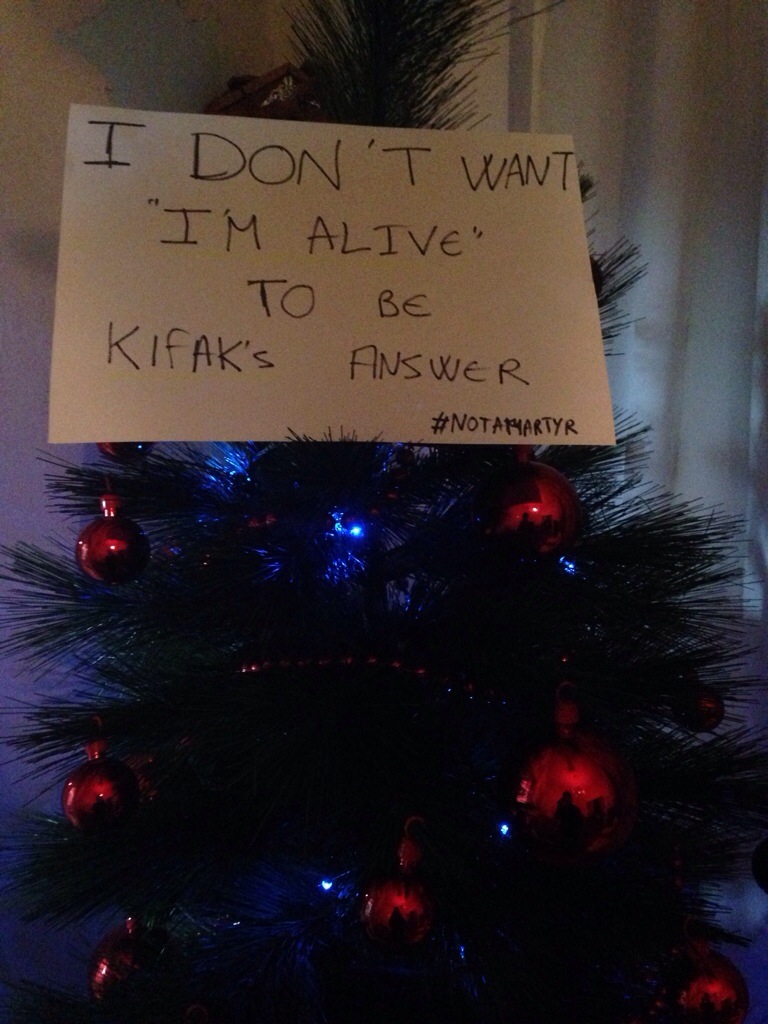
Today, a group of Lebanese enthusiasts have launched a Facebook page for people who are tired of surviving Lebanon of 2013, called I am NOT A Martyr. Like I’ve said before, they’re asking everyone to stop devaluating their life. They’re asking us to think about how we’d want things to change. People are posting selfies of their hopes of this country that is slowly but surely making everyone hopeless:

There are many things I’d want for my country. Some might say it’s silly or too simplistic to wish for such things in Lebanon.

I want accountability. I want rights. I want for my Northern border not to end at the Madfoun checkpoint. I want not to feel like a stranger among familiar faces. I want to say that I have lived as family surround me on my death bed.

And, perhaps more imminently:
20131230-224258.jpg

A Tale of Two Cities: Lebanon Edition

I went to watch a movie in Beirut yesterday. It was done by 1AM so I simply went back home. As I walked up the sidewalk leading to my apartment, I could hear the parties bustling around me. Gemmayzé was gearing up to lose its cars. Cars were still circling the roads fervently in search for their next destination.

Even the movie that I watched was marred by the beats being dropped at a nearby nightclub. It was one of those old cinemas that didn’t bother invest in soundproof systems. Or was the club too loud? I guess nightlife in Beirut is alive and well. All was well.

As I walked back home, there was probably someone my age also making his way back to his place in the Northern city of Tripoli. Unlike me, however, he did not walk carelessly to his apartment, carefully examining his surroundings. That man was probably too wary of the bloodshed taking place in his city as he walked, of all the people that died, of his life that hung with the balance of every footstep he took on that cold bloody and empty Tarmac.

My day prior to the movie had been meaningless. I have a ton of exams to prepare to and anyone who has dabbled with medical school exams knows the material I’m supposed to cover by next week is basically uncoverable. But I persevered anyway. My friends asked me if I wanted to go out to their favorite burger joint. I declined. They went anyway, had ice cream afterwards. Nothing like some calories to burn off the stress.

And as I worried over my exams, there was a 16 year old boy not far from where I was trying to escape the school he attended, whose area had been overtaken by bullets and missiles. As he ran for cover, his every instinct pulling him for safety, the 16 year old boy existed no more. I don’t even know his name. He is but a number in a growing list. He is but one of many similar schoolchildren who escaped their schools by jumping over the fences, running through sniper-filled streets for their lives. Typical.

I do know, however, the name Paul Walker. As I woke up today to a house that feels cozier by the Christmas Tree I decorated a day prior, my social media timeline was lit with people who were upset that an American actor had died. I didn’t appreciate how they were more upset at a guy’s demise while trying to be fast and furious while the death of one of their own, that 16 year old whose name we don’t know, didn’t even resonate.

A few hundred meters away from me, Gemmayzé’s car free day, part of the Achrafieh2020 plan, was in full swing. The street was packed with people who had taken their children out on a sunny Sunday, benefiting from a neighborhood that had become synonymous with traffic, a day or so before it starts raining, finally.

The street was filled with children who had no other worry on their mind apart from the schoolwork they were returning to in a few hours. Those children were having fun, lots of it. They were safe. They were sheltered. They were protected. They were being brought up exactly as children should be.

And then I started thinking of the children I knew in Tripoli, how they were not being brought up exactly like children ought to be. I thought of two adorable twin girls and it broke my heart that at the tender age of three, they’ve been exposed to more gunfire and missile sounds than almost everyone else that I know. It saddened me that those two little precious girls couldn’t enjoy the same joys in life that the children roaming around Gemmayzé had, only because it was not safe for them to leave their house.

I also thought of all the children in that city who, with each passing day of violence, are forced to take sides, to become radicalized even if only in thought, and to possibly take arms later on.

These are two cities that are about 80 kilometers and a few decades apart. This is to the children of that city no one likes talking about. May they have better days someday. I wish they were sheltered, carefree and unaware sometimes. The sad part is that nobody really cares.

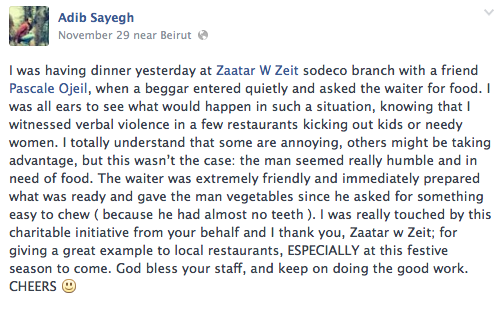
Zaatar W Zeit’s Act of Kindness

I was walking around Beirut the other day, in neighborhoods I hadn’t been to in a long time, only to find streets that have drastically changed. The most poignant moment of my walk was when I saw an old woman, sitting by the corner of the road crying. She had her mattress next to her. She had nowhere to go. The walk up to that woman was full of people like her. Things are getting tougher and there’s nothing to make them easier.

As a rule of thumb, it can be said that Lebanese restaurants are very disassociated with the general security of the country. As things get tougher, their prices get higher. I’ve rarely, if ever, heard of stories like the one below. But it is one of those rare instances that take you a few minutes to believe. 

Screen Shot 2013-12-01 at 1.46.06 PM

Of course, Zaatar w Zeit didn’t advertise this. It was simply an act of kindness on behalf of their branch in question. We all barraged Zaatar w Zeit for not serving alcohol at one of their branches this past year. It only felt fitting to highlight an act of kindness on their behalf towards those who are less fortunate in the midst of this non-festive holiday season.

Great job Zaatar w Zeit. Hopefully other restaurants follow suit in trying to make things easier for those who are overwhelmed by the harsh conditions of life in Lebanon.


The Jamerek That Cried Wolf

The last time Lebanese security personnel openly beat up civilians with absolutely no regards to the potential repercussions to their actions was when the Syrian security apparatus was ruling our country. Back then, I had to cross checkpoints set up by that army in order to go to school. We were not allowed to voice opposition… or else. We were bombarded with images of the young men and women who tried to defy that apparatus: how they were beaten up then taken in those army vehicles to some jail cell in who knows where.

Things have been miserable in Lebanon, yes. But amid all of the tensions and the violence and the country not knowing where it’s heading, I didn’t think I’d see people getting beaten up by armed forces whose job is to supposedly maintain order.

NewTV’s journalistic crew was researching the corruption that infests Lebanese Customs at our one and only airport. We all know such corruption exists. I know of stories about the hints they drop regarding the money you should pay in order to get certain equipments into the country. Of course, no tangible proof exists and even if such proof were to be found, what would change?

NewTV’s crew didn’t think the country that championed freedom of speech and of the press would do such a thing to them. So they took their megaphones and braced those Beiruti roads and called for the head of customs to grant them an interview. They got beaten up and arrested. People were outraged. Customs officials were scrambling to come up with excuses: they were bad-mouthing our chairperson, they said in a statement they hoped would explain where they were coming from, as if that’s an acceptable excuse. Can you imagine, for instance, what would have happened if American military personnel beat up a civilian for bad-mouthing Obama?

NewTV’s crew was released late last night. They had bruises over their face. They looked victorious and proud of what they had accomplished, as they should be. They had – even if only for a minute – gotten the country to look at our customs that have been using laws that, similarly to the entirety of Lebanon’s laws, have not been updated in a long, long time and which enable them to blatantly do whatever they please without any consequences.

I have to wonder though, what would happen to the people like you and I who don’t have the platform of a TV station to support and protect in case of such transgressions to their basic rights? Make no mistake, this isn’t a case of freedom of speech. This is a violation to those journalists’ human rights. And it happened in broad daylight. And there will be no repercussions for it, because that’s how Lebanon rolls.

But the story doesn’t end there because our jamerek figured it would be such a great idea to go on a strike to protest what had befallen them a day earlier. Their rights had been violated, I’m sure they thought, which include the right to guzzle endless amounts of money here and there to build their villas and buy their fancy cars and rise above the system that is geared towards decimating the finances of those like you and I, all while such “rights” are overlooked due to the countless of reasons that make up Lebanon’s political landscape what it is today.

I give it one more day until this becomes old news and we are forced to reckon with other more “important” things. Lebanon is always exciting that way. 

Maskhara At USJ: A Sum-Up of What’s Wrong With Lebanon

They say our country’s future resides on our generation. You know, the generation that supposedly doesn’t have illiterates, that has people going to our country’s universities to get the education that the people before us did not get to have. We were supposed to be brighter, more aware, more critical and less extreme.

We are anything but.

One of Lebanon’s universities, USJ, will close its doors tomorrow because its students decided to express civility today. It was not enough, for instance, for Hezbollah supporters that the entire country has to deal with their party’s reckless practices and their consequences and not get a say in the matter or that their hypocrisy has redefined the definition of terrorism in Lebanon. No, let’s not talk about any of that. Let’s talk about how some of their supporters decided it was a brilliant idea to remove the pictures of an infamous politician in the area where Huvelin exists and to plaster the thug that assassinated him around the place while chanting his name.

Because the country needed such a thing happening in it now. Because there’s absolutely nothing else pertinent taking place currently, the least of which is dealing with the ramification of an explosion that happened in Hezbollah HQ less than a week ago. Because someone figured: Jeez, we lost the elections a few days ago there so wouldn’t it be fun to do such a thing? I’ll get away with it anyway because, you know, I’m a Hezbollah supporter and I never, ever get into trouble. Never. This is my country and all of you just have to deal with it.

The counter reactions were not at a better level.

USJ is a Christian university. Because employing sectarian rhetoric is precisely what is needed in such conflicts, precisely what the country needs right now and precisely what is required to diffuse the tension. Let’s just bring it right into the fold and make it part of the debacle. Let’s not make it a battle of politics anymore. Let’s give our constituents exactly what they crave and what they itch for. Let’s give them what resonates with them at this very moment of a Lebanon that has fundamentalism on the rise. Let’s make this a battle of us versus them, of them trying to control us and to take over our campus.

What campus, you ask? The campus of Bashir, referring to Bashir Gemayel, the former Lebanese president around whom the current debacle took place. The campus of those who believe in his ideology and who follow in his footsteps. So is everyone else not welcome? Perhaps such an argument is tough to swallow but just because someone attended a university, however important that person is, does not turn that university into his property or into something that should always pay homage to him, regardless of who that person is.

Hezbollah’s aggressions are unacceptable and are bordering thug-like behavior. But the replies to those aggressions, even if only verbal, do not a point make. They do not even advance the situation or try to resolve it. Instead, we are left with kids playing, unaware that their actions in the Lebanon of today can have ramifications that none of them, I suppose, would want to see. But let them play. And let the politicians who support them and are defending them in the closed circles meetings taking place as we speak play. Or perhaps I was just being optimistic that my generation would be more mature than this. I guess not.