Lebanese Restaurants: What Will Your Price Limit Be?

I decided to go out with a few friends tonight for dinner. Pretty mundane stuff, right? Well, with med schools and all such dinners have become quite rare so I tend to jump on them whenever I can.

We went to a place we were all familiar with: nothing too fancy, supposedly, and prices that were acceptable, supposedly.
We were given the menus. I looked at my go-to item and it seems since I visited that place last back in September, prices had taken a hike.

That same hike also happened last year across many of the country’s restaurants. And then the year before that. And the year before that. And we can go on for several years more but the sentence would become too wordy and tedious.

As we made our way back home, my friends and I wondered: when will Lebanese restaurants realize that it’s unacceptable to have these yearly price hikes that come in like clockwork when there are very few reasons (read none at all) to warrant them?

Lebanese restaurants don’t exist in vacuum. They exist in a country where salaries have not increased since last year and where the economic situation has become very tough for many people who used to frequent such places.

Have they seen their business take a dip over the past year? I doubt. And I doubt they’ll be affected this year as well. But we’re fast reaching the point where burger joints will stamp the word gourmet next to their names and cater only to select clientele because, you know, Lebanese love their exclusivity.

I’m not saying restaurants shouldn’t open a charity-esque business or not work for profit because that defeats the purpose of their existence.  I’m just saying there comes a time when the price of a French fries platter that doesn’t contain that much fries almost hitting $5 is way too much.

Tripoli And “El Khetta L Amniyé”

I’m not the kind of people to get deterred from going to Tripoli by the sporadic fights that erupt there or the occasional bomb that finds itself to explosion. It’s not that I have a death wish – it’s that 1) the fights are often not close to the places I frequent, 2) the people I visit there are like family and 3) I  love the food.

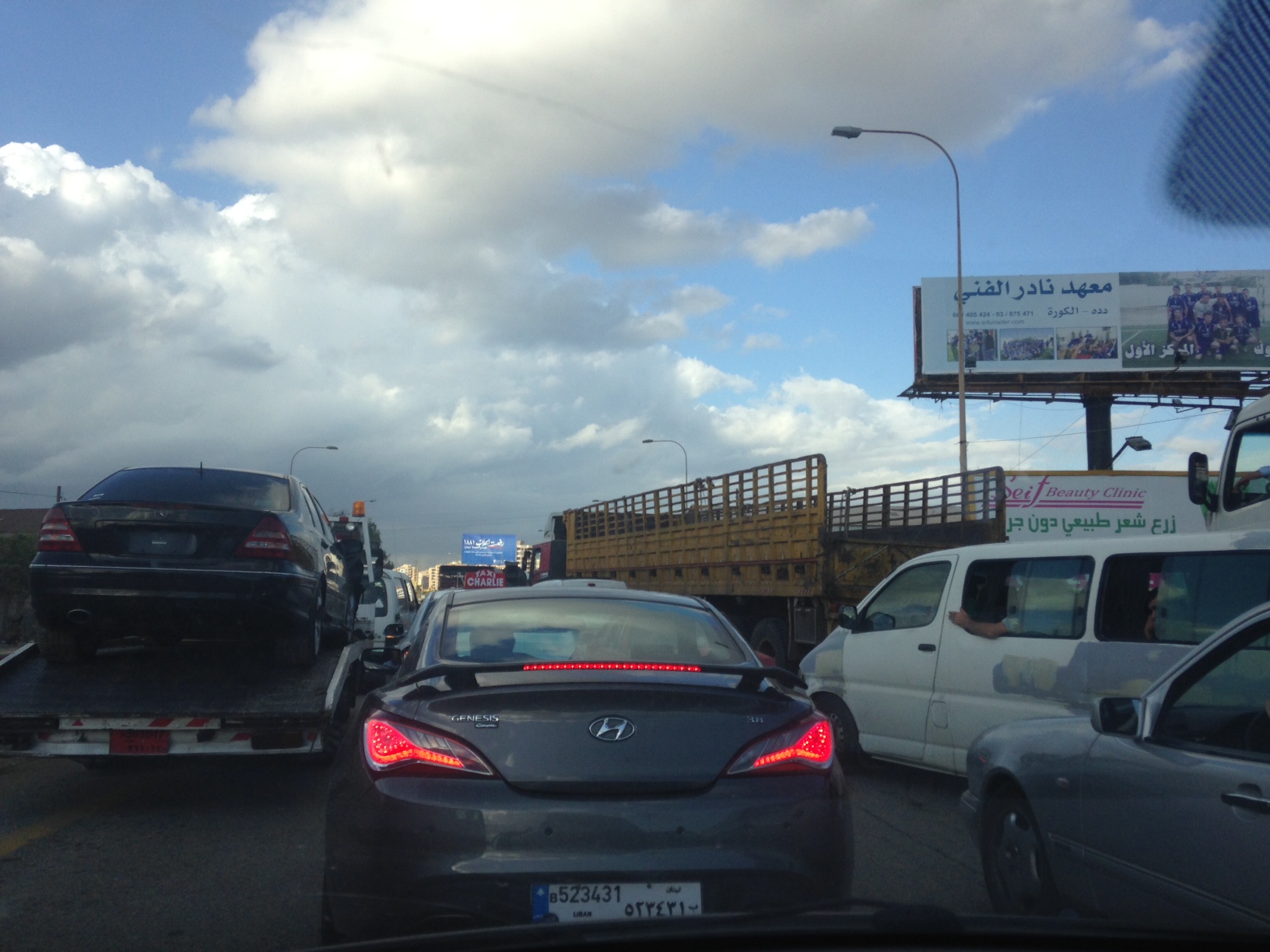
Around late September, I was driving to Tripoli, rolling fast on the highway, when I was shocked to find traffic. Those of you who have been there know it’s near impossible to have a congested highway. But it was. And it took me almost 30 minutes to cross those few kilometers into the city.

Why did that traffic exist? Because a “khetta amniye” (security plan) was put forth. I’m not following the news so I had no idea. I grabbed a picture then of the cars piling up above each other and figured I’d write a blog post about it: security vs efficiency – we just couldn’t have both. Should we accept to compromise over the other?

But I let it pass.

photo-14

Today, all entrances to the city are blocked by checkpoints that screen every car as well as rude officers that don’t even try to make it The army is also present across the city and it’s all part of said “khetta amniye.”

The catch? These past few days have witnessed a resurgence of the fights in Tripoli. And the fights are heavy – heavier than in the last round the city witnessed. Of course, no media will talk about these things because, you know, must keep perfect image about Lebanon (as many of the comments on this suggest we should). But the question is no longer of security vs efficiency in Tripoli. We’re getting neither.

My friends from Tripoli call their city jokingly the Qandahar of the North. We laugh about it because there’s nothing else to do but make fun of  the situation that has befallen their city. But the question to ask: if a security plan as stringent as the one imposed on Tripoli now can’t keep the city safe then what can?

What’s the point of making the lives of its people a military mess if said military can’t keep the city safe when the going gets tough? There’s no point I guess.

My friends in Tripoli, your city is not tragic in itself. It’s a manifestation of the utter failure of the Lebanese state. It’s sad that you have turned out to be the scapegoats of a government and a country that can’t keep its citizens safe even if it tried. The story of Tripoli and said “khetta amniye” is one sitcom waiting to happen. Just make sure to never tell that officer monitoring those many checkpoints “bonsoir” and you’ll be saved.

Disgusting Lebanese People: The “Help” Doesn’t Get a Chair… The Purse Does

Disclaimer: This post was published originally on Sunday October 20th. I then took it down as per Dyala’s request because she got word that the family had actually asked the maid to sit and she refused.

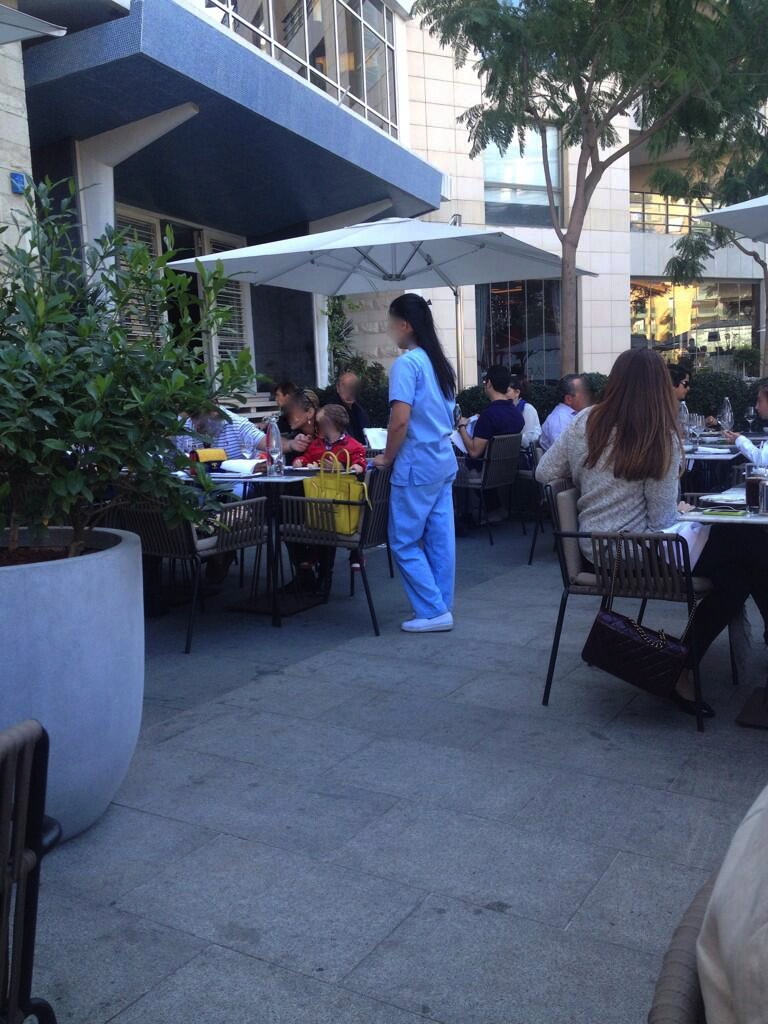
My friend Dyala Badran was having lunch at a Beiruti restaurant today when she spotted something that made her twist in anger.

A Lebanese family was sitting across the place from her having their Sunday lunch. They were all seated happily, enjoying their food. The father was cuddling his newborn who was sitting on his mother’s lap. And there was their maid, standing there, clutching the chair that was empty… save for the bag of the madame.

And Dyala documented that moment in picture.

Let’s talk about two scenarios.

Scenario #1: 

The maid wasn’t actually told to sit as Dyala was told, in which case I wonder what is it about the madame’s brain that got her to think that poor human being, who probably spends more time with that woman’s children, looking on their table had no right for a chair. Oh, nevermind. How could a Lebanese share a table with the Help? It’s so beneath us, duh!

The maid actually sat at one point to nurse the baby. Then she was told to stand up again after finishing.

The madame probably thinks she’s doing her maid a great service by taking her out with them for Sunday lunch. Who’s willing to bet she will brag about her open-mindedness in that regard to her friends in a few days? Who’s willing to bet she may have also forgotten to feed her lunch? Who’s also willing to bet she’s even prouder of that uniform she got her because “their clothes are just too filthy?”

Scenario #2:

The family asked the maid to sit and she refused. People took this as a sign that the family is good, that people treat maids well but they don’t want to benefit from our goodness as Lebanese.

Has anyone wondered though: why did that person refuse to sit? Why does she refuse to take a chair? What has led this person to believe that sitting, as an equal to the family on that table, is an abomination? What has gotten that poor woman to believe that she shouldn’t take the seat that the bag ought to have?

Conclusion:

Regardless of whether scenario #1 or #2 played out in that restaurant yesterday, a pattern emerges of a disgusting Lebanese mentality that manifests in a behavior that believes sharing the table with that person is a disgrace, a lowering standards. That woman didn’t sit because this country is brimming with disgusting individuals who don’t think she deserves an empty chair.

Dyala has written her own blog post on the matter in which she has declared “shame on [her]” for taking down the picture. I regret hiding this blogpost yesterday as well.

We “import” these people in a form of modern day slavery. We work them like there’s no tomorrow on a salary that is not only laughable but a disgrace. They don’t have rights and even if they had, we make sure they don’t have access to any of those rights’ forms. They cannot seek protection. They suffer from our abuse day in day out. Our media ridicules them or goes on manhunts against their existence because the Lebanese is always right.

But that doesn’t matter, I guess, because Beirut is THE place to visit.

Can We Get Over Beirut Being Among The World’s Best Cities?

20131019-190524.jpg

I’ve debated whether to write this or not. Then whether to publish it or not. Then I figured, screw it.

I am a proud Lebanese. And it’s because I like my country that I can’t sit aside and pretend that fake accolades mean more than they are, that void accomplishments are fuller than they actually are.

Beirut isn’t a bad city, sure. It’s perhaps the best city that we have given that our centralization policies have put everything only in and around it. But, forgive the bluntness, there’s no freaking way in hell Beirut can find itself on a world’s best cities list. Unless the person doing that list was high on some Bekaai hashish.

Beirut recently found itself to be on a list of the world’s top 25 cities, courtesy of CN Traveler. Those same people, for those who remember, voted Byblos as the #1 city in the region, with Beirut coming in second. Take that Dubai! We celebrated back then. That little triumph our cities had, although meaningless in itself, meant a lot to us.

Beirut is given the following description as per the CN Traveler website:

The capital of Lebanon has “much to offer the adventurous traveler.” Find “exotic cuisine and cocktails” at the “most exclusive clubs in the world” in what one reader calls “the Paris of the Middle East.” This city offers a “tapestry of sects, religions, and lifestyles that provide a feast for the mind of the intellectual.”

Visiting Lebanon is for the “adventurous,” it seems. I didn’t know my country was such a wild ride. Point me to the next safari why don’t you?

Perhaps Beirut is a great city for a visitor who came here to experience our unparalleled joie de vivre with someone who decided to show them Gemayzeh, Skybar and White, then spend a weekend in Faghaya, pretending that’s still Beirut, before spending the day at some beach that has more plastic than in the bodies of the women strutting their heels in its sands.

Yes, that sounds great indeed.

I don’t know what criteria were employed to rank the cities of that list. But the mark of the greatness of a city isn’t by how well and how great it treats a tourist coming to it for a week. It’s by how great it is for someone who lives there and calls that city home.

When I think of Beirut today, I think of unparalleled urbanization. I think of concrete masses upon concrete masses. I think of cultural demise that manifests in monument demolitions and old houses getting ripped off their foundations. I think of so little monuments that need to be seen in the city. I think of no public transportation. I think of no electricity, no water, of traffic, no public spaces and parks.

When I think of Beirut today, I’m being told I should think of Skybar and Dubai-esque malls because that’s what my city has to offer lately. I’m not sure how that qualifies as greatness honestly. Or I could just be the rare Lebanese who doesn’t like pubs and night clubs and all their derivatives.

Don’t let some silly list fool you into believing the city we call home doesn’t need massive plans, massive reforms, massive work, massive restructuring. Because what Beirut is today, a city living off the ghost of its luxurious past, is only great in the eyes of its beholders. And that’s not really great.

Lebanese Girls Are Not Easy To Get

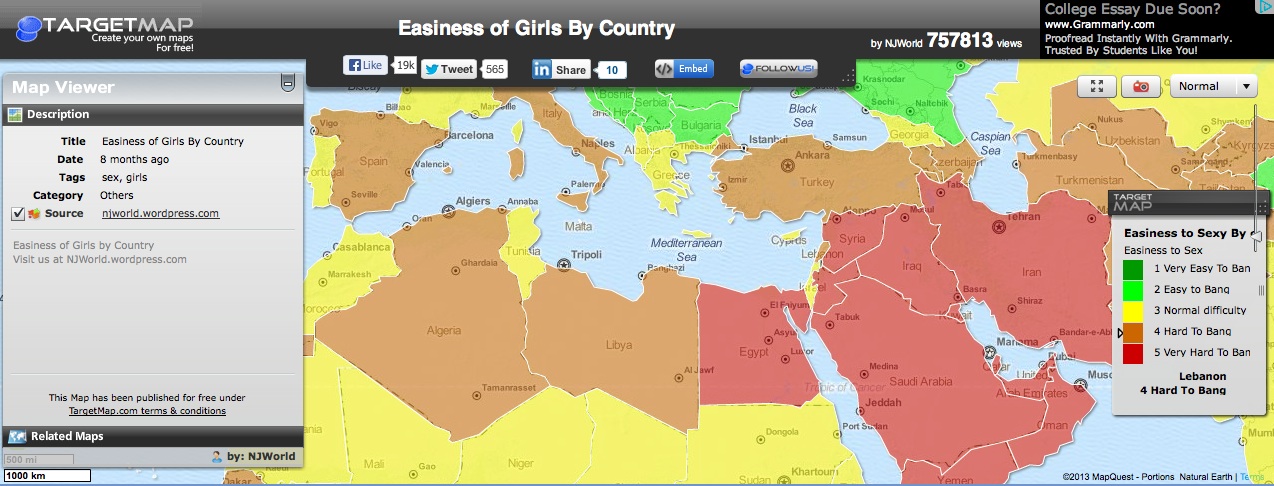
A map has surfaced recently, championed by the work of a sex tourist called Daryush Valizadeh, that grades women across the world by the level of how easy they are to be picked up.

Sounds sexist? You bet. Sounds wrong as well? It does on so many levels.

I’ve checked the map out of curiosity. It has went viral in the past few days. I have no idea on what basis it was constructed but people seem not to care. The map itself might as well serve as a “where you can rape” guide for men who have no inkling on what it means to hold it in.

But I figured I’d check where Lebanon stands. Our women, whose reputation has been tarnished by folks of the region who view anything that doesn’t fit their mold as promiscuity, are anything but the promiscuous kind that many love to portray them to be.

You can check out the map here.

lEBANESE girls


Regardless of what such a map might mean, Lebanon remains a country where sex is a taboo. The joke goes as follows:

Most Lebanese guys I know:
– Are you with premarital sex?
HELL YEAH!
– Would you marry a girl who had premarital sex?
ARE YOU INSANE?

I don’t see that changing anytime soon.