The Lebanese Government Doesn’t Want You To Get iPhones

iPhone 5C and 5S

It wasn’t enough for Lebanon’s iPhone users had to deal with the device not being officially released by Apple in the country yet with exorbitant prices and no customer service for their device. Starting in June, regulations have made getting their device into the country harder than ever.

The iPhone 5S and iPhone 5C were released recently around the world to massive customer reception. Their prices in Lebanon, however, are about $1100 for the 16GB version of the iPhone 5S and $720 for the 16GB version of the 5C. To compare, the 16GB version of the iPhone 5S in the United States is $649 whilst the same version of the 5C retails at $549.

Many Lebanese, like yours truly, refuse to succumb to these black market prices and a government which couldn’t give a rat’s ass as long as it’s making enough money for the people running it to remain afloat but still convince everyone that their beloved regulations are in our best interest. Therefore, we buy our devices from abroad and wait for someone to bring them into the country.

Prior to June 2013, that process was as simple as it gets. The phone would come in, we’d unbox it, put it our simcards and we’d be up in running in no time. Today, getting the phone into a state of functionality means getting it registered by a procedure that is retarded but still somehow makes sense for those in governance. Why so? Because they want to take back the millions lost through phone smugglings. How so? By screwing every Lebanese over in the process both bureaucratically and financially.

According to Twitter user Wissam Chidiak, @Fletchergull, the iPhones 5S and 5C don’t get the same treatment that other phones in the market do. Their price tag wasn’t enough, so our government is making it even harder to get an iPhone in Lebanon.

Say you got an iPhone 5S from the United States and wanted to bring it into Lebanon, your passport must not have any other phone registered to it in the past 6 months in order to get the phone working on Lebanese networks. The iPhone 5S or 5C, in order to be registered, take up all 3 phone spots that you are allowed on your passport for a 6 months duration. You won’t be allowed to bring in any other phone to the country if you’ve traveled within that timezone.

Furthermore, the passport being used to get the phone up and running on Lebanese networks must not have entered the country prior to September 24th. The iPhone 5S and 5C were launched on September 20th. Technically, a Lebanese could have had them in the country by the 21st. He wouldn’t have been able to get them registered, however, because that’s what our telecom ministry wants.

Mr. Chidiac has contacted both alfa and Touch, Lebanon’s only telecom operators, who confirmed on separate occasions that the aforementioned regulations are, indeed, true. They were adamant, however, that those regulations are not operator-based and are entirely enforced by the telecom ministry. Chidiac has also tried to contact minister Sehnaoui on Twitter via direct messages, which the minister couldn’t not have read, public mentions of those direct messages which anyone could read. The minister has failed to reply.

You could say that these regulations are in place given that the devices are new and all. But even that argument runs moot with our government because other newer devices do not suffer from the same treatment. Samsung’s Note 3, which was released on September 25th – 5 days after the new iPhones, can be registered with passports that have entered the country prior to the phone’s release. It also takes up only one phone slot out of the three you are allowed. Perhaps our telecom ministry wants to gradually but surely enforce one brand upon the Lebanese population simply due to availability and ease of access?

Our telecom ministry is proud of the advancements that have taken place recently, as is their right, despite some of those achievements having a big “however” plastered all across them – the 4G network comes to mind. At the rate we’re going however, I’m longing for the day when I was able to simply pop in a sim, get it to work then remove it and have my phone “liberated” as is, when my  freedom as a customer to buy whatever I wanted from wherever I wanted, within Lebanese law, was still cherished and not subject to demented, silly and retarded regulations that only serve to inflate the pockets of those benefiting from them. Those regulations, Mr. Sehnaoui, not the 4G network, will be your legacy when you’re a minister of telecom no more.

Arabs Got (No) Talent: Is It Really About Animal Abuse?

This past Saturday I found myself watching Arabs Got Talent with a friend because we seemingly had nothing else to do. Yes, I’m not the type to go bar-hopping. While going through that Lebanese-Russian bland ballerina, to that pianist who played backwards I daresay I was unimpressed.

A creepy looking Saudi man named Ahmad el Doussary then emerges and starts eating burning charcoal. He then proceeds to eat a scorpion. Then he figures it’s great to bite off the head of a snake and eat it. Everyone and their mother has talked about his act so far and it’s so horrendous that I refuse to link the video. The female judge, Najwa Karam, was appalled. The men, macho as they are, figured he was decent enough to make it to the next round and they buzzed him through.

Perhaps the definition of Arabs in Urban Dictionary should be amended to the following: people who consider eating snakes and scorpions a talent.

Ahmad el Doussary will not be doing an act on animals in whatever next round of Arabs Got Talent is, according to Gino. I have no idea what other “talent” he has up his sleeve but I daresay eating glass is so passé. The discussion about el Doussary has mainly revolved around the fact that what was broadcast on television was animal abuse and how this act will promote such behavior in the general Arab populace later on.

I disagree.

I am an animal abuser in a way or another because I fully do not intend to become a vegetarian or vegan anytime soon, if ever. I come from small town Lebanon. I’ve had distant relatives who operate local butcher shops and I’ve seen how they handle their cattle. They say it’s a painless process but I don’t believe it. I still eat the meat anyway.

I’m also fully aware of what goes on in Lebanese slaughterhouses. We’re not a country where regulations are liked and I don’t expect such places to follow protocol in the least. Yet do we really have a problem in having roast beef or chicken for our Sunday lunches? How many people, for instance, will look upon the upcoming Adha sheep slaughter as animal abuse?

Do you want to know who also skins and eats snakes for show? The Lebanese Army. Many of us have had some army personnel hosted in our hometowns for them to showcase some of their skills. The grand finale usually involves them grabbing a full-grown snake that can stretch for a few meters, have a few men hold it and start chewing on it. The mere memory of it turns my insides out. There are YouTube videos everywhere of that and I refuse to post any of them here.

In my opinion, the basic problem isn’t with Ahmad el Doussary only, it’s with the notion that there are people out there who believe that what Ahmad el Doussary did and what those army personnel do over and over again is entertainment. They decided that this kind of entertainment can be labeled as a talent in Doussary’s case. They decided it was the kind of entertainment they should air or get us all to see.

As people of this region, we are quite used to seeing horrendous stuff on TV. It was only a few weeks ago that our news broadcasts were full of pictures of dead Syrian Children. Our media have no compass to guide their sense of what should be aired or not. But the truth is that our media stems from us and we are a people who don’t mind the shock factor that our media love to use over and over again. Yes, what Ahmad el Doussary did sickens me but it will happen again if we don’t say that all the other disgusting stuff we get exposed to are not acceptable as well. I don’t see that happening anytime soon because, haven’t you heard? Someone ate a snake on Arabs Got (No) Talent and it was disgusting… now go check it.

How Lebanese Women Can Save Their Lives

Almost a year ago, my October turned pink as my mother got news that she had breast cancer. After the initial shock of the matter subsides, you’re left with one of two options: you either think rationally and fight or succumb to your emotions and crumble. It was a tough year, that’s for sure. My mom wasted away because of the chemo. She lost her hair, vomited anything she’d eat. But she’s getting better now.

My mom, however, is not your typical breast cancer patient: she doesn’t have a family history that would cause anyone to be more vigilant. The other risk factors associated with breast cancer do not apply in her case. And yet, there she was getting a needle stuck in her central IV line. My mother fell through the statistical cracks of medicine, like so many other people out there.

October may be breast cancer awareness month but I figured I’d shed some light on other cancers that aren’t discussed often and which might be prevented with some careful attention.

Breast Cancer:

I’m especially happy at the response I got after writing about my mother’s diagnosis, with many readers coming up to me to tell me that they got their mother to go get tested as well and they’re relieved she has nothing or, in the case of some unlucky few, had a very early stage of the disease. A lot of research and money has gone into breast cancer. We’re at a stage, medically, where early detection is almost synonymous with cure.

Early detection happens by personal observation first and foremost. If you feel any difference in the shape of your breast or any odd sensation that wasn’t there before, make sure you consult a gynecologist who will do a breast exam. Don’t worry, though, the exam is not painful. It consists of very careful inspection of the breast for any masses as well as how any potential mass might be affecting shape, texture, etc.

Seeing as October is free mammography month, there’s absolutely no reason for every woman aged 40 and above not to get one. If you have a family history of breast cancer, mammographies should have started by age 30-35. The sad part is that despite mammographies being either free or at a greatly reduced price during October, Lebanon’s medical community has had trouble in getting the message to some sectors of Lebanese women.

Make sure the women you know get tested this month. Make sure you haven’t had any changes. They might sound like small steps but they can go a long way in saving the lives of the women you love.

Cervical cancer:

The thing about cervical cancer is that there’s a quick screening method for it called a pap smear. It’s recommended to do the pap smear annually until you’re 30, with the test starting preferably by the age of 21. It’s a screening exam so it cannot give you a diagnosis.

The other thing about cervical cancer is that there’s a vaccine which could cut your risk of getting it by about 90%. Why so? Because the main causative agent of the cancer is a virus that’s called HPV, which is acquired by sexual intercourse. It’s preferable  to get the vaccine prior to your first sexual relation. However, even if you have had a sexual relation without taking the vaccine, you can still take it and have your risk reduced dramatically.

A lot of Lebanese women don’t take the vaccine or do a pap smear for the following reasons:

  • They believe it’s a taboo to take a vaccine for something that’s related to sex,
  • The vaccine itself is quite expensive, especially since doctors charge quite a hefty sum to administer it,
  • Many women don’t trust vaccines to begin with,
  • Having a gynecologist is, to many, only a matter that should happen after marriage.

The HPV vaccine, however, has proven itself to be very efficient. With its introduction into the medical field, cervical cancer deaths have drastically decreased. So in case you haven’t taken the vaccine or done a pap smear yet, consider this a sign that you should do so.

Ovarian Cancer:

Ovarian cancer is sometimes called the silent killer of women. It’s currently the leading cause of gynecological cancer deaths among women. It’s so inconspicuous that its diagnosis usually happens at a very advanced stage, when the disease has already metastasized. Less than 20% of women survive an advanced stage of some types of ovarian cancer. This cancer metastasizes to the lungs, liver, bowels, among other organs. The operation required to resect and manage the spread is considered a marathon and often only buys a little time for treatment, which is usually very harsh.

Ovarian cancer doesn’t have screening methods or vaccines. It requires you to be vigilant. A yearly visit to your gynecologist who does a pelvic examination should suffice. If there’s any suspicion, your physician will order an ultrasound to guide any possible diagnosis.

Your Life Matters:

My mother, like many other women, took her health way too lightly. She paid the price for it. Don’t let that happen to you or the ones you love because your health and life matter. There are other types of gynecological cancers than the aforementioned that affect women. The common denominator is not to treat any sign that your body might be telling you lightly, not to have a sense of immortality or denial imprinted on you despite all forms of common sense and, most importantly, not to so shy as to no seek out a gynecologist for any possible reason. On the contrary, make sure you find a gynecologist who proves to be the best fit for you, with whom you can be comfortable and with whom you feel free to discuss whatever’s making you worry.

Internet Freedom Keeps Deteriorating; Lebanon is Partially Free

A recent study on worldwide internet freedom has revealed that the trend of the past two years hasn’t reversed in 2013: internet freedom is deteriorating across the world, fueled substantially this year by the NSA revelations coming out of the United States, whose score has toppled substantially compared with 2012.

In order to identify the major trends of this continuing deterioration, the study in question (link) evaluated ten aspects regarding internet freedom in each of the countries studied. These ten aspects were:

  1. Blocking and filtering: governments blocking what they find undesirable,
  2. Cyberattacks against regime critics,
  3. New laws regarding online speech,
  4. Paid governmental interference in online presence,
  5. Physical attacks,
  6. Surveillance,
  7. Takedown requests,
  8. Blocking of social media platforms,
  9. Holding ISPs, hosting servies, webmasters, etc… liable,
  10. Interfering with internet and mobile services.

As such, the following major trends emerged:

  1. Increase in surveillance as countries upgrade their monitoring technology,
  2. Increase in censorship as countries pass new laws to limit the extent of free speech,
  3. Increase in arrests due to social media postings, including bloggers.

These trends aren’t only happening in authoritarian countries. Some countries have further restricted access to content they deemed harmful: porn, piracy, etc.

The study included 60 countries across the world and gave a freedom score for each country. The ratings for each country were obtained through three main categories:

  • Obstacles to access: infrastructure, governmental blocks, economic policies, etc.
  • Limit on content: through filtering, website blocking, service throttling, etc.
  • Violation of user rights: arrests, intimidation, surveillance, etc.

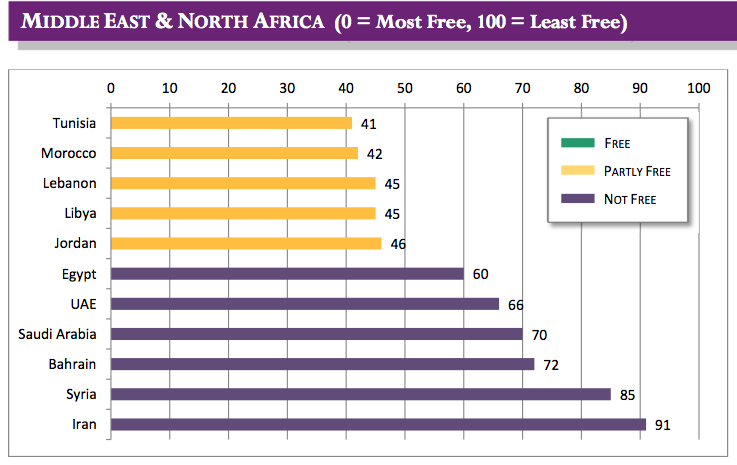
As such, countries can be classes in three different brackets. The countries deemed “free” obtained a score between 0 and 30. Those deemed partially free scored between 31 and 60. The countries categorized as not free had a score between 61 and 100. The world’s freest country is Iceland while Iran is the world’s least free country.

Lebanon’s score is 45, which means we’re only partially free. We don’t even come first regionally. The countries we trail are Morocco and Tunisia. We are also tied with Libya as this graph shows:

Internet Freedom Middle East, North Africa

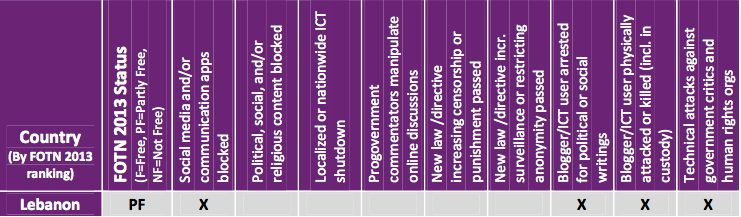
Lebanon’s grade was split in the following manner:

Lebanon Internet Freedom - Merged

The facets in which Lebanon lacked were the following:

Lebanon Internet Freedom - 1

I daresay our ranking is pretty much expected. Some social media users were arrested for badmouthing the president, regardless of whether such an arrest was warranted or not. Some bloggers were called in for questioning over blogposts in which they criticized a shabby award show. Other bloggers were sued by TV hosts for libel while those TV hosts did nothing but commit libel left and right all the time. In fact, if a survey is to be held amongst Lebanese bloggers and social media users, their personal security would rank as their main concern. Such a security is not only physical, but it’s also legal: we simply don’t have the means to defend ourselves against those in power who don’t revert to laws, which aren’t even put to effect. Is it truly freedom when you feel that you have to rephrase what you have to say every time in a way to avoid ruffling the feathers of those who can make your life a living hell through their limited mindedness?

The country is also experiencing a drastically increasing censorship. It was only a couple of days ago that our General Security stopped two movies from airing at Beirut’s Film Festival (link). While such censorship isn’t assessed in this study, as it currently stands the study lists Lebanon’s limit of content as minimal at best. But judging by how things are currently heading, this is definitely heading to increase soon.

Lebanon is currently experiencing an increase in the rate of penetration of internet services among its population, so we have a choice in front of us. We can either become like Saudi Arabia, UAE and Bahrain: technically proficient but extremely restricted. Or we can aim to become like the world’s countries which have advanced technologies and liberties to boot. I really hope we choose the latter but I’m not getting my hopes up.

AUB Professor Discovers New Chemical Reaction

As a rule of thumb, we feel proud when such discoveries happen at local institutions because we can relate to them somehow.

Today, I feel even prouder because the man that discovered this reaction was my professor at AUB.

Makhlouf Haddadin, a Jordanian professor, has discovered a new reaction which he called the Davis-Beirut reaction, after ten years of testing during which he didn’t come out on Lebanese TV shows to discuss his science, to boost himself among the Lebanese populace, to get some free advertising, etc.

This isn’t his first discovery as well. Prior to Lebanon’s civil war, Dr. Haddadin discovered a reaction which he called the Beirut reaction and which has caused AUB’s Chemistry department to get a huge boost ever since.

According to Dr. Haddadin, his new reaction might serve as a breakthrough in the treatment of cystic fibrosis, a life-threatening disorder that mostly manifests in the lungs. You’d probably recognize it as the disease that killed French singer Gregory LeMarchal. It currently has no cure.

My most memorable memory with Dr. Haddadin wasn’t the organic chemistry course I took with him during my Sophomore year. It was when I went to his class on May 7th, 2008 and we were almost 10 people and he gave us a talk about the merits of the country we were in.

He told us that what was happening outside the fences of our campus was reminiscent of things that took place around the civil war in Lebanon. He told us about student uprisings, about how democracy doesn’t work by canceling other opinions, how democracy doesn’t work via violence.

He also told us how lucky we were to be Lebanese, how lucky we were to come from a country where scientific discoveries weren’t stifled by a state that was worried about what such discoveries might entail, how fortunate he was to be working in this country where he felt he could give his all without having a big brother eye overlooking his every experiment, how grateful he was for Beirut to have welcomed him so warmly. He told us that was why he named the reaction he discovered back then after the city that he loved.

He then begged us not to waste our country away because we didn’t know the value of what we had, given the region in which we lived.

Between 2008 and 2013, I daresay we as Lebanese have probably failed Dr. Haddadin. But this man is still grateful to Beirut nonetheless.