Roadster Diner’s Route 66 Burger

20130810-154138.jpg

It can’t all be all seriousness all the time, right?

I haven’t had a full-blown burger meal in a long time. After all, the 30+ kilos I lost since January need to be maintained somehow.

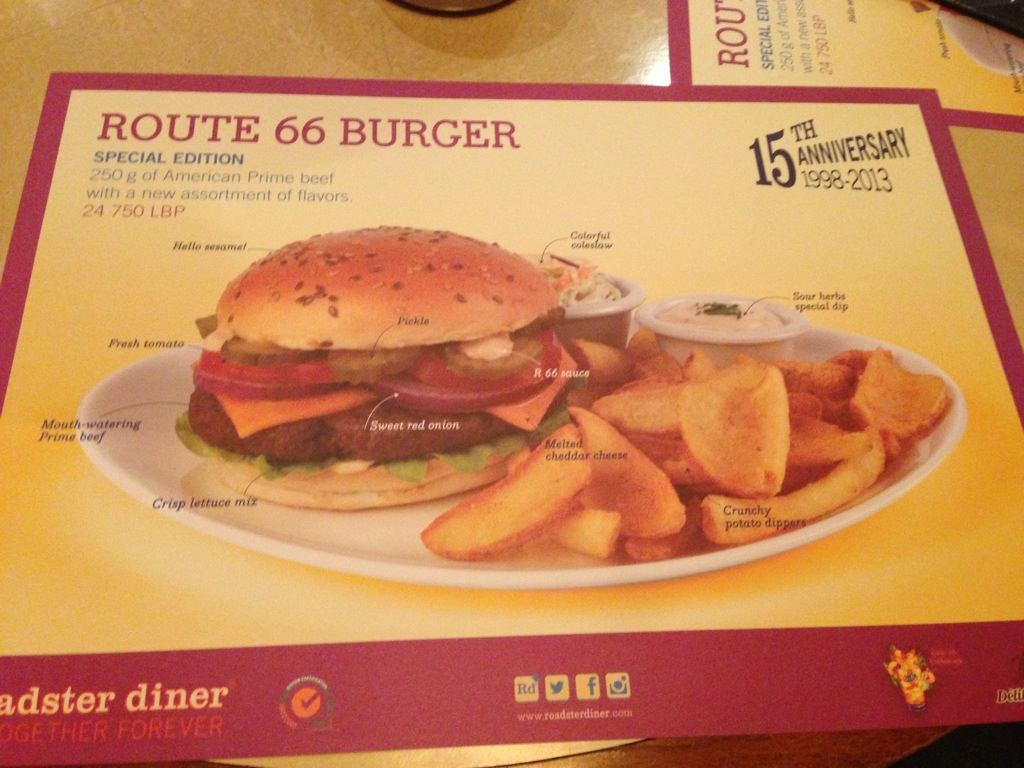
But I figured I’d let myself some leeway for only one day and try out the new burger at Roadster Diner, introduced for their 15th anniversary.
20130810-154856.jpg

Disclaimer: I do not pretend to understand meat textures, composition, cooking levels and other culinary details I won’t bother looking up to sound sophisticated.

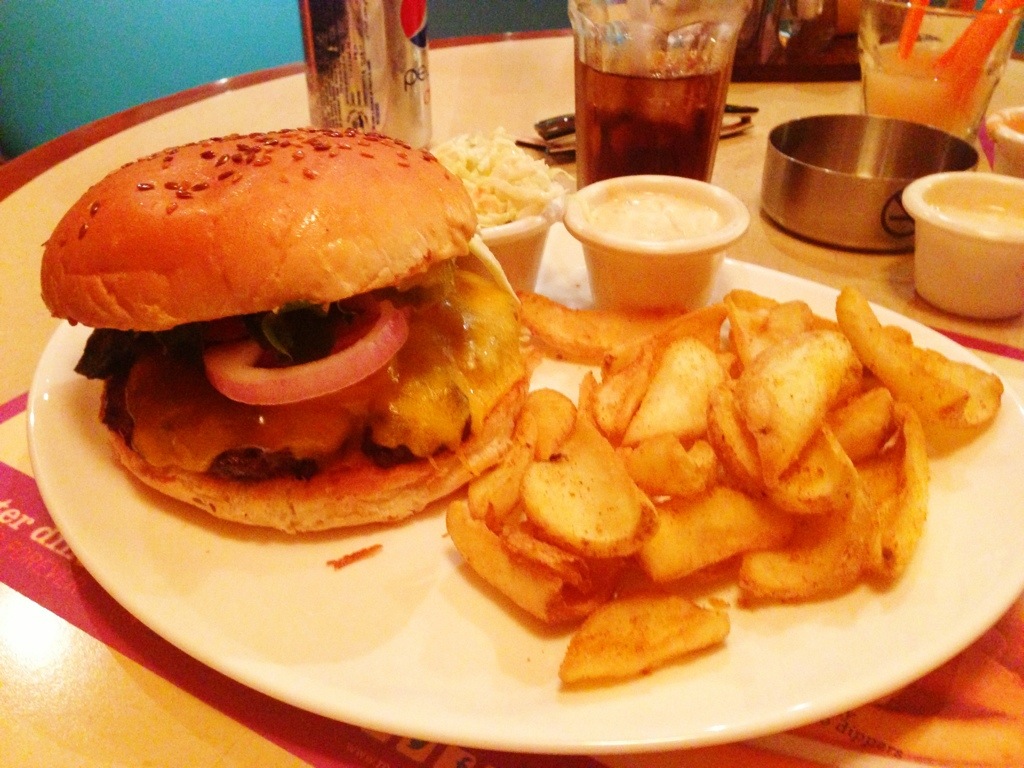
The new Roadster burger comes with their regular coleslaw salad, which I used to normally switch out for Ceasar salad. It also has a side of crunchy fries with a dip that make the meal worth it from the get-go if you feel like splurging on the calories. I really hope they include this upgrade with other burgers later on or introduce it as an addition to the menu.

The burger itself is very different taste-wise from Roadster’s other burgers of which I am a fan. This diner serves my favorite burgers in the country so far. I’m not sure if you hear this often but the Fit ‘N Burger is, in my opinion, one of their best and, at 485 calories, suits those who are on a calories-restricted diet.

With 250g of meat, this is their biggest paddy. It comes with onion, cheddar, the burger sauce and lettuce. The taste is very similar to the burger at Frosty’s palace, if you’ve tried it, except this one is lighter on the pocket. You may find the mixture odd at first but you’ll get used to it from the second bite, be hooked by the third and thoroughly enjoy your meal.

The entire meal is priced at 24,750LL ($16.5). Adding a soft drink to it would bring your bill up to about $20. The meal big enough to satisfy you for a long time (or this could be my diet-used self only).

The waiter and the manager were both very keen to know what I thought of the burger though they had no idea about the dietary composition of it, not that you’d care that much if you’re having it.

If you’re a burger fan, I recommend you give it a try at least once.

P.S.: Prophylactically, you’re welcome.

The New Brand of Lebanese Threats: I Will Shoot You

Things have been calm in Tripoli lately. There have been no mass shootings for Lebanese media not to report. Ramadan had been a more or less safe month on the city and Lebanon as a whole despite some irregularities here and there.

Yet there was something rising to the surface during those days that has apparently become so redundant that the people of that city had become used to: individual shootings.

Two people had a fight or a quarrel in the street? Their natural reaction was to draw weapons at each other. In case weapons were not available on them, their verbal threat to shoot the other person sufficed.

Meanwhile, passerby just passed by.

It’s easy to dismiss Tripoli as something out there in the North which many of you don’t care about.

This “I will shoot you” mentality, however, is not exclusive to there. It’s present in areas and settings where you’d expect such threats never to be issued, let alone possibly carried out.

It is probably my luck for Eid to fall on the day I had chosen to do my hospital duties. As I awaited the X-ray results of a patient with some breathing difficulties, the phone next to me rang. It was almost midnight so I answered out of courtesy as no one was around.

“Are you serving on the obstetrics floor?” The man asked.
“Yes,” I answered.
“Can you tell the man who just showed up on your floor to come move his car? It’s blocking the hospital’s entrance.”
“Yeah, no problem.” I hung up.

How problematic could such a request be, I figured. Guess again.

I knocked on their room door, got in, introduced myself and relayed to the husband what the security personnel asked of me.
“Can you call them back and tell them to fuck off?” He replied.
“Excuse me?” I said, not quite hearing what he was saying.
“Yeah, call them back and tell them this car belongs to the president.”
“What president?” I asked with a tone of obvious sarcasm in my voice.
“Tell them I’m not moving my car and if they ask again, I’m going downstairs to shoot them all.”
He had a gun on his waist and a Kataeb wallpaper on his iPhone. I simply looked at him sideways, rolled my eyes and left.

I will shoot you has apparently become the go-to threat for a Lebanese who doesn’t like what he’s being asked or getting exposed to. Nothing can justify this man’s outburst. I’ve seen countless women in labor pain. I’ve seen countless men who are standing by their wives supportably, obviously worried but holding it together.
This was a man, a sample of many others in this country, who are armed, brainless, moronic and ready to act out on it. And yes, we are all used to it.

Next time a psychologist wants to give you some tutorship on how to deal with shooting threats, tell them as Lebanese, we simply walk away and shrug our shoulders.

Arabic is Dying in Lebanon

We’ve all tossed around the idea of the Arabic language meeting a slow but sure demise in Lebanon. It was only very recently that a friend and I figured we should strive to lessen mixing languages during our day to day discussions. This has proven to be especially difficult seeing as our day to day discussions stem from elements in our lives where Arabic is as dead as dead goes.

As an example at the top of my head, there are next to no Arabic words that I’m aware of with which I can describe what goes on at the hospital. So I simply revert to the language that makes such descriptions easier. It’s a simple matter of convenience.

However, there are now tangible numbers as to the state of the Arabic language today. Out of more than 61,000 brevet students, only 33.7% managed to get the required 30/60 to pass their Arabic exam, one that has been easy by all standards:

I’m guessing such news comes as no surprise to anyone. I also don’t see this pattern reversing anytime soon, no matter how much the Arabic curriculum is changed or the exams made easier as the LBC reporter suggests.

For starters, the bulk of your education, be it at school or at the university level, doesn’t happen through the mother tongue, not that I’m complaining. The last thing I want to do, honestly, is to study Maths and science in Arabic. However, when you are priming a student for years and years not to use his mother tongue in almost all the dealings of his everyday life, isn’t it expected for him to slowly move away from that language?
This lack of Arabic use in education reflects clearly on the extent with which Lebanese use Arabic outside of their education as compared to neighboring countries. For instance, many of my Syrian friends find chatting, texting or doing anything of the sort in Arabic completely normal because of the extent that language is used in their education. Is that the case for us? Obviously not.

Upon leaving high school and going to college, the Arabic you get exposed to is directly correlated it with how much Arabic you are willing to take. For most, that is the one required course in order to graduate – an easy course at best, with many struggling to make it through as I’ve witnessed personally. If you’re not majoring in Arabic literature and have no interest in languages in general, there’s next to no use for you to pursue this language further. Couple this with the fact that your exposure to its components becomes non-existent and the populace suffering a decline in their Arabic proficiency becomes certain.

Back in our days, we were not overwhelmed by a lack of Arabic as the newer generation is today. We didn’t go home to countless Internet pages and smartphones that beeped to no end. How much of our laptops and devices are Arabic-equipped?
How many Internet pages that we actually use are written in Arabic? How many of the Arabic pages that are present do we normally use? Outside of the news ones, I can think of none. Horoscopes, maybe?

Moreover, the entire online presence of the Lebanese population, the youth particularly, is one which doesn’t rely on the Arabic language. We use arabizi out of convenience. We revert to English and French because even arabizi has some aspect on which we fail to agree and its use becomes tedious for those who are not that used to it. Who of us regularly tweets using Arabic? It comes as a surprise for many if some of us actually do that. Who of us has set their Facebook account to Arabic? How many of us even feel it’s easier to blog in Arabic even though it should give us a wider base? My MacBook Pro, for one, doesn’t have an Arabic keyboard.

There are a multitude of jokes about Achrafieh women who are proud of their children not knowing a word of Arabic. The reality though is that in a world as changing as this and with a people as malleable to circumstances as the Lebanese people, the Arabic language simply doesn’t seem to find a place of use except as being the language we were born hearing and speaking. Is that enough? Perhaps not.

The Geitawi Pedophile “Monster”

It is widely believed that incidents of child molestation are not really present in Lebanon. The reality, though, is that most of them go hidden for years. It might be because as a society, we forcefully turn a blind eye to such elements that may be very flagrant in front of us.

The last time child molestation made headlines was with an instructor at renowned private school. The issue has now made headlines again with a 28 year old man who has been doing so for 14 years in Geitawi, a part of Achrafieh.

There is a sense of tragedy in thinking of the lives of all the children this man has maimed and ruined. The innocence he has taken from them will have a lasting, albeit repairable, effect on their lives.
And it’s precisely that: these children can easily be helped.
The man in question has triggered countless red flags along the 14 years he spent doing his deed. And yet, no one ever thought of intervening apparently.

1) The man in question was discharged from the military back in 2007 for violent sexual conduct. That would make him 22 year old at the time. Didn’t it cross anyone’s mind to refer him to some psychological help? Doesn’t our army have anyone to council them for any PTSD, which has probably become recurrent lately?

2) The man in question was also reported to be the victim of sexual abuse himself when he was a child. I highly doubt this is new information. It never crossed anyone’s mind that such a childhood trauma would have an ever lasting impact on a person’s being?

3) The man has also been “active” for 14 years. That would make him 14 at the time things had started. I find it extremely hard to assume that there was absolutely nothing that ticked off anyone to any odd behavior he might have had back then.

There is an equally tragic aspect of this story, however, in the cluelessness and utter unprofessionalism with which Lebanese media is reporting on the issue. Of course, “monster” brings much more attention than trying to actually address the issue. Instead, we are met with attention-grabbing headlines and empty content: from baseless psychoanalytical theories to give some science cred to a journalist’s piece down to publishing pictures of the man, along with his name.

I’m not justifying what the man did as anything remotely acceptable. It’s not. It’s sick and revolting.

But what’s also not acceptable is for such incidences not to serve as a way to educate parents on signs that something wrong might be happening with their children in order to intervene before it’s too late.
Instead, we are met with gossip-like handling of the issues simply because it is believed this is what people want.

Pedophilia falls under a subset of sexual disorders called paraphilia which are related to culturally unacceptable sexual activities which cause the individual severe distress. This may not apply to this Achrafieh “monster” if his actions didn’t cause him distress. But I’m also tempted to believe that the “monster” he is today is the byproduct of his experiences as a child, which nobody even cared about. And I’m also willing to bet that many of us would have felt sorry for that child at some point in his life before the lack of help turned him into the “monster” grabbing headlines he is today.

We’re The Millers (2013) – Movie Review

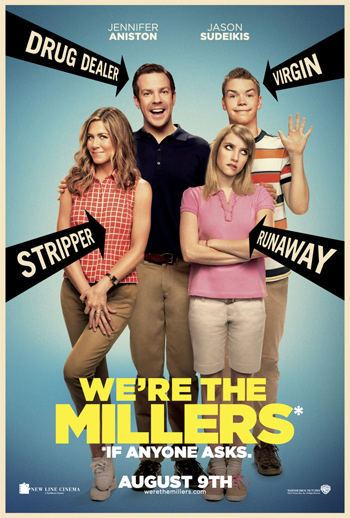
We're-The-Millers-Poster

I’ve finally found a funny movie this year! While this isn’t absolute movie brilliance as I’m sure no one really expects it to be, it has enough hearty laughs and fun scenes to be worth a trip to a theatre near you if you want to watch something along such lines.

David Clark (Jason Sudeikis) is a drug dealer working in Denver who finds himself in trouble as his stash and money are stolen by a local gang. He is then coerced by his local drug lord Brad Gurdlinger (Ed Helms) to pick up a “little” marijuana from Mexico under the name of a Mexican drug lord for which he’ll get paid $100,000. In order to get past border control easily, David devises a plan that involves hiring a stripper named Sarah (Jennifer Aniston) and two local kids, a runaway teenage girl (Emma Roberts) and a virgin teenage boy (Will Poulter) to play a fake family called the “Millers.”

The movie’s greatest asset is the ease with which its cast work together. All four main actors play off each other with ease and charm. The movie may be a tinge too long but it’s carried by the cast and there are enough funny moments and memorable scenes here to keep you going. Make sure you stick through the credits for one of the movie’s best scenes though, especially for fans of the TV show Friends.

Of course, the way the plot unravels is predictable. Don’t get your hopes up for an out-of-the-box resolution. We’re The Millers may not be the risky comedy type that is expected out of comedies these days, but at least it’s funny – it is a typical Hollywood comedy but in a year that has not seen any decent comedies, it’s somewhat refreshing for the Millers to finally show up.

3.5/5