Harry Potter and the Deathly Hallows – Part 2 Golden Globes For Your Consideration Poster & Video

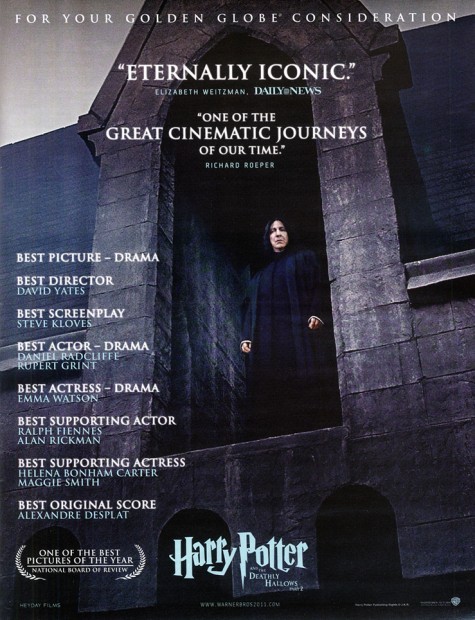
Warner Bros just shared this poster with me, which they’ve been circulating as part of the award season campaign for Harry Potter and the Deathly Hallows, Part 2.

After being slightly bummed out by Deathly Hallows not receiving almost any award love from Critics so far, this makes me feel slightly better that Warner Bros are not simply letting it slide. Perhaps they’re keeping the big guns for the award shows that matter.

Without further ado, here’s the poster:

There’s also this short but very well-done and emotional video. Ask me, I got goosebumps watching it.


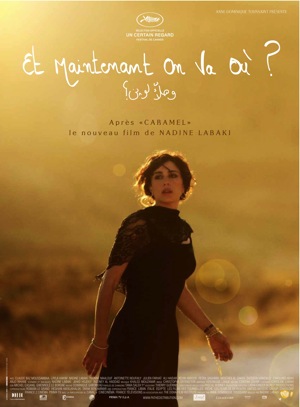
Nadine Labaki’s Where Do We Go Now, W Halla2 La Wein, Nominated For Critics Choice Award

The nominations for the Critics Choice Awards, seen by many as one of the Oscar indicators, were revealed today and our little movie that could, also known as Where Do We Go Now (read my review), has been nominated in the Foreign Movie category.

The Critics Choice Awards pride themselves on having a greater predictability of the Oscars turn out than most other Award shows, including the Golden Globes. So this is a great sign for Nadine Labaki’s movie that it might get an Oscar nomination. Getting a win, though, is a far different story.

However, the people who vote for the Foreign Movie category at the Oscars are the same type of people who attend the Toronto Film Festival where Where Do We Go Now was voted as best film. I wouldn’t get my hopes way up just yet but I would start getting slightly optimistic that Lebanese cinema, thanks to Nadine Labaki, is slowly but surely getting there.

Back to the Critics Choice Awards, the competitors of Where Do We Go Now are:

In Darkness (Poland)
Le Havre (Finland)
A Separation (Iran)
The Skin I Live In (Spain)

I’d say out of all of these movies, A Separation is Where Do We Go Now‘s main competitor.

I am saddened by the no Deathly Hallows love though. Hopefully that will turn around when the Golden Globes nominations are announced on Thursday.

One thing is clear though, things are looking very good for Nadine Labaki.

50/50 – Movie Review

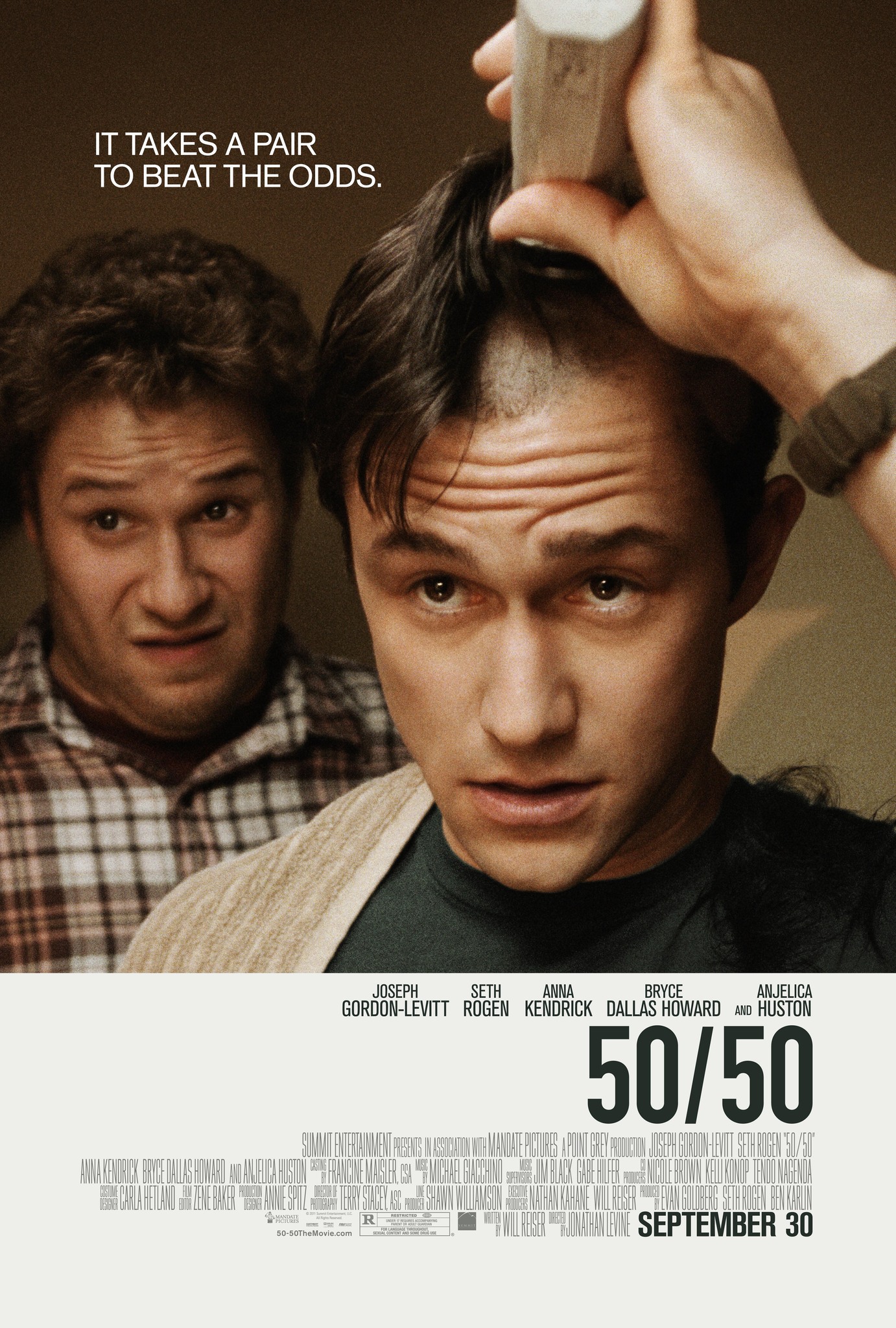
In Jonathan Levine’s 50/50, Adam (Joseph Gordon-Levitt) is a 27 year old writer of radio programs. He leads his life normally, has a girlfriend named Rachael (Bryce Dallas Howard) who rarely sleeps with him and a best friend called Kyle (Seth Rogen) who’s as goofy as they come, always horny and always on the prowl. So for all matters and purposes, Adam is a regular young man with his life wide ahead of him. That is until a backache is diagnosed as a rare form of spinal cancer with a 50/50 chance of survival.

Confronted with his life continuing being as equal to the odds of getting head or tail in a coin flip, Adam begins to cope with his new reality. A therapist, Katherine (Anna Kendrick), whose a newbie at her job, begins to help him, along with the new friends he meets in chemotherapy sessions, to deal with the reality of his illness. Life will prove hard on Adam but cope he will – taking it one smile and one laugh at a time.

50/50 is not a comedy. It is also not a tragedy. It’s a mixture of both. I was surprised when watching this movie how some people were calling it a comedy because it’s really not a comedy in absolute value. There are moments in it that will make you laugh, such as when Kyle begins convincing Adam to try and hook up with girls to which Adam replies that no girl would take him since he looks worse than Voldemort. But Kyle does not relent, obviously, and uses Adam’s story as a chick-magnet.

In a way, this heartfelt approach to cancer in cinema was never done before. But as it is with cancer, the sense of morbidity and drama soon set in especially when Adam starts to realize that there is indeed an expiry date on his body, one that might be way closer than his friends tell him, trying to convince him that cancer is nothing. A scene where Adam, who doesn’t know how to drive, takes Kyle’s car and goes around getting to a point where he just parks in the middle of the road and breaks down on the steering wheel comes to mind. Or Adam sitting next to his mother (Angelica Huston in a short but great performance) and crumbling in her arms.

The performances in 50/50, especially that of Joseph Gordon-Levitt, are enough to carry the movie as it is. Sure, Seth Rogen is mostly there for some very needed comic-relief and he pulls through but the weight of the whole movie is on Gordon-Levitt’s shoulders and he manages to carry it. Obviously fueled by a great screenplay, Gordon-Levitt gets his dialogue flowing smoothly, his performance varies between optimism and pessimism and portrays coping mechanisms of dealing with illness to a very realistic extent. Anna Kendrick, as the quirky and unsure therapist whose sessions with Adam are important for her thesis project, is good as well though she’s not really given enough room to stretch her wings.

Actually, none of the characters are given room to grow in 50/50 outside of the box set to them by the film’s basic plot. Adam not driving, for instance, is never pursued. Rachael’s disconnection from reality is also never examined. She drives Adam to chemo but refuses to go in because of “bad energy”. Adam’s father’s alzheimer is never used in the movie except for a sad comical moment at the beginning of the movie when he introduces himself to his son.

At the end of the day, 50/50 is a decent movie. It’s something that almost everyone would enjoy watching but don’t be set on getting blown away by it. The premise may be different but the overall execution is safe, tidy. 50/50 will entertain you on scene to scene basis. But the movie as a whole lacks in extra punch what its premise presents: a comedy about cancer.

And it’s precisely that. It’s very hard to do a comedy about cancer because sooner or later the reality of that disease sets in. The oncologist who delivers the news to Adam is so disconnected from his patient as if he was simply reciting a paragraph from an anatomy text book. And it’s precisely that which is wrong with 50/50 – it’s simply too disconnected from its main idea and soon drifts into known territory and becomes more of “seen this before” land.

6/10

Beirut Hotel – A New Lebanese Movie Is Banned For Sexual Content

For my review of the movie, click here.

Seems like our story with censorship in Lebanon is far from being over or at least moderated somehow. Beirut Hotel, a new Lebanese feature film by director Danielle Arbid, which was scheduled for release in January 2012, has now been banned from being shown in Lebanon. Why?

Well, according the Censorship Committee in Lebanon’s General Security, the movie would “endanger Lebanon’s security.” And you know why? Because the movie apparently has sexual themes to it.

After all what can you expect from a committee that removed a scene featuring the burning of a Syrian flag from the movie Rue Huvelin or even modified a scene in Nadine Labaki’s Where Do We Go Now, although she wasn’t that displeased by that according to her interview with Kalem El Nes. They also banned the Iranian movie Green Days from being screened mostly because it was also banned in Iran for its anti-Islamic revolution sentiment. And lastly, Steven Spielberg’s name was hidden off TinTin’s movie poster because he’s a known Israel sympathiser.

Moreover, Darine Hamze, the leading actress in the movie, has a role as a devout religious person in a current TV series airing on a Lebanese TV station. Interviewers had asked her how she could possibly play both roles. It looks like the concept of acting has eluded them.

Watch the movie’s trailer here:

And in case our folks at the General Security don’t budge, we’ll have to hunt down the DVD for this.

I don’t know about you but I’m seriously sick of a committee deciding what I’m supposed to watch or in this case not watch. This is the 21st century. Such committees should not exist.

And just as a heads up for this committee, I personally hadn’t heard of this movie before today. So thank you for exposing it. Moreover, we, as Lebanese, didn’t invent sex. And if sex is now a danger to our security, then just ban it for everyone.

The Help – Movie Review

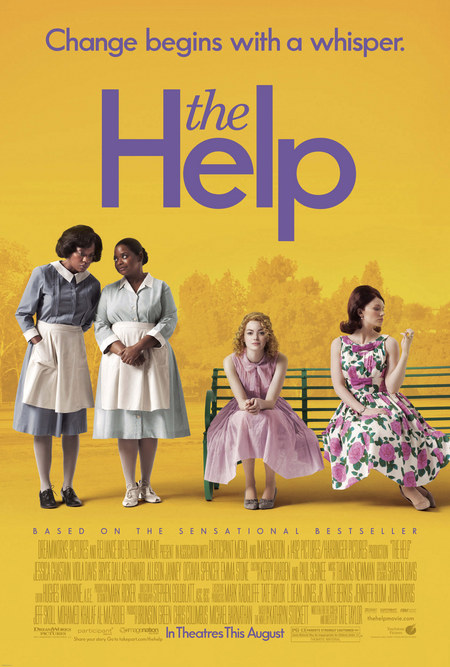
Based on the best selling novel by Kathryn Stockett (find my review of the book here), The Help is a drama about three Southern American women in their struggle for racial equality in Jackson, Mississippi.

Emma Stone stars as Eugena “Skeeter” Phelan, a recent college graduate going back home, who wants to break out of the mold society has limited her in. She’s an aspiring writer who happens to live during the era of Civil Rights Movements. Viola Davis stars as Aibileen, a maid working for a Mrs. Elizabeth, her main job being taking care of Elizabeth’s little girl, Mae Mobley, whose mother doesn’t care about. Octavia Spencer stars as Minnie, a snarky maid who literally can’t keep her mouth shut but whose cooking is so superb that her white employers tend to turn a blind eye to her blabbing.

After a proposal by Skeeter’s friend, Miss Hilly (Bryce Dallas Howard), to have separate bathrooms for the colored help, the idea in Skeeter’s mind of the necessity of change begins to blossom, especially after it gets fueled by an enthusiastic New York publisher who wants her to write. So Skeeter sets to write a story about the help in Jackson. Her first two maids to go on board? Minnie and Aibileen, who will tell Skeeter their deepest and darkest stories – stories they’ve hidden for such a long time they’ve become permanent scars in their souls. Aibileen tells her about all the little kids she raised, about how Elizabeth is an unfit mother, about how she doesn’t treat Mae Mobley like a real mother should. Minnie, who also happens to be Miss Hilly’s former maid, tells Skeeter about the “horrible awful thing” she did, which involves a special ingredient in a pie, to which you will have heartfelt laughs. But it is their struggle as a community that will bring the other maids on board – the chance to tell their side of the story, to be liberated – at least on paper – and to somehow seek salvation.

The performances in the movie are top notch. Starting with Emma Stone, she is one of our generation’s most promising actresses. After a great performance in Easy A and being the best of the actors in Crazy Stupid Love, she is back here not to steal the show but to offer an emotionally subtle performance that is exactly how the character she portrays is: not flamboyant but calm and reserved. Stone’s most emotional scenes come when she remembers her maid Constantine and discovers the story of how Constantine left them and it is in those scenes that she truly shines.

Viola Davis’ performance is being touted by critics everywhere as a tour de force performance. And it truly is. There’s one scene in particular, when she tells the story of how her son dies, where she plays on your emotional strings like a banjo in a country song. But her performance throughout is always nuanced, always great and always emotive. Probably the movie’s highlight scene, its ending, is purely her work. Davis is truly captivating. Whenever she focuses her eyes on another character in The Help, you almost see her gaze into that character’s soul. She is penetrating, invasive… and you welcome it with open arms.

Octavia Spencer is equally great as Minnie. She brings humor to the movie. It may be dark humor sometimes – literally – but it will still get you to feel happy that even amid all the horrible things these people had to go through, there’s still room for happiness in their lives. She gives hope to the other characters in the book and to you, as a viewer, that there could be a better tomorrow for them. She portrays Minnie’s strength subtly. She comes with a bruised eye to work and acts as if this wasn’t caused by her alcoholic husband. But deep down, below the strong outside of Spencer’s character, you can feel the volcano of hurt waiting to erupt.

The movie’s director, Tate Taylor, is Kathryn Stockett’s best friend since childhood. This deep understanding between such two friends has helped him bring her book to screen while entirely preserving the message she was trying to get across on page. While there are many differences between book and movie, some of which I had wished to be included in the movie, the screenplay Taylor wrote still works as a great adaptation, one of the better ones for a book to movie adaptation.

The Help is also a stunning movie visually. And even though there’s obviously no visual effect work here, this means recognition should be given to the cinematography crew that worked on it, most notably Stephen Goldblatt, whose previous works include Julie & Julia, Charlie Wilson’s War. etc…

If there’s anything to take out of The Help it’s that everyone is a victim – even those white socialite women. Yes, they are the victim of their ignorance, of their repressed memories of the black women that brought them up. The black women are victims of being at the wrong time. The little white girls are victims of negligent mothers.

At the end of the day, The Help can be summed up by its most emotional scene, which also happens to be its conclusion. As Aibileen leaves the house of her employer, Elizabeth, she sits by Mae Mobley and asks her to repeat what Aibileen has been teaching her every day. Mae Mobley stares into Aibileen’s deep, dark eyes and repeats: “You is kind. You is smart. You is important.”

9/10