On Fathers’ Day

When my mother suggested I’d get a flower for my father for father’s day, I looked at her like she had gone crazy. “But it’s a nice gesture,” she said.

Flowers is just not something you do on fathers’ day. And you know what, I don’t know why’s that.

Among the days specified by some unknown entity for us to remember our parents, fathers’ day takes a backseat for the more “important” mothers’ day. Even companies don’t bombard you with the same quantity of ads and you don’t even feel as guilty for not worrying about what gift you’d be getting your father.

It could be that fathers are always less emotional than mothers and you’d therefore assume they don’t care as much about their day as mothers care about theirs. But a gift must be bought!

I actually have no idea what gift someone can get their father for their day. What sort of gift would make your father transiently happy?

Then I remembered something. My father is prouder of me than my mother, if that’s even possible. And while I hate it when I find myself in a social setting and he starts bragging about what a son he has, I can see exactly how much that means to him.

With each passing day where my brothers and I make my father proud, we’re turning his day into father’s day.

God Bless my father. God Bless all the fathers whose influence over our lives is very under-appreciated. And may all of the people I know who have lost their father find solace on this day.

On a happier, less depressing note, check out this very poignant comic by Sareen Akharjalian whose blog is full of awesome and funny material (check her blog here):

Sex in Lebanon: How About We Stop Calling Our Women Whores?

The following is a guest post by an anonymous Lebanese woman.

I didn’t like my first time. Not because I was underprepared. Not because of the little pain I felt. Not because I didn’t feel pleasure after it. But because of what I thought people would think of me now that my hymen had been sloughed off.

I was 17 back then. Don’t faint. Yes, I was sexually active as a teenager. I’m 23 now. A lot has happened in 6 years.

I dumped my most recent boyfriend a while back. I had slept with him as well. Little did I know, however, that I’d get word that this so-called boyfriend was busy calling me a “whore” behind my back, letting everyone know about his exploits with me. He thought he had led me on. He thought I was so gullible I’d fall prey to his irresistible charm.

Time for a mini-vomit moment? Yes.

The thing my horrendous ex doesn’t know is that I wanted to sleep with him as much as he wanted to sleep with me. The thing I think most Lebanese guys don’t know is that we, Lebanese women, need sex as much as them. The only thing stopping us from pursuing it like they do is our fear from society turning on us.

“Chefto heide? Bento la flen? Eh heide charmou*a.”

I’m not afraid to walk around Hamra, my neighborhood, today with my head held high. I have nothing to be ashamed of. Who should be ashamed is every single person in Lebanese society who has no problem deflowering a girl or penetrating her, both literally and figuratively, and then pretend it was her fault for being receptive.

I have to ask those men busy calling women whores. Who are you sleeping with exactly? Dolls? Fleshlights? I rest my case.

For the women criticizing other women who sleep around, why don’t you do something useful instead? Like trying to get us into power, like trying to lobby against our current laws which are way more degrading to us than a reputation you think I’m forcing on you. Instead, you’re busy bringing down every other women who doesn’t fit into the conservative mold society has implanted in your head. I’m not judging you because of it. You have the right to be critical. But I’m pretty sure there are lots of things I can criticize about you. You don’t see me doing that, right?

People with glass houses shouldn’t throw stones.

Lebanese society, when it comes to sex, is slowly opening up. No pun intended. But we have a long way to go. No one has a problem admitting sex is a beautiful thing. And it sure is. But many have a problem acknowledging that people are actually having sex.

I spent last summer in Paris and it was one of the most liberating experiences of my life. I wasn’t afraid of what people would think of me if I had a little more than I should to drink at a pub. I didn’t care about what some guys would think if I was obviously hitting on them. I didn’t think what other girls would think about me being happy on a Saturday night.

I do that in Lebanon too.

But the thing is, the girls and guys of Paris didn’t care as well. Their equivalent in Lebanon would be eyeing me either as a potential prey or as a threat. Take your pick.

I recently read an article on NowLebanon by Angie Nassar titled “A Culture of blame” and while I believe her analogy between what happened with Myriam Klink and NewTV’s Ghadi Francis is a little far-fetched for my taste, I have to say that the most poignant point is made early on:

If a woman steps outside the strict boundaries of behavior prescribed to her, she faces communal rejection, stigmatization, violent assault (as in the case of Francis), and even death by way of “honor killing.”

The sad thing is that everyone’s participating in painting the box that women are allowed to be free in: the men, the women and our media.

For example, when it comes to the Myriam Klink incident, no one had a problem rejecting Nemr Abou Nassar for calling her a whore. Her song is sexually suggestive? Of course. But what right does that give anyone for calling her a whore, regardless of how “obvious” you might believe that is?

When it comes to the Ghadi Francis incident, if the SSNP – horrible as that party may be – had beaten up a man, wouldn’t that have caused a bigger stir than the basically irrelevant ripple that the Francis incident caused?

When it comes to everything in our society today, don’t you find that there’s a flagrant double criteria applied to women, the most simple of which is the issue of sex? Men are allowed to have sex. Women are not. If men become promiscuous, then they are deemed as studs. If we fool around, then we are whores.

People tell me that I need to appreciate my body and not let it defiled in the way that I think should be permitted. But I have to ask, what business does my body have to do with you? Isn’t this my skin, my muscles, my face, my breasts and – gasp – my vagina? Don’t I own all these things? Aren’t they the byproduct of my parents having sex to bring me here? Aren’t these my property and no one else’s? Don’t I get to do anything I want with something I own as long as it doesn’t hurt you?

I don’t see how me having sex is hurting you.

I don’t see how me having sex can be hurting anyone.

I don’t see how me having sex should elicit any response apart from the question from my girlfriends “so how was it?”

Sadly enough, getting to that point is still so far that the questions many of my girlfriends as me today is “how could you? After only the first date?”

Perhaps I’m a little hasty and upfront. Perhaps I should be a little slower. But the whole point is the reputation of Lebanon doesn’t rest on my body. Stop making it seem as if me having sex is hurting our country indefinitely. Stop making it seem as if the whole Lebanese situation rests on my hymen. Stop making it seem as if the whole solution of the sectarian system is contingent upon me being forever untouched. Stop making it seem as if being a good person can only happen with me not spreading my legs – ever – except for my future husband. Stop making it seem as if the only interaction men would want with a girl like me is to get into my pants. Not gonna happen.

If me spreading my legs for you will make you go all conservative on my reputation behind my back, then let me tell you something quite honestly. It’s going to be you and your hand every single night.

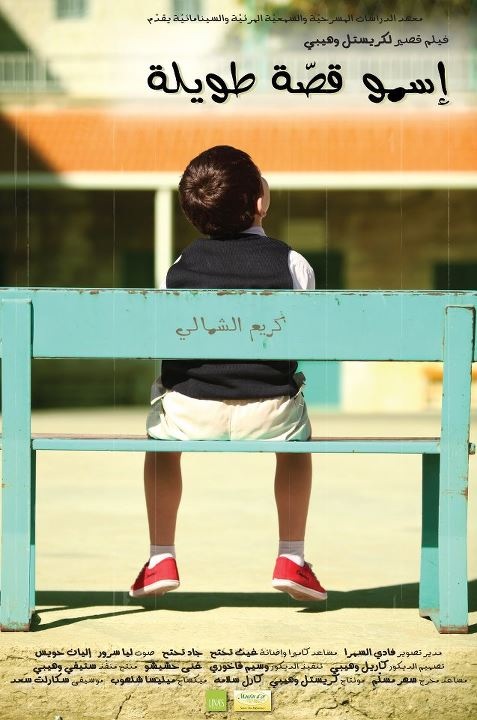
His Name Is A Long Story – A Short Lebanese Movie by Christy Whaibe

I recently went to the Outbox Film Festival which took place in Downtown Beirut at the Roman Baths from June 14th till June 17th. The festival was showing three categories of movies: foreign, animated and Lebanese short films, all participating in a competition where the winners would go on to Los Angeles and be advised by cinephilia productions there on writing scripts and making movies.

Among the Lebanese short movies that were screened there, the most interesting one, in my opinion, was Christy Whaibe’s His Name is a Long Story (Esmo Essa Tawile). The movie tells the story of a little boy whose name is so long that when the other students finish their homework and leave class, he’d still be writing his name. We all know someone like him. My brother was one. Christy tells the story of how his name came to be: how his mother wanted to name him something because of her own reasons, how his father had other intentions and ultimately how all the different options merged to give the boy a name that’s proving trouble in his every day life.

His Name is a Long Story merges comedy with subtle references about Lebanese society, paralleling the style of Nadine Labaki. Be it by taking jabs at nuns, teachers, schools, etc., the movie is about those in our society who hide behind a crust believing others wouldn’t approve of, not knowing that there are some people who are very similar, sharing the woes they believe are unique to them.

The script took Christy over a year and a half to write. The ideas of the movie are inspired from everyday life. When you watch it, you’ll be surprised as to how exactly this movie parallels certain aspects of Lebanese society and does so in only 13 minutes without preaching or coming off as patronizing. The movie took 7 days to be shot and over 2 months in post production. The fact that preparation took such a long time shows in the results delivered.

The main actor, a young boy named Karim el Chemali, was “awesome” according to Christy. And even though it may be difficult to work with little kids, his attitude and acting skills made things much easier and smoother, she said.

His Name is a Long Story won the competition at Outbox by winning the popular vote and deservedly so. With guidance from Hollywood professionals, I’m actually very excited to see what Christy can come up with in the long run. Lebanese cinematic talent is much more promising than we give it credit and His Name is a Long Story is proof for that.

Lebanon at the Heart of a French Political Scandal

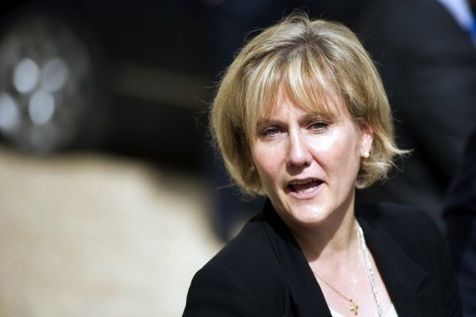
Gérald Dahan, a French imitator and comedian, faked being Louis Alliot, the #2 man of Le Pen’s right-wing Front National, and called UMP candidate to the legislative elections and former minister Nadine Morano, who’s of Italian origins.

Asking Morano about Le Pen, she replies that she thinks Le Pen has lots of talent and that there are many aspects of her policies upon which she agrees.

It’s worth noting that Morano was struggling in the polls of her corresponding district and was obviously in need to schmooze the many voters of the National Front.

Seconds later, a seemingly busy Morano hurries to end the conversation and does so by pitching a final idea which she believes should be enough to bring the fake-Alliot to her side. She declares her support for Marine Le Pen’s proposal not to let foreigners vote in France. Her argument?

J’ai pas envie que ça devienne le Liban chez moi.”

I don’t want it becoming Lebanon here.

Listen to the conversation:

Many French-Lebanese expressed outrage at the analogy she turned our country into. But I have to wonder, doesn’t she have a point?

I’m assuming she means the following: I don’t want France becoming a country where every other nation gets a say.

Isn’t that the case in Lebanon? Don’t we always nag about our decision not being in our hands?

I guess it’s different when some “outsider” tells it to our faces.

On the other hand, it’s not like things are much better in Morano’s native Italy.

The bottom line is: Lebanon is everywhere, in scandals and things that would make you proud to be Lebanese.

Amin Maalouf Honored at the French Academy

The famous Lebanese author of “Le Rocher de Tanios” became a few days ago the first Lebanese ever to be inducted at the elite French Academy (l’Académie française) as one of of 40 living members chosen by the academy to represent the French language.

While being inducted, Maalouf wore the traditional academy clothes and held a sword on which he engraved a verse in Arabic written by his father, as well as the names of his wife and his 3 sons.

The sheath had the Cedar tree engraved on it, as well as the National French symbol. Maalouf had the following to say regarding the occasion.

“I bring with me everything that my two homelands have given me: my background, my languages, my convictions, my doubts and, more than anything perhaps, my dreams of harmony, progress and coexistence.”

Minister of Culture Gaby Layoun was present at the induction and commended Maalouf for the honor that he brought upon Lebanon with his achievment.

Banque de Liban has issued 1000 silver pieces with Maalouf’s face carved on them as a tribute to the honor he bestowed upon himself and his native country.

Kalam el Nas had an interesting interview with Maalouf in which he discussed the “Arab Spring” and his next novel. Make sure you watch it here:

Why didn’t this get the attention it deserves among Lebanese blogs and people? Because we were rolling our heads in the dirt of Myriam Klink and Nemr Abou Nassar while Amin Maalouf lifted his head up high in Paris.

Thank you Mr. Maalouf.