Guns? Who cares!
Missiles? Please!
Violence? Where?
Nicotine? Yes, please!
It’s all about hookah!

The guy looks intimidating enough to steer any bullet away from him. His body has a need for massive amounts of nicotine!

Guns? Who cares!
Missiles? Please!
Violence? Where?
Nicotine? Yes, please!
It’s all about hookah!
The guy looks intimidating enough to steer any bullet away from him. His body has a need for massive amounts of nicotine!


<a
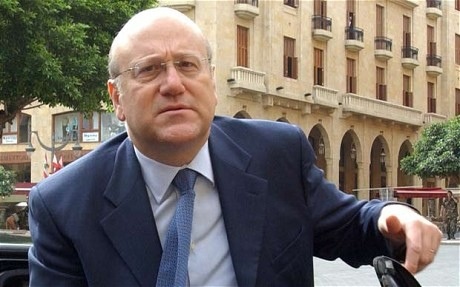
A friend from Tripoli told me yesterday about something – or someone – he saw while watching Cirque du Soleil's Saltimbanco show, currently showing at Forum de Beyrouth.
PM Najib Mikati was apparently so exhausted from what was going on in his hometown that he found it fitting to go and watch a circus show, which he must have figured would be better than the one taking place on the streets of Tripoli.
The prime minister's hometown and one of Lebanon's major cities being in turmoil wasn't enough for him to cancel attending a show. Instead, as people battled on the streets and army men died, the prime minister was busy applauding a bunch of Canadians as they jumped from place to place.
Instead of trying to come up with a plan of action and ordering the army to deploy immediately, Mikati figured it would be better for his city and the country that he takes a break from it all. If Saad Hariri was out of sync with Lebanon due to being away, what excuse can we come up with for the current prime minister for being this untactful?
Instead of blaming militias first and foremost for killing army men and civilians, how about we blame the politicians who let them roam free with their violence for obvious political gains while their eyes satiate with art?

He has a Facebook account!
Observations from his account are as follows:
1 – His username is chadoudeh. No clue what that means but it’s very unsalafist, in my opinion.

2 – He “likes” so many Arabic pages my eyes immediately lost focus. Facebook is not equipped for this. He is a fan of KFC & Masters Chips though – I guess he likes junk food.

3 – He’s “friends” with MP Mohammad Kabbara. I’m not sure if that’s the MP’s official account or someone faking it.

4 – He likes Osama Ben Laden. Duh!
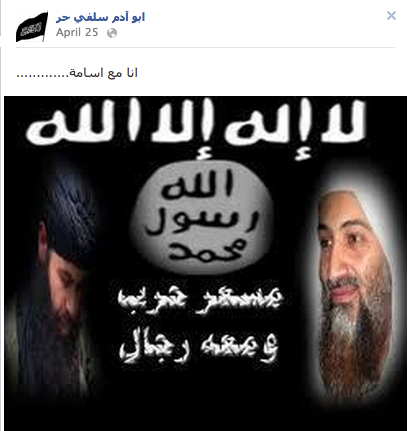
5 – He wants to become a martyr.

6 – He is one of the “moujahidin” who want to free up the Islamic world from blasphemy and tyranny.
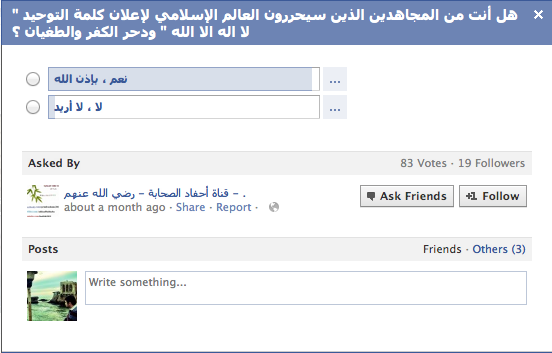
7 – His taste in books and movies is not very eclectic.

8 – He went to a Christian school… but turned out to be a salafist anyway. Let’s come up with new Salafism-preventing theories.

His brother called him a “normal citizen.” With the arrest of this “normal citizen” the whole city of Tripoli was ignited and civil strife became a threat. This “normal citizen” thing is going around a lot lately, don’t you think? I’ve seen it way too many times in different sides of the political spectrum. I shall deem the condition a disease – normal citizenitis is the name. Let’s try to find a cure where no one is above the law, regardless of what they might or might not have done.

This is a cycle that we go through every time something happens in Lebanon that is out of the ordinary. These unLebanese things happen at a rate of once or twice per year and we tend to forget them a week after they’re over.
Without further ado, this is what Lebanese do whenever chaos erupts in our beloved country:
1 – Vow not to vote for either March 8 or March 14 ever again. Both of them are ruining the country.
2 – Start posting Facebook statuses about how horrible Lebanon is.
3 – Depending on political stance, observations about the situation will be made. And everyone is correct. Don’t try to tell them otherwise.
4 – Change Facebook profile pictures to express sympathy and change things because pictures are sure catalysts for change.
5 – Lebanese memes about the situation will surface. The most recent one? “Wa2ta tkoun Trablos wel3ane, enta mamnou3 tentefe” – Buzz ripoff anyone?
6 – Levels of empathy will surge. Chaos struck in region X? We’re all region X. Of course, odds are few knew what region X was a day earlier.
7 – Call up schools and universities with fingers crossed to ask if there are classes the following day, while sounding distressed for credibility’s sake.
8 – Some will panic about anything. Blame their “PTSD” from previous events. Others will pretend to be fierce… because they roll like that.
9 – Start making jokes about the situation because it’s very appropriate.
10 – Between the aforementioned 9 points, proceed with life as if nothing’s happening because odds are you being affected are next to nul – despite your mother telling you to stay home.

When Saad Hariri first went on Twitter, many were hoping he’d use the platform productively to enhance his political career, which has been sitting on the back burner for the past few months as he globe-trotted his away around everywhere except Lebanon.
But a series of mistakes, the last two of which are only a few of days apart, have gotten many – myself included – to wonder whether it was really wise for Mr. Hariri to join the social networking platform.
In January, Hariri said good morning to an Israeli government spokesperson. Either he didn’t know who that person is or he knew and still said good morning, which in both cases is worrying: the former because it shows a certain political ignorance; the latter because it would open a Pandora’s box that Lebanon is obviously not ready for.
On May 10th, Hariri got into a useless Twitter debacle with a brainwashed pro-FPM twitter user who has been constantly barraging him. The aim of the anti-Hariri person was clear: to provoke the former prime minister. Hariri caved in. However, instead of replying in a way that a former prime minster should, Hariri’s reply was straight out of a teenager’s handbook. Of course, Tayyar.org were more than happy to flaunt this around, useless as they may be as a news-website.
On May 13th, soon after the Tripoli events erupted, a Twitter user had the following conversation with Saad Hariri:
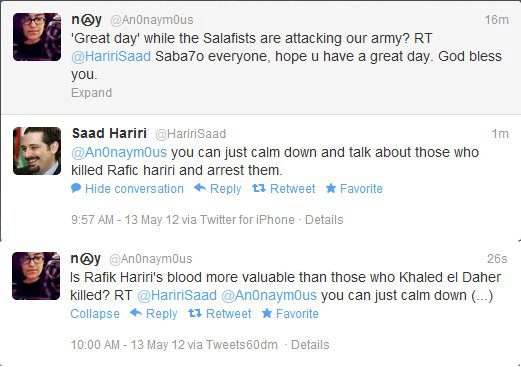
Not only is Mr. Hariri’s argument non-sensical, but it’s also offensive to every single Lebanese who has been killed or assassinated before his father and after him. I wrote on February 14th about how the memory of that day is being milked into nothingness. This only supports my idea.
Does Rafic Hariri’s murder have anything to do with the events taking place in Tripoli? Absolutely not. Is it honorable to bring in Rafic Hariri’s memory – regardless of what you thought of him – into this debate? Of course not. Does it make up a remotely acceptable argument or reply? Definitely not.
I know many people who are disappointed by the way Hariri is handling things on the ground and more tangibly on Twitter. This only serves to reinforce that. Some have even said they’ve lost their respect for the man. While I haven’t reached that extent yet, Saad Hariri is getting dangerously close. Whenever he pretends as if Rafic Hariri is the only person to be assassinated in Lebanon, I boil on the inside. I think about the many people who have died before him, starting with presidents to students, and the many journalists and politicians that died after him, leading up to the many that lost their lives in various Tripoli-related events, culminating in today’s turmoils. Then I ask myself: if a politician thinks the blood of his father is more precious than the collective of lives that have been lost in the same fight his father died for, how can I trust such a politician to run my country? How can I trust him to keep a level-head, even if it’s just a twitter conversation?
I believe Mr. Hariri’s stay outside the country has gotten very out of sync with Lebanon and it shows on Twitter not only through his replies but through his stances. Tripoli is a city where Hariri has many voters, most of whom he will need in a year to win, and he is supporting the people who are wrecking the city just to free up one man. By not condemning the salafists, the head of the moderate Sunni party in Lebanon is supporting them. If that’s not a recipe for disaster, I don’t know what is.
Perhaps Hariri should hire a PR team to run his social media presence. It would save both himself and his supporters some trouble by doing what other Lebanese politicians do. However, if he insits he wants to keep his interaction with the people going he needs to learn to double check any response he sends out on various levels: political correctness, appropriateness and most importantly whether it befits someone of his status.

 A Separate State of Mind | A Blog by Elie Fares