Saad Hariri To Be On Kalam Ennas on January 31st

Saad Hariri

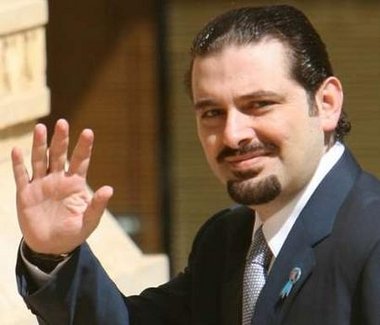
Lebanon’s most famous invisible/disappeared man is preparing a comeback. And it starts in 10 days.

Marcel Ghanem’s TV show on LBC will be the first political talk show in months (maybe even a year) to host the former prime minister of the country and the head of one of its largest parties who left the country soon after the January 2011 coup not to be heard of or seen again.

Don’t worry though – Saad Hariri wasn’t in grave danger in his self-exile in Paris, unless you count that broken leg skiing on the French (or was it Swiss?) Alps. Throughout the past two years, Hariri has gradually but surely decreased his presence all around even on Twitter following not one (click here) but two (click here) gaffs on social media.

Either way, the episode should be quite interesting. I, for one, hope it wasn’t part of an exclusive deal aiming to get viewers without tackling any serious questions. With the tricky situation the country is going through, Marcel Ghanem better be ready to grill Saad Hariri about what he has been up to these past two years and what he intends to do in the coming months.

I’m sure everyone wants to know.

Will you be watching? The whole country will.

Let’s Talk About The Rights of Lebanese Christians

Lebanese Christians are worried nowadays about their constitutional also known as God-given rights of having a firm grasp on political power again. They want to vote for their half of parliament, they want to restore the powers of the president, they want to be the tipping balance between the ongoing Shia-Sunni feud.

They want their right to their “former” glory.

This “need” to feel more relevant politically stems from a conviction that’s rising among Christians lately that their presence in Lebanon is threatened.
I have no idea where they get these ideas from to be quite honest. Even if Islamists end up ruling Syria, even if the devil himself ends up ruling Syria, their presence in the country is not threatened one bit by those bad Muslims, especially not the Muslims of Lebanon who, whether we want to admit it or not, share our same woes.

While admittedly the past 23 years have been quite harsh on this section of the Lebanese population and some things need to be fixed when it comes to their status in Lebanon especially when it comes to political representation, is political isolation really the solution for the Lebanese Christian predicament? Is our politicians counting the number of Christian voters across the country really in our interest?

Are our rights as Christians really only summed up in us wanting to vote for 50% of an arguably stillborn parliament with members who don’t care about said rights to begin with outside of electoral-sectarian-fuel purposes? What is better for us as Christians, to vote for 64 useless parliament members without any qualifications just because of their “services,” their “name,” or their “political affiliation” just because it’s our “right” or to vote for less than 64 but actually qualified parliament members?

I find it ironic that Lebanese Christians want everyone to accept that the country’s president is one of them to rule over everyone else. But they can’t fathom how everyone else (Muslims) can get to choose a few of their MPs.

But I digress.

Is it my “right” as a Maronite from the North to choose the Maronite MP of Jezzine, an area I’ve never ever visited? Is it the right of a Maronite from Jezzine to choose my MP in the North just because he’s Maronite?
What does an MP’s sect have to do with guaranteeing rights? Why does an MP’s sect automatically means that person represents me? Does that restore our rights? Or does it violate them even more? Is an MP’s sect an automatic indication of their will to work, of their qualifications?

Is this how we get proper representation? Is this how we get “our rights?” Are “our rights” only summed up by having an MP from our corresponding religion represent us?

But yes, we, as Christians, do have rights that need to be accepted and acknowledged. We have the right to:

Better roads: this (click here) is the current state of the main road in Batroun. It is my right as a Lebanese citizen first and foremost and as inhabitant of the region to have a decent road for my car. My Christian Maronite representatives are not providing me with this.

Healthcare: how many decent hospitals do we have across the country? I can name three or four. And they are all in Beirut. Fact of the matter is most “Christian” areas have shortages in the healthcare system while it is our “right” to have a decent system to take care of us. I’ll take this even further: how many Christians in Lebanon cannot afford hospitalization due to rising costs? Isn’t it our “right” for a universal healthcare system to take care of us? I don’t see any “Christian” MP advocating this.

Electricity: here comes the broken record again. Isn’t it our right in the 21st century to have more than 12 hours of electricity per day? Isn’t it our right not to have to pay two electricity bills per month just because our “Christian” ministries can’t even do a good job?

Water: Beirut and Lebanon’s roads were flooded last week with water from the biggest storm to hit the country in years. A few days later, we were out of water. Is that acceptable? Isn’t it my “right” not to have water shortages in a country that’s arguably beyond rich in the substance?

Internet: Don’t we, as Christians, have the right for decent Internet access in the 21st century? Shouldn’t we have access to speeds that don’t die whenever it rains, whenever it heats, whenever anything odd happens? Shouldn’t we have the right for a better infrastructure that’s installed and provided to us without corruption, without political propaganda and surely without us having to overpay for it?

Security & Military Wings: Who among our “Christian” MPs is really working to boost security in this country? Who among our already-voted representatives can truly ensure our right for safety, our right not to become collateral damage due to some explosion somewhere? Who among our politicians is ensuring that some families don’t have military wings to threaten other people with?

Wasta: isn’t it also my right to have the same chances for employment, for university admissions, for a proper life as the sons and daughters of our “Christian” MPs and ministers? Isn’t my right not to have to worry about being excluded from something I’m more than qualified to get into just because some other candidate knows someone who pulled some strings for him or her?

Women: shouldn’t our Christian women be given the right to pass on the nationality to their children? Don’t they have the right to a state that protects them from abuse? Don’t they have the right for civil regulations that protect their rights?

State of Law: isn’t it my right as a Christian to expect the non-smoking ban to be applied everywhere, not to have our tourism police in a deal with restaurants to violate the ban? Isn’t it my right as a Christian not to worry about people violating every single form of driving laws, of every single law known to man in this country? Don’t I have the right to live in a lawful state?

You know what’s the interesting thing about our “Christian” rights? They’re also the rights of those “Muslims” that we love to hate. They have the same rights in this country as we do. And they need their rights as much as we need ours.

We blame Lebanon’s Muslims of being blinded and of voting in sectarian ways to the same parties without any convincing reason. But it seems we have forgotten that we aren’t voting for reforms and qualifications as well, but to people who give us the same sense of belonging, the same sense of safety – to the same people who offer us a service a couple of days before elections and then forget about us for four years before they give us the allusion of fighting for “our rights” when the going gets tough.

Is it our Christian “right” to have a bigger say in our representatives? Perhaps so. After all, this is how Lebanon is made up. But it is our duty to have our say in these representatives count – in making sure that these representatives advocate for our rights as much as the rights of others who are not “of us.”

It is our right not to live in fear all the time. It is our duty not to blindly allow our politicians to make us afraid of everything else all the time.

The biggest threat to Lebanese Christians today isn’t the growing extremism around them, it’s the absolute neglect that they get from those representatives that we already voted for which leads us to leave the country and lose hope in it.

The biggest threat to Lebanese Christians are national policies which lead to the impoverishment of most of Lebanon while the focus is on making only select places more cosmopolitan. The latter areas become more liberal. The former areas fall into extremism and poverty and we panic about those “big bad Muslims” of Akkar and Bab el Tebbane being after us.

The biggest threat to Lebanese Christians today isn’t that we don’t vote for a full list of 64 Christian MPs. It is our mentality towards our own country: we have changed from people who founded the Greater State of Lebanon to people who just want their share of this country and the hell with everyone else.
And that, my fellow Christians, isn’t how we get our rights back.

The Most Sectarian Ad On Lebanese Television

OTV is currently running this Election Law promo ad in support of the “Orthodox Gathering Law” championed by the political party running OTV, the Free Patriotic Movement.

Here’s the ad:

I know firsthand that many people think this way – but to turn shameful political gossip that goes on behind closed doors into an ad that’s supposed to convince others of the same rhetoric is taking it way too far. This ad disgusts me.

But let me do what the ad does and say the following:

My name is Elie. I’m a Maronite from Batroun. At least that’s what my ID says *flashes new ID to the camera.* No matter what I do, I’ll be voting for Maronites. I don’t want to vote for Maronites only because I don’t believe they represent me.

You didn’t expect that now, did you?

There’s a fine line between proving a political point which I’m sure Aoun’s many MPs and politicians (à la son-in-law prodigy Gebran Bassil) are more than capable of doing and what the ad is all about. After all, part of the reason why I changed my opinion regarding the Orthodox Law (click here) was seeing an FPM MP named Simon Abi Ramia go on and on for ten minutes about how the Sunni vote is “killing off” Christians by drowning them out and choosing MPs that do not represent them. Such sectarian messages from MPs and TV promos such as the one in this post should not and will not be tolerated on any form of television.

Here’s a word for the politicians who believe that MPs selected by Sunnis do not represent me:

I, a Maronite Christian as we’ve already (and nauseatingly – because that’s a point that resonates apparently) established feel more represented by Nabil De Freige, Atef Majdalani, Samer Saadeh etc.. than by Assad Hardan or Emile Rahmeh.

You know what’s ironic? The FPM is supposed to be a “secular” party. At least that’s what my FPM-supporting friends kept shoving down my throat when I expressed discomfort with their party. “Oh you’re just being a Christian extremist” they said. “We embrace everyone,” they said.

The way I see it, the only thing the FPM is embracing lately with these disturbingly bad ads, with their horribly divisive rhetoric is a rising bout of Christian extremism. And Christian extremists today do not represent me.

Enjoy the ad by the only people in the country who care for your rights as Christians. Because, you know, Lebanon is made for you and no one else.

“Aux-armes, Chrétiens! Formez vos bataillons! Marchons, marchons! Qu’un sang impur (those darned Muslims) n’abreuve pas nos votes!” (this is a play on the French national anthem and translates to: to your arms, Christians. Form your battalions. Walk on, walk on so that impure blood doesn’t water down our votes.”) – this is the new slogan for the 2013 Elections.

Be ready for a lot of “we tried to restore your rights but THEY *points finger* didn’t let us” speeches over the next few months.

Let’s Talk About Lebanon’s 2013 Elections: The Orthodox Gathering Law

One can argue that the French mandate was the root of Lebanon’s sectarian system. Its goal was to make a country that serves as a safe-haven for Maronites, with an edge in parliament seats and in governing powers. The sectarian divide in power reflected upon the people over the years. Blame the French? Blame everyone I guess.

Growing sectarianism and a feeling of injustice among sections of Lebanon’s population led to the Lebanese Civil war which culminated in the Taef agreement. The agreement took away most of the president’s powers, rendering him a near-puppet in a growingly tense political scene, and equalized between Christian and Muslim representation in parliament, despite the case not being so demographically.

Subsequently, a Syrian-led Lebanese regime managed to fragment Christian communities even more. The demographics, due to constant persecution, low birth rates and high immigration rates of Christians, continued to become even more lopsided. As it stands, Lebanon’s population is 60% Muslim and 40% Christian. That’s on a good day of statistics.

The problem with a skewed demographic, however, with an equally split parliament is that many of the minority’s seats cannot be chosen by said minority, regardless of what that minority is. This wouldn’t be a problem in a place where majorities and minorities didn’t view themselves as such: I have the power of numbers, therefore I rule over you.

That’s how the idea for an Orthodox Gathering Law came to be: the power that Christians lost over the years “must” be recuperated. And that should be done despite Christians not having the power of numbers anymore.

Here’s what’s given about the Lebanese situation today:

  • There’s no such thing as a Lebanese social fabric.
  • There’s no such thing as national unity – it only exists in the wildest fictive ideas of those who live in their own Lebanon-utopia
  • There’s no hope to achieve a state of national unity under current circumstances.
  • The biggest obstacle towards national unity isn’t regional (i.e. coming from different cazas across the country) but sectarian.
  • Sects always feel threatened by different sects in the country.
  • Sects are already more or less isolated and with rising bouts of extremism.

Apart from a minority in the Lebanese population, people identify with their sects first and foremost. They are more inclined to feel sympathy towards another person’s strife if that person is from their corresponding sect. It’s sickening, definitely. It’s horrible, you bet. But it’s the way things are. To fix this, you need to fix sectarianism.

You can’t fix sectarianism by forcing secularism upon people. You can’t tell a country with many who associate the current political system with being “religious” that the country is now secular which they will undoubtedly believe is also correlated with atheism. Off with their heads! No, the change towards secularism has to be gradual just as Lebanese gradually but surely became a sectarian state. People need to leave behind their sect-survival instincts in order to adopt a more global approach towards how they vote, towards how they act regarding others who are different from them, towards how they perceive those who are different.

For instance, here’s a little experience that I observed firsthand recently.

As news of Hay el Sellom in Beirut being flooded broke out, I saw two drastically different reactions in front of me. In my own little piece of the Lebanese Bible belt, people asked: Are those Shia? If they are, then ma3le (it’s okay). On the other hand, as Lebanese journalist commented on those people of Hay el Sellom’s grave violation of the law in where they built their houses, half of Twitter’s Shias, who tend to be on the more liberal side, were up in a fit.

Sectarianism is there – even among those who claim not to be sectarian.

As it stands, Lebanese people vote in a “to be or not to be” mantra. This needs to change. They are voting as such because:

  • Christians are made to fear wilayat al Fakih and those bearded Islamists.
  • Sunnis are made to fear the Shia weapons.
  • Shia are made to fear everyone being after their weapons.
  • Druze are made to fear anyone trying to breach their tightly-knit community.
  • Minorities are made to fear everyone else.

As this article is heading, you might believe this is in defense of the Orthodox Gathering law. If you had asked me a few days ago where I stood regarding that law, I would have told you this: Based on the current way that Lebanon is run, given the country’s state and fabric, the Orthodox Gathering Law makes sense. The way I see it, it doesn’t increase sectarianism and it might help, if sects stop feeling threatened, to get people to vote based on accountability which is very needed in this country. On the long run, if sectarian parties can no longer fuel people in a sectarian way then maybe – just maybe – that would help with things.

But that was a few days ago.

The MPs going on and on about how the Orthodox Gathering Law is unconstitutional and how it’ll increase sectarianism and whatnot are full of it. The only reason they are panicking isn’t because they want to keep the idea of Lebanon being an example of non-existent co-existence intact. They want to have their own behinds saved from the chopping block of a law that most probably wouldn’t vote them in again. Our MPs – all of them – are only seeking out a law that ensures they return to power. It’s as simple as that. The discussion isn’t about the country’s sake, it’s about their own personal interests.

Today, when I think about the Orthodox Gathering Law, I am not on the fence, I am against it. It’s not because I don’t believe it’s a must to tackle the growing “injustice” towards Lebanese Christians, whatever that may be. It’s not because it is demographically incorrect as it gives Christians more weight than they’re supposed to have. It’s not even because it’s sectarian in principle. It’s not because it makes it harder for centrists to break in. It’s not because it drowns out a secular minority that can’t identify with it.

I am against the Orthodox Gathering Law today for very simple reasons:

Why should I, as a Lebanese Christian, have the prerogative of having a law tailor-made for my sect and have it applied to all other sects as well? Don’t other Lebanese sects have woes as well? Don’t they have “minorities” whose voices are also drowned out by a Christian majority somewhere?

Why should I, as a Lebanese Christian, consider myself to be the only sect in this country who has rights eaten away and who needs some “justice” restored?

Why should I, as a Lebanese Christian, have to vote only for people who correspond to my sect without knowing if those people share my worries or if they’re even aware of the issues that I want to vote for? Does a person from a certain sect running for office automatically mean that person is knowledgeable of the issues that their sect faces? No.

My problem with the Orthodox Law today is simply that it tells me that I, Elie E. Fares, a Maronite Christian (on paper) from the mountains of North Lebanon, should have a problem in having a Sunni or a Shia or a Druze or a Catholic or an Orthodox or a Jew or a Alawite or an Ismailite or a Syriac or an Evangelical or an Armenian or whatever sect a person belonged to have a say in a parliament member that represents them all, not just me.

I believe that what the Orthodox Law is telling me is unacceptable. But I’m a Christian minority in thinking so. Most Maronites and Christians, especially some of our politician who double as Christian saviors-wannabes, want you to believe that what I believe is wrong. They are telling you that their way is the only way for you to get your rights. They want you to believe that if Christians don’t elect every single Christian-designated MP, then they’re being persecuted.

The Orthodox Law isn’t the way we get back our “rights.” We get back our rights by voting to people who can fight for those rights without turning it into a media propaganda as they kickstart their 2013 election prospects. We get back our rights by actually knowing what our rights are. And let me tell you, those rights aren’t Lebanon’s Christians selecting half of its parliament all by themselves.

So as our politicians play a game of chess with each other, you know what your rights are according to some of them? You only have the right to be afraid of everyone else all the time. You only have the right to believe you are persecuted all the time – that those big bad Sunnis and Shia and Muslims are after you all the time. Welcome to the state of mass paranoia. And we just can’t live like that – not as Christians, not as Muslims, not as Lebanese and we can’t allow laws that are based on our paranoia as Christians rule the entire country.

The Date of Lebanon’s 2013 Elections

The minister of interior affairs Marwan Charbel has just announced the date of Lebanon’s 2013 parliamentary elections.

We will be heading to the polls in order to perpetuate the current status quo on June 9th. The entire country will be voting on that day and the ministry is apparently done with election preps according to the 1960 law, which was employed in 2009: the law that everyone is against but no one is willing to change.

According to the 1960 law, each caza in Lebanon is its own electoral district.

However, the minister said that if Lebanon’s political parties agree on another electoral law, the date might be postponed by a few weeks. So for all matters and purposes, June 9th it is.

Political parties will start booking those plane tickets for our expats in 3…2….