Medicine in Lebanon: The VVVVIP Patients

The following are bits and pieces of things several of my medical student colleagues and I, at many Lebanese hospitals across the country, have lived over the past few weeks. 

“What do you mean I have to deliver in third class? I DON’T DELIVER IN THIRD CLASS.”

Beautiful thing to wake up to in the morning, right? Well, such things are not fiction – they are every day reality in Lebanese hospitals. The woman in question was very very pregnant to say the least. She was also very very angry. Why? Because two emergency C-sections had taken up the first class beds she was promised to welcome her bundle of sunshine into the world.

“We couldn’t help it,” the nurse pleaded. “Those two women just came here in labor!” The nurse was almost begging as I stood there watching.

“I don’t give a shit.” The woman shrieked. “I want first class – I am not a person who can deliver a baby in third class. Take them to third class, they already delivered.”

A few phone calls later, that woman got her way. I guess some vaginas are more precious than others. Literally.

The separate classes in the Lebanese social hierarchy also reflect in its hospitals. There’s really very few things that hospitals can do. They accommodate what they can given how messed up and archaic our health sector financing is. What is bad, however, is the sense with which some people view medicine in this country: it’s not a human right that should be guaranteed to everyone. It’s a privilege, a luxury that only they should be entitled to.

“My ovaries hurt.” I was staring at the face of a supposed emergency condition who had just presented to the emergency room. I could see sunscreen all over her body. She was definitely tanning a few minutes earlier.

“How are your ovaries hurting you exactly?” I had no idea how ovaries could actually hurt a person, not to mention how a person would know where their ovaries actually are. When had the pain started? Well, the pain had happened 6 months ago and had died since but she wanted to know why that pain happened then… now. Bref, there was absolutely nothing urgent with her. But she knew enough people and had enough resources to take away physicians from places where they could be needed and keep them busy for a couple of hours in order to make sure her ovaries are perfect.

And then there are those patients who are so important they book two first class rooms because, you know, what if they got visitors? Can you imagine hosting them in one first class room? They are the patients who are so revered their treating physicians would drag themselves out of bed at times they shouldn’t be at the hospital just to do an exam that I, as a medical student, should be doing – just because it’s that particular patient. Those are the patients who are even treated differently in operating rooms just because they can enforce such levels of fear: “be careful with her… she’s important.” They are the patients on whom we don’t learn simply because they would get “too annoyed” to have that many students in their room. So no one enter please.” That vagina glows of gold, I was told.

Those are the super duper very very important patients that come to Lebanese hospitals: patients whose medical cases are nothing more than mundane, simple and even boring… patients who can turn those cases into a matter of national security. And there’s nothing you can do but smile and the most professional individual that you can be be while you secretly hate on the system that hammers hospitals and medical education alike.

Nemr Abou Nassar vs LBCI

A lot of people absolutely adored Nemr Abou Nassar’s recent 20 minute rant against LBC and the situation in Lebanon that LBC somehow represents through their misrepresentation of an award show.

After all, aren’t the best kinds of pep talks those carried about by people financially better than 95% of the Lebanese population and with a second nationality to fall back on, just in case?

LBC has now replied to Mr. Nassar with what I think is an absolutely brilliant example of professionalism. For the first time, you have a Lebanese TV station acknowledging a mistake happening and taking the blame for it. Now LBC, my hat is off to you.

Hello Everyone,

Many of you rightfully expect LBCI’s transparent and honest answer to Mr. Abou Nassar’s video.

Like most would agree, LBCI succeeded in exporting Lebanon to the world with unparalleled levels of professionalism. This did not happen by coincidence or magic, but as the result of the perseverant work of hundreds of professionals. And it happened because we believe in our country, in its talents, and in all men and women dedicating themselves for Lebanon, whom we reassure of our unwavering support.

We do not (thank God!) pretend to be perfect. Mistakes happen with all corporations, and we believe the successful institutions are those who draw lessons to avoid repeating them. Let us be clearer: LBCI takes full responsibility of the mishaps that took place and regrets their impact on all the people involved. We salute the efforts of Dr. Sfeir and For Lebanon and sincerely hope that our apologies will be accepted.

The performance, which is not reflective of our standards, was due to the fact that the filming was outsourced in all good faith by LBCI to an external team, which did not perform up to expectations. Again, we are not trying to put the blame on someone else as we fully acknowledge our lack of proper selection. And we are willing to do everything possible to repair the harm that was inadvertently made.

What is an unforeseen sub-performance should not be dealt with as a premeditated wrongdoing, or as a hidden agenda targeting local talents. Though we fully understand the frustration, linking this incident to malevolent intentions is taking things out of proportion. We cannot stress enough how much LBCI supports Lebanese talents from all genres and languages and our track record in this case cannot be brushed aside because of a blunder. An unjust accusation cannot be an answer to a non-premeditated mistake.

Many people can testify that LBCI has broken many partnerships with organizers who did not abide by our standards in term of respecting the people attending the event, thus speaking of intentional sabotage is simply not an option. Criticizing what is wrong is what we do, and we support numerous points that Mr. Abou Nassar has raised, but we are against dramatized criticism which turns into a witch hunt.

We hope that a new page will be opened, and that we will continue to collaborate with all our valued talents to serve our common cause which is Lebanon, as we are all fighting in the same ranks. Mr. Abou Nassar ensured a good coverage for the event and helped in clearing the organizers’ reputation which we also hold dear. We join our voice to his to also thank them for their efforts, hoping to put this unintentional incident behind us

If only other institutions in this country can be this professional in the way they handle criticism.

Touch’s Network Not Working & No Fix In Sight

You’d be kidding yourself if you said you could live without your phone nowadays. Now imagine that you had full reception and thought there was nothing wrong with your phone… except people had been trying to call you for hours and all they got was a busy signal or line blocked notification.

I’m not a Touch user. But a friend of mine is one of the many Touch users affected. And her story is one that needs to be told, hopefully someone out there decides to expedite attempts to fix the problem, if any attempts are actually underway.

Here is the story.

2 months ago, several people tried to call my friend’s phone only to get a signal that her line was off. However, she wasn’t notified of any calls even though her phone was active, 3G and all. It wasn’t a constant problem, it would appear sporadically and she didn’t know about it until the people that tried calling her met up with her in person.

She then called Touch’s support center. The employee decided that it was a problem with her brand new iPhone 5. I guess blaming the phone is the way to go. So in order to make sure it wasn’t a sim-card issue, she went ahead and replaced it with a nano sim straight out of Touch, hoping it was cutting the sim part that posed the problem. The employee there said it will definitely solve her problem.

Things were working for a while. It could have been the nano sim or that no one reported problems trying to contact her. The trouble-free duration lasted for a week. So when she started having trouble again, she decided to visit the Touch center again and went through several supervisors, the last of which told her the following:

  • It was a problem they’ve been having for the past 3 months and they didn’t know about it if it weren’t for the huge amount of complaints they received.
  • It doesn’t affect all Touch customers (she gave a 40% figure) and is device independent, meaning the iPhone 5 is not to blame.
  • The supervisor automatically assumed my friend is jobless and told her that other people with jobs have it worse. Because your phone matters are only important if you have a job.
  • When asked what my friend can do to fix it, the supervisor suggested to try calling someone every two hours in order to keep her line “registered” on the network. Then keep doing as such every two hours.
  • When asked if Alfa is having such issues, the supervisor said she doesn’t know. What she knows is that her network is affected.
  • When asked when the issue will be fixed, she said: we don’t know.
  • How is it acceptable for such a problem to be taking place for over 3 months with no fix in sight on Lebanon’s biggest network, I don’t know.

    The Genocide They Want Removed From Our Collective Memory

    I imagine life would have been much different for me had my last name ended with -ian. I’d have come from a very different place than the one I currently come from. I would have spoken yet another language.  I would have grown up listening to stories that morphed into darker and darker territory as I grew older: stories told by my grandparents, stories of my friend’s great grandparents, stories of entire families and homes and communities and towns and cities that exist no more today.

    If I were Armenian, I’d have been an immensely proud person of those people who are the reason I am here today, the people who defied the cold, the heat, the hunger and the systematic killing at the hand of a ruthless sultan, the people whose stories would give me strength, enriching my view of the world, making it more and more certain each day that this is not – as many want everyone to believe – a just world.

    If I were Armenian, I’d carry around a baggage of horrors around with me of things that happened to my ancestors, things few dare to speak of because of how ruthless they are. I’d never let go of those horrors, clinging to them even more when the hands of time try to take them away. Those horrors would have made me who I am.

    If I was Armenian, I’d be mad as hell today that the death of 1.5 million ancestors of mine is – to some countries – nothing more than a political pawn for them to play with, for them to have a political auction with, for them to try to forget, for them to try to make me forget. for them to try to take down historical memory lane: never written, never discussed, never acknowledged, never recognized.

    If I were Armenian, I’d be livid that the memory of 1.5 million of my countrymen, all martyrs because of their ethnicity and their religion, is being tarnished by some who want to portray it as nothing more but a collectively inserted piece of fiction in the memory of a far-away nation I’d still feel belonging to, a nation that is still hurting 98 years later.

    If I were Armenian, I’d still be hurting today and I’d hurt everyday people across communities do not recognize my people’s struggles the way they are eager to recognize the struggles of others, just because it soothes their guilt. I’d be angry no one feels remorse and guilt for the cold-blooded murder of my people, one by one – women and children and elderly and men.

    But I am not Armenian. I am but an irrelevant Lebanese with a voice that doesn’t matter in the grand scheme of things. But I feel it’s my duty to tell whoever listens that there is a people of this world who was systematically killed for just existing and whose killing isn’t recognized by everyone the way other genocides are. I’d tell that a country that plays with my country like a yo-yo killed those people and has been trying to convince its own people for 98 years now nothing wrong happened. And I would never forget and – until everyone acknowledges what happened – I wouldn’t forgive.

    May all the martyrs and innocent souls of the Armenian Genocide rest in peace.

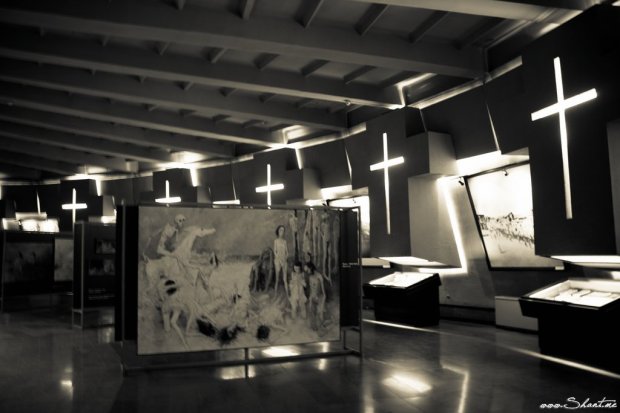
    Tsitsernagapert, inside the museum: A photo of the museum next to the memorial, Yerevan Armenia. - Photo by Shant Demirdjian

    Tsitsernagapert, inside the museum: A photo of the museum next to the memorial, Yerevan Armenia. – Photo by Shant Demirdjian

    University Crushes Taken To A New Level: Psst App

    Psst App

    The LAU, USJ, AUB, USEK, NDU & UOB Crushes pages which occupied 95% of our Facebook timelines over the past few weeks have gone to the next level by finding a companion in a new app called: Psst App. Yes, the “psst” is exactly what is said to grab someone’s attention “psst, psst.”

    The premise is very simple: You log in through your Facebook account and use the app to talk anonymously to anyone you want, effectively making the possibilities much more diverse than simply talking to someone you like.

    So if you have a crush who happens to be a Facebook friend, you can take it to the extra level now and stop posting anonymously about them on your university’s crush or hottie page.

    You can add the app via your Facebook account by clicking here or downloading the Android version here. This is gossiping, Lebanon style.