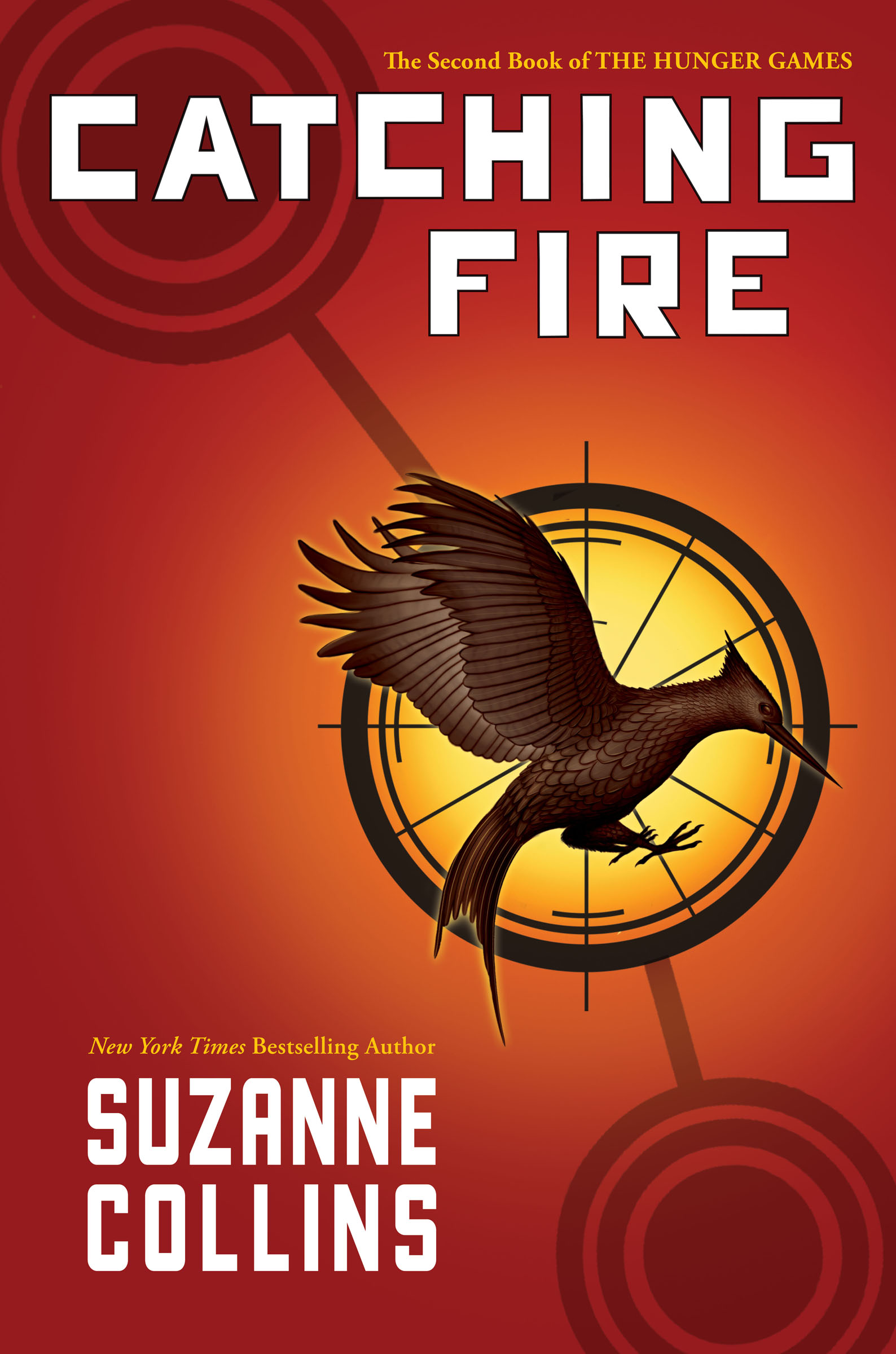
Catching Fire (Book 2 in The Hunger Games) [Book Review] – Suzanne Collins

Against all odds, Katniss Everdeen has come out triumphant from the Hunger Games. But at a price. Her last attempt at bringing Peeta and herself out of the arena alive was seen as an act of defiance by the Capitol. And they cannot remain silent.

Going back to her home district, life for Katniss is not easy. Gale, her best friend, keeps her at ice-cold distance. Peeta has also turned his back on her. It is then that President Snow drops her a visit to tell her than on the Victors’ Tour, she needs to convince all the districts of Panem, the dystopian country they live in, that her act to save both her life and Peeta’s was nothing more than an act of love – maybe it could help quench the fires of a rebellion starting to spread across Panem, a rebellion that Katniss isn’t sure she wants to quench.

But there’s a twist. Creeping up on Panem is the 75th Hunger Games, which would be made special by introducing new rules. What could those rules be? How will it affect Katniss and Peeta? And what could the 75th hunger games mean for Panem?

If you thought The Hunger Games, the first book in the trilogy, was addictive, then Catching Fire will get your heart to catch fire as it races through the pages. It is a unique and engrossing storyline; the characters you met an installment ago change as your hands flip through the pages. You cannot but feel the need to root for them. The descriptions are exquisite, thorough and gut-wrenchingly real.

The setting, similar to the the first book, is both real, fantastical and sad. The mood for this book is even darker than The Hunger Games. It is also more concise and poignant. Catching Fire has action, romance, hope, despair and, most importantly, humanity. Political themes are the underlying current of the book but they’re not flagrantly in your face, making it a dense read for adults whose imaginations want to wander off and a light read for teenagers who take it at face value.

With Catching Fire, Suzanne Collins has met the expectations she created for herself with The Hunger Games. The plot is unpredictable in many circumstances and is energetic throughout. In fact, the energy and pace keep on building right to the ending which creates a cliffhanger that will leave you shocked and searching for book three.

The main purpose of Catching Fire is to serve as a transitory bridge between The Hunger Games and Mockinjay, the third book in the series. And it does so perfectly by gradually changing the frame from the first book and creating a new dimension for the author to base the final installment in. Some might feel such transitions do not make great books. I beg to differ. You cannot read Catching Fire just to finish it. You can’t but read it to know what happens.

Within its few hundred pages, Catching Fire has, like its predecessor, humor, treason, death, love, life, loss, pain. “Girl on fire, I’m still betting on you….” How could you not?

9/10

Russell Peters in Lebanon – Show Review: Lame

Russell Peters’ show yesterday could be divided as follows:

40% of the time, he was picking on a man named Bassel.

20% of the time, he was picking on a 16 year old Saudi teenager called Khaled.

20% of the time, he was rehashing old jokes made at previous shows.

20% of the time, he was offering the audience new things.

The end conclusion is 100% of lameness.

I have watched most of his previous DVDs. So the idea I had pre-conceived about Russell Peters was that he was a good enough comedian to have a great show, albeit with a few slow moments stranded here and there. I wasn’t complaining. You can’t have it all over the top.

But what I had to go through on Saturday night at Platea Hall was definitely not something I had expected. Not in the least.

To begin with, the sound quality of the hall was horrible. Being on a limited monetary income, we couldn’t splurge to get the high-end tickets of the “lucky” front-rowers. So us, the poor commoners in the back, had to sharpen our hearing senses to be able to hear Russell Peters who seemed determined not to get the mic close to his mouth. Some had even tried to shout at him that “we couldn’t hear” but he was busy going at it with Bassel, a 38 year old man who happened to have huge eyebrows. Or caterpillars as Russell called them.

At the times when he wasn’t making fun of Bassel’s eyebrows, he was alluding to the masturbatory habits of 16 year old Khaled from Saudi Arabia. It might have been funny at first but when he interrupts a joke more than once to allude to it, it gets redundant and silly.

After feeling Khaled and Bassel became worn-out issues with the crowd, he moved on to a rehash of his previous jokes, the most famous of which is his father’s Indian heritage and accent. Car blinkers, child punishments – all retold with an Indian approach. Been there, done that.

The newer jokes, however, were not all that bad and some, especially those culturally relevant to Lebanon, were quite good. My favorite was an observation about how rampant plastic surgery has become in Lebanese society. Even the government is giving loans for people to do plastic surgery. We can’t accept ugly people here, he joked. Then a fashionably late Lebanese woman walks in. Peters looks at her and complements her breasts – or governmental breasts.

This leads me to another observation of the night. Lebanese people have redefined the concept of fashionably late and Russell Peters pointed it out. The show was supposed to start at 9:00 pm. It started at 9:30 with an opening act. Russell Peters was on stage at 9:45 and some people were still being ushered to their seats at around 10:00 pm. How hard could it be to get there on time, I have no idea.

When the opening act was better than the main show, you know something was messed up. I felt Russell Peters was unenthusiastic, disinterested, going through the motions to simply get things done and be out of there. He wasn’t really performing like he usually does. He was reciting.

I may be either too serious a person or Lebanese people are way too easily entertained because some were going gaga over the show as it ended. I’d like to think it’s the latter because I can appreciate a good comedy show when I see one. This was not one.

6/10

The Hunger Games is NOT Twilight

I had no intention to write such a post. But when I saw people on various platforms saying that The Hunger Games is just another Twilight, I simply had to step in to say no. Just no. And I think I am a qualified person to make the comparison. How so? Well, I’ve actually read both book series before the hype for their movies set in.

1 – The Books

There is a drastic difference between the themes of the books to begin with. The Hunger Games does not have supernatural human beings, let alone vampires or werewolves that have been so ruined in their portrayal that they’ve become a common source for jokes. The main characters of The Hunger Games are not driven by their incessant need to be loved but by their primal instinct for survival. Both may be intended for young adults and have a central female character but when it comes to the plot, protagonists and reception, the two series couldn’t be more different. Twilight is a fantasy love story, while The Hunger Games is an adventure about survival. That alone create a huge difference in the central elements of the book: where characters in one search for a boyfriend, the characters in another prepare for a revolution.

This brings me to point 2.

2- Katniss Everdeen and Bella Swan:

Bella’s struggles in Twilight is to choose between the sparkly vampire Edward and the transform-at-will werewolf Jacob. Her character is also nauseatingly one dimensional, useless and completely infatuated with mundane things, making her unlikeable.

Katniss is the exact opposite. Where Bella had things handed for her on a silver platter (boyfriend trouble don’t count as life problems), Katniss has to survive a world where the government has made the people hungry, where her mother is disconnected from the world and where she has to care for her only sister. Katniss’ world does not revolve around a boy, unlike Bella.

Bella is driven by her infatuation with Edward. Katniss is driven by her need to survive a cruel world. Katniss is a character young readers should look up to. Bella Swan is not.

3 – The Movies

Both movie series are turning out to be immensely popular. The Hunger Games has grossed over $25 million from midnight screenings alone. Twilight movies have broken records. Where they differ, however, is in the drastic critical reception. The Hunger Games has an aggregate score of more than 90% of positive reviews. Every single Twilight movie has been certified rotten by critics. You can read my review of The Hunger Games here. I didn’t even find it in me to review the latest Twilight movie. Enough said.

Perhaps both The Hunger Games and Twilight can be considered as a “teen” series. How that’s a bad thing, I’m not sure. The difference remains that one is absolutely relevant to what we’re living through today: revolutions, war, famine while the other lives in lala land. The fact remains that people need to get it in their heads that not anything that rings true with young adults needs to be compared with a preceding cultural phenomenon. Twilight was compared to Harry Potter. The Hunger Games is being compared to Twilight. How ridiculous, I know. When will such unfounded thoughts end? I have no clue.

The Lebanese Help: New TV Hosts Ali Mahfouz – The Man Who Beat Up The Ethiopian Maid

The “Lil Nashr” TV show, hosted by Tony Khalife, had Ali Mahfouz as one of its main guests for its Saturday March 17th episode. Mafhouz is the man that beat up the Ethiopian maid in front of her embassy. The maid has since committed suicide.

Using the platform of the TV show, Mafhouz tried to come off as an affectionate man who deeply cared for the girl and was trying to sort out her affairs. He even went further than that and said he would never beat her up and that moment outside the embassy was unlike him.

The rest of this post will be assuming that Mr. Mafhouz was, indeed, acting outside of his character – although I have to say that modern psychiatry and psychology would assert that this violent behavior is, in fact, within his character, whether he wants to admit it or not.

Now, Mr. Mafhouz goes even further and argues that the maid, whose name is Alem Dechasa, was mentally ill and an unstable presence for him and the people she knew. He even cites a coroner’s report that she was having auditory hallucinations while still alive to “prove his point.”

The end result of the episode, which I was able to touch from both my parents, is that many individuals have lost their compassion to the maid and are now seeing her as an insane person, which clears Mr. Mahfouz. He is not in the wrong anymore.

Let’s get a few things straight.

1) A coroner’s job is to examine a dead body for a cause of death, among other factors. There is no way that a coroner (or medical examiner) can tell if the deceased person they’re examining was having psychotic episodes while they were still alive. It is beyond their scope. It is impossible to tell if a dead person was mentally ill via an autopsy and more importantly, there’s no way a coroner would have the authority to write a report containing such information.

2) I am very dismissive when it comes to Lebanese media for many reasons. But I never expected a TV show to host a man like Ali Mahfouz without advocating the victim’s side. This is not how proper journalism works, especially if it’s a TV station that supposedly respects itself. For the entire duration of the show, the arguments of the Ali Mahfouz camp were so front loaded that any attempt to speak on behalf of Alem Dechasa were rendered meaningless. This leads me to point 3.

3) The purpose of the episode, which I’m sure Tony Khalife is very proud of, was not to showcase the Alem Dechasa abuse in an objective manner. It was simply to help clear Ali Mahfouz’s reputation and to convert him from the man who led an innocent woman to her death to a man who was simply escaping the ramblings of a lunatic. Judging by the reactions I got from my parents, which I’m sure echo many other households that decided to tune in, their goal was achieved. New TV must be very happy with themselves.

It is a sad day when a victim’s reputation is tarnished just so an influential Lebanese man can escape the consequences of his actions. A few days from now, the whole affair will be forgotten. It has already started. Those who had thought Alem Dechassa was innocent are now believing the contrary. The rationalization of the Lebanese ego that a Lebanese can never behave this way is starting to work full throttle. The government will soon follow suit, especially as the wheels of Mr. Mahfouz’s “wasta” start spinning.

Alem Dechassa was killed three times. Once when her body was violated in front of her embassy and dragged into Ali Mahfouz’s car. The second time was when she got so desperate and took her own life. The third time was with the Lel Nashr episode that portrayed her as insane. The end result is simple: the victim becomes the abuser and the abuser becomes the victim. Well done New TV. Well done.

The Lebanese Help: The Abused Ethiopian Woman Commits Suicide

Ali Mahfouz. Know the name. That is the name of a man who drove a woman to her death.

After publicly beating her up, right at the doors of her embassy, Mahfouz dragged his Ethiopian maid into his car and out of sight. The government had noticed the event and is now working to bring the man to court. But what good is it for that woman and her family back in her home country?

Mr. Mahfouz and his family created such an unstable work environment for the Ethiopian maid, whose name we still don’t know, that she drank detergent in an attempt to kill herself. That attempt was thwarted, leading to him beating up her in front of the embassy and somehow, in an interview conducted with LBC, he put the blame on the maid, denying he had even beaten her up. As if videos actually lie.

This Ethiopian maid’s death will, unfortunately, go in vain simply because there are a lot of people in Lebanon who share the same mentality as Ali Mahfouz, who see these Ethiopian (and other nationalities) maids as their “slaves,” who see nothing wrong in abusing them, be it by overworking them, beating them up, verbally abusing them, banning them from contacting their families…. Many simply don’t see them as human being. They don’t see them as people who, like us, have their own story in life, who have a voice and who need people to hear that voice.

Do you want to help me make the voices of maids heard? Then get aboard The Lebanese Help. If we manage to stop one family from being this abusive to their maid, then we can deem the plan a success.

Change starts with a whisper.