
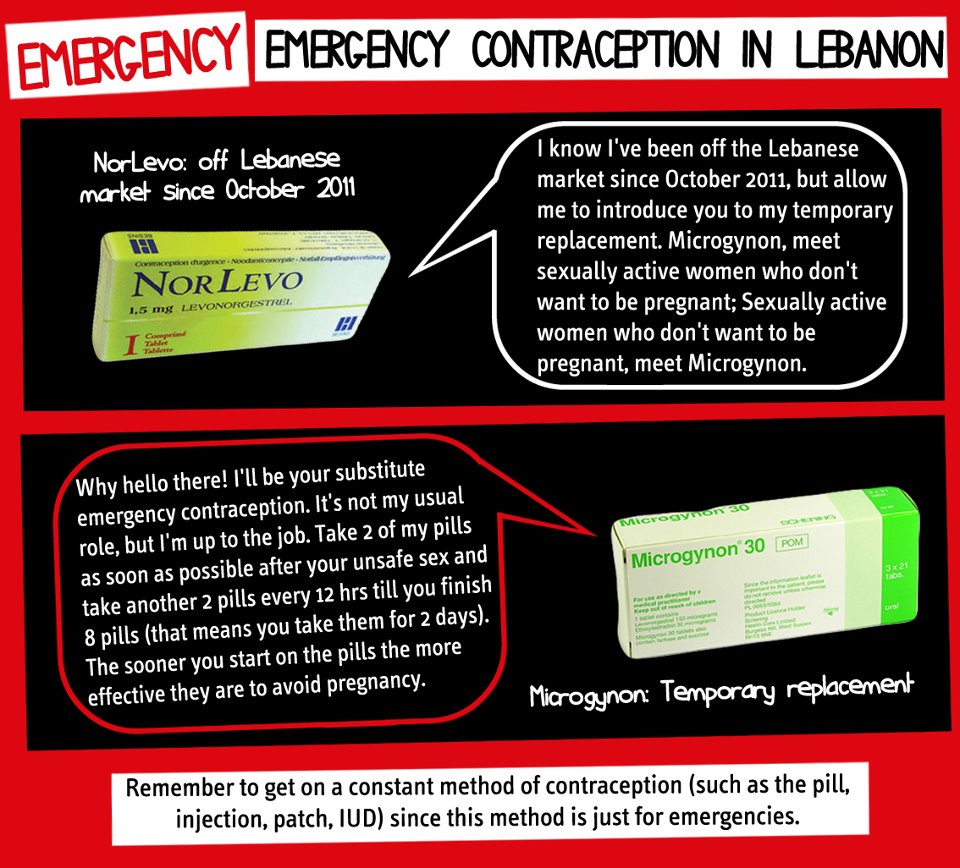
The picture making the social media rounds
This is a guest-post by Christian Sawma, a pharmacy student at the Lebanese American University, in reply to the Nasawiya post on the matter.
We need to start by differentiating between monthly contraception and emergency contraception. The monthly regimen consists of taking one pill per day, regardless of sexual encounters, in order to suppress the normal monthly period and ovulation; this regimen is used for sexually active women who are not wishing to get pregnant. On the other hand, the emergency contraception is used after an unprotected sexual intercourse in order to prevent pregnancy from happening.
The best choice of emergency contraception is a progestin only pill that increases the cervical mucus production and thickness; hence, inhibiting the sperm passage to the fallopian tubes. It is available as OTC (over-the-counter) in the United States and of course in Lebanon under the brand name of Norlevo (levonorgestrel 1.5 mg) – commonly known as the morning-after pill. The latter drug has no purpose other than emergency contraception; it cannot be used as normal monthly contraception.
Pills containing a combination of low concentration of estrogen and progesterone in one pill are used to suppress the ovulation and normal female cycle, therefore, they are used as a monthly contraceptive technique and prescribed as a once per day pill, taken at the same time every day for this purpose.
In contrast, before discovering the effectiveness of Norlevo (levonorgesrtrel 1.5 mg) as an emergency contraception technique, the regimen used was called Yuzpe (named after its founder Dr. Albert Yuzpe). It consisted of giving the combination of those low concentration estrogen and progesterone pills, discussed above, to inhibit pregnancy (before it happens) after an unprotected sexual intercourse, but they are given as multiple pills per day for the emergency contraception purpose. Now that Norlevo hasn’t been available on the Lebanese market since October 2011, the Yuzpe regimen can be used instead.
Estrogen is highly emetic (induces nausea and vomiting), and that is one of the main problems of this regimen: It consists of giving 2 or 4 tablets, of the monthly contraceptive pills, as soon as possible and repeat the same dose after 12 hours. The number of tablets to take is chosen according to the estrogen concentration in the tablets. For the 30 mcg ethinyl estradiol (EE), 4 tabs should be taken, and for the 50mcg EE, 2 tabs are advised. It is important to mention that the tablets of each dose should be taken all together and not separated.
This is a table that clarifies the aforementioned point:

Yuzpe (Microgynon 30) is effective in 75% of the cases, which is not a good statistical number, making it not a very good alternative to Norlevo. In addition, this regimen shouldn’t be followed without referring to your physician or a pharmacist and if vomiting occurs in less than 2 hours post dose, the dose should be repeated.
On the Lebanese market, a lot of brands containing 30 and 35 mcg EE are available. The one that contains levonorgestrel (Norlevo’s active ingredient) in an acceptable concentration for emergency contraception is Microgynon 30, and it is the best choice in Lebanon for a Yuzpe regimen. According to my knowledge, no 50 mcg EE is available in Lebanon for contraception.
In the case of Norlevo or combined oral contraceptive, the effectiveness is not studied beyond the 3 days period. Although the Yuzpe regimen can be given up to 5 days post intercourse, no safety and effectiveness has been proven. In addition, some studies have confirmed that beyond the initial 3 days, it’s neither safe nor effective to use Norlevo or Yuzpe (Microgynon 30).
Always refer to your physician or pharmacist before using a new drug especially if taking other drugs with it or if using it for its unlabeled use (such as in this case). In case of emergency contraception, it is important to refer to them in any case of bleeding or pregnancy post a dose of a progestin only pill, Yuzpe regimen or Ella pill, a new experimental FDA-approved drug that is not yet available in Lebanon.
















 A Separate State of Mind | A Blog by Elie Fares