Batroun Sets a World Record in Lemonade!

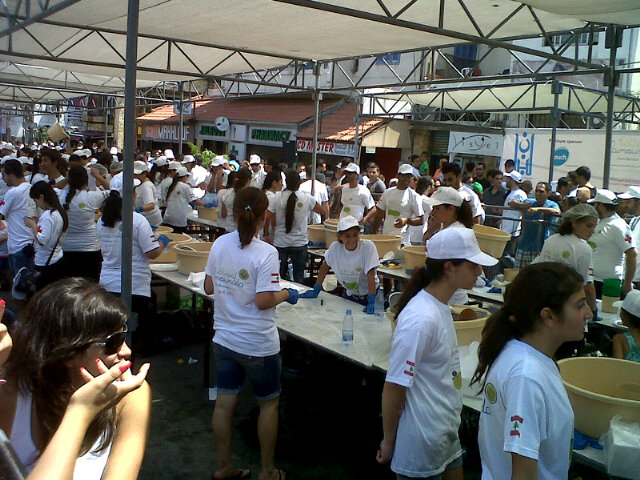
Because Batrounis make the world’s best lemonade, a world record was set today with the biggest amount of lemonade made.

Sure, it’s a silly world record that serves more as a distraction. But it’s fun and people seemed to get into it. And with it being done around noon, that left plenty of time for those who broke the record to go to awesome Batroun beaches.

Speaking of beaches, the lemonade that was prepared will be distributed all across the city, including beach goers, throughout the day. This is also comes at a good time with a cocaine scandal rocking one of the city’s venues, Taiga Cafe, only a few days ago.

Here are a couple of pictures from the event:

AUB President Responds to the Donna Shalala Honorary Degree Controversy

Remember when I told you about some AUB students causing a ruckus at this year’s Masters’ students graduation ceremony because “zionist Shalala” was being given an honorary degree?

Well, as an AUB alumnus, I received an email with the response of AUB president Peter Dorman on the whole issue and I thought it was such an interesting read that I’d share it with you all.

Dear Members of the AUB Community,

I would like to share with you a personal note, in view of several e-mails that have been circulating among the faculty and on the alumni listserv in the wake of the controversy surrounding the recent honorary degree ceremony at Commencement. In particular, I want to address the comments relating to this administration’s purported agenda related to Israel.

The first and paramount observation is that AUB has always respected and complied with the laws of Lebanon, and always will, particularly the laws prohibiting the normalization of any kind of relations with Israel.

Indeed, this position has come at a cost to some of our faculty members in recent years, particularly those who have had to give up significant funding or research partnerships because of the involvement of third-party partners who had ties to Israeli institutions.

Second, this administration at AUB has no normalization or Zionist agenda of any kind. Those who make that claim or imply it are simply wrong on the facts. But raising questions about AUB’s presumed Zionist leanings is a sensational charge that catches the eye, can spread quickly, and understandably raises deep alarm among Lebanese and others who have suffered from Israeli depredations.

The circulating messages entitled “Can AUB Find Only Those Complicit with Zionism to Honor?”–taken straight from the extremist coverage published by al-Akhbar newspaper‹is a rhetorical question that belies our history of honoring distinguished Arabs or friends of the Arab world such as Edward Said, Helen Thomas, and Hanan Ashrawi. In the last three years alone, the University has honored Walid Khalidi, Dourade Al Lahham, Eric Rouleau, Mary Robinson, Marcel Khalife, Owen Gingerich, Mostafa El-Sayed, Anthony Shadid, Wadad Kadi, and Munib Masri. Eight of these honorees were nominated by our own faculty.

Some have criticized the administration for awarding an honorary degree to individuals who do not adhere to the Palestine Academic and Cultural Boycott of Israel campaign, an initiative intended to isolate Israel from such contacts. I defend the right of those who take such a position; it is a principled stance, and one that many feel passionate about. Yet institutional decisions cannot be subordinated to an absolute litmus test imposed by the demands of outside groups. Otherwise, to pick just one example, AUB could never have decided to honor Edward Said, who initiated an acclaimed cultural dialogue through his highly visible sponsorship of a Palestinian-Israeli youth orchestra.

I was born in Lebanon in the same year as the nakba; like so many of you, I have never lived in the world without the dreadful specter of Palestinian dispossession and an expanding Israeli settlement agenda, which are deeply immoral and ultimately, in my view, self-destructive.

As for AUB, our campus is a precious and protected space where differences of opinion do‹and must‹exist in a context of mutual respect.

Free speech is fundamentally a core value of AUB and a part of our long tradition of academic freedom. We will continue to honor it, for every voice in our community.

The Provost and I will be meeting this coming week with a delegation of faculty members, who wish to present their petition of disagreement. The Board of Trustees has also asked me to review the process of vetting candidates for honorary degrees. I know the faculty delegation speak for a good number of you reading this message; but I can assure you that we jointly have only the reputation and good name of our beloved institution at heart, alongside a profound commitment to AUB’s proud legacy, our home country, Lebanon, and the region we serve.
Peter Dorman

President

In very brief summary, he’s politely telling those protesting to suck it. And I couldn’t be happier.

Two Days in the Life of a Lebanese in Beirut

It starts early in the morning. You wake up and the heat is already beyond an acceptable value. You look at your phone. Nothing on that lockscreen.

You had forgotten. The country has been disconnected from the internet for two days now. You get out of bed forcibly. The day must start. You flick on the light switch. Nothing.

So they’re cutting it 6 am – 9 am today? Neat. At least you’ll have power when you get home, right? You go towards the kitchen to prepare some coffee. You hold the teapot under the water valve. Nothing comes out. No coffee for you? But no. You are more than prepared. Hello Tannourine bottles!

A day at work or class later, you go back home. There’s electricity. But the internet and water are still nowhere to be found. The former is unusual while the latter is typical for any Beiruti summer.

As you get out of your clothes for something more relaxing, you look at the time. 3:30 pm. And the light goes out. You wonder if the switch (disjoncteur) had been overpowered by something you might have turned on by mistake. You run down the stairs of your old Beiruti building which doesn’t have an elevator and you find out that no, it’s not the switch.

You run back up the stairs and reach the landing of your apartment, sweating like a pig. Perhaps going back home hastily was a bad idea.

30 minutes later, your only source of cooling in that house, the A/C, springs to life. You praise any deity you could think of and type away at your computer, finishing up some leftover work stuff because you don’t have internet to check Facebook, Twitter or even your email. Before you know it, the screen on your laptop dims. You look at the laptop’s electricity plug and you find its light off. You glance at your watch. It’s 4:00 PM.

Thank you for 30 minutes of electricity? But it’s not done yet. 30 minutes later, you hear your fridge hum again only to hear it die down 30 minutes later. Christmas lights-esque electricity from 3 to 6 pm? You bet.

So you sit there, looking at the wall in front of you. You have no electricity, no internet and no water. It’s too hot outside for you to wander somewhere – anywhere – and for the first time in your existence in Lebanon, despite everything, you feel like you are living in a third world country.

But as it is with you being the deservedly proud Lebanese that you are, you shrug it off. Tomorrow is another day. And then your phone buzzes. You look at it and behold, there’s an iMessage there! Yes, tomorrow is another day indeed.

Is All of Lebanon’s Internet Resting on the IMEWE Cable?

Two whole-country blackouts in one week. Both lasted for a few hours during which the entirety of Lebanon was disconnected from the grid, adding to its disconnections in electricity and water – because we are not allowed to have a 24/7 sector that runs smoothly in the country.

It could be that we decided to feel compassion to the people of Virginia in the US, bracing themselves through massive storms. We can’t let them be the only people on the globe who are suffering through internet disconnections?

Let’s hope the Americans can be appreciative.

But sarcasm aside, how come all of Lebanon’s internet rests on the state of one cable: IMEWE, the one we got connected to not long ago?

Don’t we have other cables, such as Cadmus, that also connect Lebanon to the grid? Where are those cables when something happens to IMEWE?

Don’t we have a backup plan in case anything happens to IMEWE? Can’t we revert to the old bandwidth that was enough to sustain connectivity although not speed (dismal as the current one may be) in case something happens to this cable?

And regarding IMEWE, how come a cable that cost millions upon millions of dollars is having this many problems? Two blackouts this week alone with the total number of blackouts increasing the further you go back in your observation. And why are the problems only centered in Lebanon? Alexandria, for instance, another location that gets bandwidth from the cable is not suffering from the blackouts we are having.

They want to let you think Lebanese internet has gotten better. But what good is an extra Mbps in speed when you can’t even use it for hours and hours? What good is the internet that comes from a cable that’s looking to be more fragile than an osteoporotic woman’s bones?

With this many recurrent problems with the IMEWE cable, perhaps the ministry of telecommunications should look into the main problem leading to the blackouts and not patch it up in a few hours so it happens again a few days later.

In all my years as an internet user, all of which have been in Lebanon, there has never been as many internet blackouts as we’ve had since our internet got “better.”


Jessica Kahawaty: A Lebanese Wins Miss Australia 2012

This is not the first time this happens and the resemblance between both girls’ cases is interesting.

Jessica Kahawaty has been crowned Miss Australia 2012, the second Lebanese after Nicole Ghazal. Both of them had participated in Miss Lebanon before attempting their luck at Miss Australia and both of them were deemed good enough to be runner ups only.

I guess this speaks more about the insurmountable amount of “wasta” present in the Miss Lebanon competition, regardless of what they try to portray, and where the best candidate doesn’t always win, let alone letting proper girls participate in the first place.

But hey, world peace is super important!

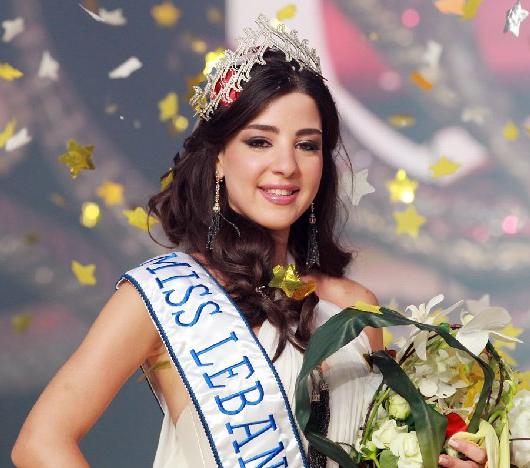
Jessica was a candidate at the 2012 Miss Lebanon pageant which saw Rahaf Abdallah win: