Beirut Hotel – A New Lebanese Movie Is Banned For Sexual Content

For my review of the movie, click here.

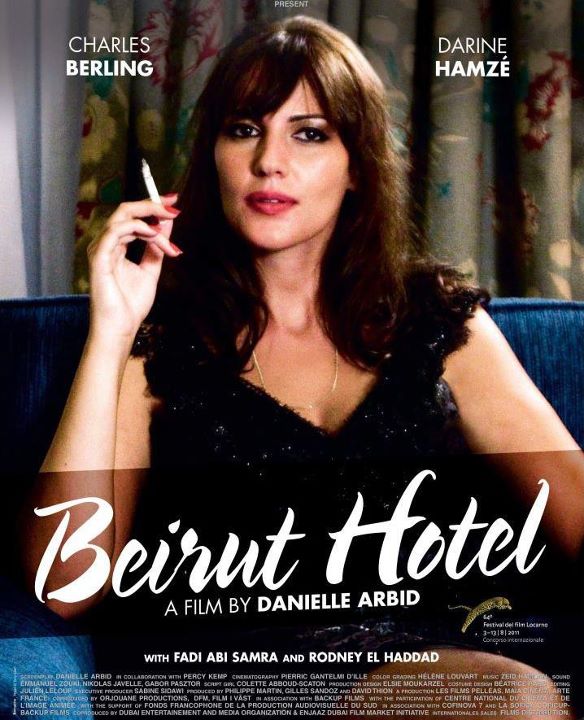
Seems like our story with censorship in Lebanon is far from being over or at least moderated somehow. Beirut Hotel, a new Lebanese feature film by director Danielle Arbid, which was scheduled for release in January 2012, has now been banned from being shown in Lebanon. Why?

Well, according the Censorship Committee in Lebanon’s General Security, the movie would “endanger Lebanon’s security.” And you know why? Because the movie apparently has sexual themes to it.

After all what can you expect from a committee that removed a scene featuring the burning of a Syrian flag from the movie Rue Huvelin or even modified a scene in Nadine Labaki’s Where Do We Go Now, although she wasn’t that displeased by that according to her interview with Kalem El Nes. They also banned the Iranian movie Green Days from being screened mostly because it was also banned in Iran for its anti-Islamic revolution sentiment. And lastly, Steven Spielberg’s name was hidden off TinTin’s movie poster because he’s a known Israel sympathiser.

Moreover, Darine Hamze, the leading actress in the movie, has a role as a devout religious person in a current TV series airing on a Lebanese TV station. Interviewers had asked her how she could possibly play both roles. It looks like the concept of acting has eluded them.

Watch the movie’s trailer here:

And in case our folks at the General Security don’t budge, we’ll have to hunt down the DVD for this.

I don’t know about you but I’m seriously sick of a committee deciding what I’m supposed to watch or in this case not watch. This is the 21st century. Such committees should not exist.

And just as a heads up for this committee, I personally hadn’t heard of this movie before today. So thank you for exposing it. Moreover, we, as Lebanese, didn’t invent sex. And if sex is now a danger to our security, then just ban it for everyone.

Destroying Beirut’s Culture: Achrafieh’s Mar Mitr Construction Site

It’s sad to see Beirut losing its culture with all these new buildings replacing better looking older ones daily. It hurts to see your capital slowly turn from a city with architectural taste to a concrete mess. But I never thought I’d see a construction site in the middle of a cemetery – let alone one of the most famous cemeteries of Achrafieh: Mar Mitr.

As I walked back from ABC with a friend yesterday, that friend (being the staunch Orthodox that he is) wanted to visit Mar Mitr for a few minutes. So I wandered around the mausoleums, which I find breathtaking, only to find a horrific site. Next to where people like Gebran Tueini are buried is what appears to be an extension of the church next to the cemeteries. And since space is sort of limited, what did those in charge think as the next best thing? Build on top of the mausoleums of course.

So instead of Mar Mitr being a collection of these:

It now has this to add to its “flavor”:

You’d think the block of concrete forming the Spinneys parking lot next to the cemetery would be enough. Apparently not. You know, sometimes a church is just good the way it is. I’m pretty sure extending the Mar Mitr church isn’t of a vital necessity.

Blackout Beirut: The Recent Electricity Crisis in Lebanon

I felt like I was in a war zone this past weekend when the power in Beirut kept circulating between three hours of grid connection and three hours of grid disconnection. Perhaps the “highlight” of my day was trying to shower using a lit candle as your only source of light.

I am used to electricity outages. I am from a village in Northern Lebanon where more than 12 hours of coverage per day is seen by many as some form of the second coming of Christ. But in my village in North Lebanon, I have a “moteur” subscription which fills in the many blanks left by the electricity we should get from our dear state. In my Achrafieh neighborhood, however, you don’t have “moteur” providers because you never needed them before. Add to that grandparents who have been through weeks and weeks of no-electricity during the civil war and it makes the three hours tolerable for a power-needing person like me.

But no matter, as Beirut cycled between Beirut-on and Beirut-off in three hour turns, even the iPhone app to track the outages didn’t work anymore. And I had no idea what was happening until I watched the news and saw that workers from South Lebanon had apparently decided to strike at the Zahrani Power Plant. A little delving into this and a political nature of the strike is also revealed. Nearby municipalities supported the decision of the plant’s “workers” for strike. The “apparent” cause? Electricite du Liban (EDL) decided to move a 40 MVA transformer from the Plant to the nearby city of Saida.

Part of the news report I watched has Southerners complain about them being “left out,” about them being “targeted” by the Lebanese state with only few hours of coverage per day. My initial reaction was: are they [insert obscene word] kidding me?

Let’s get  a few things straight.

1) The Southerners are not the only people who have suffered in Lebanon. It’s 2011. The Israelis left 11 years ago. The July 2006 war happened, well, in 2006. We all stood by them through all of their Israel-related misery. We harbored them in our schools, gave them food from our homes and did what any proper citizen would do. They can stop accusing the whole country of targeting them whenever something doesn’t go their way.

2) I get as much coverage as they do in my village in North Lebanon and yet you don’t find me storming power plants and cutting power for those who have it. This is NOT the way you solve things.

3) Apparently our beloved minister Gebran Bassil (whom we, in my caza, voted against a bunch of times and yet always found in power) couldn’t even get the political parties behind the “workers” to get them to stop their “strike.” This begs the question: if the minister of energy, who’s also a proud ally of those political parties, can’t reign them in, then who can? This also raises doubt on exactly how far Aoun can control Hezbollah. Mr. Aoun was always proud of being Hezbollah’s main ally in the country, believing that Hezbollah did whatever Aoun wanted. Well, not always, is it?

4) Now that our prime minister Miqati has apparently sorted things out, the question asks itself: what if Hezbollah decides to act out again? what’s there to stop them? If their own allies can’t do anything against them then who can? What’s to stop this whole “I can do whatever I want and you can’t do anything about it” mentality that they have?

As I came back to my Achrafieh neighborhood at 6 pm today, I was struck by how dark it was. Few were the buildings that had lights in them. The streets were dark. The people were gloomy. I couldn’t wait to go back home to North Lebanon where there was actually light and mind you, my house in Achrafieh is exactly halfway between St. George’s and Geitawi hospitals – you’d think an area where two hospitals were located would get some preferential treatment. But no matter. A friend in Jal El Dib had 8 minutes of electricity all day today. A friend in Mansourieh a little more than 8 minutes but also a dismal amount. And yet, you don’t find us storming roads, burning tires, calling for strikes in power plants in our regions. It’s not that we couldn’t do that. The easiest thing to do is spur violence. What’s not easy, however, is to suck it up and work on fixing the electricity situation, which has been coexistent with our life as far as I can remember, with a radical solution, not ruin whatever few megawatts other people get.

And this is one of the reasons, dear Hezbollah, I can never – ever – support you.

But you know what’s interesting? Out of all the governments that have been ruling the country since 2005, this is probably the most dysfunctional one. What’s sad? It’s one-sided and made up mostly of those who want to change and reform. Well, here’s how it goes: over promise, under-give, the system blows up, blame others.

Lebanese Brew: Courage Is Contagious

If you were like me and hadn’t heard of the new Lebanese beer in town, well, now it’s time to pay attention. In case you thought, like me, that almost no one can top off leading Lebanese beer Almaza’s ad, here comes a “Courage” campaign by Lebanese Brew.

With a YouTube video featuring Lebanese youth partying, drawing graffiti, living their life all to the backdrop of our gorgeous capital, the brand new beer’s image is glowing.

The video even starts with a guy and a girl the morning after having sex, being courageous enough to tackle something that happens very often in Lebanese society while almost everyone hides behind their shadow regarding it.

The liveliness of Beirut and its youth is the center piece of this ad to show the courage of both the city and the people. The video serves a double purpose: to show the courage of this brand in trying to enter an already almost-full market and the courage of the Lebanese people who have defied all odds and are still here.

The theme “courage is contagious” is to show that if you are courageous enough to stand for what you believe in, those who are less so will soon follow. It’s not very hard to relate this to the recent revolutions in the Middle East and how, according to Robert Fisk, the Lebanese revolution in 2005 gave the spark that started them all. After all, our courage as Lebanese is contagious.

Kudos for a very well-done video. It’s sad it only has 3000 views since it was uploaded in July 2011.

Rue Huvelin – New Lebanese Movie

And the series of interesting-looking Lebanese movies continues. After blogging about Nadine Labaki’s upcoming movie, Where Do We Go Now, it’s time to put the spotlight on Rue Huvelin.

For anyone who doesn’t know Beirut well, specifically Achrafieh, Rue Huvelin is considered a landmark. It is where the prestigious French system based university “Université St. Joseph” is located.

Slated for a November 17th release date, Rue Huvelin is a movie about the Lebanese student movement at the time of the Syrian (direct) occupation of the country, between 1990 and 2005.

The movie’s official summary is as follows:

In 1990, the Lebanon War ends with the Syrian army’s takeover of the Presidential Palace, signaling an ensuing fifteen years occupation. One of the consequences of this period was a general sense of collective retreat and apathy among the population. On Huvelin Street, where the Middle East’s leading Francophone university (Saint-Joseph) settles, a group of students opposed to the status-quo decide to break the silence and rally a pacifying resistance movement in the heart of Beirut at the close of the 1990s. Their resistance was a struggle between two opposing worldviews: between a liberal and freedom-loving lifestyle of a group of friends and compatriots, and between the oppression of authorities and the indifference of society.

Are you interested? Cause I sure am.