GQ or How White People Ruined Beirut’s Nightlife on Their Last Day on Earth

This is a guest post by Lary Bou Safi, a self-proclaimed stylist and nightlife ambassador. You can follow him on Facebook here.

In today’s episode of ‘Things White People Do’, GQ attempts to teach Westerners how to party in Beirut like it’s their last night. The idea seems nice, and Beirut IS, whether you like it or not, a party city, but the old saying ‘The Road to Hell is paved with good intentions’ couldn’t have been more fitting in that case.

Who in their right mind would consider B018 a plat de resistance on their last night on Earth? Who in their right mind would pass out at 3 am in Beirut on their last night on Earth.

Let me tell you how that laughable scenario should’ve gone.

Your last night on Earth is Saturday night. Which Saturday night? ANY Saturday night.

Dinner:

Before you go wild, you should always eat, and Mar Mikhael-Gemmayzeh is perfect for that, if it’s only for step 2 of your last night on Earth.

Whether you’d like to indulge in some Lebanese food at Em Nazih, Kahwet Leila or Enab, international food at Prune, À Coté or The Happy Prince, try Beirut’s best burger at The Smoking Bun or drool over Soul Food at Butcher’s BBQ Joint, that area, the Lower East Side of Beirut (yup, I’m using your metaphors, sue me!) is perfect if you’re feeling like having a bite before you plan next day’s hangover.

Whatever you’re planning on doing, never do it on an empty stomach. Now that your dinner plans are set, it’s time for pre-drinking.

Drinks:

Forget what any straight couple from the 09 (the area code, not the year) has told you. I’m sure they’re nice people, but they party like it’s Ayia Napa, circa 2010. And it’s 2017; the times they are a changin’.

I’m one of Beirut’s main party animals. Just ask anyone, and if I don’t go to Mothershucker, then neither should you. No one cool ever goes there on their last night on Earth. I’m sure it’s a nice place, but a gin/oyster bar before getting hammered? Really? That’s a recipe for disaster! No wonder you were passing out at 3am.

There are a lot of cool bars in Mar Mikhael, from Floyd The Dog to Vyvyan’s to Internazionale, and if you’re lucky enough, you might get invited to some cool private house party. Actually, all you have to do is be white & have an accent, and you’re there already. You’ll meet most of Beirut’s elite, and you’ll probably end up on some guestlist for step 3. You also might get to meet me, which could be the highlight of your night.

Party:

It’s 12:30 am, which means you should get going if you’re someone’s +1 if you don’t want to miss on any guestlist.

For the main course, you have 2 of Beirut’s party moguls: The Grand Factory and Überhaus. Both will make you forget your last name, with their taste in EDM and their love for extravagant lights & setups.

Whoever compared B018 to Berghain should be fired. You might get some of Berghain’s PG-13 action at Reunion, the elite’s room in The Grand Factory beside the perennial CU NXT SAT, or even inside Überhaus’ monster or under The Gärten’s dome (‘Haus’ summer location), but B018 is not what it used to be. You’ll be dancing there for hours to international DJs that would usually be playing in Berlin and Amsterdam.

After-Party:

It’s 4:30 am. It’s time for the after-party. How come no one ever told you about the after-party scene in Beirut? My personal favorite is usually Projekt, but Pre and Off & On deliver as well. You’d be dancing your ass off till 9 am and suffer from jet lag once you leave the premises. This step is almost as unmissable as the previous one.

After-after-party:

If you’re not a shmuck, which I doubt you’d be, since you’ve already made it through this phase, you have 3 options: go to Barbar or any food place that opens 24/7, tag along a bunch of party animals and finish at some house party with some techno, some booze & some Zaatar w Zeit takeout, or get lucky & go home with someone.

In all cases, why would anyone want to pass out on their last night on Earth, in a city that covers every aspect of nightlife? Next time you decide to write an article, just tag along someone who’s actually relevant in Beirut’s nightlife, perhaps then your article would be worth a read.
You can also follow Lary, the author of this post on Twitter: @larybs.

Lebanese Ministry of Culture Is Transferring The Roman Columns That Were Thrown Away To A Safe Location


Around 2 days after I wrote a very widely circulated post about the matter, which referenced a L’Orient Le Jour article on the issue, Lebanon’s Ministry of Culture decided to take notice of the 500 or so Roman Columns entrusted to its care, and it has begun transferring them to warehouses for safe keeping.

The actions of the Ministry of Culture were brought to my attention by SkyNews Arabia reporter Larissa Aoun who tweeted the above referenced picture from the site where the Roman Columns were thrown away when their warehouse was dismantled earlier this year.

Minister of Culture Ghattas Khoury, on the other hand, is not happy that the issue got this much attention, especially with MP and head of Kataeb Samy Gemayel discussed the issue in a Facebook live video, which you can view here:

In a statement from the site where the Ministry of Culture was doing its job, Minister Khoury issued the following statement:

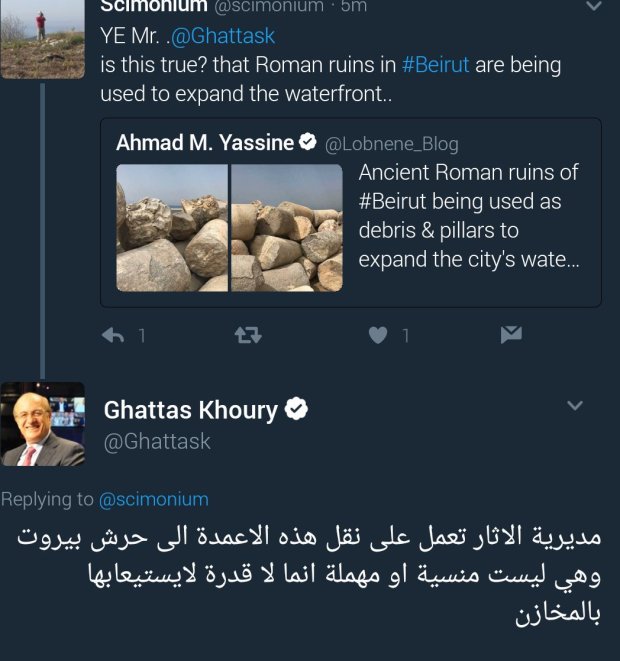
The statement’s essence translates to: “we’re here to assert that the columns here are under the care of the Ministry of Culture. I had said on Twitter that we were monitoring the columns and would transfer them to Horsh Beirut soon.”

Of course, the definition of “soon” in Lebanese politics and governance would’ve been months if not longer, hadn’t the issue gained the traction that it did, forcing the Ministry to save face by acting on the issue as promptly as it did, and transferring the columns – especially those with inscriptions and other decorations – for safe keeping.

As I mentioned previously, the columns were supposed to be transported to different locations across Beirut to make Jbeil-esque entrances or streets in the city, but such plans were changed for reasons that have not been detailed.

The columns, according to Minister Ghattas Khoury, are now set to be transferred to Horsh Beirut, which is the last green space available in Beirut – if they keep it of course. What will happen to them in Horsh Beirut is probably uncertain as sections of it are going to be transformed to a hospital, because that’s exactly what Beirut needs: less green spaces, more buildings.

It’s a shame that our history and heritage needs viral blog posts for our system to governance to act on protecting it. It’s not just about these columns. It’s also about the many ancient houses around Beirut, the many sites uncovered at various construction plots around the city, among others. How many more times are we supposed to cry out for such landmarks and historical sites to be studied and preserved when it should be a reflex for concerned ministries to do so?

It doesn’t make sense that in a country with as much history, a lot of it is wiped to ease the way for businessmen, without Lebanese people even becoming aware of it in the first place, and to have that history’s last frontier be social media, not authorities who should be the main defender of the heritage of the country they’re serving.

Until the next archeological crisis, I hope these columns beautify Beirut. We all know it needs it.

500 Roman Columns In Beirut Have Been Thrown Away By The Sea Next To Biel, Because Who Needs History Anyway

Make sure you download this blog’s iOS app to stay up to date! (Link). 

The saga of the sure and constant destruction of any historical remnants of Beirut continue. The city, which is constantly listed among the world’s oldest continuously inhabited locales, is having progressively less things to show for its history as the Lebanese government and everyone involved in governance seems not to care the least about that particular aspect of the city, treating it with as much carelessness as you could imagine… and then some.

Picture this: if you go near Biel, in the recently built Beirut Waterfront area, you will stumble on an archeological discovery that most countries around the world can’t even boast about having: between 400 to 500 roman columns are found there, thrown away by the sea, waiting for kingdom come to do its job.

Of course, it’s not a discovery per se. Rather, those columns are there because the place that’s been storing them for the past 20 years was recently demolished to make way for new construction in the area. I wonder what string of logic led them to believe that the best mode of action towards those columns was just to throw them away near the sea and wait?

First reported a few days ago by L’Orient Le Jour, these columns were obtained during the many archeological digs that took place around Beirut between 1993 and 1997, soon after the end of the Lebanese civil war. The plan for the columns in questions, all of which were well-preserved, was to be dispersed around the city in various historical public spaces, similar to the one you’d see entering Jbeil.

Except that did not happen: the columns were never properly sorted, they were never categorized according which site they were extracted from in order to plant them in their natural location, and here they are today lying by the sea.

The person overseeing those columns was Hans Curvers, the archeologist appointed by Solidere. Needless to say, we all know the story of Solidere with any archeological finding in the Downtown Beirut area: complete media blackout, banning anyone and everything from approaching the site where those ruins were found and then – suddenly – those ruins vanishing or getting destroyed beyond recognition.

The General Directory of Antiquities in Lebanon (DGA) admitted that there were some shortcomings in the way the columns have been dealt with, which is an understatement given the fact they’re lying by a polluted sea because their warehouse was demolished without a backup plan.

The Ministry of Culture, through its head Mr. Ghattas Khoury (whose track record is of taking out the protections of cultural houses around the city), noted that the columns were “not forgotten” but awaiting transfer to Horsh Beirut, and that they were lying there because they didn’t have warehouses to store them. How is that even an excuse?

Why weren’t those columns transferred to Horsh Beirut months ago when the park opened instead of waiting until media notices the fact they’ve been thrown away? Why weren’t transient alternative warehouses built for these columns until such transfer could be accomplished? Are the ministry of culture and the DGA so incompetent that they don’t know (or probably don’t care) about the damage that such columns might be exposed to in such conditions?

The fact of the matter is, Beirut – one of the world’s most archeologically rich places – is becoming progressively poorer in anything that represents its history and heritage by the day. From old houses and breweries and buildings, to ruins and roman columns, nothing is safe. But I guess it all doesn’t matter as long as some shady international publication decides that it should be placed on a “best of” list which makes everything a-okay.

Lebanese Civil Society Triumphs: Naqabati Beats All Political Parties Combined At Syndicate of Engineers Elections

Make sure you download this blog’s iOS app to stay up to date! (Link). 

Tonight, we celebrate. It may not be the national victory we hope to see come parliamentary elections (if they allow us to vote) but every little step towards dismantling the hegemony of political parties over everything surrounding our daily life counts.

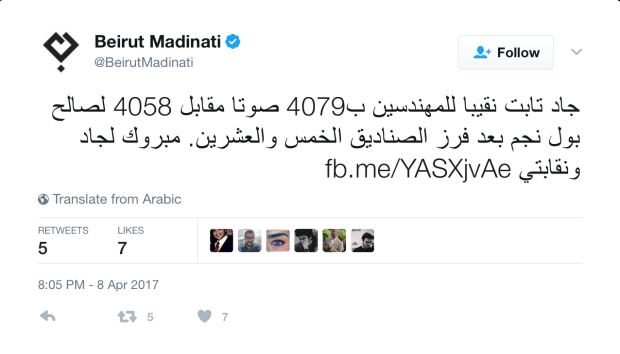
That step, today, is the resounding triumph of Lebanon’s civil society movement in the Beirut Syndicate of Engineers Elections, in a list they called Naqabati, represented by Engineer Jad Tabet, over a list headed by Paul Najm, who’s backed by all political parties in power.

After a grueling electoral day, and a rather quick vote count aided by the use of electronic vote tabulations, Jad Tabet narrowly beat Paul Najm by about 21 votes:


This is a resounding victory. To have civil movement be this victorious over all political parties combined shows that if we’re united, we can achieve the results we hope to aspire at levels we had previously not dreamed of.

Naqabati’s campaign has been exemplary in how syndicates should be running in the country. They’ve been inviting press and engineers to attend their events in which they announced very clear platforms, geared towards giving a chance towards young engineers at making a dent in a field where hierarchy, as is the case in the remainder of Lebanese jobs, is key.

Jad Tabet wanted to help the youth. He wanted to restore his profession’s dignity and rights away from the uselessness of political parties. Today, he succeeded.

This is not a victory only for engineers. This is a victory for all of us to look up to. Yes, we can. Jad Tabet and Beirut’s engineers, thank you for showing us that.

Here’s hoping we can take this victory and turn it into parliament seats in the vote that matters most. We are the change that this country deserves, and we are about to bring it.

Mabrouk Jad Tabet. Mabrouk Naqabati.

Beirut Will Have Super Fast Internet On April 9th, 11th and 13th; Other Regions Starting April 15th

Make sure you download this blog’s iOS app to stay up to date! (Link). 

Let me start by saying this: Imad Kreidieh is the example of a Lebanese official that we need more of in every form of governance. Not only has he put his predecessor to shame in the 8 weeks he’s been heading Ogero, but he has also done so to every single Lebanese politician with how he has been clear, thorough and keen on making sure transparency is key in everything he does.

As such, Mr. Kreidieh held a Facebook live Q&A which you can watch in its entirety here:


In the parts that are relevant to us as consumers without all kinds of tech backgrounds, the highlights are as follows:

  • New plans with faster speeds and bigger quotas as well as reduced pricing should be available in the next 2-3 weeks pending a decree from the Ministry of Telecommunications.
  • Internet will not be as fast as it can be until infrastructure is changed, notably that of exchange sites (or centrals). The project regarding this will have its tender on April 19th with implementation following soon after. Drastic improvements should start being available in the Fall of 2017.
  • Unlimited internet might come back to Ogero users.
  • New ministry decree will slash the one month wait period between switching ISPs (Switching from Ogero to someone else or vice versa).

As for things that we will get to experience sooner rather than a later, Mr. Kreidieh announced opening up all of the possible internet speed in Beirut on three separate days, which will be April 9th (this Sunday), April 11th (next Tuesday) and April 13th (next Thursday).

Each day will see a different part of the Greater Beirut area receive as fast internet as possible, depending on how much your line can handle.

The regions are divided as such:

  • On April 9th: Badaro – Mazra3a – Elissar – Mrayjeh – Jdeideh -Hazmieh – Ras Beirut – Riyad el Solh.
  • On April 11th: Furn el Chebbek, Bir Hassan, Hadath, Amrousiye, Adlieh, Hamra, Choueifat, Nahr.
  • On April 13th: Dawra, Sin El Fil, Chiyah, Achrafieh, Mina el Hosn, Ras el Nab3, Dekwaneh.

Of course, since Lebanon isn’t only Beirut as one of the people asking Kreidieh said, other regions in the country will have on Sunday starting April 15th to benefit from the same event whereby internet speed will be uncapped with each user getting as fast a service as possible depending on how far they are from the exchange.

Faster speeds will be available from 8AM till 8PM and feedback is requested either on Twitter at @ikreidieh, or by emailing ogero on thepeople@ogero.gov.lb or at Ogero’s Facebook account, which you can access here.