The Lebanese Fathers Who Hate Their Daughters

I didn’t believe when I was told she was getting a divorce.

The initial thought that crossed my mind, in sectarian Lebanon, was the how, given her sect. I then asked the why. They said her husband was beating her up. I would have never told. I knew her for a very long time. I knew her husband for considerably less but he never gave the impression of being a wife beater.

Or that could have been the reason why she liked wearing longer sleeves than usual during the times when long sleeves were intolerable.

What will happen to the children? I asked. Nobody knew. They said they might split custody. Others said their father didn’t have time to take care of them. In a few weeks since she took her decision, she became a single woman with children to support in a country that doesn’t accept cases like hers.

And I couldn’t have been prouder of her: standing up for herself, her body, her bruised arms, her children, their sanctity and all of their well-being.

I figured things could only get better for her now: she had family that should help her get back on her feet, she had the support needed to recuperate from months or maybe years of abuse, she had the strength to make herself whole again.

How wrong was I?

Her father was a man of ambition. He sought office many times. Sometimes through proxies whose campaigns he orchestrated, other times by running directly. His ambition surpassed the confines of the town in which he acted but he knew he wouldn’t get farther than that. He tried nonetheless, expanding his repertoire of friends to a growing list of much more influential men who gave him purpose, who gave him lists to drop in conversation, who gave him fake importance which he mistook as influence.

And her father beat her up as well.

He beat her up when he knew she was getting a divorce.

He beat her up when he knew she was going through with the divorce.

He beat her up when he knew she had custody of her children.

He beat her up when he asked her to stop the divorce and get the children back to their father and she refused. He beat her up so much that her ailing mother came to stand between them and was slammed across the floor, as she was withstanding for years, despite the chemo coursing through her veins and the cancer killing her insides.

He beat her up because he felt it gave him power, because he figured it would straighten her behavior.

She feared he’d beat her up if she visited her mother in the hospital. So she didn’t visit.

She feared he’d beat her up if she visited her mother to take care of her on the days her husband had her kids. So she’d wait in the car until he left before she’d sneak in.

She feared he’d beat her up if she did anything that he would think was out of the ordinary so she never did.

Her husband beating her up was something. Her father, on the other hand, was something else.

His abuse diffused to her siblings who mentally abused her as well. He rendered her a doormat on which they stepped every time the woes of life overburdened them. And she took all of it anyway.

Then, when it all became too much to bear, she decided to seek help. So she went to a lawyer. How can I sue both my father and my husband, she asked while clutching the medical reports detailing the abuse she was withstanding. The lawyer advised her not to. If you sued them, he said, the law will say there’s something wrong with you because they both beat you up.

There was nothing she could do. So she kept on taking it, hoping that one day things will get better.

That father is one of the Lebanese fathers who hate their daughters, who don’t deserve their daughters, their wives or any of the women of their lives. Those are the fathers who should stand by their daughters, forcibly weakened by society and by law, regardless of whether their daughters are in the wrong or the right, but not only fail to do so, they stand against their daughters forcing them to go down to where society put them. Those are the fathers who perpetuate the weakness that society has inflicted in our women.

I hope for a day when she wakes up and find the strength she has, despite it all, somehow rewarded. Until then, may her god be with her.

The Closing of Ghost & Lebanon’s LGBT “Crust” Activism?

“Gay people should not exist. They are an abomination.” Raise your hand if you’ve heard this countless times in your life.

It doesn’t matter what your sexual orientation is. Homophobia is entrenched in Lebanese society and pretending it doesn’t exist because you live in a more “liberal” place in Beirut doesn’t mean it’s not there.

People see someone wearing something they may not fancy and they say he’s gay. People see a girl with super-short hair and not-so girly clothes and she’s a lesbian. People see two close friends from the same gender walking on the street and they’re automatically dating.

And sometimes, when someone has enough power, they act out on their homophobia. It’s very easy to freak out how someone as homophobic as the mayor of dekwane, the newest a place to close down a gay pub, made it to office. But is it any surprise?

Is it any surprise really and honestly that your security task force, which has no problem wolf-whistling your women on the streets, also has no problem in violating people that your law considers as “unnatural?”

I had no idea what “Ghost” was until today. I asked a few LGBT friends the following question: if it had been a hetereosexual place, do you think it closing would have been justified if the same stuff were happening in it?
They answered yes. The question begets itself: is it okay to do whatever people did at Ghost just because it’s a gay place?

Of course, Ghost closed down because it broke one particular Lebanese law, not the many others that, in any normal setting, should have counted. Of course the mayor wanted to protect his city against the “louwat” and whatnot. And you know what’s also interesting? For everyone person outraged by what happened and by what that mayor said, there are many more others who were just convinced to re-elect that mayor. No amount of Facebook sharing and Tweeting will change what people believe in deeply, surely and resoundingly: gay is not right and should not exist.

You know what’s the best way to tell a homophobic official to go to hell with his decisions? To have the law on your side to protect you, to have a law that doesn’t label you as an inferior human being just because of who you want to sleep with.

Until a time when closing down pubs because they’re gay-friendly becomes illegal and raiding cinemas because someone thinks “unnatural” things are happening there becomes not allowed, isn’t getting up in a fit because of those events happening while forgetting the base of the issue sort of like crust-activism whereby the small victories that might result are celebrated but the underlying cause for the struggle leading to those victories remains?

Until a time when homosexuality is removed form Lebanon’s penal code and homosexual men and women are not considered in law with a prefix, pubs will keep closing and cinemas will keep on being raided and activists will keep on panicking. It’s a cycle that will repeat itself indefinitely – until Lebanon’s LGBT community manages to get LGBT-friendly officials on their side in order to advocate for their rights and make laws that can be shoved in the mayor of Dekwane’s face.

I don’t see that happening anytime soon.

Lawless Mayhem on Bliss Street

Just when you thought some aspects of our life as Lebanese couldn’t get more hectic, Beirut comes again to surprise you.

Triple parking? We got it. Further breaches of the smoking ban? Yes, we have that too.

A friend of mine recently sent me the following pictures that she took over at Bliss Street, next to AUB:

Al Kahwa - Indoor Smoking Al Kahwa Indoor Smoking


Bliss Street triple parking Beirut Bliss Street - Triple Parking

She was harassed by the valet parking people for taking picture of their triple parking on the street, effectively limiting the road to only one lane which is not nearly enough for the cars that cross on that busy path.

To make things even more interesting, the valet parking worked for a restaurant called “Al Kahwa” which was also blatantly breaching the non-smoking law with hookahs and cigarettes being present everywhere.

They tried to contact the tourism police number for both violations but they found no answer in the several times they attempted to call.

My question is the following: how is it acceptable that a valet parking service would effectively block an entire street and not have anyone with a badge or some form of authority tell them off? And how is it possible that our restaurants keep breaching the smoking ban without caring the least about someone to tell them off?

Maybe it’s time to say, “khlosna ba2a?”

What’s The Legal Limit of Cyber Lebanese-Israeli Contact?

In the age of the internet, we, as a Lebanese, are bound to stumble on Israelis who are just like us – browsing around – and many of them actually reading the blogs we write, the pages we share, possibly even following us on twitter and others befriending us on Facebook.

For example, in the past few months, I’ve gotten over 3000 users from Israel to read this blog. And I cannot not allow it. And frankly, I don’t mind them reading.

I don’t have Israeli Facebook friends – I felt like this had to be put out there to prevent any sensitive folk from starting to hurl treason charges from the get-go.

My question is simple: when does our internet interaction with Israelis become illegal? Is replying to a comment by an Israeli on this blog considered illegal? What if I didn’t know he was Israeli? Am I supposed to track every user’s IP to know their country of origin? Can I not reply to emails by readers who happen to be Israeli and who are telling me that they enjoy what they have to say?

I’m not advocating normalization. In the case of war, I – Elie Fares – would be the first to support whoever wants to defend my country because they are, at the end of the day, my people. But don’t you think that worrying about an email or blog reply to another person who might as well be just like us is taking it too far?

This reminds me of a day when I was searching for an article to read about Lebanon’s oil reserves. One of those articles was on Haaretz, which required you to register in order to be able to read the article. And I couldn’t register because I didn’t know if that would be considered illegal as well. Is that normal? Is that how things are supposed to be?

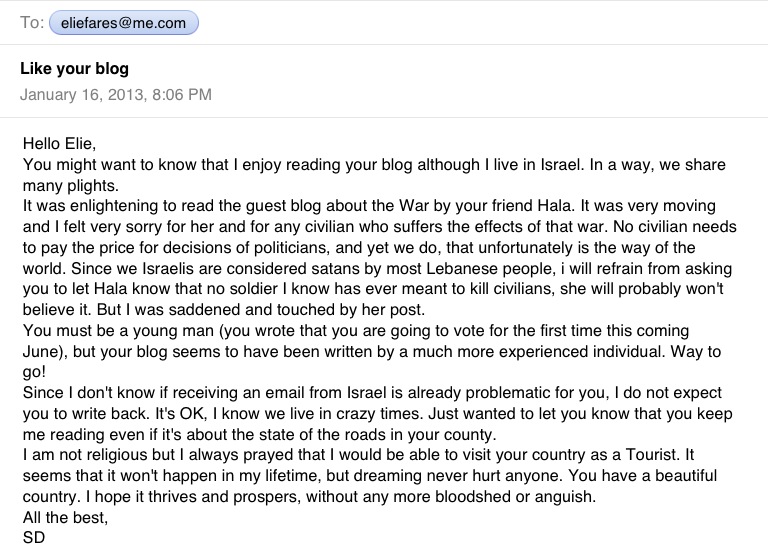
I recently received an email from an Israeli whose name I won’t mention – and the email was touching. People advised me not to reply. So I didn’t. But I really, really wanted to. Not because I “approve” of the state of Israel. Not because I want to leak out information which I don’t have. Not because I want to feel a rebel in doing so. But because the following email really does warrant a reply as decent as the email itself:

LebanoN israel emailSo here it goes.

Dear SD,

Thank you for your email. I’m sorry I couldn’t reply earlier and I believe this isn’t quite the reply you were expecting. But it’ll have to do for now. I was told not to reply via email. Others told me of a workaround that couldn’t be tracked but that would have been way too fishy. So I figured I’d do it here, out in the open, because I really have nothing to hide. This is, after all, a simple reply to an email.

I sent this Hala’s way. She didn’t have too many kind things to say which is understandable if you ask me because she’s the one who was hurt due to repeated wars not me. So I will never fully understand what she has gone through. But she has said this with which I agree: “We know that human beings do not enjoy killing each others unless they’re sick people, your soldiers follow orders, they fear orders, they are taught to be obedient for their “cause.”

I am not as young as you think I am – voting age in Lebanon is 21 and I’m already beyond that point. And thank you for always reading – even if it’s about the road state in my country.

I’m afraid your wish will never happen in our lifetimes. It’s the way things are. But I know many Lebanese would love to visit our enemy to the South.

Best,

Elie

So what is our legal limit as Lebanese when it comes to internet contact which is becoming frequent lately with Israelis? Where is that line that we don’t really want to cross?


LBC and the LF: Don’t Celebrate Just Yet

There was a news item which overtook Friday’s Achrafieh bombing today and that’s the judge ruling in the lawsuit between the Lebanese Forces and Pierre Daher, the head of the Lebanese Broadcasting Corporation, who was accused by the LF of abusing the trust they put in him when they handed him the TV station which was founded by their founder more than two decades ago.

A similar ruling had been given last year but Pierre Daher chose to take it to higher courts. LF supporters seem to think that today’s ruling is the final one in the case. Simply put, it is not. According to Agnes Sema’an, a good friend of mine who recently graduated from law school, there are more details about the ruling which seem to have escaped most people.

This is apparently an indictment which came out from the criminal division of the court of cassation (temyiz). It declares the previous case, whose ruling turned out to be in favor of the LF, valid. The argument presented by Daher  at this court was that time had passed on the events that were being argued which makes the initial case invalid; LF argued that Daher should be arrested for fraud and embezzlement.

This opens the way to the ownership trial which means that the case will now be forwarded to the single criminal judge of Beirut and he will look into it. That judge will listen to witnesses and he’ll be given documents by both sides to prove their points and he will give a ruling which might go either way – however, his ruling can go to the appeals court.
The appeals court, also, has way too many ways with which it could advance. So the LF have won a fight in a battle that has not ended yet and will keep going for months to come. Headlines that say “LBC is owned by the LF” are erroneous. LF supporters should not pop champagne bottles all over Facebook just yet. There’s still a long way to go.

But the real question is: what will this mean to LBC as a TV station if it returned to the Lebanese Forces?

If we go by other Lebanese TV stations which are handled by political parties (Future, NBN, Al Manar, OTV), this means that the quality of LBC as a TV station will degrade rapidly. Most of these TV stations are unwatchable due to their extreme bias and ridiculous one-sidedness so even if the TV shows that are offered remain at a certain relatively high standard, the news won’t be. I expect the viewership of the TV station to decrease the more biased its news service becomes.

I also expect a lot of political hiring and firing to happen. Many LF-supporters searching for jobs will suddenly find a spot for them in the midst of LBC. It has already started with my Facebook timeline filled with excited mass communication majors who also happen to be LF supporters and for their supporters to be hired, others have got to go. How disappointed will those people be when they find out that it won’t be that imminent.

All in all, while it is perhaps the Lebanese Forces’ right to own LBC, I have to wonder if it’s the best thing for Lebanon’s leading TV station to become deeply and politically involved? One thing is for sure though: even if the LF end up winning the whole thing, it will not be an easy walk in the park for them to run a station.