Can We Get Over Beirut Being Among The World’s Best Cities?

20131019-190524.jpg

I’ve debated whether to write this or not. Then whether to publish it or not. Then I figured, screw it.

I am a proud Lebanese. And it’s because I like my country that I can’t sit aside and pretend that fake accolades mean more than they are, that void accomplishments are fuller than they actually are.

Beirut isn’t a bad city, sure. It’s perhaps the best city that we have given that our centralization policies have put everything only in and around it. But, forgive the bluntness, there’s no freaking way in hell Beirut can find itself on a world’s best cities list. Unless the person doing that list was high on some Bekaai hashish.

Beirut recently found itself to be on a list of the world’s top 25 cities, courtesy of CN Traveler. Those same people, for those who remember, voted Byblos as the #1 city in the region, with Beirut coming in second. Take that Dubai! We celebrated back then. That little triumph our cities had, although meaningless in itself, meant a lot to us.

Beirut is given the following description as per the CN Traveler website:

The capital of Lebanon has “much to offer the adventurous traveler.” Find “exotic cuisine and cocktails” at the “most exclusive clubs in the world” in what one reader calls “the Paris of the Middle East.” This city offers a “tapestry of sects, religions, and lifestyles that provide a feast for the mind of the intellectual.”

Visiting Lebanon is for the “adventurous,” it seems. I didn’t know my country was such a wild ride. Point me to the next safari why don’t you?

Perhaps Beirut is a great city for a visitor who came here to experience our unparalleled joie de vivre with someone who decided to show them Gemayzeh, Skybar and White, then spend a weekend in Faghaya, pretending that’s still Beirut, before spending the day at some beach that has more plastic than in the bodies of the women strutting their heels in its sands.

Yes, that sounds great indeed.

I don’t know what criteria were employed to rank the cities of that list. But the mark of the greatness of a city isn’t by how well and how great it treats a tourist coming to it for a week. It’s by how great it is for someone who lives there and calls that city home.

When I think of Beirut today, I think of unparalleled urbanization. I think of concrete masses upon concrete masses. I think of cultural demise that manifests in monument demolitions and old houses getting ripped off their foundations. I think of so little monuments that need to be seen in the city. I think of no public transportation. I think of no electricity, no water, of traffic, no public spaces and parks.

When I think of Beirut today, I’m being told I should think of Skybar and Dubai-esque malls because that’s what my city has to offer lately. I’m not sure how that qualifies as greatness honestly. Or I could just be the rare Lebanese who doesn’t like pubs and night clubs and all their derivatives.

Don’t let some silly list fool you into believing the city we call home doesn’t need massive plans, massive reforms, massive work, massive restructuring. Because what Beirut is today, a city living off the ghost of its luxurious past, is only great in the eyes of its beholders. And that’s not really great.

Lebanese Girls Are Not Easy To Get

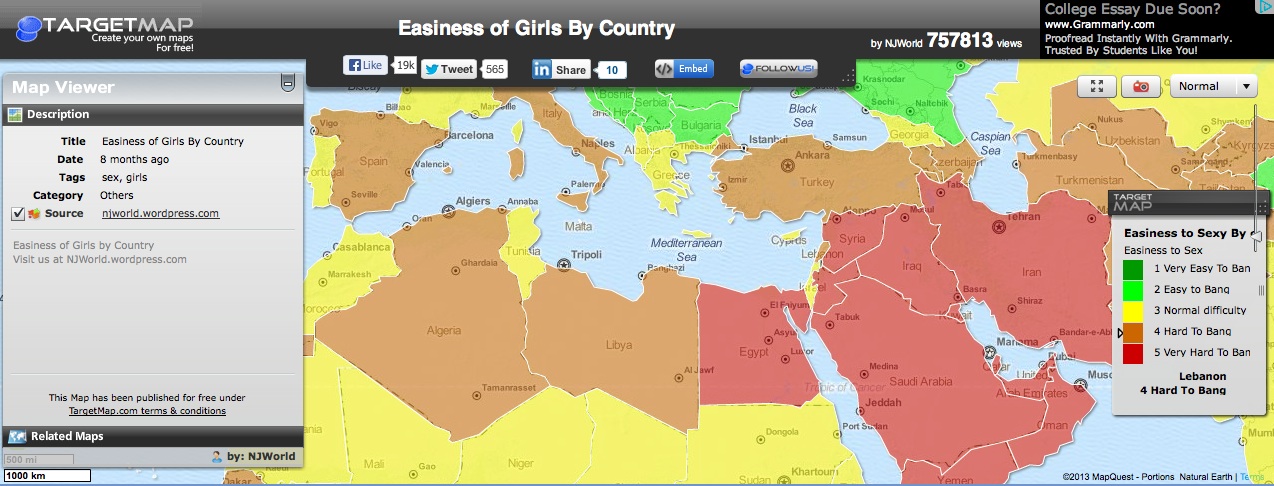
A map has surfaced recently, championed by the work of a sex tourist called Daryush Valizadeh, that grades women across the world by the level of how easy they are to be picked up.

Sounds sexist? You bet. Sounds wrong as well? It does on so many levels.

I’ve checked the map out of curiosity. It has went viral in the past few days. I have no idea on what basis it was constructed but people seem not to care. The map itself might as well serve as a “where you can rape” guide for men who have no inkling on what it means to hold it in.

But I figured I’d check where Lebanon stands. Our women, whose reputation has been tarnished by folks of the region who view anything that doesn’t fit their mold as promiscuity, are anything but the promiscuous kind that many love to portray them to be.

You can check out the map here.

lEBANESE girls


Regardless of what such a map might mean, Lebanon remains a country where sex is a taboo. The joke goes as follows:

Most Lebanese guys I know:
– Are you with premarital sex?
HELL YEAH!
– Would you marry a girl who had premarital sex?
ARE YOU INSANE?

I don’t see that changing anytime soon.


A Lebanese Meditation House Is The World’s Best

I recently stumbled on a gallery that featured the winners of the World Architecture Festival, which took place in Singapore in early October, and which awarded the best architectural projects of the world that took place between January 2012 and June 2013. The projects didn’t need to be built in order to compete.

A Lebanese project, as I’ve found out, was chosen as the best house among future projects. Designed by MZ architects, the meditation house looks quite odd and definitely not anything we’re used to as Lebanese. It’s made as something that blends into its surrounding hills and mountains, doesn’t challenge the location it’s in and provides its owner a means for him to feel closer to God.

The house also has a room which is dug vertically into a nearby cliff. The house itself, it seems, satisfies the requirements of Islam without it being anything typically Muslim. The vertical room is akin to a minaret. Its location, overlooking its surroundings and the seaside, can be considered to be a dome and the direction towards Mecca is conserved.

You can check out more information about the meanings behind the house here.

Check out the following renderings of what the house will look like. I personally wouldn’t want my house to be like this and I’m definitely not an architect in order to appreciate the work that has gone into it. But at least this is a ranking that matters.

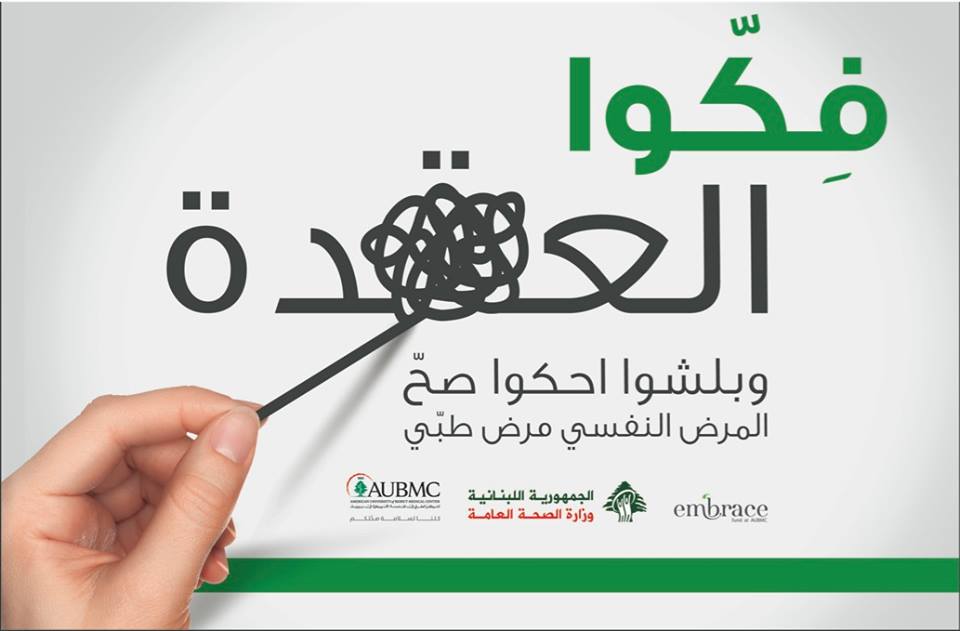
Fekko El 3e2de

Fekko el 3e2de

When it comes to mental health, Lebanon has a long way to go. My rotation in psychiatry at one of the country’s hospitals has opened my eyes, as I wrote about here, to a domain of medicine that many don’t want to believe exists, preferring to even have cancer than a psychiatric disorder.

Families, in 2013, would rather revert to exorcisms in order to tackle issues with their sons and daughters, rather than take them to doctors. Explanations of demons instead of some chemical imbalances are preferred. The stigma of the word “insane” haunts any other demon-less explanation.

The victim in all of this, apart from the patient, is our ability to truly advance as communities, especially as we tend to believe that not calling a disease by its name makes it all okay.

Technically independent from AUBMC, the Embrace fund is trying to change how Lebanese view mental health and they’re resorting to a great campaign, in my opinion, that they’re titling: “Fekko l 3e2de,” which translates literally to untie the knot, referring to the “knot” that mental health perception imposes on Lebanese societies.

They’ll be having a gala dinner in a few days to support their campaign, with a performance by Ziad el Rahbani. Find the details here.

This Website is Banned As Per The Lebanese Ministry of Telecommunications

Picture via @ohmyhappiness, click for full size.

Picture via @ohmyhappiness, click for full size.

Yesterday afternoon, Twitter user Raja Farah was busy researching late Lebanese politician Habib Pasha Saad when he stumbled on a page that wouldn’t open.

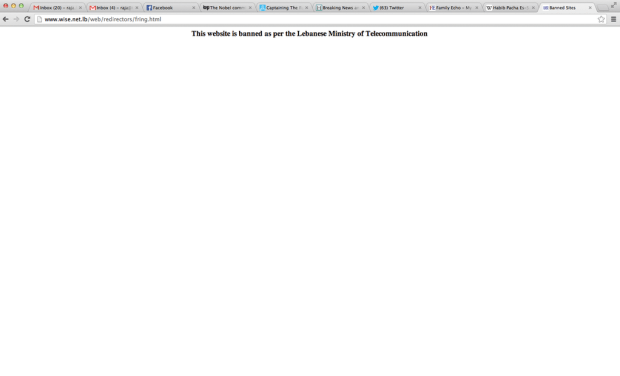
The notification as to why that particular website was unaccessible was a simple prompt: This website is banned as per the Lebanese ministry of Telecommunications. The above screenshot is what he got.

Using modern technology, which seems to have escaped our ministry of telecommunication, I managed to access the website in question. It turned out to be a directory of people: trying to build family trees, connect with relatives you may not know, etc. There was nothing more to it and definitely nothing less since it was pretty bland as it is. And yet, the website was banned. I tried to access it using a different ISP and the website would refuse to load even though my internet connection worked quite well.

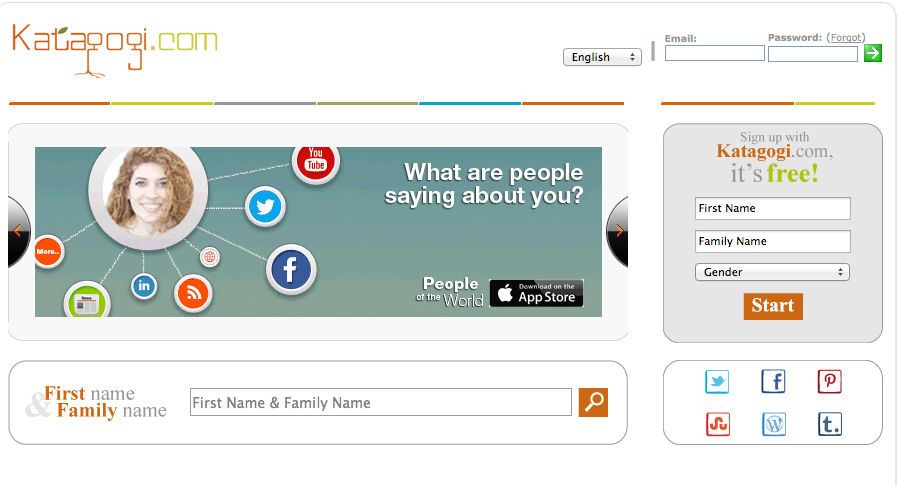
katagogi.com

The page Mr. Farah was trying to access had nothing striking as well. I managed to procure the following screenshots of its content. As you can see, there’s simply nothing there.

Yesterday as well, it was revealed that another website was blocked as well, pertaining to the Mansour Labaki scandal. You can check out the details regarding it here. The Mansour Labaki website also has next to no shocking content. It provides next to nothing new on the case; it doesn’t give any new information, it doesn’t give any proof as to what the man did. It is, however, not accessible for anyone whose IP address is Lebanese.

Ladies and gentlemen, it seems we have more things to worry about when it comes to censorship in Lebanon than the banning of movies, books and possibly some music. It was only recently that they removed two movies out of the Beirut Film Festival because they didn’t fit with the moral code they want to enforce on all of us. But we now have another big brother watching over our heads in order to make sure we get “proper” exposure: our ministry of telecommunications.

I remember well when that same ministry made itself  the knight in shining armor fighting for my rights as a citizen to have my data remain private from security personnel who wanted to use it to fight terrorism. But there are other rights that pertain to me, as a citizen, which seem to be trampled on left and right. What right does anyone have to grant or restrict access to any sort of information to me? Isn’t this a violation to one of my fundamental rights as well?

How many websites already exist that we can’t access because someone out there decided that we had inadequate intellect to handle their content? What criteria is followed to decide that we, as a Lebanese population using our dismal and detrimental internet services, should not be allowed to access this website and not the other? What right does the minister of telecommunication, or whoever decides these things, have in order to decide whether a website should or should not be allowed to the general population?

They tell us day in day out about how our internet and telecom services have improved recently. They brag about 4G, about prices dropping and whatnot.  We have faster internet to access less and less websites. It starts with the ones I listed here, but who knows where this will go?

We have 4G and better 3G, supposedly (the reception in my hometown would beg to differ). But bringing in 4G phones into the country, or any phone that you want, for that matter is simply going to hell and back (link) with regulations upon regulations whose only purpose is to make your life as an irrelevant citizen harder while not making a dent in the business of those who’re supposedly targeted by these rules.

This isn’t about politics. I couldn’t care less who’s the current minister of telecom, who was before him or who might come after him. As I look at this, a clear pattern unfolds in front of me: the supposed advancements in the telecom sector we are having are coming at the expense of my personal freedoms as a consumer and as a citizen. The more we’re “advancing,” the more we crave for how things were before all this “improvement.” True advancement is giving people choices. It’s giving them full access to everything they need to formulate opinions. At this rate, I’d say take back your 4G and give me those choices for that is true advancement.