Annahar’s 80 Years Anniversary “Little Leaders” Ad… Stolen?

I loved the recent ad by Annahar for their 80th anniversary, featuring different Lebanese politicians during their early days – with slight jabs at how they turned out today – then ending it with one of the most spot-on taglines I’ve recently seen: We were writing history when they were just children.

The ad, however, it turns out is not as original as I had hoped it would be. I was recently sent the following UN ad for refugees, dating back to 2009, featuring a very similar theme that is centered around important characters as children:

Advertising is definitely not within my scope. But is it really difficult not to get this loosely “inspired” from other people’s material? Have ideas become this scarce? Or do those running such ads believe their original source would never be uncovered?

Either way, despite the Annahar ad being extremely effective, I – for one – am disappointed it didn’t turn out to be the stroke of genius I thought it was.

Lack of Money Can Cost One Year Old Elie Sadaqa His Life

One year old Elie Sadaqa is suffering from a form of vasculitis – inflammation that affects blood vessels – and his parents, like so many others in Lebanon, cannot afford the medical measures required to save their son’s life.

I don’t have more information on the child’s diagnosis to explain it. LBC had listed it as temporal arteritis – a condition that affects one of the arteries reaching the head – but I notified them that such a diagnosis is unlikely given its age of onset is usually above 50. But exceptions in medicine do exist. They have since changed their wording on their news link.

According to the child’s father, the lack of a medical code for the procedures required to help Elie – a pure bureaucratic measure – means the ministry of public health in the country won’t cover it. I guess they need any excuse not to pay the approximated $150,000 for treatment. Or it could be that Elie Sadaqa simply doesn’t have the required wasta to save his life. Welcome to Lebanon, where your life is contingent upon your connections.

Elie Sadaqa is not a lone case in the country. Lebanon has next to no primary care. Our hospitals are in competition amongst each other and many of them are, as such, so specialized they are borderline unaffordable to people who don’t have insurance, aren’t super rich, or – like Elie’s case – do not belong to the inner circles of the minister of health.

What will happen to Elie Sadaqa? I can tell you that it’ll take some doctor with very, very good intentions to help. It’ll take a hospital who puts aside the business aspect of medicine for a moment. It’ll take a lot of people who are willing to pitch in with whatever means they can afford. The question, though, is what happens to the other Elie Sadaqas whose stories don’t make it to national TV amidst the situation of medicine in Lebanon today?

LBC hasn’t listed a way to help the family so if anyone knows how, let me know. And for those who are interested, I intend to write an article soon detailing why medicine in Lebanon is the way it is. Until then, hopefully Elie Sadaqa finds the ways to grow up, go to school and give joy to his family and friends.

112 Foreigners Get Lebanese Citizenship. Children of Lebanese Mothers? Nope

There are a lot of injustices that take place in Lebanon daily. For the past few days, it has been the horrid traffic that has overtaken the Lebanese highway due to some serious incompetence – is that a shock? But I daresay a bigger injustice has taken place recently, one that reflects the serious inequality that half of our population goes through daily.

112 people  were granted the Lebanese citizenship yesterday via a presidential decree. Many of those 112 people are from Lebanese origin and as such should get the Lebanese citizenship. Others, however, are most probably not as is the case of Mary Fontinato, an Italian.

I have no idea what criteria are employed to grant citizenship to foreigners in Lebanon as I don’t believe there’s a clear path to citizenship here. To be honest, up until yesterday I didn’t know anyone wanted it.

Mary Fontinato, incidentally not the only woman granted the citizenship yesterday, is an odd case indeed because her children – if any – will never be able to have the honor of being Lebanese bestowed upon them like her. Such a bummer, yes I know.

The list of people who were granted Lebanese citizenship also contains many Jordanians. Those of you who have now gotten worried about the country’s fabric, fear not: the sectarian composition of the list is well preserved. For every “Muslim” addition to our country, you’ll find an Italian priest or a French “Francois.” Lebanon is anything but atypical in that regards.

The list of 112 “foreigners” who were granted citizenship does not contain the children of Samira Sweidan, a Lebanese mother who tried for years to get her government to acknowledge the existence of her children. A judge, who ruled in her favor, soon had his ruling overruled by a governmental decree for it being unconstitutional.

Samira Sweidan is one in a sea of Lebanese mothers who cannot pass on their citizenship just because a solution around the Palestinian dilemma has yet to be found. My cousin, an American, recently got married to another American. Her children will never be Lebanese. My other cousin will soon be married to another American – and her children will only know of their mother’s homeland only by name and the occasional visits, if any.

I’d like to think that our president felt a tinge of regret as he signed that decree into effect. I’d like to think our prime minister thought about all the Lebanese women who have been fighting for years to get to where those 112 people got. I guess I’m being too sentimental. Why would anyone who’s American, Australian, Italian, Austrian or any other decent nationality want the Lebanese one is beyond me.

Check out the list of those 112 people here (Arabic link).

Demonstrate For Peace, Live from Beirut, Online

Demonstrate for Peace Beirut

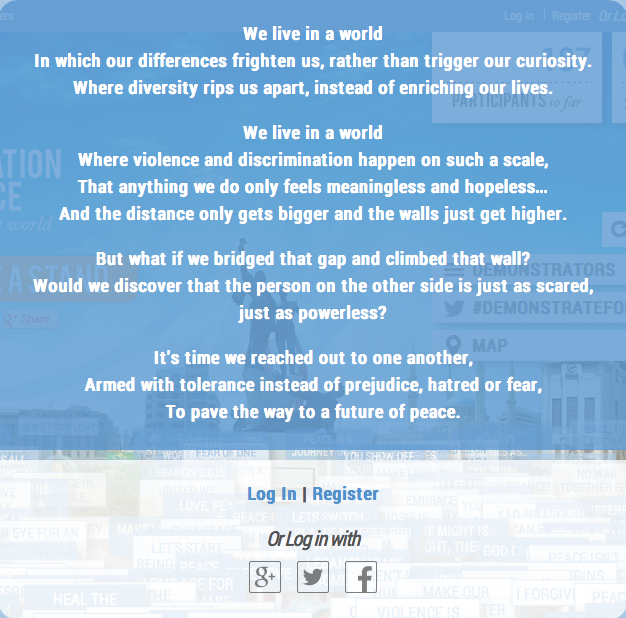
The next age of protests is upon us. A new initiative has made its way online today, called Demonstrate for Peace, which calls on an online gathering on September 21st in order to protest for peace. It will be the first of its kind. It is orchestrated by the United Nations.

You can join the movement by following this link. This demonstration, despite the website listing Martyr’s Square, will not take place in any physical locations in Lebanon but is simply Lebanon playing its part in International Peace Day.

I have to ask: what effect could such a rally truly have? Is an online protest as efficient as a real life one that requires people to go down to Martyr’s Square and ask for peace using their voices, not their keyboards? Or does the UN know that such protests may not be as effective or as enticing to people?

I’m not really sure what a protest such as Demonstrate For Peace could do, especially that real life protests – complete with bloody faces – in this country have failed to do much as a general rule of thumb. But I guess there’s no harm in logging in with any social account and expressing the simple and extremely important need to live in peace, especially in a country like ours. I assume we’ve all come to appreciate the beauty in the quietness of these past few days, which have been oddly calmer than their predecessors.

Demonstrate for Peace Beirut 2


Let’s hope that those who actually dictate peace log in as well?

Lebanon’s Phone Registration Procedure Needs To Be Rethought

My iPhone 5 fell in water almost a month ago. I didn’t know, so it sat in a puddle absorbing all the moisture it can get until its screen went bust.

We don’t have certified personnel for the iPhone in the country who can fix it and I’ll be sure they’re providing the best possible material. The man I took my iPhone to wanted to switch the screen to something that looked fishy, cost $200 and didn’t even work that well. He blamed my phone.

That same screen would cost about $300 in places around Beirut. So I decided to follow my instinct and send my phone to my family abroad for an out of warranty replacement, which is what happened.

The phone was brought into the country by an old man I barely knew and who had no idea he should register the phone at the airport. I figured it’s not a big deal, I’ll just take my passport the following day and head out to the nearest telecom center to get the procedure done.

That wasn’t possible. My passport didn’t work because I had been in Lebanon for more than a month since I traveled last. Obviously, dragging the 85 year old man who brought in the phone to one of those centers was out of the question. So what was I supposed to do to get my phone working on our networks?

I was lucky enough to know an exchange student who had been in the country for two weeks. So he did me a favor, fetched his passport and registered the phone for me. The process, advertised to be easy and seamless, took half a day and several car trips around Beirut just for something that should be second nature to anyone who gets a phone: the device getting reception. I have no clue what I would have done hadn’t the exchange student been available.

It is said these procedures are to prevent illegal smuggling of devices, provide another source of income for our government and basically make our life “easier” when it comes to phone purchases. But is that happening with phone prices taking a hike and the procedure having many parts of it that are apparently not thought out?

What if a relative sends you a gift from abroad with someone you don’t know at all and that person doesn’t register it. Are you supposed to take a trip to Syria just to get your passport stamped in order to get your phone to work?

I checked the online brochure the ministry posted back in May to see if there was a workaround on the matter. There was none. If you purchased a device online, you’d have a way to get it registered after paying the exorbitant taxes and using the customs’ receipt. But you’re basically out of luck in case you don’t have a recently stamped passport at your disposal.

Buying a phone and getting it to work by inserting a sim is apparently too simple for a country like this. But it’s all okay as long as we keep providing revenue for the government.