Day One: Rebuilding Tripoli

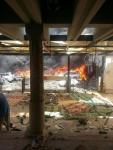
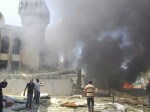
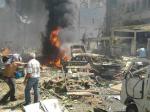
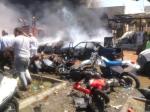
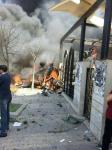
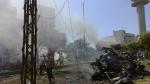
Day one post two blasts that killed 45 of its sons and daughters, this is Tripoli.

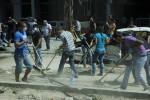
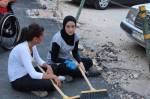
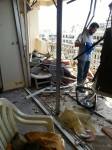
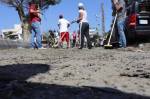
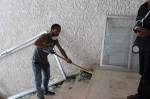
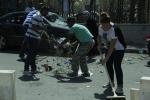
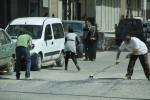
This morning, these young men and women are not pointing fingers and expressing blame. They are not sinking to the sectarian rhetoric that many people believe will change how this country is going. They are mourning their city in the way they know best: by cleaning up the rubble and the destruction so they can at least have part of the place they call home back.

For many Lebanese, Tripoli is a city that exists way up there, beyond that army checkpoint, that we don’t need to visit. For many Lebanese, Tripoli exists only as a city that is ravaged by Islamists and militants and violence and destruction. But this city, which currently sits in a near-comatose situation, is – thanks to the efforts of those young men and women – trying to get its spirit back, fully knowing that it may not be for long in a country that has become nothing more than the playground of the struggles of others.

Today, I will not bore you with political extrapolations about what might have been and what could be. I won’t state of the obvious and remind everyone how bad the situation is, something all of us know and live. Today, I salute those young men and women of Tripoli who, in that simple act of sweeping the rubble off the streets of their city or visiting the wounded of yesterday’s acts of cowardice, are trying their best to achieve some form of normalcy. And isn’t normalcy what we all long for nowadays?

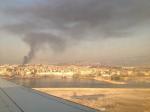
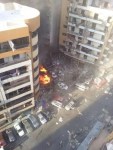
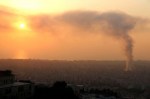
The above pictures have been obtained through this Facebook page.

Lebanon, Screw This

It’s been one week since our news broadcasts last cut out regular useless programming to let us know that a part of our country was burning to the ground following an explosion, that people were dying, that terrorism had struck yet again.

It’s been one week since innocent people lost their lives just for being at the wrong place at the wrong time. Last week, those people were shopping. This week, those same people were praying. How many more wrong places and wrong times are we supposed to accept as a justification to the absolute hell we are living through?

What is the current situation in Lebanon? I don’t really know. There’s no diagnostic criteria to follow to really ascertain how deep this goes. There’s simply a sense of “if no one I knew died then it’s sad but forgettable” that’s roaming around. Till when are we supposed to be happy that someone we know didn’t die just because he was at the wrong place at the wrong time?

Till when will our media worry first and foremost about the explosion being in the proximity of a politician’s house, one that he barely uses, then after making sure that politician was okay turn around to examine the possibility of other irrelevant casualties like you and me and then parade their burnt corpses for sheer shock value left and right – except those pictures don’t even shock us anymore?

What is this country in which you are forced to worry about doing the most mundane of things just because you might die doing them? What is this cause that needs to target people who are praying? What is this cause that needs to target people who were shopping?

Why are these causes and wars entering our country through open wide doors? Why is my country always getting screwed, always in a state of violence?

What is this need for people to start throwing blame on those who satisfy their rhetoric of choice just moments after an explosion, while the wounded are still bleeding and the victims have still to be found?

What is this life in which our mothers waste all their tears away, worrying for our sakes, while the only thing that we might have done is drive past a street that ended up becoming ground zero a few minutes later? Till when will our fathers regret not leaving and establishing our families in countries where they don’t have to worry about their sons and daughters meeting their demise on the blown up tarmac, resting on blown up concrete?

How further can our cities handle being ripped apart this way? How much more can the people of Tripoli take in a city that has not only been destroyed by gun violence but now has an affinity for explosions as well?

What is this life in which a strange car on your home street can cause you insomnia? What is this life when your own home doesn’t feel safe anymore?

How is this any different from the times they want us to believe are long gone, “tenzeker w ma ten3ad?” How further down the abyss will every single one of our politicians take us now that they have yet another opportunity to get their rhetoric to sink further, to let their anger seep to surface even more, to let people hate each other more than they already do?

All the words resonate emptily. All of our mothers’ tears fall down on useless surfaces. All of our worry won’t change a thing. All our anger won’t make a dent. All of the victims will soon be forgotten. All of the explosions are to be replaced by the next explosion which takes center stage. All of the people are to mourn in days that are becoming way too many. Nineteen have died in Tripoli today as a first estimate. Nineteen men and women and children died just because they felt like being closer to the entity they worship on a day of worshipping. If there’s really a God, He must have left this land a long, long time ago.

It’s just a bomb, again? Should we be “resilient” again? Lebanon, screw this.

Caramel, The Attack, 12 Angry Lebanese on International Best Movies Lists


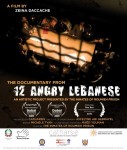
The Guardian has  published a list of the top 10 Arab movies and they featured Zeina Daccache’s Twelve Angry Lebanese on the list, with nine other Egyptian movies of which I haven’t heard.

The list’s author justified their choice for choosing the movie in it being deeply moving and full of humanity. I have to wonder why that movie hasn’t made a splash in Lebanon:

I was on the jury when this won the top documentary award at Dubai in 2009. The director is a young Lebanese drama-therapist who put on a production of 12 Angry Men inside Lebanon’s most notorious prison and filmed the long protracted process. The film was partly an attempt to reform the country’s criminal and penal laws and improve prison living conditions. It also enabled Daccache to extend her drama-therapy work to prisons across Lebanon, and she had started working in Syria shortly before the current conflict began. It is deeply moving and full of humanity, particularly in the way it describes the process of lifting men from a profound states of despair into a renewed desire to live and build a different future for themselves.

As a follow-up to that list, The Huffington Post wouldn’t take it. As such, they published their own list of 6 movies they believe The Guardian missed and included Ziad Doueiri’s The Attack and Nadine Labaki’s Caramel.

On the latter, the author wrote:

Labaki’s film was my in. I’m a relative newcomer to the magical world of cinema from MENA, having been brought up on a mixture of Woody Allen, the works of Fellini and Visconti, all sprinkled with a bit of Lina Wertmüller, and Caramel got me hooked from the first frame. It’s sensual, full of life and each time I watch it, it makes me proud to be a woman. It’s also the reason I yearned to travel to Beirut, and once I got there, I could see Labaki’s lushly constructed characters at every turn. I may be a romantic, but it’s a must watch for anyone who has yet to discover the beauty of Lebanese cinema. And its people. Labaki’s follow up, Where Do We Go Now? is also a greatly entertaining lesson in peace.

On The Attack:

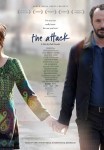
Showcased at the Dubai Film Festival last December, Doueiri’s film is currently screening across the U.S.. The tragic story, of a Palestinian surgeon who discovers his marriage may not have been what it seemed, was what engulfed emotionally, at first. But then the absurd politics that enveloped the project really drove its profound meaning home for me. Lebanon banned the film because Doueiri had “snuck” into Israel to film his project, which of course was indispensable to the truthfulness of the story. A Gulf film organization distanced itself from The Attack though it had partly financed it in development. Of course, Doueiri is now having the last laugh, because his film has been winning prizes and hearts around the world, but The Attack remains a great example of why watching a film is almost always better than watching the news.

Lebanese filmmakers seem to be doing a rather fine job at having their works make a dent abroad.  It’s great to see Lebanese cinema getting such recognition abroad, especially with movies that are not what we’ve come to believe our filmmakers only know how to make.

It is sad that a movie such as The Attack will not be screened here for the most absurd reasons. I had the chance to watch the movie while on a trip to Paris and while I wasn’t as engrossed by it as the French with whom I shared the theatre or other Lebanese who found it highly engaging, I could appreciate the need for such a movie especially given the intense discussion it spurred with the Lebanese who watched the movie with me.

I believe that’s what cinema should do: spring up debate and discussion, especially in this country and specifically when it comes to topics that are still considered so taboo that discussing them can have “treason” plastered all over you. It seems those foreigners appreciate our movies more than we do.


Spotted in Harissa: Labbayka Nasrallah

I guess it must be completely natural for religious people to go to Harissa. Even I feel like going there sometimes. There’s just something about the serenity of that place.

I also guess it must be completely natural for religious people to bring their political zeal with them to churches and mosques. Checking such stuff at home is way too mainstream lately.

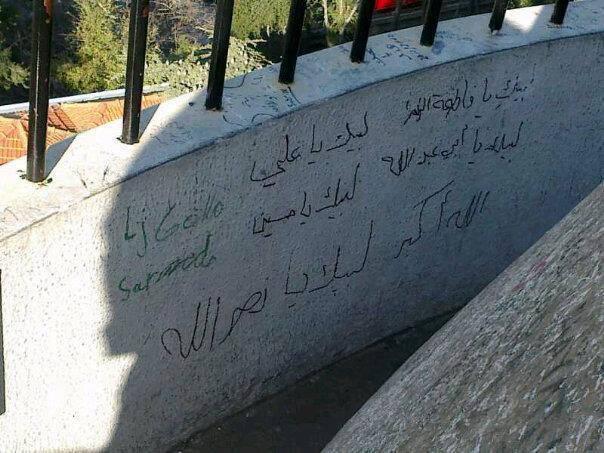
It must be completely normal also to bring sharpies, permanent markers and express such political ideologies on the walls of religious establishments because a support for a politician cannot be sufficient except when it’s coupled with graffiti.

The following was spotted at Harissa:

Harissa Nasrallah

Picture via @JessyGeagea

And to think those prayers were the worst thing being written on the walls of Harissa.


It’s Just A Bomb

I was watching a movie today.

What a mundane and worthless sentence to start anything with. But I was watching a movie today.

It was a quiet afternoon. I had seen a dear friend whom I hadn’t seen in a while. We spoke about our lives. We didn’t talk about politics. I drank minted lemonade. She drank coffee. The time passed.

But yes, I was watching a movie today. And it was a theatre full of people who were watching the movie with me. And less than five minutes from where the movie was taking place, part of my country was getting blown up to pieces, people were getting blown up to bits.

And there I was, watching a movie.

The theatre doors closed behind us as we made our way out of the complex. Look, an explosion happened nearby, my friend told me. Make sure you make your way out calmly. I looked around and people had no other care in the world. Those who were shopping were still going about their chores meticulously. The people hoarding the escalators were still doing so extravagantly.

And there I was, pissed beyond fury, trying to see if my other friend was home and if anything had happened to her.

She is 23. In statistical terms, her life is well ahead of her. In real terms, she is terrified by a window slamming, fireworks going off or anything that reminds her of the bombs she has endured for years. I was relieved to know she hadn’t gone home today. I was glad she was okay. What a fucked up country, I told her. Yes, she replied. Is there anything more redundant to say?

I checked the news on my way to my car. Many were dead. Many more were injured. No officials were targeted. It was an attack simply against people like me who decided to spend their afternoon off, courtesy of the Virgin Mary’s ascension, to shop with their kids, with their mothers, with their families or friends, just like me.

The drive home was uneventful. People were still going around their afternoon business like it was nobody’s business. Life was sluggishly going on. It was bound to pick up its pace tomorrow. I was sure all would be forgotten by next week. This is our span. I guess that’s how it rolls.

As I neared residential areas of my country’s torn capital, I could hear the news blasting off balconies as people huddled next to their TV sets. Tripoli was joining the game as well because that city doesn’t like to be left out of the big celebrations. Politicians were salivating over their upcoming TV opportunities to express their condemnation while secretly insinuating that this party’s interference here and there led to this or that other party’s condemnation of some party’s actions has led to this, while people’s flesh still burns on the asphalt and cement. But don’t you be mistaken, sympathy supersedes policy.

The people were expressing sympathy. There was a tinge of unity as so happens in the face of true national tragedies. I figure it would only be a matter of time before someone parades this. Those who wanted to express sympathy figured stating their sect at the start of their sentence would give it some credibility. Others were more worried about the potential day off tomorrow. It was, after all, a day of national mourning. Aren’t those getting way too many and springing up way too often? But what would a day do to the mother who will mourn all her life?

It’s just a bomb. We tell it to ourselves like it’s nothing. A bomb. An explosion. Destruction, rubble, death. We’re getting way too used to it. We’re getting too comfortable with the way we live around it. We’re getting too subdued in the way we just take it, brush it off and long for the day when we forget. It’s just a bomb.