Jeish Lebnen… 3askar 3a Min?

It’s quite simple really. They flaunt their strength on the people who have no one to watch their back, no militia weapons in their arms and no wasta to clear their names. They dare to beat those people up for speaking. They dare to turn peaceful protests into matters of them flexing their muscles.

3askar 3a min? 3askar 3al d3if. 3askar 3a yalli ma fi bdahro 7ada. 3askar 3a yalli fiyon yesta2wo 3leih.

Lebanese Army

Photo by Bilal Jawich

Can we excuse them? Perhaps so. After all, the level of repression of power (as to not to say castration) in the picture below is too damn high. Something’s gotta give somewhere – and some Lebanese are the ones on whom that something is given every single time.

Picture courtesy of Naharnet

Picture courtesy of Naharnet

Armed forces that only use their power against the weak are not armed forces that can protect me. They are not armed forces I respect. They are not armed forces I feel any patriotism toward. They are armed forces that disgust me. And the latest protest wasn’t their first time at it recently. They also beat up students protesting Lebanon’s history book almost a year ago.

Can we expect otherwise from a country that is on the fast track to become an exemplary failure? Failure of governance, failure of politics, failure of a parliament, failure of mentalities and last but not least failure of an army.

I may not think the protests against the parliament’s mandate will get us anywhere – not when the country’s legal and judicial division is not even separate from the political debacle. Speaking of judicial power, let’s add another failure to the above list: the constitutional “joke” council. But it’s the damn right of the protesters not to get beaten up for protesting.

Do I live in a dictatorship? It’s sure feeling more and more like it with every single day. Teslam ya 3askar lebnen ya 7amina.

The Uselessness of the Lebanese Passport: Lebanese Band The Wanton Bishops Refused UK Visa

We pretend fleetingly that the situation of the Lebanese passport is acceptable. Sure we have to wait a while to get our visas. Sure we get preferential treatment at airports sometimes. Sure we sometimes get special queues reserved for us. But it’s the way things are.

A friend of mine who was traveling to the United States was pulled aside during his layover to be questioned. They immediately recoiled when he told them he was in a possession of a permanent residency.

My best friend went to hell and back trying to procure a visa to go to Europe for nothing more but touristic purposes where he’d spend his well-earned money and return.

Our passport is the world’s most expensive and grants is enters to so few countries we’ve come second to last position. And we are all victims – except the politicians who should work on fixing the situation but are so pleased with their special passport that they couldn’t care less about us poor commoners.

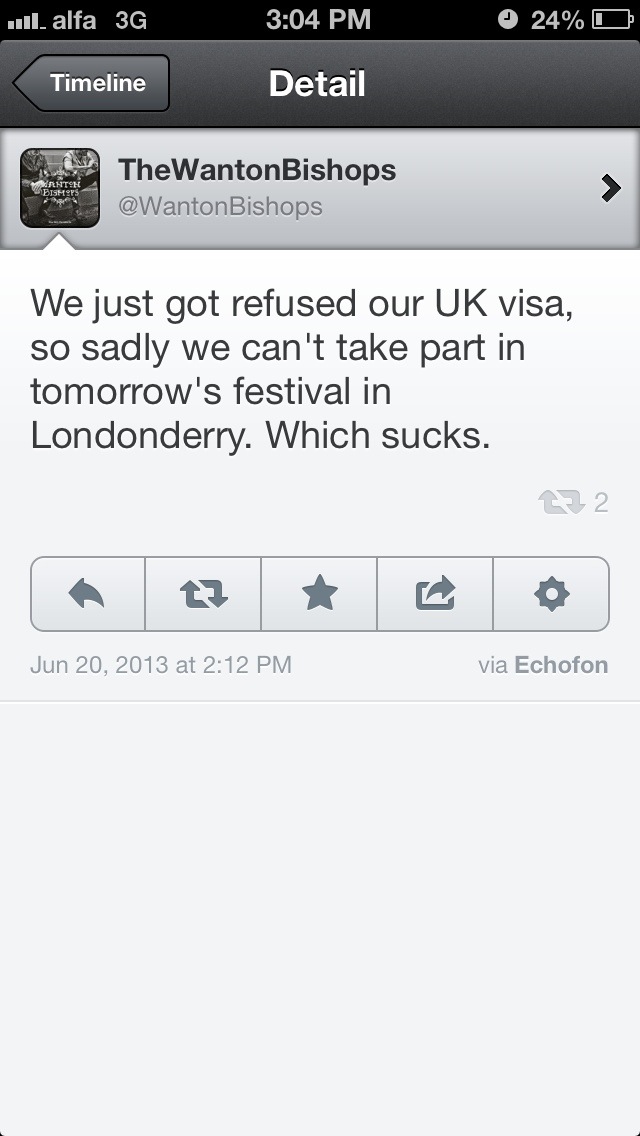
The latest casualty in the ongoing Lebanese passport massacre are local band The Wanton Bishops who were supposed to participate in a festival in the United Kingdom and who had their visa application to the UK rejected as per their tweet:

20130620-151608.jpg

I guess those visa rejections our passports amass are exactly what’s needed to make us stand out in the crowd of those who book airplane tickets and fly away. They’re exactly what is needed to know precisely what those embassies we apply to think of us.

Ease of bureaucracy, who needs you. Plenty of opportunities, who needs you too. But hey, at least we’re proud to have some parts of the country on terrorist lists everywhere.

Saving The Jesuite Garden… because It’s Christian

20130620-100833.jpg

I always thought everyone knew that Beirut had a green space problem. The city has 3 parks that are open to the public. You can count the trees on the entire city’s sidewalks. There is no concept of urban planning. And there’s certainly no functional public transport system, which is one of the main flaws with the city structure.

Yet there are people who think all is fine with the city environmentally. Don’t be shocked, yes they exist.

The fight to save the Jesuite Garden, which culminated in a protest held at the garden in question slightly less than a week ago didn’t take much to go down sectarian lines. The representative of the Beirut municipality that showed up at the protest had one line of interrogation to throw at those who didn’t want the garden removed: what’s your name? Where are you from? Who’s politically backing you?

Because, you know, God forbid a fight to save a park is exactly just that: a fight to save a green space.

Interestingly, for many – the fight wasn’t to save a green space. Many protestors against the park’s removal don’t even care that this is one of the few areas of green space in Beirut. They care that there are ancient Christian ruins there… And that might be exactly what is needed to save the park.

It’s one thing to tear down a tree. It’s even one thing to tear down a Phoenician port, a Roman hippodrome or any other old structure. But once religion comes into play, all projects are off. Do not even attempt. It happened with the Beirut Downtown site recently and it might happen again here.

The bottom line when the religion card is played in such cases often turns out to be positive. It might be even smart to cash in that card whenever possible. But is it healthy to coerce a municipality to save a park just because they don’t dare to awaken a sleeping monster not because they, as a municipality, should become aware of the problems such a destruction would cause?

The municipality will end up not learning anything for future practices later on or even possibly thinking about some plans to really tackle the issues that necessitated the park’s destruction.

Till when will the focus of individuals in this country be religion-centric, ignoring other facets of society that affect their lives as well and which are worth speaking up for?

I don’t want the Jesuite Garden gone not because it has a derivative of Jesus in its name and on its grounds. But what do I know, I guess. Talking about a temporary fix for parking and destruction of green spaces sure pales in comparison to Jesus.

The Lebanese President & The Arrest of Jean Assy

It was July 2011.

Some local band had their song picked up by Lebanon’s “security” agencies and were investigated regarding its supposedly president-insuling content. Everyone got up in a fit. The law being employed to justify the arrest was an ancient one that forbids Lebanese citizens from insulting the president.

A few hours later, it was our president Michel Sleiman himself who ordered the band be released when he found out they were arrested due to insulting him.

It is now June 2013.

A local activist named Jean Assy, who also happens to be a staunch FPM supporter, is arrested for insulting the president. All hell broke loose on social media. The constitution’s preamble that guaranteers freedom of speech has been quoted so many times that I can almost recite it at this point had I been paying closer attention. Jean Assy will soon be released because these charges never, ever stick. And he will become a local hero for many who are beginning to idolize him.

But is July 2011 similar to June 2013?

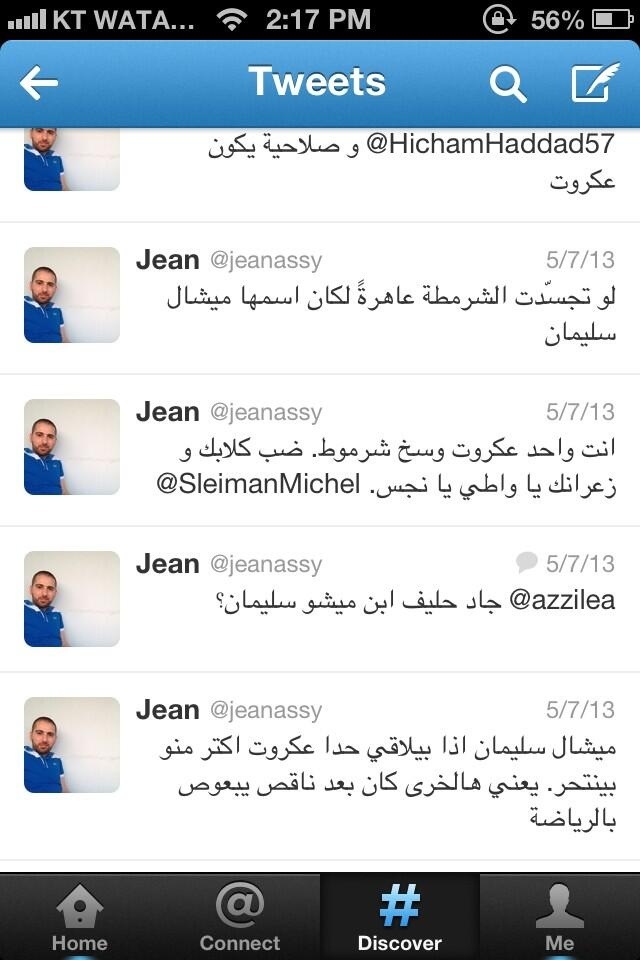
I do not follow Jean Assy on Twitter because I mostly disagree with content and find the tone unacceptable. But I occasionally get his tweets retweeted onto my timeline. Is this matter only because he “criticized” the president? I remember seeing many tweets in which the words “president” and “castrated” [in that order] were mentioned. Is that freedom of opinion or is it libel?

20130618-143049.jpg

Is the arrest of Jean Assy warranted? Possibly not. In an ideal situation, I can call my president anything and expect to get away unscathed. But this isn’t an ideal country. In fact, I can barely think of a few things that make standards of life here remotely acceptable. You only need to check the news – word of advice: do not – to know how deep in this hellhole we are. What Jean Assy’s arrest for investigation, however, is not a matter of political rhetorical martyrdom and the Lebanese president turning into a dictator when, for all matters and purposes, the Lebanese president may be perfectly unaware of this even happening and the whole arrest is carried out by some security men with a vendetta under the pretext of a law that needs to be changed and removed.

The other element of the Jean Assy arrest is some prominent FPM politicians running to his rescue with tweets and retweets of their own. I have to ask those politicians: where were you when Hachem Salman was killed at the front doors of the Iranian Embassy? Where are you now that Ramy and Marwa Olleik are forbidden from going back to their hometown due to their threats on their lives? Or are my liberties as a Lebanese contingent upon the political rhetoric they can spark?

It is a sad day when opinionated people get arrested due to silly outdated laws, regardless of how over-the-line those people may have gone. But look at the silver lining: at least Jean Assy has people to watch his back. Many other Lebanese do not.

The Attack (2013) – Movie Review

20130609-055719.jpg

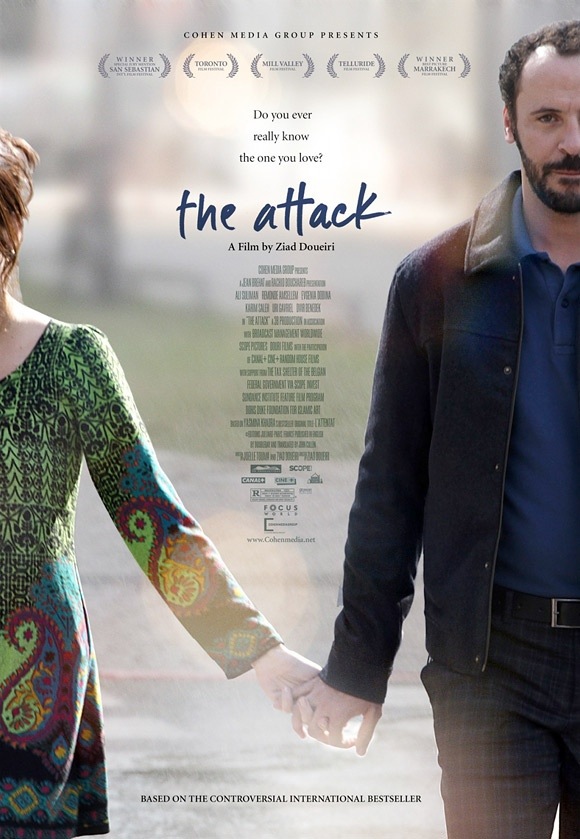
Ziad Doueiri’s The Attack might as well be considered as the most controversial “Lebanese” movie of recent times. But that’s not saying much. The hype surrounding the politics of the movie has been resounding. But does The Attack deliver on all the promises the director and the people who like him gave?

Amin (Ali Suliman) is an Arab-Israeli surgeon living and practicing medicine in Tel Aviv. While receiving some humanitarian award from the Israelis, Amin receives a call from his wife who sounds distressed. He doesn’t give it much attention, the focus is all on him. Soon enough, while having lunch at the rooftop of their Israeli hospital, the surgeons hear an explosion. 17 casualties ensue, 11 of which are children… And it’s Amin’s wife Siham (Raymond Amsalem) who committed the attack. Between the barrage of the Israelis who suddenly turn on the man they believe they sheltered into becoming one of them and the guard of the Arabs who believe Siham did a noble thing and are disgusted by the “bastard” who left his heritage and home to integrate in a place that is not his, Amin seeks out to find why his wife became a radical person who managed to get convinced to blow herself up for the Palestinian cause.

Sounds good, right? Well, in theory it does.

The Attack is divided into two parts. The first one is what can be called the Hebrew segment in which Tel Aviv is shown as a bustling cosmopolitan city whose people are as disassociated with the conflict raging outside their city’s confines while the other half is the Arab part, situated in Nablos, whose people struggle in their everyday life and revel in the idea of martyrdom, turning Siham into a local heroin. In a way, each part serves to pitch each side’s case.

I found the take on the issue, which the movie tries to do, shallow and borderline grating at times, even in its tackling of Siham’s radicalization which The Attack finds even more astonishing due to the fact she’s Christian. The Attack doesn’t go as deep as it should. it remains up there, flapping around the stereotypical stories of both sides – the action/reaction scenario that never ends. It never asks the tough questions: are the reactions warranted? Are they the best way to tackle the actions that led to them?

And I, for one, am glad and fully supportive of not choosing The Attack as Lebanon’s Oscar submission last year because there’s nothing Lebanese about the movie at all. In fact, the Lebanese elements of the movie are a mention of Hassan Nasrallah and Beirut – separately.

As a movie, The Attack works. It’s a decent thriller. There isn’t a dull moment, constantly keeping up the pace it sets from the get-go. The camera work, cinematography and locations are all well-done. But don’t expect it to blow you away. The acting, however, is superb. Both lead actors do a great job in their roles. Amsalem’s portrayal of Siham is gut-wrenching at times as is the life Ali Suliman gives her husband.

What The Attack manages to do, which might be the most important thing, is create a discussion. I watched the movie with 4 other Lebanese while on a stay in Paris – the movie will not be released in Lebanon – and we spent almost 40 minutes huddled outside the cinema center discussing what we had just seen. As a nation, though, Lebanon is possibly nowhere near ready for such a movie to be screened although the current state of Israel is eye-opening to what we, as a country, are so desperately lacking.

3/5