How Tripoli Didn’t Sleep Last Night

What happens in Tripoli stays in Tripoli – at least that’s what Lebanese media and politicians want.

The battles currently taking place in the city aren’t registering except with those who are affected. It could be because Tripoli’s politicians are the masterminds behind them. It could be because Lebanese media knows it will never spillover outside the city’s confines.

What is certain, however, is that the following video illustrates the worst night in Tripoli since the civil war whereby the city was shelled with over 1200 mortars.

This is Lebanon too. I was starting to doubt anything existed beyond Madfoun.

Why The Lebanese Government Is Silent On Tripoli

Every once in a while, the city I once referred to as “3enna” by mistake becomes a place I force myself to go the extra mile to recognize.
The last time such heavy fights broke out in the city, we were all in outrage at how media couldn’t care less about the people dying and the innocent lives in danger. Today, the outrage over Tripoli’s worst night since the Civil War is gravitating towards a government that is as apathetic as apathy goes.

However, are we supposed to expect anything more from our government? Tripoli’s Ministers and MPs go on air to voice their disdain and condemnation over what’s going on. What’s actually happening, though, is that in the other side of the room is one of their henchmen waiting on a phone to issue further instructions to the fighters on both sides of the battles.

Najib Mikati feigns peace. But he probably has men fighting. Mohammad el Safadi feigns innocence. But he probably has men fighting too. Have you ever seen how Bab el Tebbane worships Kabbara? Why do you think that is? You don’t have to over think it really.

The solution for Tripoli isn’t political. If it were, all those politicians asking for calm and peace would have succeeded by now. The problem is that those same politicians want to perpetuate the status quo, because this status quo works and does wonders for them and their careers.
It keeps the city poor for them to do their “charity” work.It keeps the city relevant politically for them to make a “political” dent and remain in the country’s political spotlight.

Perhaps the solution for Tripoli is for a side of the battle to actually win. Perhaps the problem in this country is that we have never had a clear winner and a clear loser in anything, not elections, not the war and not even those sporadic battles in Tripoli which we’ve gotten used to.

Until then, my thoughts go to all the people spending their days and nights in absolute terror in the city I’ve come to love, a place that doesn’t deserve the hand it’s dealt.

Untold Stories of Rape in Lebanon

I didn’t know prior to yesterday that many people thought stories of rape couldn’t possibly go undetected for years. I didn’t know prior to yesterday that somehow I lived in my own version of Lebanese reality where I’m exposed to little tidbits of everything that most of us hear about in theory, in realms of fiction we never think would happen to people who are close to us in any way.

News of rape attempts surfaced frequently over the past few days. Some were verified (link), others are still just stories and may have been made up, causing a disservice to every single person out there in this country still feeling the sting of the pain but going through their days anyway.

Because there’s this notion that rape in Lebanon, and possibly other countries, surfaces quickly and cannot go unnoticed for a long period of time, I will be going up close and personal with the stories of two people I know personally very well. Only those few people who are deeply familiar with their story will know who they are. But the following stories are 100% accurate and have happened here, around every single one of us.

Story #1:

She was sitting in Deir l Salib with her psychiatrist facing her, asking her all the questions she never thought she’d have to answer. When did it start? 1997. How did it start? He was her employer. What did he do? So many things.
She remembered the first time he forced himself on her. How he threatened her he’d hunt down her family members with his influence if she ever dared speak. She remembered how she’d come to the office and see him naked on the couch, his semen all over the carpet. He had just had a prostitute over. She remembered as he forced her to clean the mess. She remembered as he peed on the carpet as she cleaned. She remembered holding back the tears.
She remembered all the weddings she didn’t go through. She remembered feeling excited about those invitation cards, doing her hair and painting her nails only to get a phone call prohibiting her from attending… Or else. She’d fight with her family in order to get them not to want to take her with them anymore. There was nothing else she could do.
She remembered all the possible marriages that passed by her over the year. She remembered the physician who lived in Canada and found her to be of exquisite beauty. She remembered turning him down because he wouldn’t let her go.
1997 was when it started. 2009 was when she cracked. 12 years has turned her in into a different woman, a different person. She wouldn’t be the same ever again.

Story #2:

He was a seven year old student at one of the country’s many primary schools. He was anything but calm, constantly finding himself in trouble. He raised his hand and asked his teacher for permission to use the restroom. She dismissed him. He hopped his way to the bathroom, entered the cubicle and stood there as a middle aged man faced him with a menacing look on his face.
The little boy tried to escape him but couldn’t. The man grabbed the boy, cupped his mouth so he wouldn’t scream and unzipped his pants.
The boy couldn’t remember anything of what happened afterwards. The man threatened him in order to keep quiet. He returned to class with pee all over his pants. He tried to hide it but couldn’t. His class made fun of him and he sat there crying because there was nothing else he could do.
When he got home, he snuck past his mother and spilled water on his pants to hide the stain. He then threw it in with the laundry. She would never know. And he didn’t tell anyone what happened with him that day. He didn’t know if they’d understand. He didn’t know if they’d believe him. He didn’t know if they’d help.
He held his story in and didn’t tell it to anyone until he turned 23.

That woman and that boy know they can’t get their past back in order to have a different version of their future and present. And here we are telling them that we live in a place where we really can’t do anything for them, where they’ll just have to make do with the hand they’re dealt. Because that’s how things simply are.

The Cost of Running An Ad on Lebanese TV During A Lebanese Politician’s Interview

MTV hosted Michel Aoun on Walid Abboud’s show “Bi Mawdou3iya” yesterday and he discussed the current debacle in the country regarding the electoral law and whatnot.

So because we live in extremely sensitive times, Lebanon’s main political foe for Michel Aoun is, naturally, going to seek out airtime as well. Samir Geagea will be on “Bi Mawdou3iya” as well tomorrow, all to MTV’s delight.

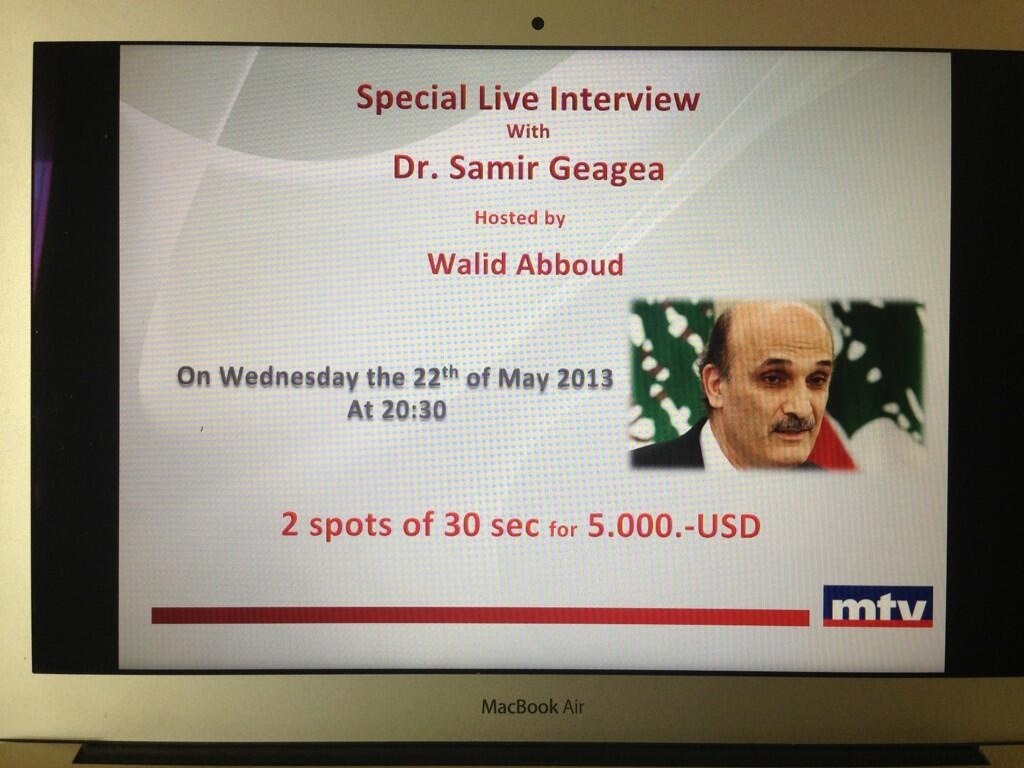
This isn’t about what both politicians want to discuss (or not discuss). It’s not about their propositions and constant tug-of-war leading nowhere. In order to announce the episode, I stumbled on the picture that follows.
The most interesting part of the picture to me was the cost to run an ad on MTV during Samir Geagea’s show. Two 30 second ads can cost you up to $5000.

20130521-122129.jpg

Every single second of commercial break is probably sold by now. This is how much audience our politicians bring in. Too bad there’s absolutely no tangible and efficient measures that are brought with them and the income they bring to the TV stations they appear on.

Lebanese Startup “Transterra Media” Among World’s Most Unlikely Successes

20130521-111653.jpg

Mashable has compiled a list of 25 startup companies at unlikely places around the world and a Lebanese startup called Transterra Media came in on the list at #23.

According to their website (link), the startup aims at redefining the way news is communicated by providing outlets with pictures and material straight out of from the scene.

I don’t know why Mashable considers Lebanon an unlikely place for such a news-centric startup to flourish. If anything, isn’t reporting news from where everything happens the best way to make a dent and cause a ripple? And in more general terms, haven’t many Lebanese startups also managed to become successful?

Either way, congrats to the people running Transterra Media for the recognition. Hopefully other local startups get noticed on a global scale as well soon.