How Annoying Are The Convoys of Lebanese Politicians?

I was going back home to Batroun on Friday, stuck in typical traffic overload in Jounieh, when a GMC Yukon suddenly appears behind me, flashing my eyes out for me to give him the left lane.

It was late at night. The right lane was all blocked with cars. It was beyond obvious I couldn’t change lanes except if I wanted to cause some interesting car accident for news services to report the following day. And still he flashed his headlights on and off at me.

Soon enough, when the right lane barely managed to clear, the GMC car bypassed me with another similar car immediately behind it. Up to that point, I had thought it was just one of your regular Lebanese douchebag drivers who think they’re in more hurry than everyone else. However, both GMC cars were exactly the same color and make. They were without license plates and both of them were acting as if the highway belonged to their mother.

A few minutes later, I saw similar headlights beaming at my rear-view mirror. I manage to cede lanes. And behold: two similar GMC cars, without license plates, same color and make. It was another of case of Lebanese politician highway-titis.

Those 4 cars managed to hijack the highway for my entire trip back home. They try to block you from passing them if you tried. And that wasn’t the first time nor was it the last time in recent days when I ran into such convoys.

A few months prior, 4 similar cars created some sort of a cross on the highway, occupying all three lanes, effectively blocking the entire traffic behind them: 2 cars in the central lane and one on each side. I had no idea what they were so I tried to go past them. They almost rammed by car into the separator. It was my one and only warning.

Yesterday, as I took a cab to the Beiruti neighborhood of Hamra, we encountered a fancy car with a “parliament” license plate. That vehicle didn’t care we had right of passage. It almost slammed into us as it tried to overtake us. Douchy Lebanese driving, perhaps. But at least they had a license plate this time.

So the question is: how annoying are the convoys of Lebanese politicians? Very.

Perhaps the extra security measures are warranted. But how can I explain the lack of license plates, for instance? What’s to say those four cars are for some major politician from the North and not for some criminal who knows his way among high-end people? And how is a politician allowed to break the law just because he is whoever he is, effectively making the lives of other Lebanese a worse driving hell because no one dares to double cross those tainted cars that rule the road when they pass?

Our politicians are the primary douches of driving. The mark of the sophistication of a country’s ruling class starts with the way they drive. Let’s just say our politicians drive as if the highway is their jungle.

And you know what’s worse? We’re paying for that.

How Corruption in Lebanon Remains

My hometown, Ebrine, and the Batroun region overall, have been “plagued” over the past few months with an ambitious developmental project to establish a sewage and water pipe network. The former pipes are supposed to connect houses to treatment facilities, the first of their kind in the country. The latter pipes are supposed to increase and make water distribution more efficient across the region.

To that effect, relevant governmental bodies hired contractors. To say the contractor chosen for the project has been doing a crappy job would be the understatement of the year. Take a look at these pictures (link) to know what we’re going through.

Coupled with the lack of competence is a serious lack of efficiency and waste of resources. They finish a section of a road, wait a couple of months to actually lay down some asphalt, make us enjoy the patches for a week or two and then dig it again because they remembered they need to lay down some other pipes. And repeat asphalt-less process.

The question that I asked repeatedly was the following: how did our government accept to hire someone as incompetent as that contractor  to do a project as ambitious as the one at hand?

But the contractor in question is but one example of what happens around this country to perpetuate the entrenched corruption in governance. How they do that is fairly simple.

Take a look at this very interesting report by Executive Magazine (link) about Lebanon’s debt, now around $60 billion. The most interesting part to me in that report, which confirmed what I had previously heard about these contracting jobs, is the following:

Most public debt is held by Lebanese individuals and institutions. While approximately 20 percent is held by foreign governments and multilateral institutions, nearly 80 percent is held by bond and note holders.

The contractor handling the project in my region is one of those people. Our government owes him so much money that they cannot not give him the projects he asks for and pay him money to “execute” them. The execution plan – at least in my hometown and region – went in the following way:

  1. Make sure you get the project from the government.
  2. Get paid a huge amount some of which the government may not be able to pay and increase the debt loop.
  3. Find a cheaper contractor who’s willing to do the job for a fraction of the money. In our case, a little investigation revealed the project wasn’t done by the contractor mentioned previously but by a Syrian contractor who got hired to do the job.
  4. Give that subcontractor a ridiculously low amount of money.
  5. Sit back and relax and try to watch as politicians try to save face.

Those Lebanese individuals to whom the state is indebted with approximately $45 billion keep our governments hostage to their power: if they want certain projects, they get them. If they want certain policies passed, the policies will pass. If they want anything to happen, it will happen. And the merry goes round in other regions, in different ways and forms.

So next time you feel like investing copious amounts of money in this country, invest them in making the government owe you money.

Ziad Doueiri’s “The Attack” Banned in Lebanon

The Attack is that kind of movies that spring controversies without people even watching it. When I first blogged about it (link) back in December 2012, I asked the obvious question: will the movie having to do with Israel, being shot there and whatnot, deter it from being screened here?

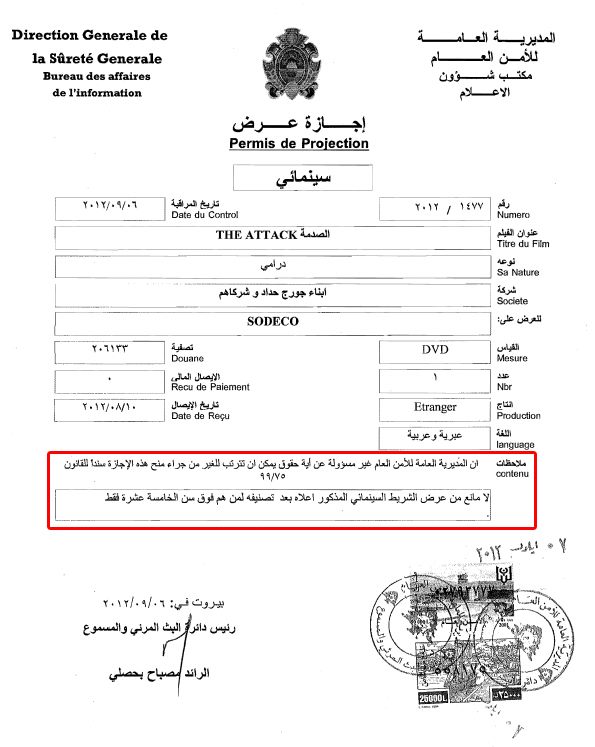
For a while, it seemed the answered would be no – the movie had gotten its permit for screening approved back in September:


Ziad Doueiri The Attack Permit Lebanon


Then came Oscar time and the movie’s director made a big deal out of our ministry of culture refusing to have his movie represent Lebanon at the Oscars. People panicked: what an act of cultural terrorism, etc… I thought the ministry of culture’s decision was spot-on. It was simply choosing not to submit the movie for an award show, not banning people from watching it. Regardless of how excellent the movie is, does it represent Lebanon enough for it to be our submission for the Oscars? I hardly think so (link).

However, things have taken yet another turn. The permit shown above was asked to be returned by relevant authorities because minister Marwan Charbel decided to ban “The Attack” from being shown in Lebanese theaters. The justification for that was exactly the initial question I had asked way back when: part of the movie was shot in Israel.

Now the decision to ban the movie is downright unacceptable:

  1. Lebanon has had Palestinian movies released in it, some of which have had parts of them shot in Israel. Paradise Now anyone?
  2. The movie is not an Israeli movie for us to maybe fathom banning it. There are Israeli actors in it but that doesn’t mean the movie is funded by the Israeli government.
  3. How about we start banning all movies with parts that may have been shot in Tel Aviv? I can think of many American movies with Israel-centric scenes. Or do we just panic when it’s a Lebanese filmmaker?
  4. What’s the point really of banning a movie with a sequence shot in Israel? It doesn’t end the occupation, it doesn’t serve a higher moral purpose and there’s no point to it at all.
  5. Shouldn’t the ministry of interior affairs have more serious things at hand? For instance, shouldn’t they be working on an electoral law? How about working on all the racist municipalities issuing curfews against Syrians? Or better yet, why not work on the deteriorating security situation in the country? Oh wait, movie shot in Israel trumps all of those anytime of the day.

We have reached a time where our government doesn’t even know that I can download whatever movie they ban with a few clicks (and a 24 hour waiting time given our internet). The moment “The Attack” becomes available online is the moment I get to watch it. And I’ll see that Tel Aviv scene and I won’t panic nor will I become a traitor nor will some feeling inside me move towards our Southern enemy. Who’s the only entity hurting from such archaic and irrelevant bans? The filmmaker who’s hurting financially and Lebanon’s reputation as a country for freedom, being dragged daily towards the abyss by minds still stuck in 1864.

Good job Marwan Charbel. One day you sign a civil marriage contract, the other you ban a movie – because keeping a good streak is too mainstream.

(Source).

Lebanese Slang

Take a moment and ponder on the phrase: “shi tik-tik shi ti3a.” I’m sure – or at least I hope – the expression makes sense to all Lebanese out there. Ask anyone else and they’d stare at you as if you spoke Gibberish, which that sentence may as well be.

The Lebanese dialect, which – in my very biased opinion – is the most beautiful Arabic dialect out there, is filled with these slang expressions that only make sense to us.

The thing about those slang expressions is that you never give them a second thought until you see them listed and explained for those who don’t speak your dialect. Other expressions include:

  • De2 el may, may
  • Jeet w Allah jeibak
  • Ghechech w mecheh
  • Metel neswein el feren
  • Those aren’t the best ones. Check out the interesting and hilarious full Iist here.

    The Closing of Ghost & Lebanon’s LGBT “Crust” Activism?

    “Gay people should not exist. They are an abomination.” Raise your hand if you’ve heard this countless times in your life.

    It doesn’t matter what your sexual orientation is. Homophobia is entrenched in Lebanese society and pretending it doesn’t exist because you live in a more “liberal” place in Beirut doesn’t mean it’s not there.

    People see someone wearing something they may not fancy and they say he’s gay. People see a girl with super-short hair and not-so girly clothes and she’s a lesbian. People see two close friends from the same gender walking on the street and they’re automatically dating.

    And sometimes, when someone has enough power, they act out on their homophobia. It’s very easy to freak out how someone as homophobic as the mayor of dekwane, the newest a place to close down a gay pub, made it to office. But is it any surprise?

    Is it any surprise really and honestly that your security task force, which has no problem wolf-whistling your women on the streets, also has no problem in violating people that your law considers as “unnatural?”

    I had no idea what “Ghost” was until today. I asked a few LGBT friends the following question: if it had been a hetereosexual place, do you think it closing would have been justified if the same stuff were happening in it?
    They answered yes. The question begets itself: is it okay to do whatever people did at Ghost just because it’s a gay place?

    Of course, Ghost closed down because it broke one particular Lebanese law, not the many others that, in any normal setting, should have counted. Of course the mayor wanted to protect his city against the “louwat” and whatnot. And you know what’s also interesting? For everyone person outraged by what happened and by what that mayor said, there are many more others who were just convinced to re-elect that mayor. No amount of Facebook sharing and Tweeting will change what people believe in deeply, surely and resoundingly: gay is not right and should not exist.

    You know what’s the best way to tell a homophobic official to go to hell with his decisions? To have the law on your side to protect you, to have a law that doesn’t label you as an inferior human being just because of who you want to sleep with.

    Until a time when closing down pubs because they’re gay-friendly becomes illegal and raiding cinemas because someone thinks “unnatural” things are happening there becomes not allowed, isn’t getting up in a fit because of those events happening while forgetting the base of the issue sort of like crust-activism whereby the small victories that might result are celebrated but the underlying cause for the struggle leading to those victories remains?

    Until a time when homosexuality is removed form Lebanon’s penal code and homosexual men and women are not considered in law with a prefix, pubs will keep closing and cinemas will keep on being raided and activists will keep on panicking. It’s a cycle that will repeat itself indefinitely – until Lebanon’s LGBT community manages to get LGBT-friendly officials on their side in order to advocate for their rights and make laws that can be shoved in the mayor of Dekwane’s face.

    I don’t see that happening anytime soon.