Radio Beirut’s Sexist Ad

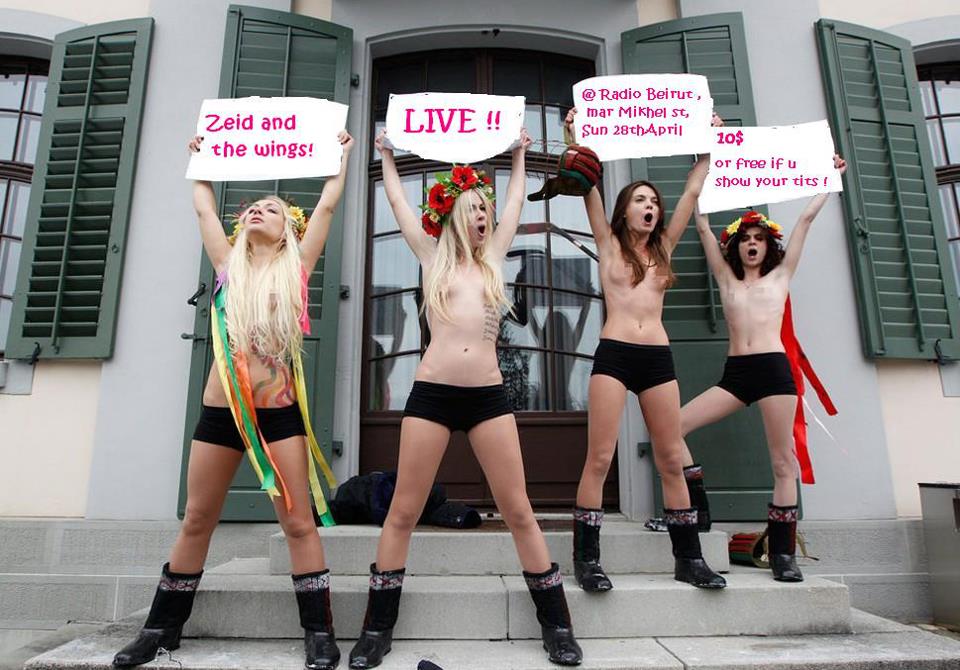
To promote an upcoming event by Zeid and the Wings, Radio Beirut – a local place that’s been promoting local acts such as OAK – has gotten Ukrainian feminist group Femen, famous for their topless protests, to help them. Of course, Femen don’t know yet and would probably sue if they knew.

A picture (link) which was originally intended to protest what Femen believe is a hockey-related injustice in Ukraine – don’t ask – has been photoshopped by Radio Beirut to advertise the aforementioned performance:
Radio Beirut Sexist Ad Femen


Isn’t it ironic that an organization against sexism would be the center of a sexist ad?

I am not one to have a seizure whenever activists find something to nitpick at in advertising, especially if the ad is smart enough. But this isn’t witty enough to pass. Well, women (and men?) – you can show your breasts and you’ll be spared from paying $10 to watch Zeid and his wings.

Does such an ad reflect the image of the local Lebanese band it’s promoting? I hope not. Is it right to use the bodies of women who are working against the discrimination of women around the world (the topless protests for Iranian women were organized by Femen) in order to promote something as trivial and nonsensical as a performance by a Lebanese band at some pub? The difference in magnitude of importance between what those protestors were originally doing and what they’ve been made to do is proof enough.

It doesn’t matter if you support what Femen does or not. This isn’t “art” in order to maybe explain it. What this “ad” comes off is cheap and absolutely uncalled for and I, for one, hope Radio Beirut remove it as soon as they can.


Disfiguring AUB with Zaha Hadid’s Building

Zaha Hadid AUB

Towards the end of my AUB days, someone decided to close down the area that held an infirmary in order for some new construction to take place.

I am not unfamiliar with construction projects at AUB which filled my time when I was there: both the Olayan School of Business and the Hostler student center opened when I was a student. I’m no expert nor do I know anything about architecture but they never struck me as disembodied elements of AUB’s campus.

The building depicted in the above picture is what’s standing in place of the infirmary today. Is it hideous? You bet. Is it an atrocity? Definitely. Does it take away from the charm of AUB’s upper campus? Well, it is a concrete block with holes in it. Again, unprofessional opinion here.

Why is such an ugly building overshadowing Nicely Hall? Because it has Zaha Hadid affixed to it, the world’s most famous architect, who “won” the competition to build this. As if the pull of her name alone isn’t enough to sway the competition.

I have to ask – and it’s obviously too late now for such a question – but didn’t anyone from AUB’s administration get a tinge of nausea as they passed by this growing structure and saw it disfiguring the campus many of them call home? And isn’t the mere presence of such a building disrespectful to the architecture faculty at AUB which is more than capable of coming up with better and more campus-relevant buildings?

But I guess this is how things roll around the country: go with the flashiest, most expensive, most prominent names because that’s sure to be better. Issam Fares- no relation-, after whom this building is named, should probably sue them for libel.

Taxing The Syrian Refugees

Self-imposed curfews were not enough for some municipalities in Lebanon when it comes to the growing presence of Syrians in the country and within their bounds.

Some are now considering the possibility of taxing those Syrians as well with amounts that are simply nonsensical for a poor refugee who can barely afford his or her rent: 100,000LL for just seeking residence inside the town.

The rationale behind these taxes is that these Syrians are treated like Lebanese citizens in those municipalities, by which they probably mean their garbage being collected occasionally. Except that those Syrians cannot even take out their garbage after 9 pm or a policeman would force them back to whichever door they came out from because they’re definitely up to no good if they’re walking the streets past their imposed “bedtime.”

I’m not against foreigners paying municipal taxes if municipalities are providing those foreigners, regardless of their nationalities, with the basic rights it’s providing to its voting citizens. I hardly think my and the potential tax money of Syrian refugees is going to any development. Municipalities are, more often than none, only a tool for political parties to flex their muscles every six years and for people not to get over it until the next election cycle rolls by.

However, are the Syrian foreigners – refugees or not – being treated the same as Lebanese citizens? I can already hear the laughter. At least I can make plans and go out past 9 pm. And isn’t the timing of said-taxes highly inappropriate, inhumane and downright despicable?

Municipalities, starting with mine, keep on coming up with ways to make the lives of people who don’t want to even be here a living hell. What’s their limit in tightening the noose on the Syrians who live within their jurisdiction when the perceived security threat of those Syrians is exaggerated to say the least? As long as mayors feel like they’re flexing their muscles and their citizens get a sense of fake-safety, anything goes.


Thoughts on Beirut’s Social Media Awards

Before the award ceremony is held next week and this gets considered as a post by one of those bad sports who didn’t like not winning, I figured I’d pitch in on the current “it” thing on Lebanon’s social media scene.

First things first, I believe I have to commend the organizers for their work. They’ve been withstanding the barrage of not-constructive negativity well and devoting their time for this – free of charge.

Now, since I cannot, for the life of me, be absolutely gushing about anything, I feel like I have to give a few remarks which I hope are taken into consideration for the awards’ next iteration:

The nominations:

The nomination process was all over the place. I personally didn’t nominate myself nor anyone else for that matter. But I believe that, since databases in all of the awards’ major categories are present, perhaps it would have been better if the judging panel relied on those and narrowed down the nominees instead. Moreover, does the fact that someone randomly nominated a blog or an institution to a category mean the nominee is particularly representative of said-category?

As an example: is the most engaging tweep category truly representative of Lebanon’s most engaging tweeps? Doesn’t it lack some names such as @TawaNicolas, @MarkInHd, @TKHaddad or @Shadonium?

The categories:

Some of the categories are either too broad or too ambiguous. For instance, my blog is nominated for “best news blog” along with several others, one being Naharnet which later pulled out of the competition to allow bloggers to compete among themselves. I personally think Naharnet should be the only one in this category because they are the only one really providing news. But they’re not a blog. And I don’t think we are really providing “news.” So which is it?

Another example that comes to mind is the best NGO/community category which has Lebanese Memes campaigning against several NGOs such as Donner Sang Compter and Foodblessed. Is it really fair for NGOs who are actively trying to save lives or change the way people think to compete with one of Lebanon’s most popular Facebook pages?

In a recent interview, Aline Chirinian – a member of the Online Collaborative running the awards – said that the NGO/Community category is the most voted on particularly because of Lebanese Memes. I personally find it nonsensical for them to win just because the category was made to include them. And Lebanese Memes are obviously winning.

The Formula:

The 50% judges/50% voting formula is fair. But it would have been better if we didn’t know how nominees stood among the judges. When the voting began, SMABeirut’s twitter account tweeted that nominees were listed in the descending order of judges’ points. If those that are not listed first were to have any “decent” shot at winning, they’d have to get a huge number of votes and I’m not sure how feasible that is with the judges re-voting on the categories later on. Revealing how the judges voted very early in the competition takes away from the competitive spirit.

I’ll take my case as an example. I’m fifth in the blog of the year category and last in the best news category. I’m not optimistic to the point of foolishness about my prospects and it’s more than okay. I’m having fun with the campaign more than anything else. After all, how many times does the Pope endorse someone? However, it would have been more interesting for me if I didn’t know that the judges prefer four other blogs over mine as the year’s best blogs.

Potential Winner Bias:

When members of the jury were announced, it was also made public that those members won’t be in for the running for any potential award. This affected Lebanese politician Nicolas Sehanoui who is, without a doubt, Lebanon’s most active politician on Twitter. However, as I was voting, I couldn’t help but notice that other categories also had some bias to some candidates which are involved in the organization of the Social Media Awards. As an example: Phoenicia Hotel is hosting the award ceremony and they are up for an award – conveniently first in their category as well. Another example: Alfa is both a sponsor and up for several categories.

Judging Panel Bias:

A question that can’t but be asked about the judging panel is the following: can they leave their own personal preference aside and judge a medium in which they are personally interacting with most of the nominated candidates and are on better terms with some than others?

Final Thoughts:

I applaud you if you’re still reading till this point. Many have been telling me how these awards may not be very useful and that their purpose is misguided, spamming timelines in the process. Well, I think this whole thing is just for fun and better have our timelines spammed with this than with posts about the weather, no?

And in case you still haven’t voted for this blog (what are you waiting for, seriously?), please do.

Middle Eastern Talent Show Overdose: Star Academy Is Back

Star Academy Arabia

Just when you thought saturation was reached with Arabs Got Talent, The Voice, X Factor Arabia and Arab Idol, Star Academy decides to return to the singing show scene after a two year hiatus, fully-rebranded as Star Academy Arabia.

Casting for the show has started in Jordan and will continue across countries of the region. Lebanon will have its share next week at Monroe Hotel. And to re-assert itself as the most popular of the bunch, its Facebook page – started less than a month ago – already has north of 50,000 likes (link).

A source has told me the show will start this coming October on a yet-to-be-chosen TV station although I think we can assume it won’t be MBC who should have its hands (and schedule) full with both The Voice and Arab Idol. Dutch company Endemol is currently at the helm.

Toni Qahwaji has been tipped off to direct the show. He was a regular when the show aired on LBC in 2011 and earlier.

So in case the other twenty three talent shows weren’t enough to satisfy this apparently incessant need among the public, another one will be launching yet another “winner” to forget about.

I, for one, had thought Star Academy decided to call it off – similar to what happened to the French version – after its last lackluster season. I figured people may have gotten tired of it. It seems I was extrapolating based on what I felt towards these shows now that I’m not thirteen anymore.

I bet these shows have lost track of the participants they can’t wait to make millions off then forget about the moment the season wraps.  I don’t know about you but I’ve lost track after Joseph Attieh.