Accidental Sectarian

Answering “we’re in West Beirut” to a question of location was my mistake. I hadn’t really meant the war-sense of the word but when you grow up hearing about areas being in West Beirut and other areas being in East Beirut, the terminology sticks. 

For the person who heard me, however, I was another one of those – the people whose heads are transfixed with their own region, their own bubble, dismissing everything else in the process. I tried to explain that I didn’t mean it that way. No amount of speech could change things.

Today, a few months after that incidence, I sat reflecting on it and only one conclusion presented itself to me.

It’s not the cliche line about how the war hasn’t really ended yet. It’s not the even more-cliche line about remembering and not repeating: “tenzeker w ma ten3ad.”

I am a person who, like many people from my demographic criteria, is in a dilemma of pride and blame. I cannot not be proud of where I’m from or the houses, families and regions that built me. But there’s also a tinge of blame for those houses and regions and people that I cannot shake off. I am caught between Christian pride and Christian blame. And I think others are caught between Muslim pride and Muslim blame as well – in the sociological aspect of the notion, of course.

But the truth of the matter is that I have no idea what actually happened during those 15 years. I keep hearing about how some politicians were vicious warlords back then who killed people mercilessly or about MPs standing on checkpoints as military men. I keep hearing about those battles whose names keep getting thrown around, as I nod without having a clue what’s being discussed.

Does anyone really know what happened during the civil war, even those who actually lived it? Of course, they would never admit the answer is no. Everyone I know considers their side of the story as scripture. I’m sure the other side of the country has a different story which they take as scripture as well. And both sides get offended if you insinuate they may not know the whole story.

When the current ruling class of the country, most of which was the class leading the civil war, throws around war-era jabs at each other when the going gets tough, what can you expect from all the regular folk who considered those politicians their reference during Lebanon’s civil war?

How could we actually be called to learn from the civil war when those who ran the battles and the politics of the war haven’t sat down and discussed what happened between 1975 or earlier and 1990 to agree on what  needs to be learned in the first place?

We cannot rewrite the history that hasn’t even been written yet.

Until a time when the notion of west and east Beirut becomes purely geographical, I am, like the majority of Lebanese today, an accidental sectarian of the conditions in which I was brought up, of those hidden green lines that exist between regions and people and of the rubble we’re still sifting through 23 years later.

Batroun & Keserwan Fighting Over Gebran Bassil

Let’s call it the war of pre-electoral billboards like you’ve never seen before: two regions, many kilometers apart, fighting over the same man with fiery reformative, empowering, pride-filled slogans.

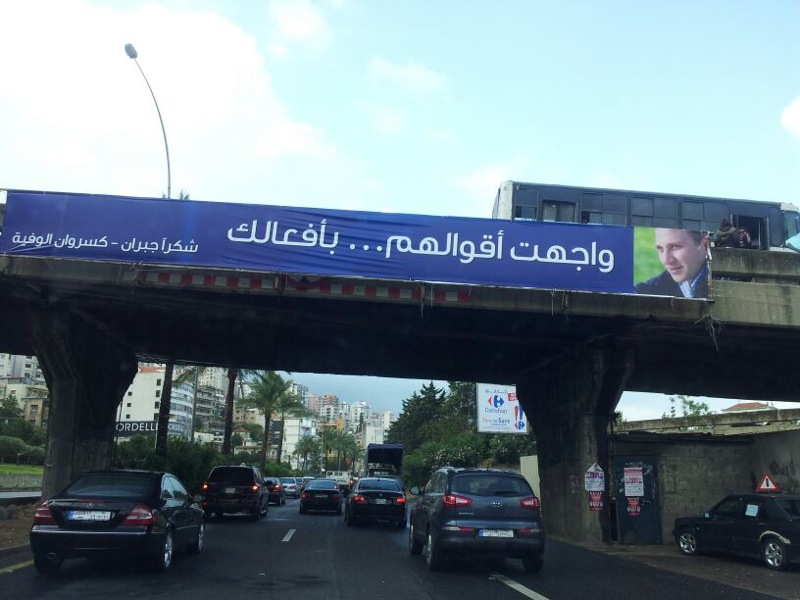
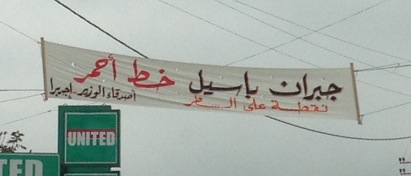
As I was driving back home to Batroun last Saturday, I was surprised to see a Keserwani-centric propaganda for Gebran Bassil all over the bridges stretching across the highway.

Gebran Bassil Batroun Keserwan - 1

Thank you Ismail Sakalaki for the picture

The question couldn’t not ask itself in my head: Is Gebran Bassil running in Keserwan this time around?

It made electoral sense for him to do so seeing as his chances in our home district are next to nil, something even people from his entourage agree on.

But something didn’t add up. Why would I have to answer several polls over the past few months about elections in Batroun in which he was presented as the main candidate for the March 8 side of Lebanon’s political spectrum? Aren’t those polls run by political groups who want to test out how the wind in a certain region is blowing?
And why would Gebran Bassil be doing electoral visits across Batroun to many households and villages over the past few months if he doesn’t intend to run there?

The Keserwani posters seem to have a deeper rumor around them. Let’s call it schmoozing galore. According to this article (link), the posters are the attempt of a Keserwani MP to kiss up to the FPM’s leader in order not to kick him off his prospective list in the region. And you thought our politicians couldn’t be that desperate?

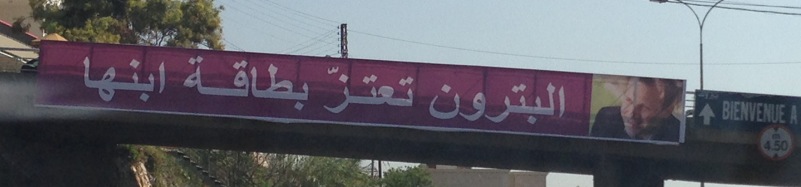
Batroun, however, wouldn’t accept this Keserwani schmoozing, regardless of who did it or why it was being done in the first place. So à la “bring it, b*tch,” we started our own gebranophile campaign across our highway.

Batroun is proud of its son’s energy:

Batroun Gebran Bassil Keserwan - 6

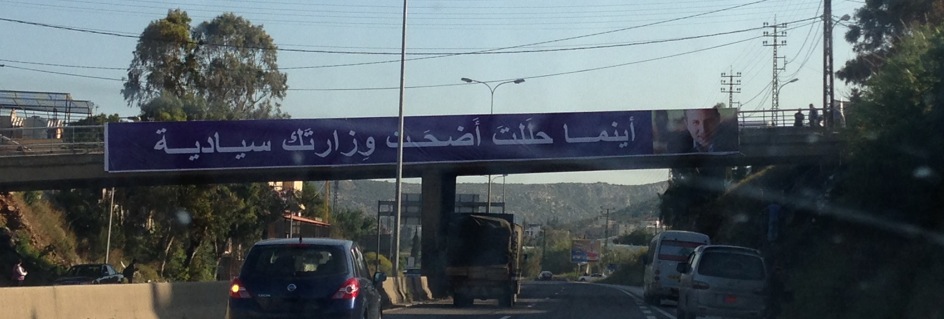
Whenever you land, your ministries become essential:

Gebran Bassil Batroun Keserwan - 3

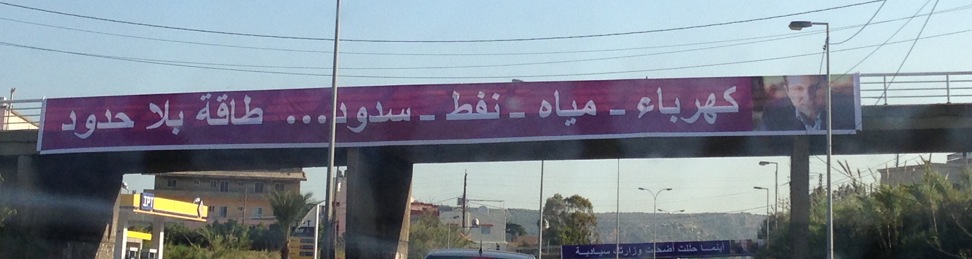
Electricity, oil, water, dams… energy without limit:

Gebran Bassil Batroun Keserwan - 2

We’ve lived and seen the dams in Batroun:

Gebran Bassil Batroun Keserwan -

Gebran Bassil is a red line. Point à la ligne:

Gebran Bassil Batroun Keserwan - 5

If only billboards translated to ministerial actions or governmental projects, we’d be one first-world country by now. If political marketing blitz translated into votes, Gebran Bassil would have been in parliament now.

But as it goes in this country, the supplies of any kiss-up material, especially leading up to elections, begin to run dangerously low due to the huge demand. Who’s willing to bet that a counter campaign will be run to discredit any possible accomplishments advocated by this campaign? You know it will only be a matter of time.

So where will Gebran Bassil run? I guess the answer is quite simple: who cares about Batroun when Keserwan, the self-proclaimed heart of Lebanon’s Maronitestan, is vying for you?

As for me, I’m enjoying the billboard cat-fight. Sorry Keserwan, I’m going to side with my home-turf on this. I’m biased like that. Batroun FTW.

Gebran, why don’t you stay?

The Relativity of Freedom of Speech in Lebanon

The last few days have taught me that the statement: “I believe in freedom of speech” has to be amended to become the following: “I believe in freedom of speech as long as I agree with the speech.” Beyond that point of agreement, all bets of civility of discourse are off. Bigot, ignorant, racist, condescending, extremist, hypocrite, illiterate or any derogatory word of choice gets dropped in order to counter a point, regardless of what that point may be.

Santa Muerte, Santa Ejre:

I didn’t want to go over anything related to this issue again. It was blown way out of proportion. But my words were taken out of context. Lebanon’s self-anointed blogging police started to ridicule what I had to offer. Somehow this blog being nominated for Blog of the Year at the Social Media Awards became a mark of shame for some people – as if that changed things. News outlets started contacting me for their stories. And I realized that, even though I had actually blogged about the issue, I had never gotten the chance to say what I had to say for my input was very brief. In spite of the issue being overdone at this point, I believe it is my right to tell my point of view in detail. You may want to read it and you may not but here it goes.

I found Bershka shirt, aptly called shirtgate – the Mexican Embassy IS opening a shrine – offensive. Is it my right to find it offensive? You bet it is. Did I call for the shirt to be banned from Lebanese markets? No. Did I say it wasn’t a person’s right to wear the shirt? No I didn’t.

You don’t need google to consider the shirt offensive. Any person’s first impression of what the shirt says is with what they connect it. I believe it was Descartes’ school of thought which said our perceptions are the actions of our mind on our senses. The actions of your mind come from your previous experiences. When Lebanese people look at that shirt, the first thing they’d see is what they previously know: Mary icons present in churches or homes.

What people don’t seem to get is that people have different red lines whose crossing means getting offended. If people are offended by the shirt, it’s okay. If people are not, it’s okay as well because those people have their own lines as well and if they are crossed then they will bring their own fury to being. What’s not okay is some people calling those who are offended bigots, ignorants, etc… For not being aware of Santa Muerte, which 90% of the Lebanese populace wasn’t even aware of prior to yesterday.

This brings me to another point: Santa Muerte is irrelevant. It is not culturally relevant here and it’s being used to iron out the issue by those who want to portray all religious folk in Lebanon as a bunch of narrow-minded individuals. Is the shirt Santa Muerte? It could be. At least that’s what Bershka said. But it could be Our Lady of Guadelupe as well, which is actually present in many Lebanese churches, one of which is in my hometown which could be why I found the shirt print familiar.

The point is: the fact that Santa Muerte is not something most Lebanese are familiar with means that the shirt will be taken offensively. People do not have to google a shirt print. You judge it based on what you know. As an example, alcohol is allowed in Lebanon but it’s not culturally permitted in Saudi Arabia. Would you walk in their streets with a Jack Daniels shirt? Cow meat is allowed here but it’s not culturally allowed in India… how about a shirt with a burger on it? The list goes on.

You may not want to be culturally limited even if you are aware but what I believe many need to realize is there’s more to the world than the space between them and their computer and Twitter followers and, if a person has a blog, readers. We talk and analyze and extrapolate but the fact of the matter remains that less than a third of the Lebanese population has smartphones and not everyone has access to the internet and not everyone likes to read our English-written blogs. I may not get up in a fit if I see someone wearing that shirt on the street but are you willing to bet no one else would?

Only today, I had my legs crossed at a bank in Tripoli when a man asked me to uncross them because he was offended by my shoes’ sole being in the far corner of his eyesight.

Another important thing to note is that Santa Muerte is not a saint nor is it a holy figure. It’s Mexican folklore. Lebanese people who are not aware of their own folklore are supposed to know international folklores as well now? The Catholic Church of Mexico considers those who worship Santa Muerte as heretics-lite. This may not be relevant to those who don’t care what any religious institution has to say but it does for those who do, of which I am not. But there is another aspect to the conversation that is being disregarded because it doesn’t fit with the perfect Santa Whatever explanation.

After all, why would Mexican relatives of mine find the shirt print offensive if it were all that “innocent?”

Another point being raised is that Bershka is simply bringing in their entire collection to Lebanon, which I find to be non-sensical. Do companies always automatically import everything they make into this country without any form of market study or market appraisal? Any look at the shirt would have sufficed to realize it might cause a backlash among many of their customers. The shirt may have not been brought into the country but the price tag of 49,000LL means there was a will to bring it in.

The bottom line is: both sides of the story have arguments in their favor. It goes down to what you believe in. If you believe holy figures should not be demonized then the shirt offends you. If not, then the shirt will not. But people from both sides attacking each other is unacceptable as I witnessed firsthand with people calling me ignorant, a bigot, condescending and a bunch of other things just for the fun of it.

Ziad el Rahbani vs AUB Students:

Nothing can beat Santa Muerte when it comes to attention over the past few days. But the man of whom I am not a fan Mr. Ziad el Rahbani had an open dialogue session at AUB during which a bunch of attendees protested his political stance against the Syrian revolution and called him out on it.

The interesting part, though, is that I found out about the Ziad el Rahbani protest not from someone who is supportive of those students but one who was absolutely outraged because they made AUB students look like fools in front of such a man. That person, typically, felt it appropriate to call those students every word imaginable from the belt down. And he wasn’t alone at it.

The protesting students had their share of supporters as well who felt what they did was absolutely noble. I am personally with what those students did because it was 1) peaceful, 2) a demonstration of their basic right of free speech and 3) it didn’t interfere with the session’s proceedings.

I believe it is their right to protest in the way that they did. Their right stops in a hypothetical scenario where they wreck the hall or attack Mr. Rahbani himself.

I am personally supportive of what the students did and I commend them on it. But isn’t it the right of both who are against and supportive of Ziad el Rahbani to be heard?

George Abdallah:

On the other side of the political spectrum, many Lebanese are protesting what they are calling the French authorities unjustly keeping Lebanese George Abdallah behind bars. To that extent, they set up protests outside of the French embassy occasionally, most of which were peaceful and only served to prove the point being raised.

I do not agree with the protests, nor do I agree with the whole “unjust imprisonment” idea. But isn’t it their right to voice their disdain of the situation as well without having irrelevant me ridiculing them for it?

Boycotting Guns ‘N Roses, BDS, Israel:

Prior to the Guns ‘N Roses concert in Lebanon, a movement calling to boycott the concert was started. Many Lebanese may have not gone to the concert because of it but many other did. After all, the concert was a success. The boycott call was picked up by many Lebanese and often ridiculed.
The only question that popped in my head was: are they bothering me if they are not attending a concert without calling for the concert to be canceled?
The only answer that answered my question satisfyingly was: no they are not.

So I shrugged it off and didn’t write about it. Let them have their fun. I don’t think we should panic every time an artist who has set foot in Israel decides to hold a concert here. But what if someone wants to have a panic attack because of it? Simply, let them have it.

I draw the line when those movements start expanding to some form of neo-culutral terrorism whereby they get the concert in question to be canceled, the artist to cower from coming over and, sometimes, Lebanese acts to suffer in the process.

The bottom line:

Be it a shirt, a political movement, a concert, a dialogue session or a simple conversation, people are allowed to differ in opinion and have their opinion heard even if others find it subpar, unconvincing or unacceptable. What is becoming clearer to me, however, is that the concept of freedom of speech in Lebanon is relative. You get to enjoy its perks as long as you conform to what the vocal bunch expects of you to write or say.

But you know what, the past few days have also shown me that if being ignorant, a bigot and condescending comprises of what I did, then I am all those three and more and I’m proud of it.

Do you regret the whole Bershka shirt post, I was asked over the past two days. My answer was and will always be: definitely not.

Notta-Bene:

For those who were up in a fit how we weren’t discussing more “relevant” issues in Lebanon today, I invite you to read the following articles which I have written over the past two weeks:

It’s not my problem the only time you read is when a post goes viral enough for you to get a link.

Stalking and Spamming in Lebanon’s Smartphone Age

You’re a driving on the highway calmly, focusing on the road and the barrage of cars trying to violate your vehicle’s space. You look around to the motorcycle trying to block you and you see a guy is driving. Coincidentally, you happen to be a girl. He looks at you intently. You cross eyes for a second and then look away.

You thought that was it.

The next day, your phone starts buzzing. You look down – an unknown number is calling. A slide to answer later and it’s a voice you definitely don’t recognize.
– Are you [insert name] and were you driving a [insert car color and brand] around [insert time] on the highway at [location]?
– Excuse me?
– I’m the guy who was driving the motorcycle next to you. Don’t you work at [insert job], your dad’s name is [insert name], are originally from [insert town]?
– What the hell?
– I’m a really nice guy who would like to keep talking to you. Do you mind?
– Of course I do!
– I am persistent…

You hang up. But it doesn’t stop there. Next thing you know, your phone is buzzing again. This time, it’s whatsapp. You open the app and immediately block the number. A few seconds later, the same number is calling you from viber. You end up deleting the app.

The above story is not fiction – it happened with a friend of mine recently. And she’s not a lone example.

Another friend of mine – who also happens to be a girl – had a similar scenario happen to her as well. She was lucky enough to have her father answer the call and gave the caller a piece of his mind.

I am certain those are not two standalone incidences. In the time and age of apps that allow strangers access to your private information with a few clicks, whose job is it to draw the limit?
The problem isn’t with apps such as Tru-caller and address book which outsource their data to their users who willingly share their entire address books with the companies. If you’re worried about your privacy because of such apps, simply don’t use them.

It’s about the other apps that require a source inside some governmental headquarters to fill them in with all the necessary information about license plates and user information.

Should we be also worried about out-of-nowhere stalkers now whenever we buy a new car?
“You get a free freak with each car purchase.” Perhaps ad companies should use that tagline as well?

Our spamming and stalking situation isn’t restricted to sexually-oppressed people. More often than not, I’m finding myself in whatsapp groups filled with numbers similar to mine whereby someone is advertising something. I exit the group, block the group creator and believe that’s the end of it.
But they keep coming back: be it those who text me to buy phone numbers that hold some resemblance to mine or the companies you don’t even know existed who text you about their new offers or even getting some notifications from certain banks you had never set foot in that a credit card was used on your account.

What account is it again that I have so much money in without knowing?

On top of it all, a lot of people I know – including yours truly – are receiving calls recently from either blocked numbers which could be Israelis (it happened before) or international numbers originating from Algeria, Mali or some other place in Africa and sometimes Europe we are more than positive we have no relation with.

I once answered one of those calls – static is all you hear before the call is dropped.

The truth is that the political debates surrounding your “private data” which are used quite often to rally the masses are becoming more and more meaningless since a lot of your data is not only available for security personnel to use but from random people on the street who can pull up your number and make your life a living hell if they want just by writing down your license plate number.
How are entities in Algeria getting our phone numbers and calling us often in the first place? And what is the governmental source of those apps that give strangers unlimited access to part of your information? And when will we have control over the spam text messages and calls we are getting in increasing numbers lately?

Perhaps in the time and age of smartphones and apps, some leeway regarding some aspect of your privacy is needed. But I’m certain the current situation in Lebanon is not acceptable.

Hold on, a +213 number is calling me.

Santa Muerte Shrine To Open in Lebanon

Following the outrage of some Lebanese that other Lebanese were outraged at a possible shirtgate involving demonizing a Virgin Mary icon are not aware of well-rooted Mexican folklore, the Mexican embassy, in collaboration with the Lebanese government, will be building a Santa Muerte shrine in the village of DeirBella.

Issuing a brief statement on the matter, the Mexican embassy noted the “overwhelming support” their not-recognized saint has gotten over the past few hours in Lebanon. They were “absolutely dumbfounded” by the well-rooted knowledge of Santa Muerte among the Lebanese populace whereby everyone seems to be quite the expert. “We didn’t know Santa Muerte had so many fans in Lebanon,” they said, “this makes us quite excited about possible culture fusion between the countries.” The embassy was also quite “enthusiastic” about the culture fusion prospect in Lebanese society, à la St. Patrick’s Day and Thanksgiving.

“It shouldn’t be exclusive to the Irish and the Americans, now should it?” They said.

A date to celebrate the Day of the Dead is still being debated. They’re not sure if it fits with all the Halloween parties that will take place on October 31st.

The Lebanese government, on the other hand, sees this step as another confirmation of the deep ties between Lebanon and Mexico where a sizable expat population could be found. They find the building of the Santa Muerte shrine will strengthen the relation between the two countries, giving both expats and Lebanese residents a taste of Mexican lore. The government noted the choice of location as somewhere that has a Spanish flare in its name so Santa Muerte feels right at home.

Seeing as Santa Muerte is not recognized by both the Catholic Church and the Mexican Catholic Church, both governments have teamed up with country-gone-pop singer Taylor Swift in order to record an anthem taking a jab at the inadequacy of the Catholic Church and the ignorance of those who don’t know Santa Muerte outside of its natural habitat. The initial leaked lyrics read the following:

I remember when Pope Francis was elected, last month
We said this is it, now’s our shot
Cause like he wasn’t wearing a fancy robe
When he waved his one Argentinian hand
Then he came around again and said
Minions, Santa Muerte will not be recognized ever
And all of you have to deal with it
God Bless those who don’t know it exists.

Oh, Santa Muerte called me up last night and said
The Catholic Church and I are never ever ever getting together
We are never ever ever getting together
They can talk to their minions, talk to their friends, talk to me
But the Catholic Church and I are never ever ever getting together
Like, ever!

We are not entirely sure about the hit potential of the above song but rumor has it Najwa Karam was enlisted to write the accomagnying Arabic version. Her latest tweets have all been of the anthem’s possible lyrics: “Albi fata7, seret shouf, Santa Muerte ejet.”

Meanwhile, research is underway at the American University of Beirut between psychologist Thomas Renecamp and philosopher Patrick Henderson. This rare collaboration between these often-diverging sciences is centered around the peculiar reaction that was observed following ShirtGate whereby Lebanese people established a duality of freedom of expression. They are trying to understand the dynamics behind calling other people ignorant and condescending because of a simple disagreement of opinion. “Freedom of expression seems to go only one way only in Lebanon,” Henderson said. “If your opinion isn’t that of the cool people, then your opinion is automatically relegated to something subpar compared to the other self-proclaimed wise men and women.”

They are also working on a hierarchy of ignorance whereby different levels of the entity will be categorized as they have found the term to be thrown around very loosely.
“Not sure if an English word or a prostitute,” professor Renecamp was heard saying in typical German candidness.

If you feel like participating in their research, you can email TR8656@aub.edu.lb and PH7.13@aub.edu.lb.

The Maronite and Catholic Churches in Lebanon have yet to take any measures due to the Patriarch being on a European road trip for the next month and a half.
The shrine in question is set to open on April 31st, 2013.