The Death of the Lebanese Dekkéné

Rue Aabrine Beirut Lebanon

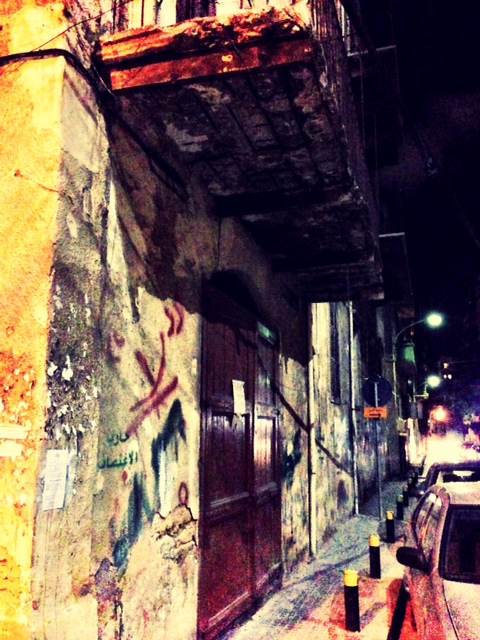
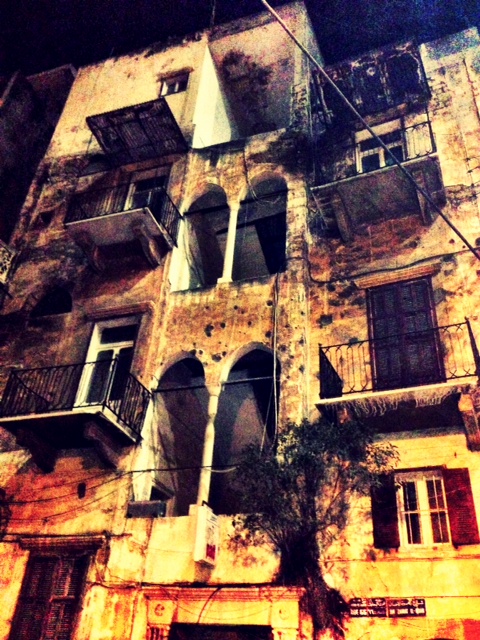
Aabrine Street was, until recently, one of the last remaining Achrafieh streets that still contained a flair of an old Lebanese life that you wouldn’t believe still existed in Beirut, especially Achrafieh: one where a family lived in the same building which had a dekkéné that they ran. Their house harbored them for decades – all through the civil war.

Their house’s entrance is very inconspicuous. The cats roaming around the place hid in the space of those traditional windows. The family took care of them. I went to their place a few times: high ceilings, old chandeliers and armchairs… what you’d expect to find in old Lebanese houses in the village was there. Except this was the heart of Beirut.

Their house was also the witness to the Civil War story I wrote on this blog in 2011. You can read it in its three parts here.

Their home is no longer theirs as some investors took over the entire stretch of buildings on their block, all of which are old buildings. But this isn’t Amin Maalouf’s house for it to cause a ruckus.

Beirut Aabrine Street Old Bldg Beirut Aabrine Street old building 2

As I walked by the house yesterday, I was saddened to see all the dark, empty windows. What used to be lit apartments and the voices that emanated from inside is now nothing but emptiness awaiting for it to become non-existent.

The family that lived in that apartment lived off a small dekkéné at the other side of the building which stretches down the street by being connected to lesser maintained parts. This dekkéné allowed their father to send many of his children to the United States where they got naturalized shortly after the civil war ended. He ran the small place for 50 years. He played cards with my grandpa and other Aabrine men as customers came in and out – Tarnib Koubba in case you’re wondering. Backgammon tables were there as well.

Dekkane Beirut Aabrine Street Lebanon

Today, the door of Sassine’s dekkéné holds a paper which he signed to announce that he had relocated. Another small office a few meters away, in that same building, announced the same thing. This dekkéné, which by the looks of it could fit anywhere but in Achrafieh, is gone for good. It still stands. But not for long.

The building that contained the dekkéné and all the nearby buildings connected to it will soon be demolished to allow another colorless high rise in their place. The history of the place will be gone for good. The place where my grandpa played cards with his friends, where small children would run to get their mother something she urgently needed for the tabkha she was cooking will be gone and with it another chapter in the life of a city that will soon not recognize itself anymore.

This isn’t about the worth of the dekkéné or its efficiency – it’s about what the dekkéné signifies: how easily we tear down what is old to bring in what is newer but never better.

This is the other side of the building in question, less maintained than the section where the family lived:

Aabrine Street Old Building

Beirut Rue Aabrine old bldg

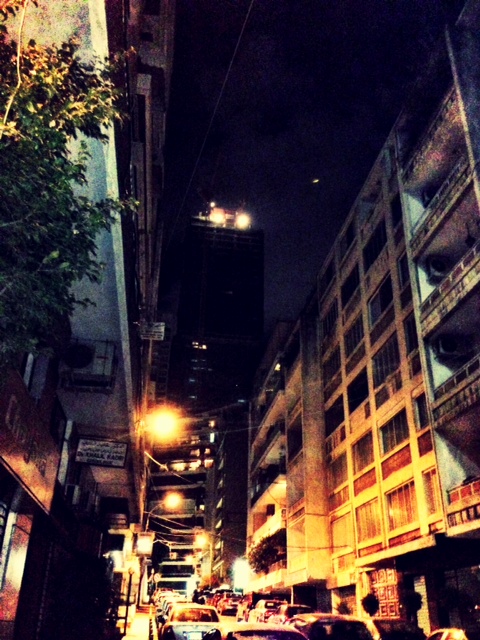
And this is what the dekkéné and its building will be replaced with. Beautiful.

beirut achrafieh high rise

The Phoenicians Discovered America?

Move over Mr. Columbus, our ancestors are in the house.

According to this article by CNN (link), our good old Phoenicians may have beat Christopher Columbus to discover good old (or new) America by about 2000 years.

Our Cedar trees have wood that is strong enough to build a boat that could withstand the 10,000 km journey. The Phoenicians, being cunning sailors, have the expertise required for the voyage – and a British man is set to prove this is, indeed, the case.

The theory has its detractors of course.

Either way, it seems like the alphabet may not be the only important thing the original inhabitants of Lebanon discovered and offered the world.

This should definitely prove to be some valuable information for all our Phoeniciaphilic Lebanese.

My Lebanese Bloggers Reinvent The World Entry: Bionic Humans

The following is my submission to the competition supervised by the ministry of telecommunications.

The moment you wake up to the world, all information you get is acquired through your senses. You first see your mother through your eyes. You first hear her voice through your ears. You first feel her touch through your skin, smell her hair through you nose and taste the food you are given through your taste buds.

These sensory experiences help shape your brain dramatically – they alter your cognition and your interaction with the world around you in ways that you can’t even quantify.

Now imagine you lost one of the organs responsible for your senses. Imagine you lost one of your eyes due to some freak accident. Imagine you were born with a genetic condition of deficient bone conduction in your ear or very few sensory cells in your nose to smell. Imagine for a second that your interaction with the world today is lacking one major aspect and you’ll see how hard it is. You only need to close one eye while walking with a few friends in order to see how your visual field is reduced.

I have had one uncle who lost his eye as a child to a heater-related accident. My uncle has passed away now, may he rest in peace, but the loss of his eye was a life changing experience that, regardless of the psychological aspect of the matter, affected his life negatively. My best friend suffers from the same thing: he lost his eye because he was a playful little boy with a heightened sense of curiosity. My cousin has deficiency in his hearing and is helped with hearing aids that don’t give him the proper sense of hearing that you and I have but a sense that allows him to make do and lead a normal life – or as normal a life as you could lead.

Lebanon is a country of war. We have all gone through very horrible life circumstances that have left many in Lebanon impaired. Some have had lasting damage to their spinal cord, leaving them crippled. Others have had their limbs completely amputated. The image is one that’s very hard to imagine.

The above premise leads me to the following:

My idea:

What if I could give my best friend an eye that allows him to see the world the way I see it, that allows him to see people who walk on the side of his non-functional eye? What if I could give my cousin a cochlea that not only gets him to hear but gives him a perfect sense of hearing? What if we can give all the war injured people prosthetic limbs that do not only serve minimal function but can emulate the function of the limb they lost?

Let’s take it a step further: what if we can extend the average life span, better life circumstances and improve the human condition?

As a medical student, I am faced daily with countless diseases, even those with a genetic basis, whose only “purpose” is to lead to this organ failing or that. My job is to cut this path of destruction at a point which leaves the organ in question salvageable enough for me to give the patient a better quality of life. But what if I’m too late? And what if I can’t find a transplant organ in time?

As things stand today, the only hope for my figurative patient is to die.

All of these terminally-ill patients, impaired, blind & amputated people may have hope if we broaden our approach to our own body by employing the technological advances we have reached these days and create organs that combine this nano-technology that’s being pioneered around the world with the medical expertise that is available plenty.

By creating a bionic eye, which combines medicine and technology which is helping shape medicine daily, someone who is blind might regain his sight. By integrating some minimal AI function on a prosthetic limb, an amputee might regain normal function in that limb. By manufacturing a heart, the countless people around the Earth who suffer from cardiac conditions could find a way to become better.

The list goes on. Imagine the possibilities if whichever organ comes to your mind is no longer a piece of fiction but a certainty that requires tinkering an approach and incorporating different disciplines together. The paths of the sciences are not as divided as people make them out to be. They are intertwined in more ways than they differ.

The lifespan of these bionic organs would also be superior to the span of normal organs. Their availability means that any case of dysfunction can be fixed by pinpointing the circuit that’s leading to the shortage.

What could we as Lebanese do? We have the minds and the medical expertise that could help shape this. And we have a lot of Lebanese youth whose pride and joy is technology – not just those who admire their smartphones but those who can actually build a smartphone or repair one in a matter of minutes. What those people need and currently lack is resources.

You might say that such a plan is perhaps too far-fetched or too ambitious given where we are today. And perhaps it is. But going beyond the limitation of this body that we have might prove to be a key-point in bettering our life in so many other ways. These bionic organs can help us understand what we don’t currently understand about current bodily functions, notably neural, which we are currently ignorant about. The purpose of these organs might even surpass their imminent use and lead to a different approach to life in which people begin to tackle the problems that everyone faces in a more meaningful way, be it from pollution, to energy.

My opinion is that this is the next frontier that medicine will be embarking on. If we, as Lebanese of the newer generation, embark on it, we might be able to catch up to the entire world in so many ways. Perhaps it’s worth a shot.

I believe bionic senses and organs is an idea that needs to be put out there – hopefully someone, somewhere finds it not insane enough to act out on it.

Reinvent the world by reinventing its inherent weakness. Fix people so they can fix the world.

Mne2leba Ta3ate

Knowing some people can truly help. They could provide you with a job, get you out of a tough spot, provide you with a decent future. The saying goes: behind every comfortable man in this country is a super “wasta” taking care of things.

Some people’s wasta is so strong it gets them to evade jail time entirely for trading massive amounts of drugs, ruining the lives of countless people in the process. It’s fairly straightforward: mne2leba ta3ate. (we turn their drug trading to drug use).

I will not mention acronyms or allude to names or people or political parties because the issue isn’t specific to one side of Lebanon’s political spectrum.

But do you know those major drug scandals we hear about in the news?

I know for a fact that those who are in charge of the whole affair never get reprimanded. All they get is a very, very minimal jail time that serves to “clean their system” while the bigger fish take care of all those extra loose ends that may have remained.

If you want to trade drugs in Lebanon, make sure you know someone influential. That someone could be a parliament member, it could be an family with a full blown military wing, it could also be a major political party head. Because if you know such people, you will never get caught. And even if you get caught, the only thing you get is a slap on the wrist while someone else pinches your cheek.

Good boy, they’d say. He turned his whole life around.

As for all those poor souls whose lives this good boy ruined, well, tough luck for them. They don’t know someone who can make jail time easier for them.

Mne2leba lal tajra ta3ate. Because breaking the law, ruining the lives of so many people and not facing repercussions for it is how things are done here. And they have the audacity to want to keep their shamelessness secret.

A Lebanese Christian Family’s Sunday Lunch Discussion

The following dialogue is an almost verbatim excerpt of what has been going on lately at the Sunday lunch table of the Christian families I’m associated with. The names have been altered – albeit they still retain a “Christian” flavor but I promise it’s not for Sectarian reasons – except my own.

Georges: You know, they said they might postpone the elections.

Mary: Better. Nothing good can come out of it.

Elie: Makes sense seeing as we don’t have a law yet.

Joseph: There is one. The Orthodox Law.

Elie: What about the Orthodox Law?

Joseph: It’s supposed to make our votes weightier. How the hell does Hariri get a parliament member in Achrafieh and the LF don’t? Or how can’t the LF choose MPs across Lebanon like Aoun does without Hariri hoarding their backs?

Georges: Yes. And those imbeciles with the Future Movement have the decency to call us unpatriotic. As if they are the patriotic ones for not supporting the Orthodox law only because their man Hariri doesn’t.

Joseph: Yeah and they’ve always been in bed with the Syrians screwing us. They’re ones to talk about patriotism. Their leader got blown up? Have we had a leader who hasn’t been threatened in this country?

Georges: Hariri doesn’t even have the decency to stand up against Al Assir. And he has the nerves to call on the LF for trying to distance themselves from his sinking ship.

Joseph: He doesn’t even have the money anymore. Looks like Saudi Arabia may not be in with him on this one.

Georges: Saudi Arabia is busy drawing caricatures about the patriarch while they go fuck Christians every day. What a country of retards. Fuck them and their prophet.

Elie: Enough with religious crap. How would you feel if someone insulted your Christ?

Joseph: Whatever. Anyway, I’m with the Orthodox Law. It allows us to stick it to Aoun.

Elie: There are other laws which do that and allow the LF to have more weight without being this crappy. Besides, why would you want to vote for the MP of Keserwan or anywhere else exactly? Betdallak ghrib. 

Georges: How does the Orthodox Law work exactly? We vote for the Maronites of Batroun only?

Mary: I don’t understand why you must have this discussion every week. Is it gonna be this way until election day?

Elie: You go into the voting place. The person in charge gives you a ballot paper with all the lists running for your sect’s MPs. You choose one of the lists then you pick an MP to give him or her your preferential vote. So we vote for the Maronites of Lebanon. All 34 of them.

Peter: How will I explain this process to my mother exactly? I’m not sure if I understand it.

Mary: the more complex these laws become, the more I think all these elections are useless. The same people are gonna win any way.

Joseph: I know how I’m voting.

Georges: Yeah, me too.

Elie: If the law stays the same and we remain a one district place, I’m most probably not voting for Antoine Zahra. I’m sure as hell not voting for Boutros Harb and definitely not for Gebran Bassil.

Georges: Are you fucking serious? Please tell me you’re joking.

Elie: Not at all.

Joseph: Leave him be. He’ll change his mind soon. Elie not voting for Antoine Zahra? And pigs fly.

Elie: Why would I vote for Antoine Zahra exactly? What has he done that should make me eternally grateful for him that he should get my vote and stay and MP for the 3rd time?

Georges: He’s not Gebran Bassil!

Elie: I’m not voting for Gebran Bassil.

Joseph: Not voting for Zahra is you not caring enough. If other people thought like you, Bassil would win.

Peter: Why would anyone give a shit? My family has been supportive of Boutros Harb ever since he entered parliament in 1972. And what good did that do us? I never asked anything of him. Never. Except when I wanted to provide my son who studied law with a job. I begged him and he promised he’d help but he didn’t. I held it in and I voted for him in 2009 because I couldn’t stand the idea of Bassil winning. I was happy when Harb won because Bassil didn’t win. But my son is now working a dead-end job with no prospects. I would never admit this to a Aounist of course. Screw them.

Elie: I understand but an MP’s job isn’t exactly to provide jobs for those who ask for it. He should have helped. But what has he done in the past 23 years that should get me to vote for him? Nothing!

Georges: the highway!

Joseph: Yes, the highway.

Elie: the highway that has been in the works for 40 years? The one which was started near Tannourine because that makes perfect sense? No, thanks.

Georges: As long as there’s something called Michel Aoun roaming the Earth, I will vote against him.

Elie: What about the economy? The roads? Electricity? Telecom?

Joseph: Oh shut up. You’re almost becoming Aounist these days with liking Sehanoui. Do you fancy that unibrow?

Elie: The man does a good job. I cannot not acknowledge it. Besides, why would you not care about the economy and security in voting? Do you fancy almost every one my age leaving the country or considering leaving it?

Georges: Really? Assume I won’t be voting for the LF because you don’t like them these days. Mesh 3ejebne bel marra 3a fekra. Who am I supposed to vote for? Those third party leftists who have no chance of winning?

Elie: I don’t know. But voting for someone because you want the other to lose doesn’t work for me.

Joseph: It does for me. As long as Gebran Bassil never ever becomes a parliament member, I’m happy.

Georges: I concur. I couldn’t have been happier when he lost in 2009.

Elie: Gebran Bassil isn’t winning in Batroun no matter how I vote. At least I’d rather vote in a way that doesn’t make me feel disgusted with myself for the years afterwards.

Joseph: What if he wins?

Elie: Really? How is that possible exactly? Where will he get his votes? Do you want me to get you the 2009 results for you to see how impossible that is? Let’s not pretend that a lot of people in the district are thinking like me at the moment. Kellna 3ashra.

Georges: Yeah, 10 is more than enough of your kind for now. We can’t let them win and run the country. We can’t allow it. Michel Aoun wants to get that Orthodox Law to pass so he becomes president next year, you know that?

Joseph: Yes, that’s true. He wants to become president.

Peter: Michel Aoun president? Hell no. If that law passes, I’m voting for the LF without blinking. I can’t allow it!

I expect this discussion or some variants of it to be taking place every Sunday when the family is gathered for lunch or any other festivity for that matter until elections are over. I’m sure that the same discussion is taking place in other households which are different from mine politically in more or less the same way. Everyone is talking elections these days. So why not make what people say behind closed doors public? It beats beating around the bush in pretending as if things will change.

I only had to see a pollster in action in my hometown to see exactly how few things have really changed and how much the circumstances had.