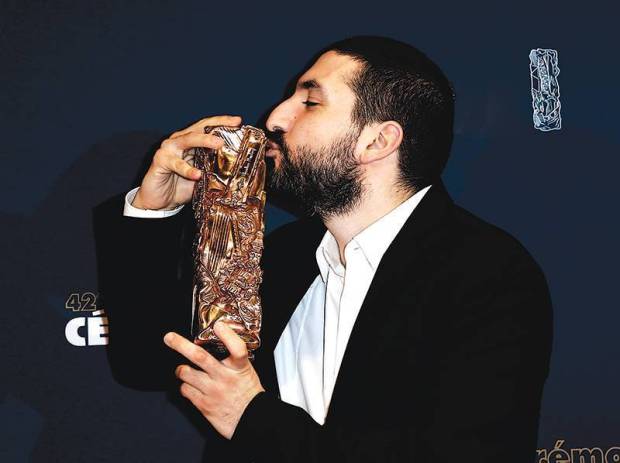
Establishing himself as one of the most coveted musicians in France for this past year, French-Lebanese musician and trumpeter Ibrahim Maalouf added another accolade to his growing list of achievements with his first César for his work on the movie “Dans les forêts de Sibérie.”
The César Awards are considered as the French equivalent of the Oscars, which will be held tonight. They are the highest French honor that can be given to the movie industry. It was Ibrahim Maalouf’s second nomination and first win.
Maalouf was competing against another Lebanese composer, Gabriel Yared, who has previously won an Oscar and a Grammy for his work on The English Patient.
The César adds to Ibrahim Maalouf’s achievements this year as he has previously won “best musical spectacle” at Les Victoires de La Musique almost two weeks ago.
Ibrahim Maalouf is considered by many to be a pioneer musician with his adaptation of Oriental quarter notes to Western music, by custom-made trumpets that have four valves instead of three. This has allowed Maalouf to create outstanding music over his career, including a Western version of Oum Kalthoum’s music in a 2015 album that was titled “Kalthoum.”
He credits his Lebanese immigrant background in shaping his musical voice and giving him a message to pass on through his work.
You can check the video of Maalouf winning here. He will be coming to Lebanon for a concert at Baalbek on July 22nd.
From Roula Yammout to Rima Dib to Miriam Klink, the current state of Lebanon’s music scene is horrific. We make fun of what is available, hoping that our ridicule leads to them ceasing to exist, but it seems they take the ridicule as attention and use it as fuel to launch even more disasters on our ears.
Enter Sevine Abi Aad, a performer whose own story with Arab record labels mirrors the current scene we’re forced to tolerate. A few years ago, Sevine had a record label interested in her. One look at her and the record label had comments: they wanted to fix her nose, make her breasts bigger and fix her gaped teeth.
She told them no and decided to do her own thing. The result is her debut song “Ana Mesh Fenneneh,” a satirical look at the Lebanon’s music of today where ass and breasts and blonde hair overtake any semblance of notes.
I sat down for a brief chat with Sevine about her song and her song, as well as upcoming album.
What prompted you to write this song and perform it?
I met with a lyricist I love (Nami Moukheiber) and started telling him about the topics I would like to sing about, that I love comedy, and making people laugh during my performances was important to showcase on the album, and how for me, it’s super important that I’ve lived and gone through whatever I’m singing about.
I remember telling him that I’d like to do a song about the fact that it’s very frustrating for artists to get heard if they’re not willing to play by the rules of the industry (i.e change your physical features, act a certain way, sing a certain style). Years before, I had been approached by industry people who, after just one glance at me had said: Bedna na3mellik menkharik, sodrik, nzabbit el fere2 ben snenik etc… without even discussing the music.
And so I told Nami ‘Ya khayye, ana mich fenneneh, tayib! w ma beddeh koun fenneneh!!!’ So, it’s quite autobiographical. The song was also written with Mike Massy.
What message do you want to give across through this song and album to the current musical status quo in lebanon?
This applies to the song, not the entire album. It’s about the dilemma, the temptation faced by ‘unknown’ independent artists to just give up and give in to the formatted way of the industry.
And we might be tempted to do so because we feel that we aren’t recognized and validated enough in the field.
For example, in terms of live music performance, not many venues will agree to host you and your music if they think the audience won’t enjoy it and they base the criteria for audience’s enjoyment on the repertoire and choice of songs.
Sadly, in most venues, they will ask you to play and rehash songs the people already know and love to dance and sing to… and so you get stuck doing what everyone else is doing or feeling frustrated that you can’t play the music YOU want in many places and share it with people.
So, sometimes, for independent artists, it’s a choice between this (becoming a ‘fenneneh’) or to keep playing for a tiny audience, and find other ways of supporting yourself financially – which is so harmful, because it will take time away from the music and creativity… And its a vicious cycle we need to break once and for all.
The thing is there is a whole underlying hub of amazing vocalists all over the country, who write amazing stuff, and who are performing for a tiny niche audience. And they don’t get the recognition from the wider audience that they so deserve.
Things are changing, for sure, but it still needs to be valued by a wider range of people who sometimes don’t even know about this independent scene. The bigger message though, goes beyond the music industry. It’s a message to young girls and women to stop trying to alter the way they look and act, just in order to be perceived as more ‘attractive’, ‘popular’, ‘fun’.
There is way too much pressure for women here to go under the knife, and it’s a shame they have forgotten how beautiful a person is by being unique and having their own identity. No one, in any industry should make a woman feel that she isn’t pretty enough or talented enough. And self confidence and knowing yourself and believing in what you’re doing should stay your main way of achieving the success you aim for. No compromise.
Is the satirical style of this present in the rest of your album?
It’s not on the entire album, no. Though, again, I love comedy, I also wanted to showcase other sides of me, so. But it’s definitely present in another Lebanese song called ‘Chaghlet Belle,’ written and composed by Mike Massy, which I hope we’ll be able to shoot a video for before the end of the year. Other songs are very cinematic and theatrical, and they’re in other languages (french and english).
I leave you with the song:
Ana Mech Fenneneh
La2 bass je te jure mich mbayyan! Abadan!
La2 bass ktir tali3 naturel!
We7etik we7yetik, yih walaw ana b2ellik chou!
Ana ana ana ana ana ana
Ana mech fenneneh Ana mech fenneneh
Ana mech fenneneh w ba3ref ghanneh
Wejje byit7arrak aktar men jesme
Bghanne bsawte mech bi hazzet khasre
B2adde ghnene bala tanneh w ranneh
Ana mech fehmene w mech se2lene
Ana mech fenneneh Ana mech fenneneh
Ana mech fenneneh w ba3ref ghanneh
Kel el ness ma beddon gheir masla7te
leh chaklek 7elo w ma 3am tenchehre?
Leh bi Kelna Star ma 3am techterke?
Sawt w talle w haybe bass 2ten3eh 2ten3eh 2ten3eh
W ana
Ana mech fehmeneh
Ana mech fehmeneh Ana mech fehmeneh w mech fer2eneh
Tayib leh ma bta3mle chi CD?
7ki Montana byestmanno 3alayke
Eh lek chou fiya halla2?
Kella 3amaliyit tejmil machina halla2!
Ya 3layke chou ma-jdoube yekhreb baytik ente
7at dallik hek ente 7at dallik hek!
2al chou 2al? 2al ana badde awwem me2t-eyet el fan
Pfff….chou hableh!
Lezim kabbir 3a2le w kabbir…
7atta ysir sawteh ad3af men khasre
Sar badda chi hamse wghamze w lamse
7atta el jomhour ya3melneh nejmeh!
Ente mech fenneneh Ente mech fenneneh Ente mech fenneneh w rou7e ndabbeh!
That awkward moment when the bar is being set so low for “music” in the Middle East that the singers we used to think were talentless begin to appear as producing valid art.
More than a decade ago, when Haifa Wehbe first started singing, everyone and their mother complained about how she was all sex and no talent. As people got used to what Haifa offered, her half-sister Roula Yammout figured it would be alright for her to break into the Lebanese and Arab music industry as well.
I guess she did not get the memo, however, that the tastefulness that her sister offers is not easily attainable. So she made a porno instead, and in doing so makes her sister look like the Oum Koutlhoum of 2016 when it comes to singing.
The song is titled “Ana Rola.” In case you remember, her sister also has a song titled “Ana Haifa” released early in her career. Between both songs, and I can’t believe we’re calling them “songs,” one can be considered a masterpiece compared to the other.
In her song, Roula Yammout claims that she can “fall for any guy” as she prances around in barely-there bikinis while sucking on pacifiers. I don’t get it. She should’ve just gotten a dildo and be done with it.
The following snaps summarize the whole video:
There’s literally nothing more to it than her breasts and her ass and her flashing them around in the hope of her vulgarity catching on and becoming the next big thing in the music scene.
This is not to give her a boost. Her video will make the round soon enough without needing us. After all this is Arabia, and you can smell the sexual repression, and you can almost see her naked. But it is a very scary moment, definitely, when this woman managed to find a producer willing to splurge on her making a porno music video and probably did so happily, if you know what I mean, thinking that there is a possibility for her to actually make a “musical” dent.
I really hope they’re proven wrong because the only thing to be said about this is: what the fuck is this shit? Is she doing a demo for what the Khaleejis can expect?
Picture this, a sarcastic joke making fun of a Lebanese pop star ends up threatening one of the biggest and funniest pages to grace Lebanese and Arab Facebook.
Over the past few months, and in lightning-speed time, the sarcastic page calling itself “Adeela,” referring to the world’s biggest pop star Adele, was as famous in these parts of the world as the character it’s based on.
What started of as jokes placing a hypothetical Adele in an Arab setting soon became a scathing, sometimes over the top but often always spot on, critique of the state of the Arab pop scene. When Ahlam decided Lebanese were beneath her, Adeela was the first at the guillotines. When Beirut Madinati was running for elections, Adeela was voting for them in full force. The examples are endless.
However, with the evolution of Adeela from an Adele-sarcastic character to an all-seeing basher of Lebanese and Arab female singers, unless they’re called Julia Boutros, the amount of people that started to take offense at Adeela’s jokes started to rise exponentially.
It wasn’t that the jokes attacked their mother or father or religion – gasp – or family.
It wasn’t that the jokes were offensive in themselves to those people’s character.
No. Those people were so butthurt by a joke… about their favorite singing Diva, and at their forefront is the legions of fans of Nancy Ajram, Elissa and Maya Diab who almost managed to get Facebook to shut down Adeela’s page earlier today.
The sad part is that it’s more than likely their respective “Goddesses” couldn’t care less about being joked about. In these parts of the world, any publicity is good publicity. It’s not like Adeela making fun of a singer on Facebook is a Kim-Kardashian-Exposing-Taylor-Swift moment. And yet, the amount of offense that some people take at creative, and yet ultimately useless, jokes is beyond unacceptable.
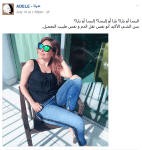
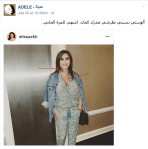
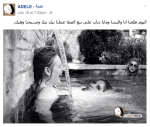
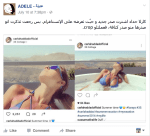
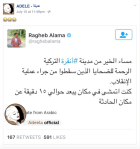
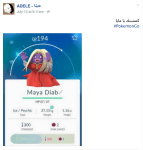
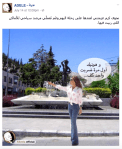
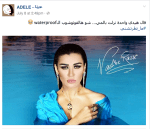
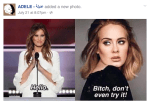
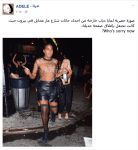
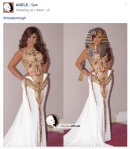
Some of the jokes are as follows, as you can see few are those about whom there were no jokes:
Isn’t that the Arab way of doing things, though, so when someone “offends” you, your reflex to deal with that person is to silence them? It must be engrained in Arab DNA.
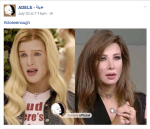
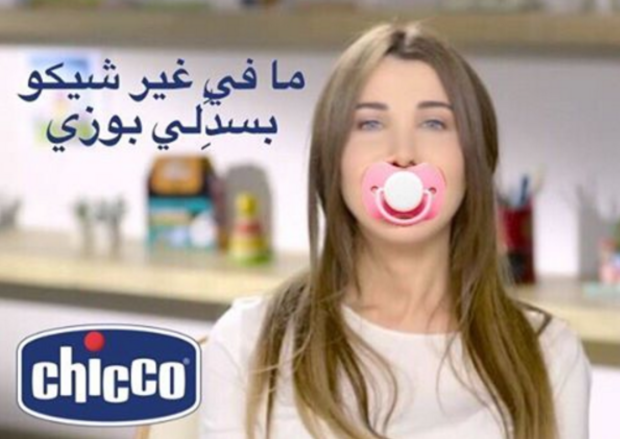
The picture that threatened the existence of Adeela’s page yesterday was the following:
There’s really nothing to it. It makes fun of how Nancy Ajram seems to find her way as a spokesperson for everything in the Middle East. It was reported to Facebook as “offensive content and propagating pedophilia.” The extent some people go to is unbelievable.
So to the “fanzet” who think that jokes are something worth getting up in a fit about:
How about you make chill pills part of your daily routine? Why don’t you do some mental exercises to somehow boost your mental capacities to someone who doesn’t take personal offense at a joke targeting someone who will never be affected by it and who doesn’t relate to you in any way other than you fangirling over them releasing a song after Eid el Fitr?
The fact of the matter is we need pages like Adeela in these parts of the world, not only to serve as a much-needed comic relief that never borders on the cliche, but also to maybe, just maybe, shake some sense into our over-botoxed, over-stretched, over-faked scene. Who knows, maybe the next Arab revolution is not about changing political systems but reducing lip fillers?
You’ve seen the billboards all over the highway. They sort of came out of nowhere, didn’t they? The latest pop sensation to overtake the country, if you don’t account for Sejaan Azzi’s dismissal from the Kataeb party, is an 80’s influenced, mustache-heavy man who’s throwing it back to the when the overbearing Lebanese father figure was in.
Ladies and gentlemen, I’m talking about the one and only Nabil Harfouch, whose “albo” is making every other “alb” in this country swoon.
Never mind the fact that, according to twitter user @TawaNicolas, the song might be remixed to the following once they break up:
No, we are facing a serious work of art the likes of which the Lebanese republic has not witnessed since Fairuz released “Kifak Enta” back when songs had a purpose.
Please note the Cross on Nabil Harfouch’s wrist. This is a pious man, whose religiosity plays a very big reason in him becoming so “in” right now. After all, who dares not buy this man’s singles when Jesus is on his side?
In fact, Nabil Harfouch’s religion could be the exact reason why he is all over our highways today. But before we delve into the juicy details of Harfouch’s past, ones that rival Haifa Wehbe’s Hezbollah affiliated days, let us rewind.
A few years ago, Nabil Harfouch was just another middle-aged man who woke up one day and remembered he had a dream. You see, Martin Luther King had a dream, but so did Nabil. So he released a song in his attempt to become the next Ragheb Alama.
That song, titled “Touwsayeh,” was Nabil Harfouch’s combination of his two biggest passions in life: Women and God. In the song, he claims that God ordered his love interest specifically made for him. The magnum opus can be listened to below:
Almost 4 years later, and only 1200 hits on YouTube later, it’s safe to say the song did not take off. At all. So Mr. Harfouch realized that the best way to make it big in the showbiz business was to have lots of money and spend it on branding.
But where does a helpless hopeless pious man like Mr. Harfouch get all the money? Lightbulb! Religion, of course.
As reported by Rima Karaki last year (link), and as has surfaced on Facebook, Mr. Harfouch, along with his futuristic and pioneering lyricist Naji Sfeir, created a charity that they named after St. Rita which, for years, took money out of religious people’s pockets for a variety of religious reasons, such as investments and projects for Mr. Harfouch and Mr. Sfeir. The Maronite Church eventually caught up and closed down the charity, but not before the duo had made millions, reportedly.
So what does a Lebanese nouveau riche do? Buy yachts? Iftar at the Four Seasons? An apartment in Burj Hammoud? Nope! You start a singing career, of course. Or rather, restart it.
So, instilling a photoshop team from 2003, Harfouch and Sfeir decided they would take the country by storm. And hence came to be… “Dalli D7aki” (Keep Smiling), a song for Mother’s Day.
They filled our streets with the song’s billboards. They inundated our visual fields with their stellar works of art. The song, however, remained quite elusive, and the question remained: what would Mr. Harfouch’s mother do? Not listen to the song would be my top bet.
This song being extremely occasion specific couldn’t make a dent for Mr. Harfouch in the artistic domain. So he decided to go back to the drawing board. He figured people wouldn’t remember two failed attempts, so let’s plan for a summery comeback, one that would be with a bang. This time, the bang was in the hair because Mr. Harfouch got implants.
And here came to be Ya Albi, a song about Mr. Harfouch’s heart. While driving to Beirut from the North (#TeamNorth) yesterday, I decided to see where Harfouch had released the song. Like all the greats, he gave Anghami the exclusive.
“Ya Albi” has been on the region’s prime streaming service for weeks now, and has only amassed a couple thousand streams. Not to brag, but if I taped my cousin Yasmina blabbing, she would get more streams than that.
My friends and I wondered why a song that has taken up every single visual field point of our streets would fail to resonate this massively. Could it be that the song just sucked? The only way to know was to listen to it. So we did.
It started.
Albi, Ya albi
Albi albi albi, Ya albi
Albi albi albi
Albi ya albi
Albi albi albi
Albi ya albi
Wlak Albi albi albi
Albi ya albi
I’m not sure if any of you counted, but the opening lyrics of the song is nothing more than Nabil Harfouch wailing about his heart, 21 times to be exact. And then came in the first verse:
Albi ma7rou2 w mekwi
Darbetou akbar berhan
Dammak mech 3am temchi
3el2ane bi noss el sheryan
This is pure medical knowledge right there. For the few seconds in which those lyrics reverberated off my speakers and onto my ear ossicles, I felt a rush of cardiology take over me. Can anyone else even?
At this point, popular request was to stop the song and listen to anything else instead, even Maya Diab. But we persevered:
Albi albi albi
Albi ya albi
Albi albi albi
Albi ya albi
Ya albi chou sayer fik
Wa7dak b rou7e tsawik
Ya albi chou sayir feek
Rou7e enta
3omre enta
Rou7e enta
3omre enta
rou7e enta wou 3omre enta
rou7e enta wou 3omre enta
Ana 3ayesh dayib fik
In case you’re keeping count, we’re up to 34 “albi”s at this point. I won’t bother counting “rou7e” and “3omre” because why bother.
Albi albi albi
Albi ya albi
Wlek albi albi albi
Albi ya albi
Ya seken bi 2akhe
Jra7ak Jra7e
Dawahon ya rou7e
Dawahon ya rou7e
Dawahon ya rou7e
Dawahon ya rou7e
Dawahon ya rou7e
Teskon fike
w eskon fiyye
Rou7e enta
3omre enta
Rou7e enta
3omre enta
Rou7e enta
3omre enta
Rou7e enta
3omre enta
Rou7e enta
3omre enta
Ana 3ayesh dayeb fik
Albi albi albi, ya albi
Albi albi albi, ya albi
Albi ya albi
I have this feeling that, when done writing and recording, the duo behind this song couldn’t help but have a *mic drop* moment.
I, on the other hand, took a few moments to collect my jaw off the floor of my car, take my hands and pat my bleeding ears. Yes, Lebanon has a new singing sensation. And honestly, I can’t wait for when she dumps him.



















 A Separate State of Mind | A Blog by Elie Fares