Lebanese Mothers Who Make Lebanon Proud Today

Like every year, when Mother’s Day turns up, your social media channels get flooded with pictures of your friends with their mothers, Facebook statuses to announce unending love and gratitude (before they go piss off their mother the following day), and endless messaging among siblings to find that perfect gift.

I’ve written many of those posts on this blog before. You can check those here and here in case you feel like it. This year around, however, I figured the best way to increase the relevance of Mother’s Day is to highlight Lebanese mothers who have shaped the country as we know it today.

The list is not extensive nor is it exhaustive.  The following women are from different domains and are on this list for different reasons, but they all share something in common: they’ve proven that motherhood serves to add, not define who women are, especially in a region that tells them the former is all they’ll amount to be.

Joumana Haddad
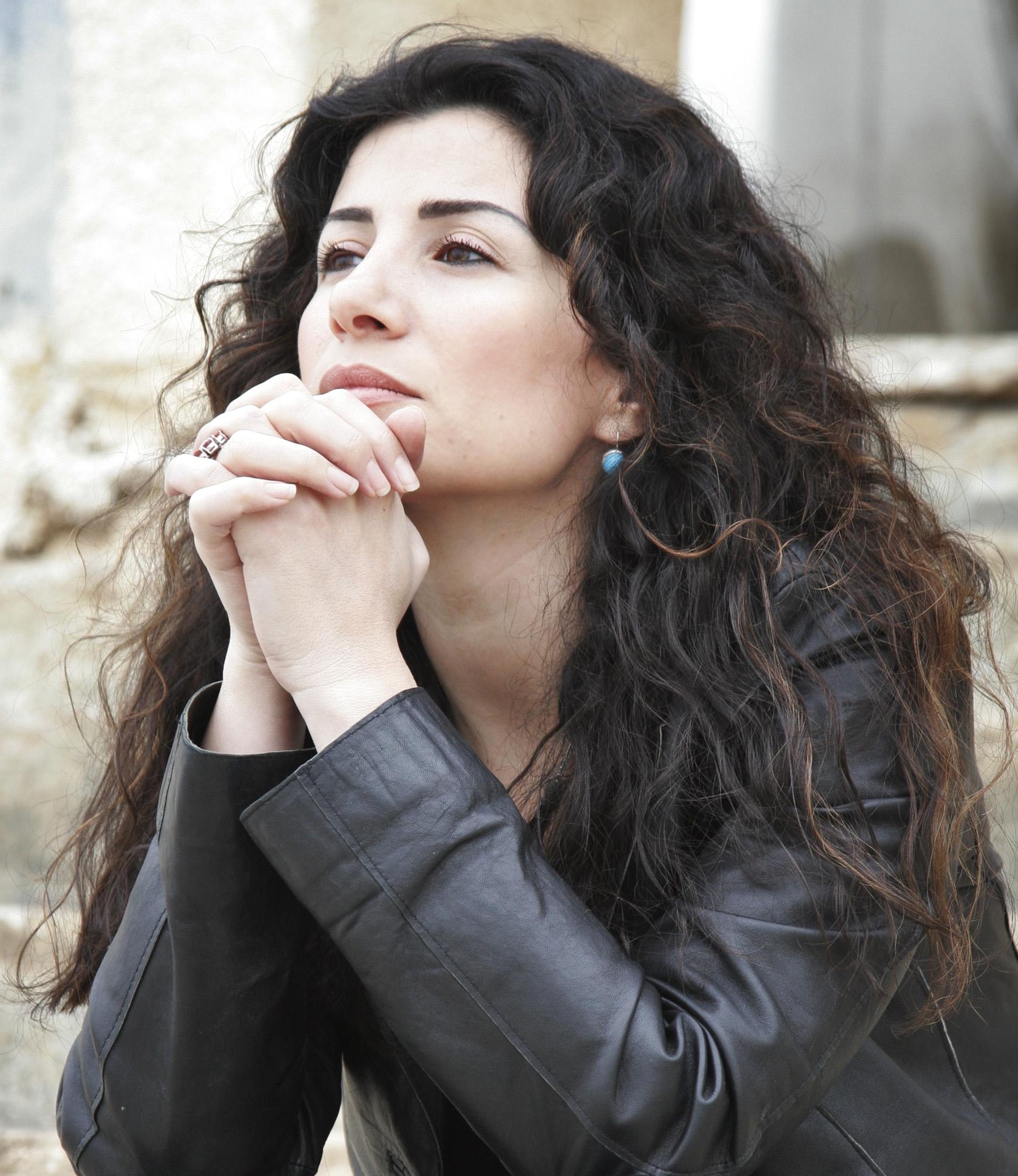
Joumana Haddad

Around these parts of the world, it is usually believed that a woman getting married and having children signals the beginning of the end of her productivity as a person. That’s what social norms say, but not if you follow the Gospel according to Joumana Haddad. One of Lebanon’s leading women when it comes to public opinion, she never shied away from controversy. She defends the sexual liberation of women, their right to do whatever they want, sleep with whoever they want whenever they want. She defends the role of women in societies. She abhors the effect that religious establishments have on women rights in our societies. She was very recently considered by Bahrain to be worse than terrorists as they banned her entry for being an atheist. And for that, she can’t not be on the list.

Lena Gebrane
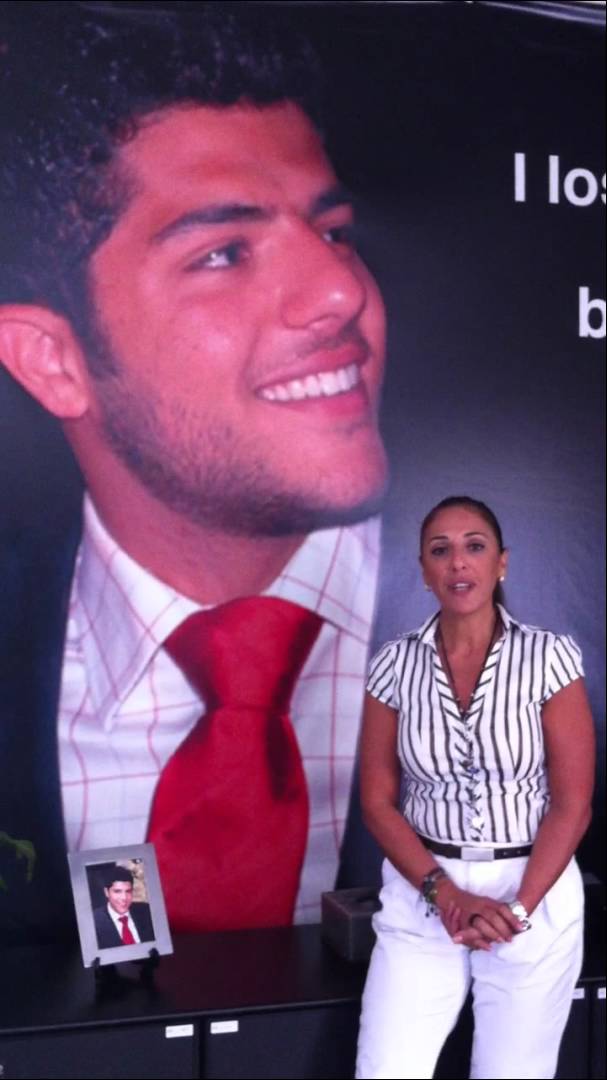
Lena Gebrane

She may not be a household name, but the NGO that she founded certainly is. Following the death of her son Hady in 2006 at the tender age of 18, Lena Gebrane turned her grief into action and pioneered the way to create one of Lebanon’s most prominent NGOs “Kunhadi,” which has worked tirelessly since its creation to create awareness over road safety in Lebanon, especially among its youth. Her goal is to not let any Lebanese mother feel what she has felt. Sadly enough, many still do. But how many mothers today owe their family’s wholeness to Lena Gebrane’s sleepless nights? She has shown that being a mother extends beyond just having a child.

Dima Sadek


Dima Sadek

Dima Sadek is the kind of women who make it look all too easy. She manages to host LBC’s news, arguably the country’s most watched. She also has her own daytime political talk show where she has never shied away from talking tough stances and getting her guests to listen to a healthy dose of truth, even if it means them storming out. Good riddance. She has also managed to become a fashion role model for many women across the country in the very brief time since she became a household name, all while being a great role model to the young girl she’s raising.

Mona Abou Hamzeh
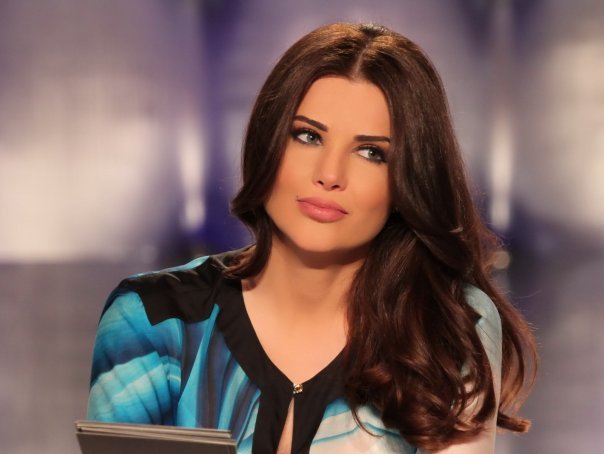
Mona Abou Hamzeh.

She hosts one of Lebanon’s most watched primetime shows. It is as such not because of its “light” nature, but because of her. She made “Talk of the Town” into what it is today, a viable competitor to the veteran show “Kalam Ennas” at the same time-slot on a different TV station. A woman running a TV show solely on primetime is not a rare thing in these parts of the world, but to have a show as successful as Abou Hamzeh’s is. Her demeanor, charm and presentation skills aren’t the only reasons she’s great. The bravery with which she handled her husband’s falling from grace over the past year as well as the support she provided her family while their entire status changed showed how strong Mona Abou Hamzeh is as a woman and as a mother. She didn’t succumb to the scandal that caught her off guard, like society usually asks of women here, but braced through it and emerged victorious.

Nancy Ajram

Nancy Ajram

She sells out arenas, conjures one chart-topping hit after the next, produces one music video after the next, churns out super-selling albums every other year, and still finds time to support the Lebanese army, women and children across the region through various charities, be the regional ambassador for several brands, judge on Arab Idol and be the Arab artist with the most video views on YouTube, ever. Long gone are the days of Nancy Ajram being synonymous with sultry. Many wondered if Ajram’s motherhood would stop her upward trajectory of fame. She proved them wrong by continuing to be one of the region’s most influential and well-known singers, as well as a full time mom to two gorgeous young girls.

The Mothers of Lebanon’s Kidnapped Soldiers

I can’t begin to imagine how difficult it must be for a mother to lose a son, but to have her son’s life be stuck in the balance of a political game for months now and still manage to get up in the morning to tend to the rest of her family must be a whole other level of achievement. They’re not famous. I don’t even know their names. But I know they’ve been working tirelessly to try and get their children to safety, to get our government to do something, anything, even as news kept becoming more and more dismal. And for that, Mother’s Day cannot pass without saluting those mothers too.

Your Mother, Too

This can’t end without a section about your mother as well. Once a year, the country stands to salute our mothers, which is something it should do every day. By being proud of us in spite of our faults, they push us to be better and strive for better. By raising us the best way they can, they are the catalyst towards a, hopefully, better future for the country and for ourselves. She’s the one who, when there isn’t enough food at the table, would rather you eat while she goes to bed hungry. She’s the one who, when there isn’t enough money, would rather you get new clothes than replace her worn out shoes. She’s the one who, despite being incapacitated beyond belief through one illness or the next, would still get out of bed to prepare you lunch. She’s the one you call “weinik/ak” on your phone, the one who’s always first to comment on your picture with “to2borne/to2brine nchallah,” who gushes with joy whenever she thinks about you and whom you won’t be able to repay.

Yes, this is to your mother, too.

Hiba Tawaji Wins Her Battle on France’s The Voice

Hiba Tawaji The Voice

Is it me or are Lebanese women on a roll these couple of days? Rima Karaki is now making headlines around the world for shutting up an Islamist (link), and Hiba Tawaji just presented another side of Lebanese women and artists during her battle on France’s The Voice.

On Françoise Hardy’s classic “Mon Ami La Rose” (YouTube link), Hiba battled 41 year old year Nög in an oriental remix of the very-subdued song, allowing her to show a different side of her voice. Nög, Hiba’s challenger, gave her a run for her money. He was absolutely excellent. The level of competition between him and Hiba has showed that there’s no such thing as someone “professional” competing against “amateurs.” They are all professionals who know what they’re doing, and at 41 Nög probably has a lot of experience under his belt that helped him almost beat the Lebanese contestant.

Ultimately, Mika chose Hiba and Nög was taken by Zazie, another coach.

French audiences were also quite receptive to Hiba’s performance:

This is a video of the performance:

http://www.youtube.com/watch?v=NY4AuN2KKt0

Let me know if the video is removed and I’ll find another version. You can also check the video on LBC’s news page (link).

The Point Behind Following Hiba On France’s The Voice:

I saw a lot of people wonder what’s the point behind the interest in Hiba’s path on France’s The Voice and how it reflects on Lebanon or us as people. It’s a certain thing that Tawaji on The Voice ultimately boosts her career as a priority and reflects little on us. But there’s more to it than that, even if it’s a little gullible to think so.

By being “la Libanaise,” she is giving the French a face of the country that they don’t usually see. It’s not much for sure, and it may be part of our collective hopeless thinking of improving our reputation bit by bit at all means possible. Either way, as a country we’ve gotten interested in so many useless things that I honestly don’t get the point in going up in a fit about this just because people are getting excited about a Lebanese being on it.

Good luck to Hiba on the rest of the show. She’s not in the finals just yet, but next time she’s live she will be up for people voting.

How Hiba Tawaji Completely Owned France’s The Voice

Hiba Tawaji The Voice

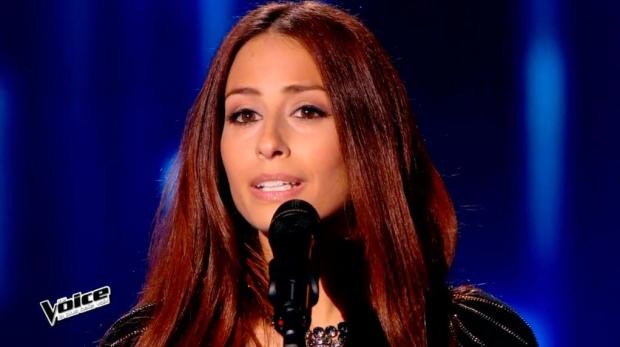
Hiba Tawaji just blew everyone away at France’s The Voice, as was expected. She started off singing Michel Legrand’s “Les Moulins De Mon Coeur” before going into her own Lebanese version of the song “La Bidayi Wala Nihayi” prompting all four judges to turn for her.

Hiba then continued singing effortlessly before ending her performance with a high note that got all 4 judges to give her a standing ovation, as well as have the audience attending the taping rise to their feet to applause her.

This is Hiba’s performance:

https://www.youtube.com/watch?v=fxXLHjMc02Y

She ended up choosing Mika as her coach for the rest of the show.

Hiba Tawaji - The Voice France

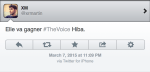
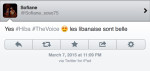
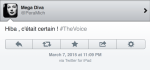
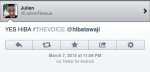
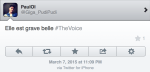
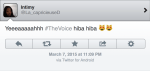
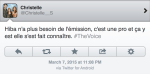
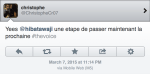
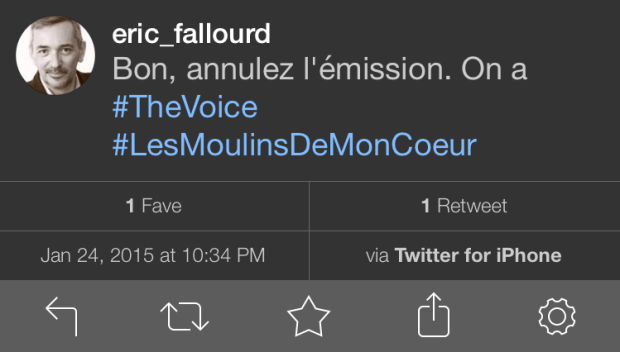
French audiences were also extremely receptive of her. “Libanaise” and “Hiba” both trended on Twitter worldwide. The following is a sample of the tweets that I screenshot as people gushed about her performance:

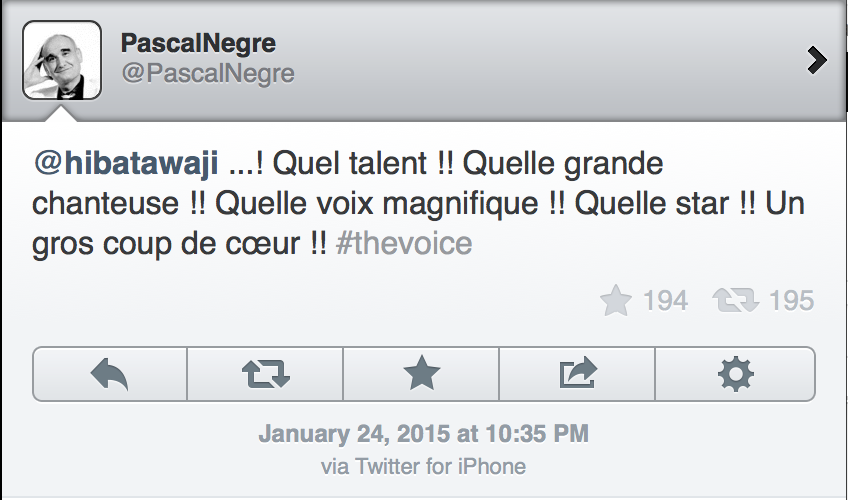
Even the head of Universal Music France was blown away by her:

Hiba Tawaji The Voice France

I saw a lot of Lebanese people wonder how it makes sense for someone as accomplished as Hiba Tawaji to end up on a French talent show.

I think someone as talented and as vocally adept as Tawaji is limited by the scope of what she can do in a country like Lebanon. Her talent can easily find a place in an international scene, with France being the easiest stepping stone as The Voice has proven to be receptive for Lebanese talents as Hiba Tawaji is the fourth Lebanese in four seasons to participate.

Sure, participating in a talent show doesn’t necessarily translate to instant success, nor does it mean she is sure to win the show. But if there’s any Lebanese that can have a shot at reaching the finals (the best outcome so far was Anthony Touma reaching the semi-finals in season 2), it’s her – and her audition only serves to prove that point: out of all 4 Lebanese, she was the best by far.

Moreover, Hiba Tawaji has been around for several years now, and her state of success, albeit impressive, is easily dwarfed by much less talented but more busted female singers in the country, which means that she is quite under-appreciated here for the level of art she is presenting.

Naturally, there will also be those who tell us that there are more important things to worry about. Of course there are more important things that Lebanese should be preoccupied with. At times like these when our army soldiers are bravely dying to let us watch such TV shows safely in the confines of our homes, and when there’s little to be optimistic about at the state of the country actually, such a moment can serve to unwind. And that’s not really a bad thing.

The French are referring to Hiba as “la Libanaise.” She represents us and is doing so extremely well. As such, Hiba Tawaji has made us all proud today and best of luck to her progression on the show.


Lady Gaga’s ARTPOP Gets Censored for the Middle East

Like her or hate her, there’s basically no escaping her especially if you tune in for 10 minutes of local radio. Lady Gaga is gearing up to release her upcoming album which she has titled: ARTPOP. A few weeks ago, she revealed the album’s title to be the following:

ARTPOP

Pretty weird, right? It’s not like you’d expect anything less from her at this point though. However, Middle Eastern countries are getting a different and censored version of this same cover, which was just released and is the following:

BYP0Iz0CQAAE123.jpg-large

They’ve increased the dimension of that ball in front of her, whatever it might mean, to cover her breasts. They’ve also colored her legs black in order to give the impression that she’s covered up.

And yes, Lebanon is one of those countries as is evident by the Lebanese iTunes Store.

I really don’t get this. Did local authorities tell her label they would refuse to sell the album under its previous cover? Or did the label do this out of courtesy? If so, did they really think people wouldn’t simply switch the censored and covered-up cover for the other one in case the decided to purchase the album?

I may not like Lady Gaga and her music but I absolutely hate censorship especially when it’s this absurd and non-sensical. What’s next? Cover her up with a burqa and retitle the album to something regionally-appropriate in order not to irk some people? After all, who knows how they’ll take the “art” in Artpop?

Last time I checked, regardless of whether I agree or not with her methods, she was someone championing for personal liberties and whatnot. Our countries have squashed that right out of the bat – and the album is yet to be released. Perhaps they’ll then censor the track listing as well which contains songs called Sex Dreams and Swine because, as you know, sex and swine are both haram.

I guess the bright side is that this wasn’t banned, not that it would make any difference given that’s available online aplenty.

Farewell Wadih el Safi

We only appreciate our artists after they die.

Wadih el Safi, one of the three remaining giants of Lebanese music, bid this world farewell today at the age of 92. Perhaps it’s easier to mourn the loss of this man, the national symbol that he is. I choose instead to reflect on the life that he has lived, not on the last days of weakness that we tend to remember those who leave us by.

Wadih el Safi, in a career that has spanned almost seven decades, has put a mark on Lebanese music and culture that is tangible and unshakeable even to those, like me, who were not exposed to him growing up. My memories with Wadih el Safi are not those of a typical Lebanese who associates him with rousing patriotism. Whenever I think of him, I think of the songs about family that he would sing, about being a father talking to his son, a father having a discussion with his daughter… I remember how the people around me feel whenever they listen to those songs and how vulnerable he makes them, in the space of a few minutes, with his melody and voice.

They called Mr. el Safi the voice of Lebanon as he sung about this piece of heaven that he called home. It’s a shame that the voice of Lebanon is leaving this country while his piece of heaven is probably anything but. You may be wondering why someone like me, who’s the last person you’d imagine would write about such a thing, is actually doing so. But with Wadih el Safi’s demise, Lebanon has lost a key pillar in the little that remains in the culture that is truly honorable and decent of this country we call home.

Wadih el Safi’s death isn’t just that of a singer that the Lebanese population likes because they feel they must, out of respect. His death takes us one step closer to the full realization of the cultural demise that we are heading to, especially when it comes to music and arts.

Farewell Wadih el Safi, the man who has lived and has done so abundantly.