Lebanon’s Is The 8th Worst Country In The World For Women Rights

Earlier today, Lebanese minister of internal affairs Nouhad el Machnouk gave an impassioned speech celebrating International Women’s Day in which he proclaimed Lebanese women are not that far behind compared to their male counterpart in the country, something that no other country in the region has achieved. In coming to that conclusion, Machnouk was in part reliant on the fact that Lebanese women were named among the world’s sexiest.

Congrats Lebanese ladies, your value is now directly correlated to your rack and how tight-clad your skirts are. Cue in the applause.

I’m sure this comes as no surprise for a governing body that is as disenchanted and disenfranchised from the population it’s governing as Lebanon’s governments, both current and past. The garbage on our streets is proof enough for that. 

The thing about Lebanon, however, is that it is the center of multiple international studies, as are most countries around the world, especially when it comes to the gender gap and women rights. Among those international studies is one carried out by the World Economic Forum, which was published in mid November 2015. 

That study’s findings can be summarized in the following infographic by LA Times’ Priya Krishnakumar:

Gender Gap worldwide

This puts us on a shameful list of countries where the gender gap is so severe that the term second sex does not delineate an other-hood but rather inferiority. We are 8th in the worst countries in the world when it comes to equality between men and women, adding it to another worst-of-list for us to be “proud” of.

Happy international women’s day my fellow Lebanese.

Our women can’t pass on our beautiful citizenship to their children, but what matters is that they can wear whatever they want (if their male family members deem it appropriate).

Our women have single-digit representation in a triple-digits parliament, but what matters is that one of those representatives is stunning (and would make a healthy argument to being on that sexiest countries list).

Our women’s wages are always inferior to their male counterparts in the country, but what matters is that those men have no problem spending the money on those women (because financial independence is so passé).

Our women’s participation in the workforce is inferior to their male counterparts in the country, but what matters certainly is those women’s job as housewives, bringing up generations (of children whose girls grow up to be just like their mothers and whose boys grow up just like their fathers).

Our women can get beaten to death legally at the hand of their spouse with no legal protection against that domestic abuse, but what matters is obviously for that man to remain the dominant figure in that household, his word never repeated twice.

Faced with such a reality, some of us Lebanese will look at that list and say: but Saudi Arabia isn’t there. Women can’t even drive there. Yes, because looking up to Saudi Arabia is obviously the best way for our society to move forward. There’s more to women rights than getting behind the wheel of a car.

If our governing bodies think that the entirety of Lebanese women is summarized by the touristy reports they see about Mar Mkhayel on a Saturday night, it’s our duty as Lebanese to be aware that our country extends beyond its party streets.

I hope Lebanon ends up on the other part of that infographic one day. Such a drift will not happen if we don’t all contribute to putting our women forward. These upcoming municipal elections, encourage your mothers and sisters to run. Encourage all our women who are so excellent at what they do to propagate their excellence onto a bigger medium. Mentalities need to change, and that is the best way to do so.

Until then, less Nouhad el Machnouk empty propaganda, and more reality please. Happy International Women’s Day, everyone.

Congrats Lebanon, We Have The World’s 9th Worst Passport

Oh so close. We almost dropped out of the top ten this year, but no such luck.

After all the hassle secondary to our General Security deciding out of the blue that a good bunch of the country’s passport would no longer be functional, it’s safe to say that apart from that useless bureaucracy, very minimal improvement has occurred to the state of our travel document over the past year. After all, how could it given that the only semblance of governance we get is when Saudi Arabia is upset at us?

Henley & Partners, the world’s leading Citizenship research consultancy firm, published their yearly report about passport strengths – the same one that gets us upset every year – and we’re at #96 when it comes to the worst passports of the world, in a list that tops at #104 with Afghanistan. We share the #96 spot, which translates to the 9th worst passport in the world with Bangladesh, Congo and Sri Lanka.

The bottom 10 is as follows:

  1. Afghanistan,
  2. Pakistan,
  3. Iraq,
  4. Somalia,
  5. Syria,
  6. Libya,
  7. Sudan, Palestine, Nepal, Eritrea, Ethiopia, Iran,
  8. Kosovo, South Sudan, Yemen,
  9. Bangladesh, Congo, Lebanon, Sri Lanka,
  10. Burundi, North Korea, Myanmar.

Meanwhile, a slew of European and American countries top the list with passports that give them access to more 170 countries visa-free. We are allowed access to 39.

The highest ranking Arab country is the UAE at #38 with a passport that grants them visa-free entry to 122 countries. The highest ranking regional country, however, is Cyprus at #17 with 159 visa-free country, bolstered by the fact it’s in the European Union. Our enemy to the South, meanwhile, comes in at #25 with around 147 countries its citizens can enter without a hassle.

The situation is not that bleak, however, because our passport rank has actually gone up from last year, mostly because a bunch of countries fell below us such as Syria, South Sudan and Iraq:

Lebanon Passport

We have, however, gained two more visa-free countries to travel to in the past year, up to 39.

There’s nothing more indicative about how being born somewhere is detrimental to your “worth” as a person as the hierarchy behind passports, a yearly reminder that if you happen to come from a place that is not Europe, not America, and not completely in the good graces of either of those two entities, your worth is inherently lower.

But that’s not the full explanation behind how low our passport and citizenship ranks. This rank is a reflection of the unstable political situation in a country that hasn’t had a president in almost two years and doesn’t seem like it will have one anytime soon, hasn’t managed to vote for a parliament in over 1000 days, has garbage piling up on its streets, has one of the most incompetent ruling classes to exist, has a militia roaming its lands with the ability to shake the country up at will (as in protests because of a caricature on a TV show).

Look at the UAE. A few years ago, they had only access to 64 countries without visas. In 2016, their citizens can visit double that number. Why so? Because their ruling class – new-age dictators and whatnot – have a clear vision for a future that enables their citizens to be the best version of themselves (within the limited freedom confines offered of course). We can make fun all we want of how fake Dubai is, of how silly it is to have a “Happiness” minister, but the fact remains that not only are Emiratis leagues above us now, they are also in an upward trajectory while we slumber in our lower ranks content that we have real snow and not a fake slope built inside a Dubai mall.

United Arab Emirates Passport

What can we do to fix this?

We need to be more aware citizens. We can’t bury our heads in the glories of days past and pretend that is a representation of our present. When the time comes to vote, we shouldn’t go back to what we know thinking it’s what we need – we need to see that there are alternatives to the parties that have been ruining our lives for years. As long as our politicians keep getting a blank space from us to do whatever they want, they’ll be content with keeping a status quo that enables them and disables us, including a passport that forces everyone to stay put – unless they were lucky enough to have a second one on the side to use at will.


When Lebanon’s Trash Becomes International, But We Are Too Busy Kissing Saudi Arabia’s Ass

Don’t call it brain dead.

Congrats Lebanon, we have made the international news cycle once more, the first time this year and hopefully the first of many.

No, it wasn’t about that viral Facebook fake-pictures-filled post proclaiming the beauty of God’s gift to Earth. I can hear your hearts break all the way here.

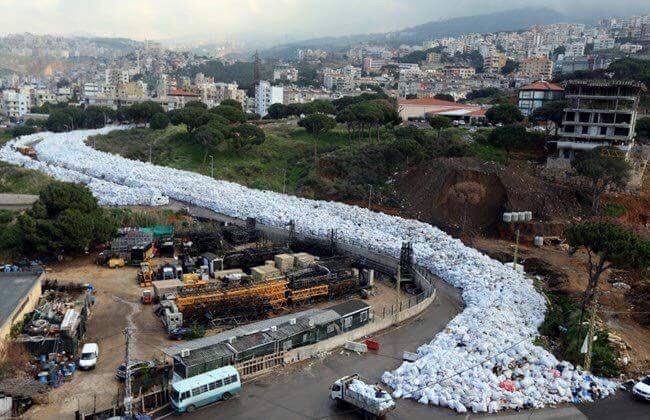
What made us international is actually old news to us. It’s so old in fact that not only does nobody care anymore, but the hype surrounding the issue has disappeared with each vanishing garbage bag stashed away in one of Lebanon’s valleys or on random roads, snaking around curves like white rancid rivers. Out of sight, out of mind – Lebanon style.


There is a bright side to the ordeal, however. Even our garbage bags look nice. They’re white, snow-like, built into winding rivers or towering pyramids.

Say hi to Buzzfeed.

Say thank you to CNN.

Wait for the upcoming onslaught from other outlets as well in the next few days. We are making it big. Aren’t we all proud?

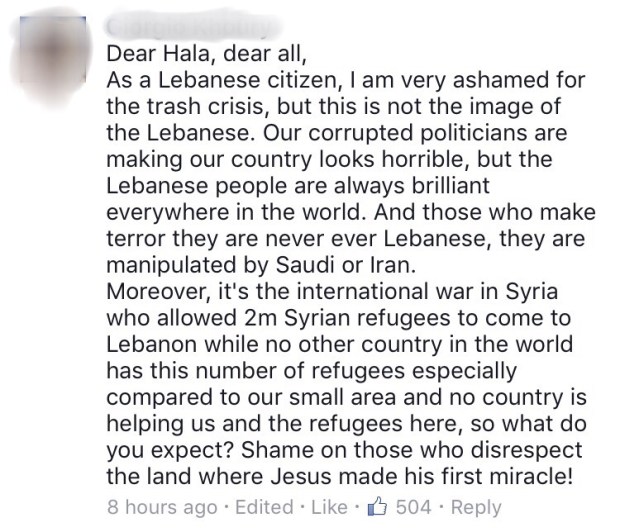
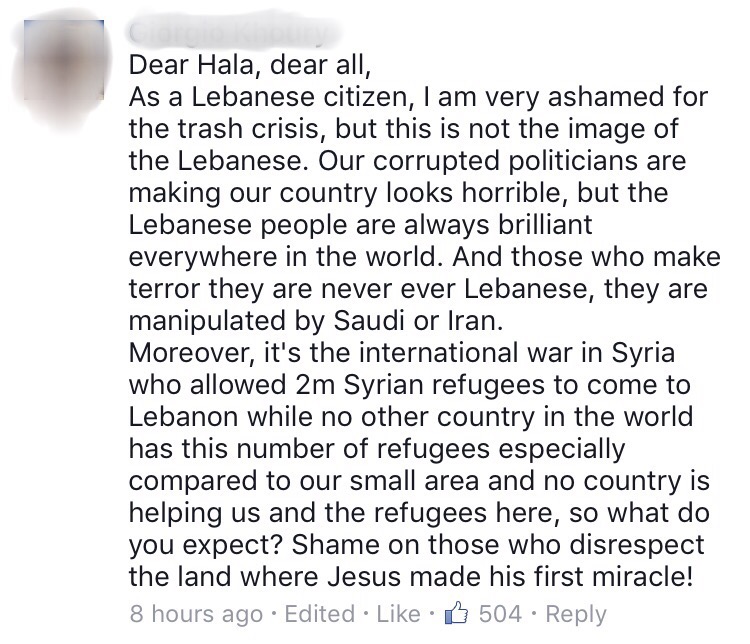
Except, of course, this is *obviously* not the image of the country:

img_2545

I mean it’s always someone else’s fault, never ours collectively.

Putting lipstick on a dead pig level: Lebanon.

Is anything happening regarding the garbage crisis? Not really. Our government is busy doing other things, or just one thing to be exact: kiss Saudi Arabia’s ass like no country has missed another country’s ass before.

This past week, our government convened for SEVEN straight hours to discuss one item on their agenda: how to formulate a paragraph to please Saudi Arabia in order not to face their wrath manifesting in them not giving us money anymore, beggars-style.

I don’t think our government has convened for a total of 7 hours discussing the garbage crisis, or any other Lebanese crisis for that matter, over the last several months.

Live Love Saudi Arabia.

This past week, Saad Hariri decided to launch a petition across the country in order to show Saudi Arabia that Lebanon loved it so, akin to our country giving them a big fat political blowjob.

No politician cared enough to act about the garbage crisis, or any other crisis, since it started. Have we ever had a “Loyalty to Lebanon” petition circle around the country before?

Live Love Saudi Arabia.

This past week, minister of Justice Ashraf Rifi quit to protest the Lebanese stance towards Saudi Arabia’s recent embassy attack, first and foremost, and to a lesser extent protest the handling of Michel Samaha’s case. It took their reference country being seemingly offended for some ministers to resign.
Months after the garbage piled up on our streets, months after protests of hundreds of thousands… No other minister resigned or was even fazed by the notion of needing to resign.
This past week, Lebanese politicians of all kinds of kinds had something to say about Saudi Arabia. Even those that opposed KSA politically were at loss about what to do.
This amount of political maneuvering has not occurred not only with the garbage crisis, but with out presidential vacuum issue as well.

Live Love Saudi Arabia.

There comes a point where an entire country begging for absolution from another entity for the sake of money, for the sake of empty Arabism, for the sake of useless politics when that country’s capital is drowning in trash becomes not only humiliating but also insulting.

This is where we are today: a country sinking in garbage, but whose priority is how low it can go to its knees. But please, by a all means, don’t call it brain dead.

Let’s keep loving Saudi Arabia.

Geagea and Aoun’s New Love Fest: The Good, The Bad, The Ugly

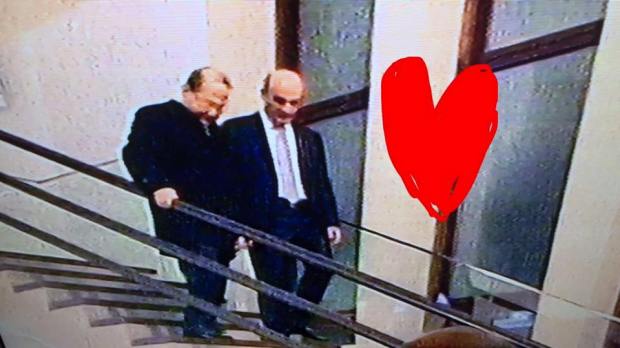
Samir Geagea and Michel Aoun

In a widely predicted move, LF leader Samir Geagea and FPM leader Michel Aoun came out with a political understanding yesterday that saw the former supporting the latter for Lebanon’s presidency, after about 33 failed attempts at electing a president and 30 years of the same practiced politics.

Lebanon’s Christian field was predominantly supportive. After all, the whole burying the hatchet fest that we saw on TV was done because Christianity, and Christians sure love seeing #TeamJesus in all its glory on Lebanese TV.

The Good:

We can now say that on January 18th, 2016, after around 30 years of feud, Samir Geagea and Michel Aoun finally saw eye to eye in something. A more zealous response would be: LET THEM KNOW NOW THAT CHRISTIANS WILL NEVER BE PUT ASIDE AGAIN, etc. But that’s not really the case.

It’s good to see a semblance of unity occur regardless of what that unity might mean. It’s good to see Geagea and Aoun talk things out.

But.

The Bad:

Many think that this move was visionary. The fact of the matter is it’s nothing other than reactionary to Saad Hariri nominating Sleiman Frangieh for president a few weeks ago. The only disturbance in the presidential race, protracted and dull as it was, was Saad Hariri’s deal back in November-December. That disturbance became the catalyst behind both the FPM and the LF’s deal today in order to “reclaim” their constitution-given Christian right.

How good can a move made in reaction and spite be, rather than it being foreseeing and contemplative, especially in the grand picture of Lebanese politics that not only requires foresight to navigate its murky waters? Why don’t you refer to Jumblat for that?

What this move does is not elevate the level of politics that Geagea and Aoun are practicing. It’s not a good thing that Lebanon’s Christian community is now practicing the same kind of tribal politics that the country’s other factions do. By “uniting,” Geagea and Aoun moved from their failed politics on a national level to failed politics on a sectarian level.

Yes, they were Christian leaders first and foremost, many of their policies had inter-sectarian tendencies. How will they move from here? Not in that way, clearly.

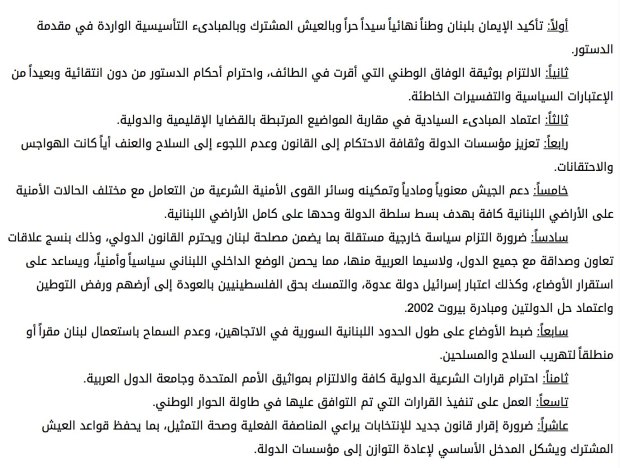
The move also comes to the backdrop of a 10 point agreement that the two forged over the past 6 months. It reads as follows:

Geagea Aoun Agreement

The agreement’s key points then are the following:

  • No use of weapons in case of conflict,
  • Supporting the Lebanese army in governing the entirety of Lebanon’s territories alone,
  • A Switzerland-esque foreign policy to get the country to avoid struggles,
  • Supporting UN resolutions,
  • A new electoral law.

Sure, those headlines are all wonderful, and looking at them with no critical thought warrants giving their alliance a second thought. But you can’t not be critical of Lebanese political talk, and the question therefore becomes: how will they do them?

The difference in ideology between Geagea and Aoun is not only related to their Civil War days: the two were supremely divergent even in times of “peace.” They have not agreed on an electoral law other than the Orthodox Law, and even that agreement was more about whose balls are bigger rather than it being done with political wisdom. They have not agreed on which kind of foreign policy they see best for the country. They have not agreed on which way is best to actually get the army to be the only rightful security force in the country, and how to implement all kinds of UN resolutions (hinting at ridding Hezbollah of its weapons).

Alliances need to have a minimum of common ideology. Establishing them just for the sake of common interests in the short run will prove, in the long run, to be detrimental, especially when it affects an entire community (in this case Lebanon’s Christians).

Is this how Christian rights are restored? By making Lebanon’s Christians more exclusive rather than inclusive? By making them more sequestered? By thirding the country instead of keeping it halved? By turning Christians from the entity that governed Lebanon’s dichotomy to another destabilizing agent in an unstable country?

Ignoring the differences that these two presented to Lebanon’s Christian community is the first step towards removing any semblance of democracy from that community. Difference is not to be feared in political contexts. Disregarding it is what’s scary.

The Ugly:

Geagea and Aoun made peace. But I have to wonder: what kind of peace?

They’re making the kind of peace that requires us to bury our heads in the sand, like the perpetual ostriches that our Lebanese existence has made us into; the kind of peace that does not deal with the past requiring such a peace to be made in the first place, effectively making it a recipe for impeding disaster.

The argument goes: other factions have done these peace making deals before, and as such Christians doing it should be celebrated. Making peace is good. But is it?

Is the peace made by Lebanon’s other war factions actual peace? The idea of making peace invokes stability. Is the country stable? Is making peace in spite of history not through it, as all those other factions have done, putting the country on the right path towards healing post our civil war?

I look around and see people from different sects still hating each other, still worried about the intentions of one another. I look around and see a political discourse that still gets those who have supposedly made up after our civil war to fear each other.

What kind of peace are they talking about then?

There are things that are a little too late, and this is one of them. Where was the common interest of Lebanon’s Christian community 30 years ago when these two were actively working on canceling each other out, when their wars tore apart Christian communities and left thousands of victims in their wake?

Yes, this is not the time to bring up war-time memories, but healing only starts with remembering.  Would there have been a need for such a “deal” to be made in 2016 had those two actually cared about the community they’re panicking about today back in the 1980s?

Peace cannot be made by those who only know war.

The Uglier:

I’m afraid to inform you my fellow Lebanese that this “alliance” does not, in any way, affect your life as a Lebanese in the ways that actually matter.

It will not bring you electricity.

It will not fix your garbage crisis.

It will not make your internet faster so you can stream Netflix.

It will not increase your minimum wage.

It will not make your passport worthwhile.

It will not stop the “SSSS” checks on your boarding passes and “random” checkups in airports.

It will not stop ISIS.

It will not extract the oil from our fields.

And, ironically, it does not even guarantee that a president be elected.

Our Lebanese reality cannot be changed when the same people who have been practicing their failed politics over us for 30 years start practicing their politics together.

The Funny:

To end this on a happier note, I can’t but share a few of the lighter tones with which some Lebanese handled the news, in the joke that this actually is:

The Stunning History Behind Ras Beirut’s Endangered “Red House”

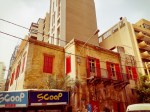
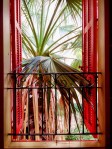
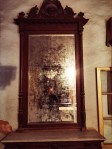
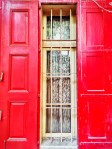
Nestled in the heart of Hamra, on Abdel Aziz street leading to Bliss Street, is a house most of us passed by without noticing until very recently. Its red window tiles always caught my eye in the days when I used to frequent that area, but their history was never evident. Isn’t that the story everywhere in Beirut though? You pass by these gloriously beautiful old houses, sigh at their dismal prospects in a city that cares less about its history and more about its bottom line and just continue about without giving a second thought at the times and stories those walls inhabit.

Let me take you on a journey across Hamra’s Red House.

One Of The Oldest Houses in Ras Beirut:

The Red House is comprised of two stories, the first of which was built in the late 1700s, along with a small kitchen above it to consitute the first part of the second story which was later continued in the 1800s by the Rebeiz family, which was back then one of the main Orthodox families of Ras Beirut and a prime owner of much of the land upon which Hamra today is built.

The story of the Rebeiz family dates back to as far as the house they lived in: they came to Hamra around 400 years ago and slowly made their way up the echelons of society, buying land from the well-renowned Druze Talhouk family. Together with the other prominent Bekhazi family, they became forces to be reckoned with in their area. Their names became synonymous with Ras Beirut, and vice versa.

The Red House has housed many generations of the Rebeiz family, but its most prominent were two women: Samira and Marie Abdo Rebeiz, both of whom were widows who lived in the house in the early 20th century, and it is them that made the house the beacon of Ras Beiruti elite life.

Pioneering Matriarchs Of Ras Beirut’s Political Ring:

Marie ABdo Rbeiz

Marie Abdo Rebeiz was unfortunate enough to find herself a widow with two sons: Michel and Georges, at a very young age. Her plight was also shared by her cousin Samira Rebeiz who lost her husband at the tender age of 25, and was left with four children to take care of.

Marie Abdo then invited her cousin, whose inherited property had been taken by the rest of the Rebeiz family for fear of her remarrying out of the family, to live with her in Hamra’s Red House, along with her four children, in the “newer” upper story part of the house.

The two women co-existed quite well and their children grew up around each other. Michel, Marie Abdo’s son, still lives in the bottom floor of the house to this very day. Georges later became a prominent cardiologist in the area and has 3 children who currently inherited the house after their father’s passing a few months ago.

Marie Abdo and Samira, however, were extremely powerful women. They were so powerful in fact that they  had a major role to play in the dynamics of Beirut’s political life around that time: it is the Red House that became a reference for many of Ras Beirut’s elite politicians, of differing sects, in order to truly have a shot at whatever position they coveted: Marie Abdo and Samira were important electoral keys to the women of the area, the extended Rebeiz family and its 3000+ votes at the time. They kept a garden next to the house, cooked for their neighborhood and hosted many gatherings for the women of the region.

Among the politicians whose careers were majorly influenced by this house are Habib Abi Chahla, one of country’s independence heroes, Bahije Takieddine, Saeb Salam – father of current PM Tamam Salam, Sami el Solh and Fawzi el Hoss, all of whom became MPs or PMs at a later point in their careers. Their descendants tell tales, even today, at how important that house was to their fathers.

Louis Armstrong Visited Too:

Louis Armstrong

During his visit to Lebanon in the 1960s, Louis Armstrong, one of they key figures in Jazz music, visited the Red House. He was brought to Lebanon by one of Samira Rebeiz’s sons, Georges Rebeiz, who founded Caviar House and Prunier. That son wanted to introduce Armstrong to the house that built him.

It Survived The Civil War:

The house also made it relatively unscathed through the Lebanese civil war. Its tenants refused to vacate the house for the many militias that demanded it, and through a stroke of luck was left militia-free.

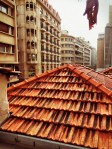
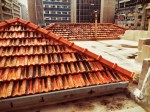
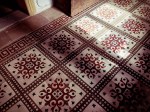
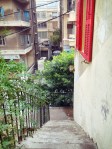
After the end of the civil war, its main tenant Samir Rebeiz, a well known conservationist and restorative architect with an impressive portfolio, who is currently vacating as per a court order, made sure to restore the part in which he lived to the best of his capacities. You can see from many of the pictures at the beginning of this post how relatively well-preserved the house is.

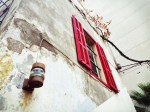
The current tenants even made it a yearly affair to repaint the windows with their characteristic red color, as I was told by Paola Rebeiz, a well-known Beiruti socialite and fashion consultant.

A Rebeiz Family Feud:

Over the past few days, the imminent threat to Hamra’s “Red House” got activists and Beirut’s heritage preservation groups to try and save the house. In their attempt to do so, a potential family feud between the Rebeiz family was unearthed: one between the descendants of Samira and Marie Abdo.

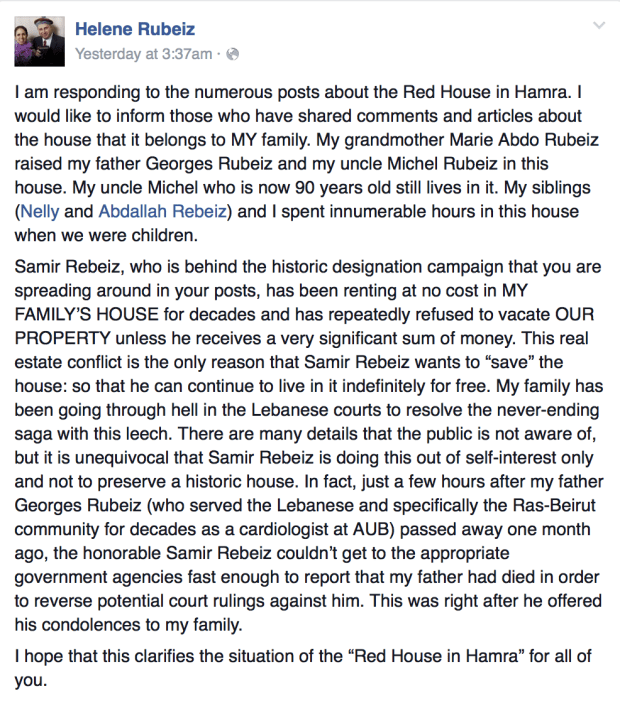
Helene Rebeiz, one of the three people who recently inherited the house after the passing of Marie Abdo’s son Georges, had the following statement:

Helene Rbeiz Red House Beirut Hamra

Samir Rebeiz, who has been living in the house for years, was doing so under Lebanon’s ancient and outdated renting laws, which effectively mean that tenants pay minimal amounts to their landlords and evicting them is near impossible.

When asked about this, Samir Rebeiz refused to make a statement and simply said: “I am leaving this house. I’ve done everything I can to maintain it, and my conscience is clear.”

When I visited, the house was being vacated. Everything Samir owned was being tucked away in boxes, leaving empty rooms and hallways.

The court order requiring Samir Rbeiz to vacate the premises mentioned that the owners wanted to demolish. It is unknown, however, which real estate mogul is interested in the property.

Heritage Trumps Money:

The fate of the house will be decided tomorrow in Lebanon’s Ministry of Culture which will determine whether the house fits the criteria to be considered a national heritage site, protecting it in theory from demolition.

In my opinion, the relevance of a family feud over this house’s fate is not important. We are not interfering in Rbeiz family matters when we give an opinion on the subjective worth of a property at the heart of their feud.

What is constant, regardless of all the other variables, is that this house is a jewel at the heart of Beirut that should be preserved regardless.

It is one of the last remnants of true Lebanese architecture of the area.

It is so preserved that Lebanon’s archeological committee warned against its demolition.

It is a representative of the history of its region and of its country.

It would be such a shame to let all of this go and replace it with yet another concrete block that can bring people millions, but rob them of their identity and heritage.

Beirut is a city that is being maimed every day by the construction robbing it of its flair, of its character, and turning it into yet another one of those plots of lands made up of concrete jungles. This house stands defiant to the progressive and purposeful de-Beirutification of Beirut. Let’s not ruin that too.