Could Patriarch Raï Become The Next Pope?

The conclave of Cardinals in charge of electing the new pope to replace Benedict XVI is currently underway at the Sistine chapel in the Vatican. You’re out of luck if you are a Roman tourist at this time of year – you can blame Benedict’s old age for that.

As it is with papal elections, there is no clear frontrunner as of this point. The myth goes that the cardinals leave their choice to the holy spirit through copious amounts of prayers and holiness. That is if you believe the holy spirit is a combination of politics, geographic, demographics and whatnot.

Eventually, any Pope nowadays is chosen based on one premise only: strengthening the position of the Catholic Church around the world. The late pope John Paul II led one of the biggest developments the Catholic Church had seen when it comes to the Youth, especially in popularity. Benedict’s undeclared job was to contain this surge that John Paul caused in a more Christian, usable, framework.

Today, the Catholic church is stuck at the edge of a steep cliff with the following predicaments:

  1. Decreasing worshippers across the world,
  2. Rise in Christian persecution in certain parts of the world,
  3. Sex-related scandals that plague Catholic priests more often than none,
  4. Corruption scandals that always seem to find a foothold,
  5. The issues of abortion, same-sex marriage and other thorny issues.

Seeing as the Catholic church is firm in its position regarding abortion, same-sex marriages (despite some recent breakthroughs in that regard), stem cell research and the like, I believe point #5 is not even an option in the voters’ mindset. Corruption and sex-related scandals are issues that Cardinals feel should be best kept in-house, not influencing the decision of choosing a Pope who will lead a Church not only based on those two criteria. The stances of the Catholic church regarding the many sex abuse cases that were revealed is a testament to that – if anything, it reminds me of typical elderly Lebanese women whose job in life is to cover up any wrongdoing in their family and showcase it to the world in positive light. Cardinals are similar to those elderly women in that regard.

The most important framework for Cardinals voting today is the following: help Christians around the world stay Christians and lessen the numbers of Christians who are deciding not to be so anymore. There’s little that a Pope can do when it comes to decreasing worshippers – after all, how do you convince people who lack faith that they should have it? It’s impossible. But what the papal conclave of Cardinals can affect is the persecution of Christian minorities across the world, notably in the Middle East.

Pope Benedict’s XVI’s visit to Lebanon back in September – his last major visit to any country before his resignation – was not out of the blue. Him demanding Patriarch Raï to go to Syria and hold mass there, which sparked an insane reaction, was also not out of the blue. Small steps they may be, sure, but for the faithful who still cling to their belief despite the hardships, a patriarch or a Pope acknowledging their strife is some very important business.

The question, therefore, asks itself: Could Patriarch Raï be the dark horse to be elected as the upcoming Pope?

Many Lebanese have already set Facebook pages to that effect, out of enthusiasm mostly, as if a liking a Facebook page to demand our patriarch be instated as Pope is actually beneficial or worth it. But that’s how things are with us – we always take things to Facebook.

However, I have thought about it lately and come to conclude that Mr. Raï could have a decent, albeit slight chance, at becoming the world’s next Pope for the following reasons:

  1. If the main focus is to target the persecution of Christians in the world, what better option than the head of the Christian majority in the location where Christians are targeted the most? The Middle East.
  2. Former pope Benedict’s XVI’s visit to Lebanon was, in part, to sign the Post-Synodal Apostolic Exhortation (text) in which the Vatican goes on and on about the crucial importance of the Church in the Middle East.
  3. A Pope from the Middle East would set the wheels for true Muslim-Christian dialogue, which is what this deeply religious and troubled region needs and the Vatican knows this.
  4. Patriarch Raï is age appropriate to be pope. He is only 73. He also speaks several languages fluently, as is required of Lebanese bishops.
  5. Patriarch Raï does not come from a country where priest sex scandals are aplenty and being relatively unknown to the vote has a rather “cleaner” slate than his counterparts. He was also elected as an assistant to the interim Pope over the past week.

The reasons may not be supremely compelling to have someone become Pope, sure. But they’re still viable enough to put Mr. Raï on the papal map. I’m not even sure if Mr. Raï can be a good pope but he might become one.  And frankly, him getting elected sort of scares me.

The Perks of Being Lebanese

Back in December, I hosted a photographer who wanted to visit Lebanon in order to experience our on-the-edge diverse lifestyle. I showed him around as much as I could given the short time I had, taking myself to Tyre for the first time in my life. I had never been that far South before. I left him there in order for him to see life in that Southern city firsthand. A couple of days later, we met up in Beirut and somehow he started contrasting and comparing my country with his. He comes from one of the world’s biggest superpowers so it’s understandable that my country is lacking in comparison.

But I couldn’t take it. Snarkiness started to ooze out of every word I uttered like the sharp blade of a knife. Jabs here and there about how his country could never – ever – have the history that my country has started flowing. I even surprised myself when it comes to political declarations which would probably get any Lebanese who knows me turn his head in disbelief. Imagine me proclaiming support for Hezbollah and you’ll get the drift.

I felt it was necessary. It’s not about being politically correct. It’s this built in sensor inside my brain to defend Lebanon whenever I can to whoever I can. And it goes off at random times, despite the logical part of me telling me that I should probably stop. I can’t help it. My relationship with my country is that of some serious love-hate. And I can’t escape it.

Bref, I nag too much sometimes and I know it. I know some of you hate it – but living in Lebanon leaves you constantly angry, constantly furious, constantly edgy. We all deal with it with the best way we can and considering what we’re dealt with every day, I daresay we handle it really well. Most of the time at least.

To those who thought I’m being quite negative, you’re probably right. This one’s for you. Now smile and take it in because such articles will only come rarely. Let it sink in because you won’t hear me saying this very often – not that it matters since it’s now online for everyone to see – but here it goes: I probably wouldn’t trade growing up in Lebanon for anything else in the whole world.

It’s not about the copious amount of money I could have had. It’s not about super kickass passports I often wish I possessed. I think growing up here, witnessing the struggles of here, dealing with the hardships that here represents have gotten me to grow as a person in ways that any other place probably wouldn’t have provided.

In a way, growing up here has made me a person who is capable of standing on his feet wherever you throw him. It might sound cliche – positive vibes always go around clicheville – but it’s something that the past year has truly reinforced in me.

When I was in France, the French were shocked I could juggle three languages fluently without a hitch, something that was completely normal to me but seemed very odd to them. It is there that I came to appreciate exactly how thankful I am for the decent education I got here. The fact that I was able to keep up with more knowledgeable physicians at the hospital where I did my clerkship doesn’t only reflect on my mental capacities but on the way education in Lebanon shapes you up without you even knowing it. It is no wonder that with all the preparation we subtly get in school and later on in higher education institutes, we are able to excel when given room and opportunity.

That month I spent in France opened up my eyes to something else that I hadn’t really thought of: life in Lebanon does not go on in a protective bubble that separates you from everything else happening around you.
The aforementioned idea started to get formulated in my mind back in 2011 when I wrote a small article about 9/11 and some members of American family stopped talking to me as a result. I still don’t see anything wrong with my article. If anything, I stand by it more than before. But it’s the perception of the article which differentiates my American kin from yours truly. For them, I am being harsh and insensitive because I haven’t lived it and I am not American. To me, they are being very concentric and limited. But it’s no one’s fault really: my perception as a Lebanese of the world is and will always be of people whose fate isn’t in their hand, of a country which is always a part in a chessgame of bigger fish.
And while we nag about that as is our right, I think the premise of the life this sets is healthy: to know that there’s always another story taking place somewhere, to know that there is another side to us, to know that there is life form outside of the bubble that we love to live inside and to know that everything has a reference point to put things in perspective.

The photographer who came here back in December was more than interested in something that I not only took for granted but thought was beyond normal. My hometown coexists quite peacefully with a neighboring Shiite town. My best friends happen to be either Shiite or atheists or Sunni or Maronites. We differ politically, we argue more often than not. We come from severely different backgrounds in our own country. But we still find ourselves at one table having dinner as often as we argue about the backgrounds from which we come. The experience itself is one that we ignore because it’s never in the forefront of our thoughts. But to an outsider, the interactions we have and the friendships we strike are things that are beyond interesting. When that photographer pointed out how odd to him that dinner table setting was, I started to think about it more and I realized that I am what I am today because of those people that have come into my life from all those different backgrounds. And despite some eccentric bearded men from all sides wanting to tell us that our friendships are abnormal, our relationships still exist and they keep flourishing. The majority of us as Lebanese have friends who come from backgrounds that had, until quite recently in historical terms, been fighting against each other. Yet that’s never an issue. It’s not even something we think about. But imagine how bland our lives would be if the only people we knew shared our thoughts, our views and barely differed from us in the things that count.

And as I go back home every day from class or from those dinners with friends, another thing I take for granted is my family. The fact that the family unit is still very cohesive in this country is a treasure in itself. Child psychology tells you how important a tightly-knit family is for the development of a human being. But this isn’t about psychological theories. How often do we think about the warm meal awaiting us back home which our grandmother or mother more than willingly cooked for us, along with a warm hug because even though they had last seen us a few hours prior they miss us terribly?
And I don’t meant this in a sexist manner for those feminists gearing up for international women’s day. How often do we think about that awesome person we call grandpa who, as he grows up, becomes more kind hearted than a five year old boy? Or how about those siblings of ours that we love to hate but can’t imagine living without? Or those cousins we keep bickering with and the aunts and uncles who raised them? How about our fathers who, despite their strong facade, love us to the moon and back?
The family unit in Lebanon is not restricted to the parents and siblings. It transcends them to anyone who shares your family name. And we pretend that it aggravates us off when families gather in certain occasions. But the truth is that our family, including those extended members we don’t like to think about, act as a firm ground for us to stand in troubled times. And they do that without us asking for it.

Life in Lebanon sets you up to be a great individual when given the framework to allow such greatness to unfold. It makes you more aware of the world. It gives you a rich cultural experience to start from. It gives you a strong educational package to build a life upon and gives you a sense of belonging that makes you prone to find anchor wherever you’re thrown. It saddens me to say that I will probably leave this place someday because the future might be bleak. And I lose hope in it sometimes and I rekindle it at other times despite my better judgement. But it remains that being Lebanese is something that makes me proud. It is something that I believe has offered me the essential that makes human beings shine and make a life for themselves. That life probably won’t happen here. But that life will forever owe itself to here.

Cheers to all those Lebanese perks we keep taking for granted.

A Lebanese Christian Family’s Sunday Lunch Discussion

The following dialogue is an almost verbatim excerpt of what has been going on lately at the Sunday lunch table of the Christian families I’m associated with. The names have been altered – albeit they still retain a “Christian” flavor but I promise it’s not for Sectarian reasons – except my own.

Georges: You know, they said they might postpone the elections.

Mary: Better. Nothing good can come out of it.

Elie: Makes sense seeing as we don’t have a law yet.

Joseph: There is one. The Orthodox Law.

Elie: What about the Orthodox Law?

Joseph: It’s supposed to make our votes weightier. How the hell does Hariri get a parliament member in Achrafieh and the LF don’t? Or how can’t the LF choose MPs across Lebanon like Aoun does without Hariri hoarding their backs?

Georges: Yes. And those imbeciles with the Future Movement have the decency to call us unpatriotic. As if they are the patriotic ones for not supporting the Orthodox law only because their man Hariri doesn’t.

Joseph: Yeah and they’ve always been in bed with the Syrians screwing us. They’re ones to talk about patriotism. Their leader got blown up? Have we had a leader who hasn’t been threatened in this country?

Georges: Hariri doesn’t even have the decency to stand up against Al Assir. And he has the nerves to call on the LF for trying to distance themselves from his sinking ship.

Joseph: He doesn’t even have the money anymore. Looks like Saudi Arabia may not be in with him on this one.

Georges: Saudi Arabia is busy drawing caricatures about the patriarch while they go fuck Christians every day. What a country of retards. Fuck them and their prophet.

Elie: Enough with religious crap. How would you feel if someone insulted your Christ?

Joseph: Whatever. Anyway, I’m with the Orthodox Law. It allows us to stick it to Aoun.

Elie: There are other laws which do that and allow the LF to have more weight without being this crappy. Besides, why would you want to vote for the MP of Keserwan or anywhere else exactly? Betdallak ghrib. 

Georges: How does the Orthodox Law work exactly? We vote for the Maronites of Batroun only?

Mary: I don’t understand why you must have this discussion every week. Is it gonna be this way until election day?

Elie: You go into the voting place. The person in charge gives you a ballot paper with all the lists running for your sect’s MPs. You choose one of the lists then you pick an MP to give him or her your preferential vote. So we vote for the Maronites of Lebanon. All 34 of them.

Peter: How will I explain this process to my mother exactly? I’m not sure if I understand it.

Mary: the more complex these laws become, the more I think all these elections are useless. The same people are gonna win any way.

Joseph: I know how I’m voting.

Georges: Yeah, me too.

Elie: If the law stays the same and we remain a one district place, I’m most probably not voting for Antoine Zahra. I’m sure as hell not voting for Boutros Harb and definitely not for Gebran Bassil.

Georges: Are you fucking serious? Please tell me you’re joking.

Elie: Not at all.

Joseph: Leave him be. He’ll change his mind soon. Elie not voting for Antoine Zahra? And pigs fly.

Elie: Why would I vote for Antoine Zahra exactly? What has he done that should make me eternally grateful for him that he should get my vote and stay and MP for the 3rd time?

Georges: He’s not Gebran Bassil!

Elie: I’m not voting for Gebran Bassil.

Joseph: Not voting for Zahra is you not caring enough. If other people thought like you, Bassil would win.

Peter: Why would anyone give a shit? My family has been supportive of Boutros Harb ever since he entered parliament in 1972. And what good did that do us? I never asked anything of him. Never. Except when I wanted to provide my son who studied law with a job. I begged him and he promised he’d help but he didn’t. I held it in and I voted for him in 2009 because I couldn’t stand the idea of Bassil winning. I was happy when Harb won because Bassil didn’t win. But my son is now working a dead-end job with no prospects. I would never admit this to a Aounist of course. Screw them.

Elie: I understand but an MP’s job isn’t exactly to provide jobs for those who ask for it. He should have helped. But what has he done in the past 23 years that should get me to vote for him? Nothing!

Georges: the highway!

Joseph: Yes, the highway.

Elie: the highway that has been in the works for 40 years? The one which was started near Tannourine because that makes perfect sense? No, thanks.

Georges: As long as there’s something called Michel Aoun roaming the Earth, I will vote against him.

Elie: What about the economy? The roads? Electricity? Telecom?

Joseph: Oh shut up. You’re almost becoming Aounist these days with liking Sehanoui. Do you fancy that unibrow?

Elie: The man does a good job. I cannot not acknowledge it. Besides, why would you not care about the economy and security in voting? Do you fancy almost every one my age leaving the country or considering leaving it?

Georges: Really? Assume I won’t be voting for the LF because you don’t like them these days. Mesh 3ejebne bel marra 3a fekra. Who am I supposed to vote for? Those third party leftists who have no chance of winning?

Elie: I don’t know. But voting for someone because you want the other to lose doesn’t work for me.

Joseph: It does for me. As long as Gebran Bassil never ever becomes a parliament member, I’m happy.

Georges: I concur. I couldn’t have been happier when he lost in 2009.

Elie: Gebran Bassil isn’t winning in Batroun no matter how I vote. At least I’d rather vote in a way that doesn’t make me feel disgusted with myself for the years afterwards.

Joseph: What if he wins?

Elie: Really? How is that possible exactly? Where will he get his votes? Do you want me to get you the 2009 results for you to see how impossible that is? Let’s not pretend that a lot of people in the district are thinking like me at the moment. Kellna 3ashra.

Georges: Yeah, 10 is more than enough of your kind for now. We can’t let them win and run the country. We can’t allow it. Michel Aoun wants to get that Orthodox Law to pass so he becomes president next year, you know that?

Joseph: Yes, that’s true. He wants to become president.

Peter: Michel Aoun president? Hell no. If that law passes, I’m voting for the LF without blinking. I can’t allow it!

I expect this discussion or some variants of it to be taking place every Sunday when the family is gathered for lunch or any other festivity for that matter until elections are over. I’m sure that the same discussion is taking place in other households which are different from mine politically in more or less the same way. Everyone is talking elections these days. So why not make what people say behind closed doors public? It beats beating around the bush in pretending as if things will change.

I only had to see a pollster in action in my hometown to see exactly how few things have really changed and how much the circumstances had.

Lebanon’s First Civil Marriage Approved

Civil Marriage lebanon - 2

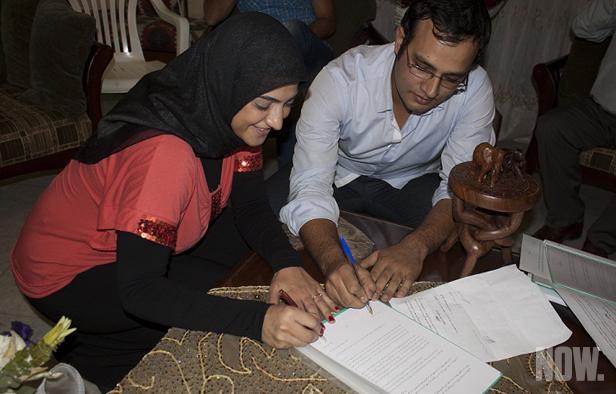
“I will sign Khouloud and Nidale’s marriage,” Marwan Charbel – our minister of interior affairs – declared today, “even though I do not support civil marriage myself.”

I don’t get why it seems like not supporting civil marriage is actually a healthy mentality for politicians who are ruling our country.

Perhaps it is to please their growing political aspirations, after all the majority of Lebanese apparently do not support the issue with drastic differences across sects. A recent poll I read shows the following results: Druze and Christians support civil marriage with more than 60% while Shiites and Sunnis oppose it with more than 70%. The total comes down to almost 57% not supporting civil marriage.

Khouloud and Nidale’s marriage passed through a lot to get to where it is. There was a time where it appeared it won’t pass as minister of justice Shakib Qortbawi said he doesn’t believe the legal aspects of it work out. A committee that was assigned to look into the issue decided that the marriage was in fact legal and despite statements from minister of interior affairs that he wouldn’t sign, he apparently did.

So it is now official – Lebanon has now had its first civil marriage ever. But at what price?

Could Nidale and Khouloud’s marriage truly get more Lebanese who are enthusiastic about this to do what they did (link)? They stroke off their sects off all their legal documents, when through a lot of legalities in order to bypass the strict counter-regulations to what they were doing and eventually had to wait months and months until their issue was resolved.

Their marriage and the debate that ensued sparked reactions from religious and common folk that no one could have expected. From fatwas declaring apostasy on all Muslim politicians who approve of it to Christian priests convening for the main purpose of discussing it.


I’m willing to bet that if their issue hadn’t received media attention, it wouldn’t have ended up this favorably as well.

The questions to be asked are: will Nidale and Khouloud’s marriage be the first of many to be done in the same way? Or will the hardships they went through deter people from doing so when the alternative is much, much simpler? Will their marriage open up the flood gates or will it remain a singular event standing in a country that seems to be as close to legalizing civil marriage as it is to come up with a new electoral law especially when so many couples are nowhere near willing to strike off their sects just to get married while there is a much simpler alternative only 100km and $2000 away?

Congrats to Nidale and Khouloud. Hopefully their struggle to have their union recognized doesn’t die off as another cause du jour in a country where causes are faster to spring up than rabbits reproducing.

The Miserable Maronites of Lebanon

Today is the day when Maronites across Lebanon get a surge of pride on the memory of St. Maroun, the sect’s founder.

Throughout the day, if you were “lucky” enough to come from Lebanon’s bible belt and have a lot of deeply religious friends, you’ll be swamped with Facebook statuses and pictures to glorify the day. Many celebratory dinners will be held across the country as well. It is one of those occasions.

This is the day for Maronites across Lebanon to feel empowered and self-sufficient and whatever floats their boat when it comes to self glorification.

The truth, however, is that today – February 9th, 2013 – as Lebanon’s Maronites rise to a fake glory on the day of their founder, they couldn’t be more wretched.

I’ll start with yours truly.

I was born in a Maronite family whose dose of religiousness grew as I grew. I dabbled with religion. Sometimes I grew into it, more often than not I grew out of it. My lack of ignorance when it comes to what the sect box on my ID contains led many to label me as a Christian extremist. I didn’t mind it.

But today, the only thing Maronite about me is probably what’s written next to my name on the voters list. It’s not about lack of faith. It’s not about atheism. It’s about a state of utter disgust with the social aspect that “my” sect has become and what it has made me, by default, in the process.

Today, Maronites in the country are forced to live in fear. I don’t think our fears are in any way justified. Do you know what’s the only reason that justifies us living in fear? It’s because Michel Aoun and Samir Geagea said we should be afraid.

The former told us we should panic from the impeding rise of Islamists in Syria and behold, Maronites across the land started gearing up for the apocalypse.

The latter has shoved the threat of Hezbollah’s weapons down our throats, making it a constant fixture in our daily lives, that the only thing we see as we go about our lives normally now is weapons. Illegal weapons everywhere.

Whenever our major “Maronite” politicians tell us to do something, we do it. Not because we want to – but because there’s an inherent conviction among the majority of Maronites that those leaders know best. Our critical thinking capacities are not just dismal, they are becoming non-existent.

Case in point? The electoral law. How many Maronites support the Orthodox Gathering Law? I suppose they are a lot. Are those Maronites truly convinced by the law? I doubt but they don’t know they’re not really convinced.

All they know is that their political reference came out in support of the law and gave them a set of arguments for them to wrap their heads around. Fast forward a few days later and the whole idea is now sitting comfortably in their brains, equipped with a full arsenal of conviction as if it was there for months. And then try to tell them otherwise. Try to ask any Maronite today about which law they see best and their answer will be what their politician of choice told you. Go on, try it.

We are a people that has become so weak that we can’t even stand up to the horrendous and absolute lack of qualification that flow from every single “Maronite” politician today.

Today, the road leading up to the main villages of my district has fallen into a serious state of disrepair. I wrote about it before (link) and observed an interesting reaction regarding the issue. The LF’ers blamed Gebran Bassil for the road. The Aounists blamed the district’s two MPs. Both LF’ers and Aounists are joined by the fact that their cars are getting screwed whenever they want to drive on that road – but they can’t even get together to get it fixed because God forbid their holy politician of choice be the one to blame.

What’s worse is that we are more than utterly convinced that those politicians are sacred.

Try to tell a Aounist that Gebran Bassil or Michel Aoun are not the people that Jesus meant when He said “whoever is without sin, cast the first stone.”

Try to tell a Lebanese Forces supporter that the “hakim” is not the saint they want him to be or that the Lebanese Forces are slacking off with how they’re handling things, letting themselves be dragged into quarrels revolving around those epic never-ending Christian rights.

Maronites have now been convinced that those “Christian rights” that our heads have been drilled with are truly what our politicians are after. The idea that “Christian rights” is simply a pre-electoral ploy to get our Maronite blood boiling before we go vote didn’t cross anyone’s mind. If our politicians are truly concerned for our rights, then why haven’t they done something about it already? If our politicians are truly convinced about the army, then why do all their statements drip with unprecedented hypocrisy? If our politicians truly care about our well-being in this country then why haven’t they actually done anything to improve it?

The answer is quite simple: because we have the memory span of a fish. If they don’t do it a few months before the elections, we won’t remember come the time to vote.

We get carried away with useless rhetoric of people who couldn’t care less about our interests and eventually transform that rhetoric, in our heads, to scripture. Try to tell a Maronite in Lebanon today that their rights are of having hospitals and schools, not about commanding the country again, and you might as well have committed some form of higher treason. Try to tell a Maronite in Lebanon that, contrary to popular belief, you don’t feel threatened at every waking moment of your life and you might as well have been committed to an asylum. Try to tell a Maronite in Lebanon today that those big bad Muslims are not really out there to get us at every kink in the road and you will get inundated with a slew of swear words against their “prophet.”

And while a lot of Lebanon is trying to go past the civil war mentality, many Maronites still live in it. Many are even proud of it. If you, as a Maronite, were born after the end of the civil war then your opinion is irrelevant. Their “struggle” during the civil war makes them experts and it turns you into a non-sensical nobody. They fail to see how living in 1975 when it’s 2013 is not only pathological, it’s also sickening. They fail to see that using the civil war to attempt to score points when it’s been over for 23 years is not only not healthy but downright despicable. They live in the past and revel in the fact that they do so.

So between living in constant fear, pretending as if we actually have political free will and getting swept away with dreams of a Maronite utopia, we have become a people that are beyond miserable at life in Lebanon. How many of us as Maronites will have the guts to actually stick it to all our politicians who are actively terrorizing us come election day? Not many. How many actually see those politicians as such? Well, considering I’ve been exposed to people who are voting for certain politicians because they “asked about them” during one of their electoral visits, I daresay I wouldn’t be going on a limb if I said not many. How many of us won’t be happy when, one day after the election’s results are out, our politician of choice proclaims to represent the Christians – especially Maronites – of Lebanon?

The reality is that with how we are being forced and forcing ourselves to live, our standards have gone down dramatically. Our religious extremism is rising exponentially and we can even fathom justifying it. We cling to the glories of days that are past in order to feel relevant in the present. We gloat about the president having to be Maronite by law because it gives us some form of security. We hyperventilate in joy whenever someone tells us they believe Maronites are the reason Lebanon exists. We pretend as if nothing is absolutely wrong in our communities, in our mentalities. We pretend as if all the blame is to be put on everyone else because they are the root of all problems in this country.

This is your yearly dose of a reality check.

My angry rant is also easily applicable to other sects in Lebanon. Because everyone is miserable. However, the moment someone from outside any sect criticizes it, people get offended. Even those who claim not to be sectarian. My prerogative, as a Maronite, is that I get to criticize how my sect has become, at least socially, all I want. And if this angers you, then I’m more than glad I hit a nerve.

Happy St. Maroun day.