The Attack (2013) – Movie Review

20130609-055719.jpg

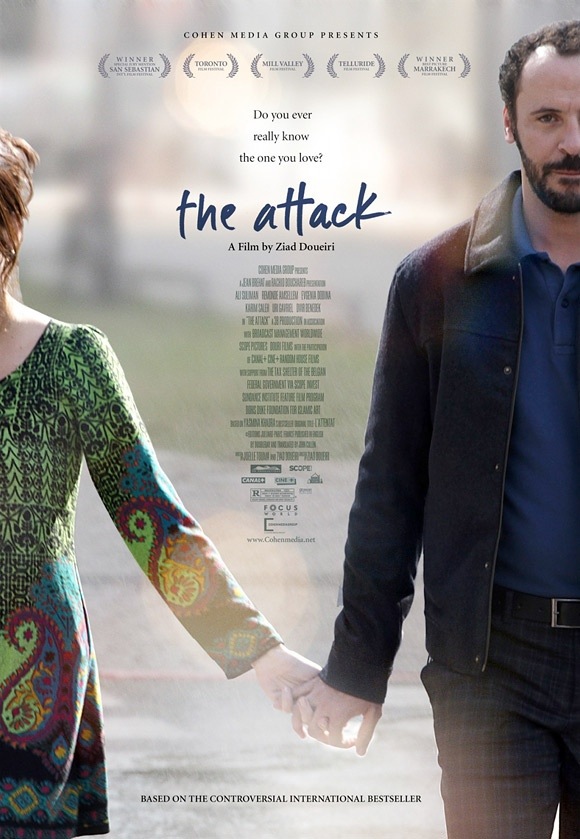
Ziad Doueiri’s The Attack might as well be considered as the most controversial “Lebanese” movie of recent times. But that’s not saying much. The hype surrounding the politics of the movie has been resounding. But does The Attack deliver on all the promises the director and the people who like him gave?

Amin (Ali Suliman) is an Arab-Israeli surgeon living and practicing medicine in Tel Aviv. While receiving some humanitarian award from the Israelis, Amin receives a call from his wife who sounds distressed. He doesn’t give it much attention, the focus is all on him. Soon enough, while having lunch at the rooftop of their Israeli hospital, the surgeons hear an explosion. 17 casualties ensue, 11 of which are children… And it’s Amin’s wife Siham (Raymond Amsalem) who committed the attack. Between the barrage of the Israelis who suddenly turn on the man they believe they sheltered into becoming one of them and the guard of the Arabs who believe Siham did a noble thing and are disgusted by the “bastard” who left his heritage and home to integrate in a place that is not his, Amin seeks out to find why his wife became a radical person who managed to get convinced to blow herself up for the Palestinian cause.

Sounds good, right? Well, in theory it does.

The Attack is divided into two parts. The first one is what can be called the Hebrew segment in which Tel Aviv is shown as a bustling cosmopolitan city whose people are as disassociated with the conflict raging outside their city’s confines while the other half is the Arab part, situated in Nablos, whose people struggle in their everyday life and revel in the idea of martyrdom, turning Siham into a local heroin. In a way, each part serves to pitch each side’s case.

I found the take on the issue, which the movie tries to do, shallow and borderline grating at times, even in its tackling of Siham’s radicalization which The Attack finds even more astonishing due to the fact she’s Christian. The Attack doesn’t go as deep as it should. it remains up there, flapping around the stereotypical stories of both sides – the action/reaction scenario that never ends. It never asks the tough questions: are the reactions warranted? Are they the best way to tackle the actions that led to them?

And I, for one, am glad and fully supportive of not choosing The Attack as Lebanon’s Oscar submission last year because there’s nothing Lebanese about the movie at all. In fact, the Lebanese elements of the movie are a mention of Hassan Nasrallah and Beirut – separately.

As a movie, The Attack works. It’s a decent thriller. There isn’t a dull moment, constantly keeping up the pace it sets from the get-go. The camera work, cinematography and locations are all well-done. But don’t expect it to blow you away. The acting, however, is superb. Both lead actors do a great job in their roles. Amsalem’s portrayal of Siham is gut-wrenching at times as is the life Ali Suliman gives her husband.

What The Attack manages to do, which might be the most important thing, is create a discussion. I watched the movie with 4 other Lebanese while on a stay in Paris – the movie will not be released in Lebanon – and we spent almost 40 minutes huddled outside the cinema center discussing what we had just seen. As a nation, though, Lebanon is possibly nowhere near ready for such a movie to be screened although the current state of Israel is eye-opening to what we, as a country, are so desperately lacking.

3/5

The Hangover 3 (2013) – Movie Review

20130527-113551.jpg

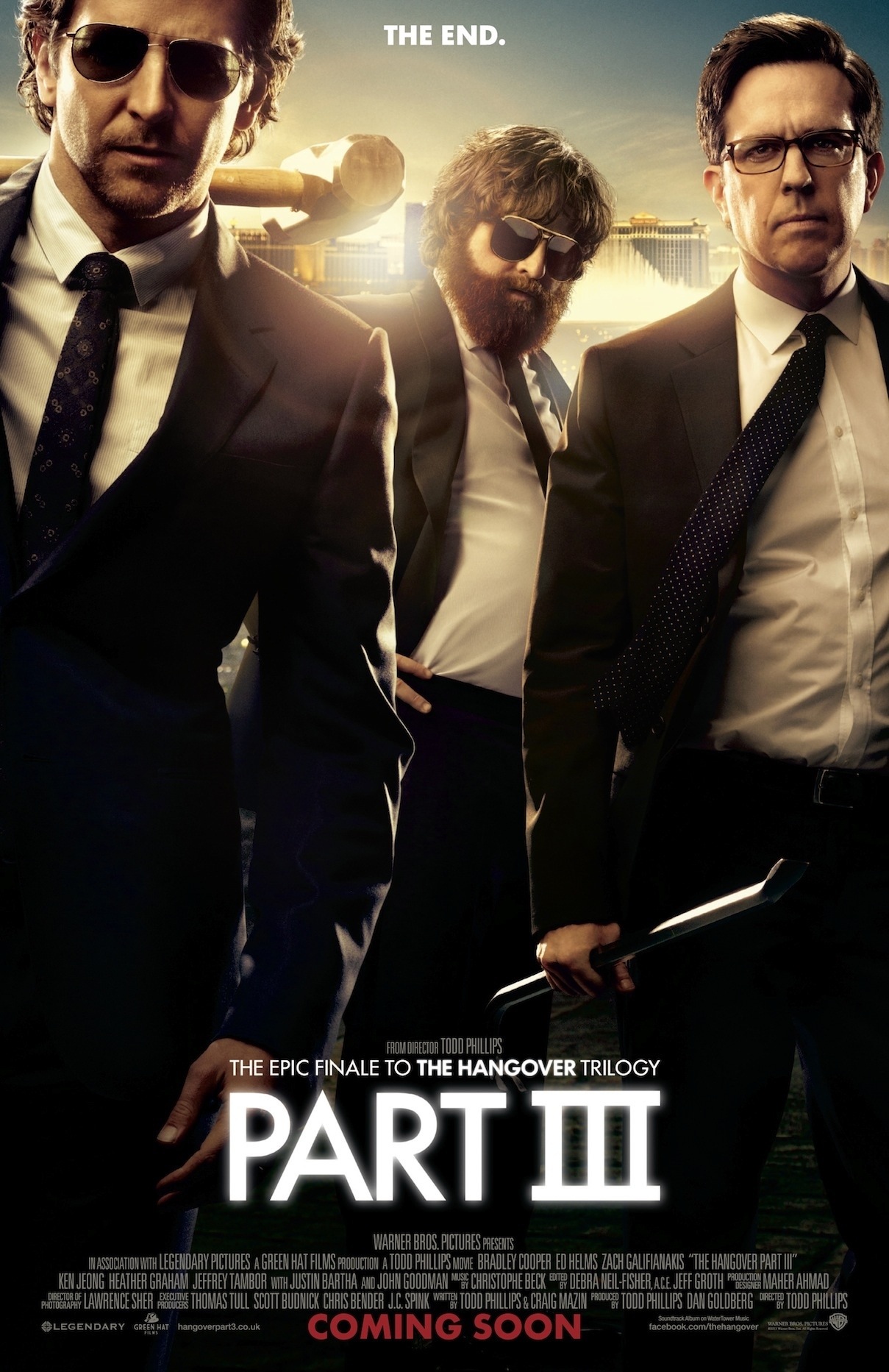
Milking it. That’s what The Hangover 3 is in a nutshell. After a comedy tour de force with the first part and a decent-enough black comedy with the second, comes a PG-13 level and hopefully final iteration in the series of middle-aged debaucheries. Except part 3 has no such things. Not even a little.

The same guys are back in an attempt to get Allen (Zack Galifianakis) to some form of rehabilitation center. On their way there, their car is ambushed by Marshall (John Goodman) who takes one of them hostage in order for them to get Mr. Chow.
There’s no drunkedness here. There are no prostitutes to serve up some seriously awkward moments. Even Melissa McCarthy borders on the irrelevant as a possible love interest for Allen. The talents of Bradley Cooper, recently discovered in Silver Linings Playbook, are wasted. John Goodman is simply turned silly as the thug of the show.

The same people that brought us the first two movies are back here. Director Todd Philips’ work in The Hangover is put to absolute shame with this sequel. The plot is silly at best. The laughs don’t even exist. The shock factors don’t come naturally. The characters are so thin that it’s impossible to do anything with them anymore.

At one point a third into the movie, as Bradley Cooper’s character watches Mr. Chow sing a karaoke song (Nine Inch Nail’s “Hurt”), he proclaims: “what the fuck am I watching?”
I was feeling the same at that point. But I hoped the movie would pull itself together. It didn’t happen. The Hangover 3 is, similarly to the other 2 parts in the trilogy, a big mess. Except it’s not the good type this time. It’s the type of messes you want to keep behind you and never look at again. Kill it, kill it with fire.

1/5

Warm Bodies [2013] – Movie Review

Warm Bodies movie poster

Vampires had their movies. Witches had their movies. Warm Bodies is the attempt to get zombies not to feel left out. It is a post apocalyptic world, as usual, and most of the Earth’s population of humans has died and risen again as zombies. The exact mechanism of this is never fully illustrated but you get the picture: pale faced, veined people roam around, searching for their next victim with a beating heart to eat.

R (Nicholas Hoult) is one of those zombies – but with a twist. He calls himself weird. And compared to his fellow undead, he might as well be. He likes to collect items that humans find of value. He often wonders about his days pre-transformation and is absolutely smitten by Julie (Theresa Palmer), a human whom he encounters on one of his feeding trips. R takes Julie back to his zombie camp and takes care of her – his relationship with Julie gets his heart to beat again and commences a transformation that could prove pivotal to changing the course of things.

You’re not watching Warm Bodies for the acting. You’re not watching it for the story, which is comical at times. You’re watching it because it is a movie that entertains you for about 90 minutes and that’s pretty much it. There’s nothing badass about this. The zombies are nowhere near scary – even the bad kind which eventually become the movie’s main villains. The sense of threat that the humans are supposedly always faced with is never communicated. The movie’s main point is to get the love story between its zombie and human main characters across and the two lead’s chemistry definitely helps with this.

Warm Bodies‘ main forte is that it is a refreshing take on the genre it plays in. It has a sufficient dose of charm to keep you going through the short running time and enough funny moments to make it memorable. I am not entirely sure how fans of the book upon which this is based will react but if you have nothing better to do and decide to grab a movie at your local theatre, odds are you won’t find something much better currently playing.

6/10

Django Unchained [2012] – Movie Review

Django Unchained Poster

It seems 2012 is the year for Hollywood slavery movies. Quentin Tarantino’s foray into the Western movie genre with Django Unchained is the polar opposite of Steven Spielberg’s Lincoln, both movies about the American slavery era. While Lincoln is about the political scene that led to the abolishing of slavery, Django goes loose in a totally different manner.

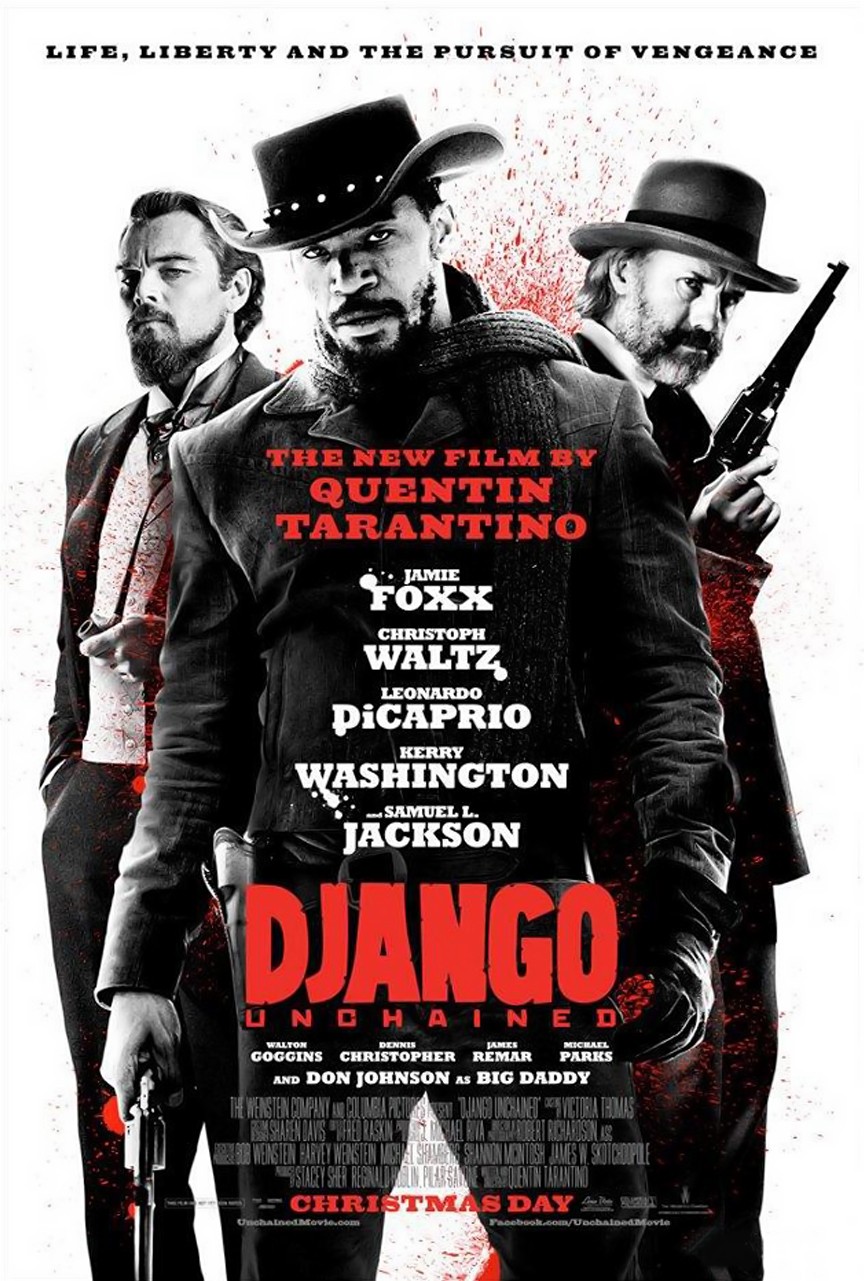
Django (Jamie Foxx) is a black slave who gets rescued and freed by German-born bounty hunter Dr. King Schultz (Christoph Waltz) who is on the hunt for the murderous Brittle brothers and only Django can help him find them. Django’s goal, however, isn’t to kill as many wanted white men as possible. It is to find and rescue his wife Broomhilda (played excellently by Scandal’s Kerry Washington) who is enslaved in a plantation called “Candieland” owned by a francophile who speaks no French called Calvin Candie (Leonardo Dicaprio) with his self-hating black butler named Stephen (Samuel L. Jackson).

Stylistically, Django Unchained is daring. The movie’s frames, shots, camera movements are unusual. The amount of gore and blood are also quite proficient. All of this is to be expected from a Tarantino movie who, as usual, delivers a riveting piece of cinema that will keep you hooked for over 160 minutes.

Tarantino, who appears in the movie in a cameo scene towards the end, wrote this movie as well. While the story isn’t very new and the overall ambiance is fairly typical for the Western genre, it’s the execution that makes up for it here. You can’t help but marvel at the technical execution of many of the movie’s scenes. Django Unchained is very bold in more than one way, notably as it showcases in subtle shades of drama mixed with comedy the horrors of slavery and racism.

The movie’s acting highlight is Leonardo DiCaprio who gives a tour de force performance of his character. In a way, while the movie goes off to a good start, it doesn’t find its footing until DiCaprio’s character comes into the picture to help make things much more interesting. Both Christoph Waltz and Jamie Foxx are great in their respective characters, excelling in scenes that find the two working together towards their goal, the latter with his comedic tendencies and the former with his sharp ability to navigate between cruelty and compassion in a heartbeat. Samuel L. Jackson makes his best at making his character downright unlikeable. You will hate that butler-slave. In a way, the Django-Shchultz duo is the polar opposite of Candie-Stephen.

Despite being un-needingly violent at times and despite being overly drawn-out towards the end as the movie tries to reach its conclusion, Django Unchained is at the end of the day Tarantino’s take on an era of American history that few Americans want to remember. Django’s charm isn’t that it’s fast-paced, keeping you hooked all the time. It’s all in its characters. Dr. Schultz isn’t mystified by Django’s humanity. He sees it clearly and is taken by it. He clearly knows that slavery is bad, not for political reasons but for humanitarian purposes, which is where Django and Lincoln veer off thematically. Django isn’t resigned to his fate – he is resilient, always fighting, always aspiring for more, always opposing the likes of Candie and Stephen who want to bring people like him down.

And it is here that Django Unchained excels: in seeing all those different personalities interact on screen. Towards the end, you forget that the movie has had about five thousand bullets fired and a growing casualty north of three hundred deaths (I did not count). The only thing that remains fixed is that these people whose lives you’re seeing unfold (or end) in front of you are highly interesting, to a backdrop of a very eclectic musical soundtrack and the vision of a director who makes the aforementioned historical era entirely his own.

4/5

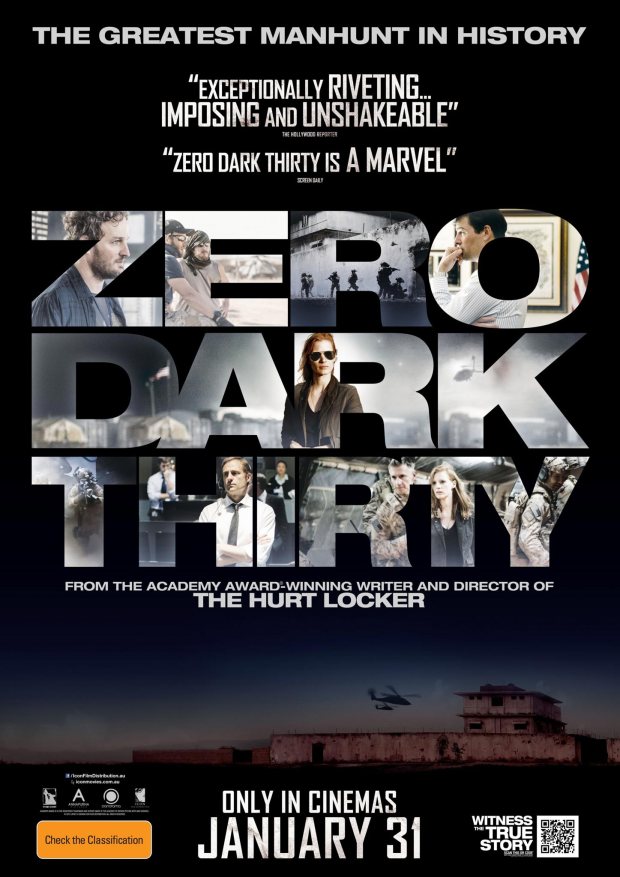
Zero Dark Thirty [2012] – Movie Review

zero-dark-thirty-poster

Here it is. Arguably the most challenged American movie of the year (a recipe for those little golden statuettes): Kathryn Bigelow’s Zero Dark Thirty. U.S. Senators of both parties came out against the movie because it portrayed the use of torture in many of its scenes in order to extract information about the whereabouts of Bin Laden. You know, because the CIA surely did not use torture. Ever.

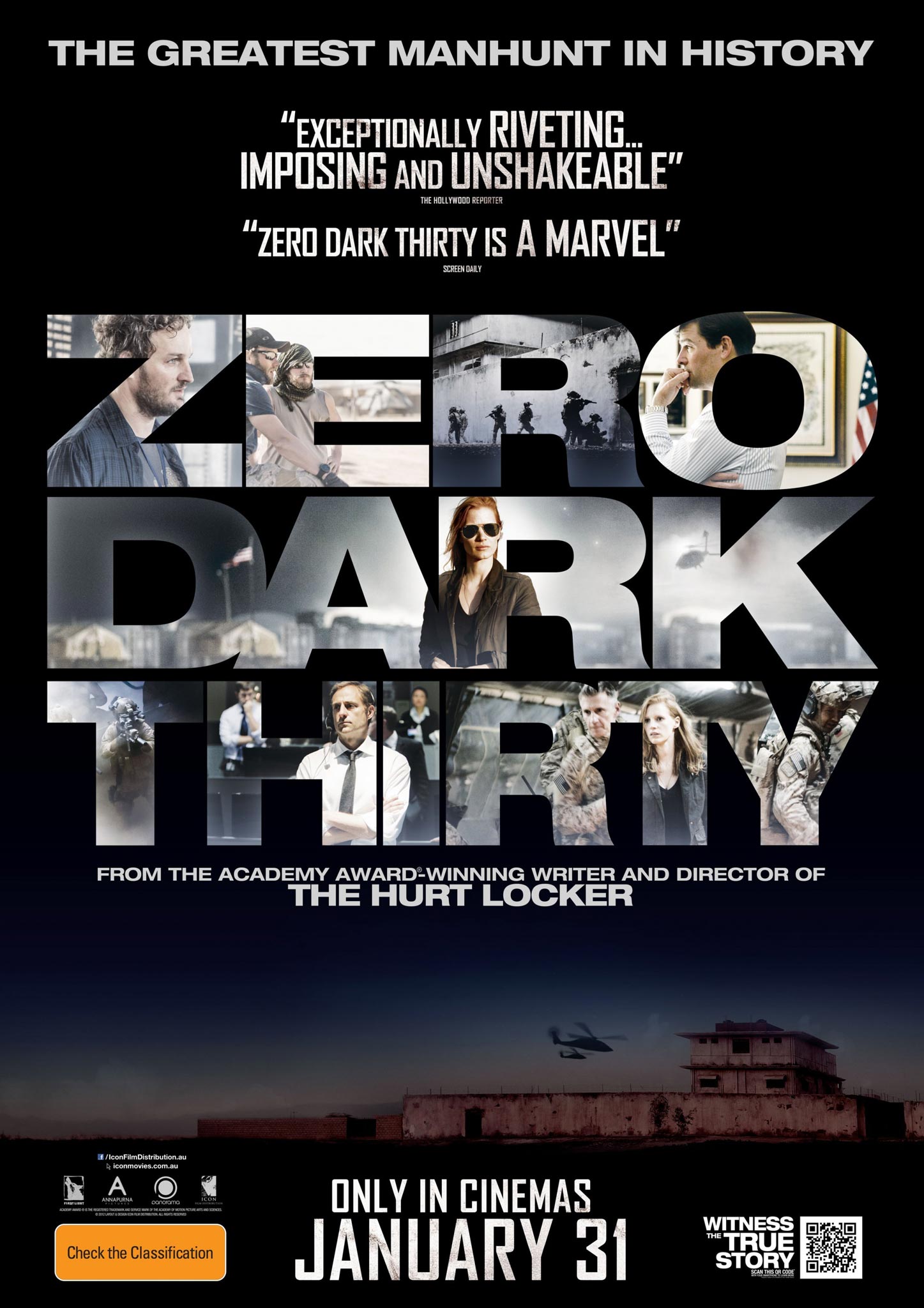
Zero Dark Thirty is the story of CIA agent Maya (Jessica Chastain) on her pursuit of Al-Qaeda leader Osama Bin Laden over the course of a decade. The torture methods her agency employs, which include but are not exclusive to food and sleep deprivation and waterboarding, lead her to a man called Abou Ahmad Al-Kuwaiti who, for every single non-idiot person out there, obviously comes from Kuwait. Except it’s not as obvious for the movie’s CIA agents who spend more than an hour of the movie’s 157 minutes running time on a manhunt before realizing that – GASP – Al Kuwaiti means he is from Kuwait. As they search for Osama Bin Laden’s main means of communication with the outside world, these CIA agents are faced with people who don’t want them to succeed leading to terrorist bombings in CIA headquarters, of fancy hotels, of different capitals around the world and a lot of exasperated agents who can’t fathom how they would be targeted as such.

It seems the dreadful The Hurt Locker did not satisfy Kathryn Bigelow’s appetite for American neo-political-military-award-magnet-dramas. I mean, why wouldn’t she tackle the same theme in one way or another all over again to become the first female director to win best director at the Oscars twice? Therefore, Bigelow is at it again. And Zero Dark Thirty includes not only every single thing I hated about The Hurt Locker but much, much more as well.

Jessica Chastain’s character Maya is definitely unlikeable. I hated her character to the extent that I couldn’t even appreciate her acting performance. She came off as grating, whining, overly melodramatic at times especially in a shouting scene with a CIA chief in Pakistan when she asks for extra man power in a man hunt that had been proving futile at that point. However, this type of performance is definitely the type to draw in award-voters: a charismatic female character at the heart of a male-dominated institute in the midst of the hunt for the world’s most wanted man? I can hear those voters orgasming already, which is a damn shame because if she ends up winning, she most certainly does not deserve it. Her strongest scene is right at the movie’s end as she silently reflects on the end of this decade-long era of her life. But even that scene’s potency isn’t enough.

One thing to say about Zero Dark Thirty, however, before I start grilling it is that Bigelow does well directing the movie from an “artistic” point of view. Some sequences are very well filmed, especially the raid on Bin Laden’s compound, and the movie is very technically proficient. However, a political movie like Zero Dark Thirty necessitates a politically oriented review. So here it goes.

Zero Dark Thirty is an insult on your intelligence. If there’s any movie which will get you outraged at its inaccuracy, it’s this. As a movie which wants to give itself authenticity by going the whole mile and asking you to “witness the whole truth,” it only comes off as mass propaganda about how the CIA is making the world a better place just by them being there and it portrays all those filthy Arabs living in these parts of the world as the scum of society: Muslim terrorists who can’t wait to blow up some Americans.

As they hunt for Abou Ahmad Al-Kuwaiti in some Pakistani city, the CIA van is stopped by Pakistani men. One of the Pakistanis driving gets out of the van in order to reason with the armed youth. “Shou ya chabeb?” he asks them in arabic – levantine Arabic no less – for: what’s up guys? A simple wikipedia search would have told Mrs. Bigelow that Arabic is, in fact, not spoken in Pakistan or any -stan ending country. But why would she care? Arabic-language, terrorist, Pakistan… it’s all the same for her intended audience. In fact, the movie’s scenes in Pakistan feature less Pakistani than Arabic, which is odd and definitely not “witnessing the truth” or as American critics are saying: “a movie reveling in keen detail.” Since when do Pakistanis speak Levantine Arabic?

The use of Arabic in the movie doesn’t only stop at Pakistan, it extends to various interrogation scenes where someone has to translate to Chastain’s character what the man is saying. Fair enough.

As one of the CIA agents sets up a meeting with a supposed worm within Al-Qaeda around Christmas time, she is found talking to Chastain’s character about baking a cake for the man to which Chastain replies: “Muslims don’t eat Cake.” Really? In fact, the entirety of Zero Dark Thirty doesn’t even bother to draw the line  between a religious extremist and a Muslim: it gets the boundary between the two to be so blurred that it’s so easy to confuse one with the other, making the entire movie not only highly stereotypical but highly nauseating and shallow as well.

For an American viewer, Zero Dark Thirty is definitely fascinating and I was even taken by its earlier scenes before the rhetoric started. American movie critics who don’t understand the other languages spoken in the movie and don’t have the ability to tear the movie apart from a non-cinematic perspective won’t care about the aforementioned points. Arabic, French, Pakistani – who cares? American movie critics believe that the way the hunt for Bin Laden was dramatized is chilling. They believe that the movie is politically non-biased. For those of us who can actually read into Bigelow’s Zero Dark Thirty, it only comes off as severely culturally-inaccurate and offensive.

Bin Laden was a bad man. He killed a lot of innocent people and I’m glad he’s dead. The CIA and whichever other intelligence agencies that helped the Americans to catch that filth of a man need to be commanded for their job. But this movie is not the way. Zero Dark Thirty wants to be the definite movie about the Bin Laden manhunt. Bigelow wants the honor of being the first and last director to tackle this issue. But that is far from the case. Again, while technically proficient, the movie is not perfect. It is too slow at times and at other times, when it moves, it is only like an arthritic ninety year old man. The first twenty minutes of torturing a Saudi are chilling to watch. They are followed by almost 90 minutes of scenes that might as well be considered as an antidote to insomnia before delivering again with the Bin Laden killing scene.

By aiming to be technically proficient, Zero Dark Thirty undercuts itself by becoming emotionally detached from the material it’s trying to portray. By showing torture scenes that more often than not lead to no-tactical results, the movie is amoral. By turning the entire struggle of all of 9/11’s victims, as it starts with real-life audio from the twin towers on that horrible day, into a vehicle for Chastain and Bigelow to cash in on some rewards, the movie is also despicable. By portraying every single non-American aspect of the movie in such gross inaccurate ways, Zero Dark Thirty is horrendous. Zero Dark Thirty is, eventually, over two and a half hours of pure propaganda that is not only offensive to the memory of the Americans who died on 9/11 but to a lot of viewer’s mental capacities.

You know what’s common between Bin Laden and Zero Dark Thirty? They are both horrifyingly bad and an abomination to existence.

1/5