The Hobbit: An Unexpected Journey [2012] – Movie Review

The Hobbit Movie Poster An Unexpected Journey Peter Jackson

Q: What do you, as Hollywood, do to a movie series that has garnered tremendous commercial success and massive critical acclaim?

A: You revisit it. Of course.

The Hobbit will surely be a massive commercial success. But it won’t garner any significant awards like its Middle Earth predecessors, which are its successors story-wise. The Return of the King has won a record 11 academy awards.

Set prior to the events of the Lord of the Rings trilogy, The Hobbit, their prequel, follows the story of Bilbo Baggins, Frodo’s uncle, as he travels with a group of dwarves who, with the help of Gandalf the wizard, will try to recuperate their kingdom Erebor from a dragon named Smaug that has overtaken it many years prior.

Peter Jackson, who also directed the Lord of the Rings trilogy, uses state of the art technology in shooting the movie.The first cinematic feature to be shot in 46 frames per second, The Hobbit is visually stunning. The art direction is impeccable. The colors feel richer and the scenes crisper to look at. The movie’s dwarves, orcs, goblins and hobbits are, of course, superbly executed. The battle scenes are gripping set-pieces. The locations in New Zealand, similarly to its predecessors in the series, chosen to shoot the movie are absolutely breathtaking, making for a Middle Earth that still feels enchanting although it’s not as absorbing as the one we had in the previous three movies.

At a running time of almost three hours, The Hobbit sports many side-plots that don’t serve the main story at all – and all these side-plots are dragged out in extensive scenes that only serve to increase the movie’s length without offering anything in value to it. The overall results becomes an overly stuffed movie that could have had so many absolutely useless moments removed, making the overall product tighter and more polished. Alas, that is not the case. Instead, you get prolonged long shots of our heroes as they travel through mountains, hills and lakes with many seconds and minutes added to scenes that have already ended for an extra artistic effect such as taking the camera slowly upwards to capture the head of a statue while the movie’s protagonists stand under it. It could be this overly slow pace at times that takes away from the movie’s grandeur and from the story’s spine.

What you are left with is an enjoyable movie – but nothing that reaches the levels of epic that oozed from every single moment of The Lord of the Rings. What you get is a movie that, while it manages stands on its own, can’t escape the comparisons from much worthier predecessors. The overall tone of the series has also changed into something less dramatic at times and more comical. That’s not necessarily a good thing.

The movie’s best scene, which, unlike many other moments, stays true to its equivalent in the book, is the first encounter ever between Gollum and Bilbo Baggins which grips at you and doesn’t let go. It doesn’t disappoint. And even though that scene’s outcome is already known, the emotional aspect that’s portrayed by a brilliant Andy Serkis as the emaciated hobbit Smeagol (Gollum) who’s even better than in Lord of the Rings and a great Martin Freeman (Baggins) still manages to resonate and pack a punch. That riddles game is just too good on paper not to be good cinema. And how could anyone resist my precious?

And just because it’s awesome, here it is again. My precious.

As the movie ends, Bilbo Baggins says “I do believe the worst is behind us.” I certainly hope that the upcoming two movies are better – but I’m not holding my breath. The problem is that the story on which this movie is based is not substantial enough for it to be turned into three movies. The add-ons which were brought from other Tolkien-related books aren’t giving the story depth but making it feel bloated. Some single sentences in the book were turned into full-blown scenes. The end result can be explained in the following way: The Hobbit is like an overly stuffed and overly cooked meal that you love. You can’t help but compare it to previous times when the meal wasn’t as stuffed and overcooked. And once it’s done, it leaves a bitter aftertaste that you can’t shake off. But there are still some bites there that make you go: man, this is good. It’s a damn shame.

6.5/10

The Attack: An Upcoming Lebanese Movie From The Maker of “West Beirut”

The Attack Ziad Doueiri

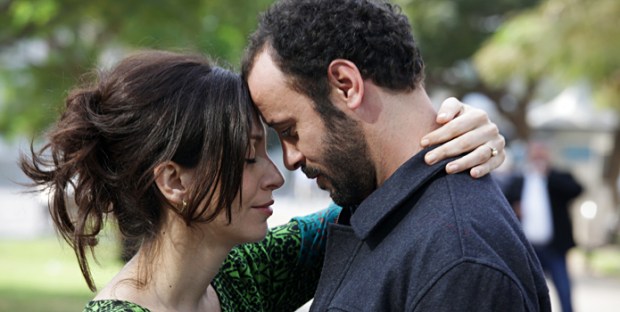
Set for release in 2013 is a movie titled The Attack by Ziad Doueiri, the director who brought us “West Beirut,” arguably one of Lebanese cinema’s most critically acclaimed movies yet.

The Attack was already screened at the Toronto Film Festival where it was well received. The movie is based on the novel by Algerian writer Yasmina Khadra and this is an overview of the plot:

When a suicide bomber strikes at a Tel Aviv café, Dr. Amin Jaafari (Ali Suliman), a Palestinian citizen of Israel and a highly respected surgeon, treats the wounded victims of the blast at a nearby hospital — at least those who will let him, as some refuse to be attended to by a Palestinian. Jaafari is not unaccustomed to such affronts, but this dreadful day has a far ruder shock in store. Late that night, Jaafari is called back to the hospital to identify the body of the bomber: his wife.

In an instant, Jaafari’s comfortable life is shattered. Grief-stricken, wracked by guilt and tormented by his own incomprehension, the doctor embarks on a desperate journey to understand his wife’s motivations for her terrible act. Retracing his wife’s recent trip to the occupied West Bank, where she had claimed to be visiting relatives, Jaafari goes in search of the people who recruited her, a voyage fraught with danger and surprises. What begins as an investigation, however, gradually evolves into a painful and revealing self-reckoning, as Jaafari is forced to confront the sum of his own life’s choices and the shaky foundations of his overlapping identities: as a Palestinian, an Israeli citizen, a doctor, and a husband.

Adapted from the critically acclaimed novel by the pseudonymous Algerian writer Yasmina Khadra, the new film from director Ziad Doueiri (West Beirut) is both a psychological thriller and an incisive exploration of one of the most complex political-ideological issues of our time. Lucid, precise and fearless, The Attack foregoes sermonizing, simplification and manipulation to remind us of cinema’s ability to engage with a charged political reality, to undermine the stereotypes that help fuel it and reveal it in its full, tragic, human dimension.

The Attack is set for a May 1st, 2013 release in France. If the content is deemed acceptable by Lebanon’s censorship bureau, it should be released here soon after that as was the case with Where Do We Go Now. It has won the top jury prize at the Marrakech Film Festival as well as two prizes at the ARTE MARE film festival.

I personally think the plot sounds interesting and based on some reviews that I read, it seems the movie is not disappointing in content. I guess we can judge for ourselves in a few months.

This is Ziad Doueiri discussing the movie.

Let’s hope the fact that the movie is filmed in Israel doesn’t end up being overly problematic.

Paulo Coelho Loves Nadine Labaki’s Where Do We Go Now

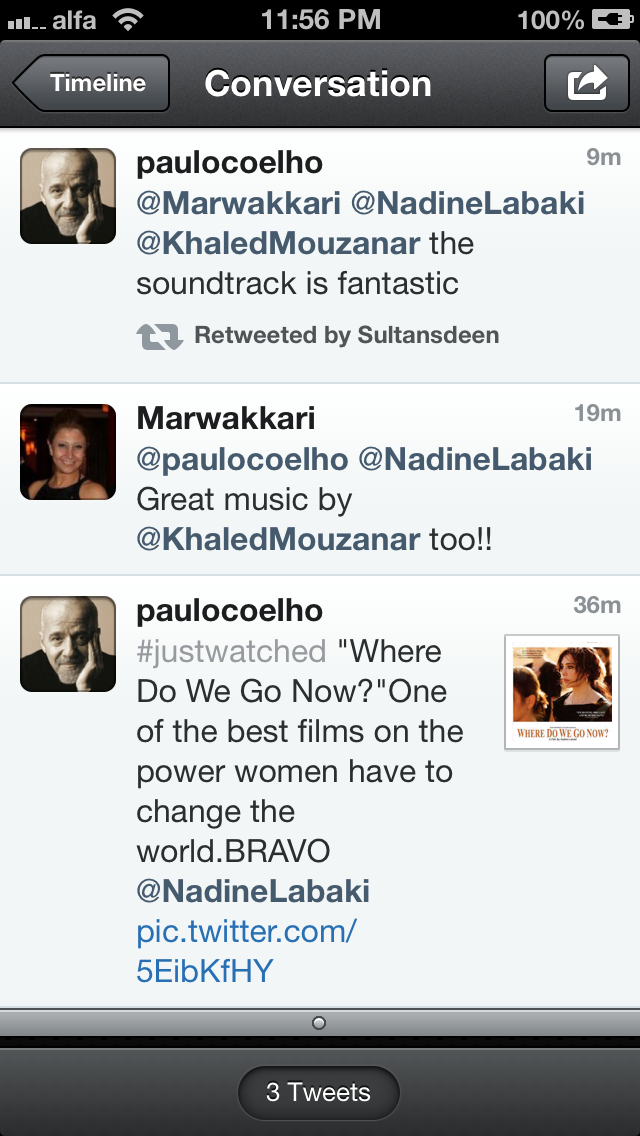
I’m not sure if I like the king of cliche making his love for Nadine Labaki’s hit movie, Where Do We Go Now, known but Paulo Coelho took it to twitter just now to let everyone know that he is a fan of Nadine Labaki’s 2011 movie which was a resounding success among audiences, even non-Lebanese ones, – less so among critics.

Coelho even liked the soundtrack, which isn’t hard to imagine as the music is definitely well done.

Paulo Coelho + Where Do We Go Now + Nadine Labaki

Ironically, the situation that sparked Where Do We Go Now happened way too many times in 2012. Hopefully Nadine Labaki won’t bother writing another movie where she invites Lebanese people from different religions (and more generally political) factions to love each other. The now-cliche aspect of Where Do We Go Now notwithstanding, I’m glad for the praise the movie just got even if it doesn’t mean much. I guess this is the first time someone as known as Coelho makes his liking for Lebanese cinema known.

Hopefully some good Lebanese movies see the light of day this year. You can buy Where Do We Go Now on DVD and Blu-Ray if you want to watch it.

Anna Karenina [2012] – Movie Review

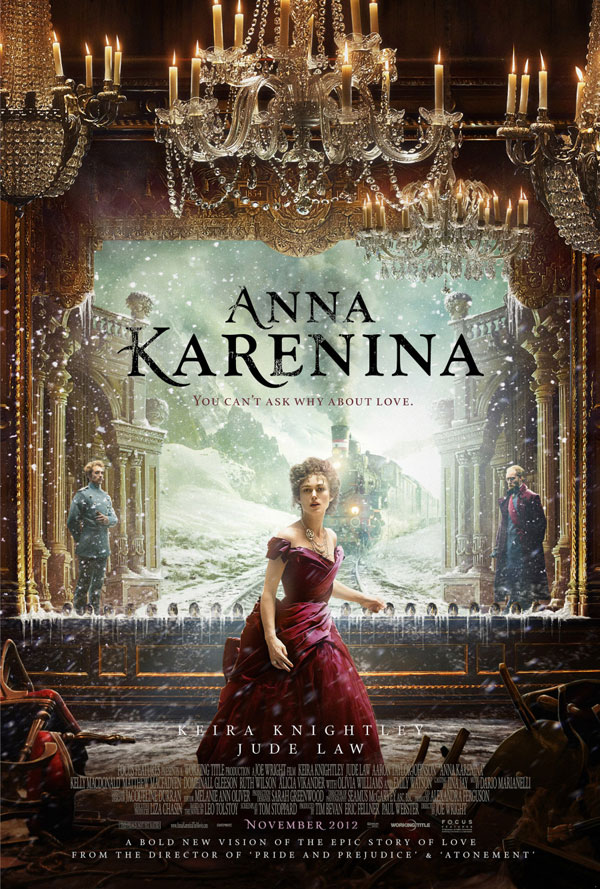
Anna Karenina Joe Wright 2012 movie poster

Joe Wright, the director who gave us “Atonement” and “Pride and Prejudice” tries his hand at one of Leo Tolstoy’s most popular novels and does so by going bold via a new cinematic vision that’s never be done before.

Anna Karenina, the story we all know of the woman who after being tormented by an uncaring husband seeks companionship in a much younger suitor, is given a fresh approach in Joe Wright’s version. The movie has a theatrical aspect that is most definitely quirky. If you are able to get past the weirdness of it, Anna Karenina will prove to be a highly enjoyable movie. If not, then it’s two dreary hours for you.

Keira Knightley gives a great performance as Anna and is definitely helped by the setting the director envisioned for the movie. She brings a ton of sensuality and sexuality to the table, as she has previously done with similar period pieces. Her best scenes, however, are as much a product of her own acting chops as they are of the art direction, camera angles and whole vision. Newcomer Aaron Taylor-Johnson, whom you’ve probably seen before in Kick-Ass and Nowhere Boy, gives a terrific performance as Count Vronsky, Anna’s younger lover. His performance is definitely years older than his young age of 22 and he delivers the right amount of emotion and subtlety that the character requires. Jude Law is almost unrecognizable as Anna’s husband Alexei Karenin. His role, however, borders on the irrelevant at times due to his grossly underdeveloped characters and that’s one of the major flaws in this adaptation.

Joe Wright’s Anna Karenina, while visually enchanting, is flawed when it comes to character development. If you haven’t read the book, Anna’s movie character comes off as a bored housewife whose husband couldn’t satisfy her anymore while, in fact, it was Anna’s husband who drove her to cheat on him but constantly shutting her out. This is not portrayed in the movie. Alexei Karenin is shown as a near saint who can’t understand why his wife would cheat on him and who’s ready to forgive her despite all odds so that by the time the end credits roll, your sympathy towards Anna, the movie’s main protagonist, is next to none.

This adaptation of Anna Karenina is fresh and energetic, risky and ambitious but it’s more about image than it is about content. What Joe Wright did was infuse some sense of modernity into this nineteenth century tale which might get it to connect with a younger demographic that’s not all too willing to read the keystone-sized book. Anna Karenina is one of the most visually inventive movies of the year and despite that taking out some substance, I was still taken away by the world portrayed on screen. However, all in all, the movie is nothing short polarizing, starting with Wright’s new take on the art direction to the way the screenplay was written, culminating in the finished product as a whole. I personally really liked it – but I can see why others would absolutely hate it. Anna Karenina is a movie that seduces you but ultimately fails to break your heart as the ice-cold train wheels break hers.

8/10

Amour [2012] – Review

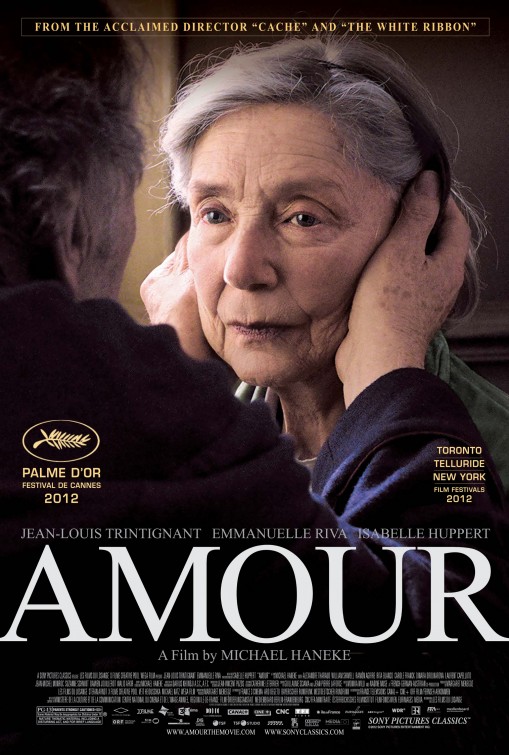
Amour 2012 Movie Poster

In an old Parisian apartment, with its yellowing books, rusty sinks and creaky tables, Georges and his wife Anne, two eighty year old former music teachers live. They go about their lives normally, attending concerts of former students, going through family albums that remind them of their younger days and caring for each other after all the time they’ve spent together. “C’est belle, la vie,” Anne says.

One day, as they’re having breakfast, Anne stops responding to Georges’ talk. He looks into his wife’s eyes and sees nothing there – she remains transfixed, unresponsive, a shell of the woman she was a few minutes earlier. He damps up a towel with water and tries to wipe her face but to no avail. As Georges gathers his things to call an ambulance, his wife comes back – but Anne has had a stroke. A carotid-stent operation going wrong later, Anne needs Georges to take care of her all the time, which he’s more than willing to do. A second stroke leaves her with right side hemiparesis, her right hand curled up in a fist. But Georges keeps taking care of his wife. He brings her a nurse three days a week, tries to sing with her “Sur Le Pont D’Avignon” when she can’t speak anymore, tries to get her to drink water when, in the rare lucid moments she gets later on, the only thing she makes him know she wants is to die.

Boasting beyond brilliant performances by Jean-Louis Trintignant and Emmanuelle Riva as Georges and Anne respectively, Amour is a heartbreaking, stunning and chilling portrayal of life in old age. Georges, the husband giving his all to care his dying wife, reaches a point where he knows what he’s doing is not enough but he keeps going anyway. The husband’s resiliency facing his wife’s forced surrender is a contrast that transcends the confines of the previously described Parisian apartment they both live in, which is the movie’s only setting though never feeling claustrophobic. The clash between the wife who wants to die and the husband who wants nothing but for her to live boasts an intense aspect of humanity that many movies fail to grasp even if they tried to. The nuances in the actors’ performances are striking. The way they look at each other through their wire-rimmed glasses, the adoration that radiates off Anne’s cheeks towards her husband… those are things you come across very rarely and you can’t but appreciate them when you do.

One of the main reasons Amour is this brilliant is Michael Haneke, the Austrian director, who has also written this great screenplay of life, love and death. The visual style he gives the movie is masterful. The pace he sets is poignant, never faltering. The movie he made draws you in, grasps and doesn’t let go. His style is shocking at time such as in Georges’ last act of love towards his wife, a stunning scene that will leave you haunted.

At a certain point in Amour, Georges tries to give Anne water, and she lets it roll angrily down her chin with a look of violent denial of life. Georges unwillingly slaps her, then apologizes like the exasperated caregiver he had become. Later on, he tells her stories of a time when he went to camp he didn’t like. He had agreed with his mother to write her daily. If he had liked his day, he’d draw flowers. If not, he’d draw stars. Amour shows us that life is a mix of flowers and stars. The love this old couple has to each other is the true embodiment of in sickness and in health. Amour is so intimate that watching it feels like you’re prying on these people’s private lives. It is so heartfelt that you can’t but feel touched by what you see. Amour shows you love. And it shows it spectacularly.

10/10