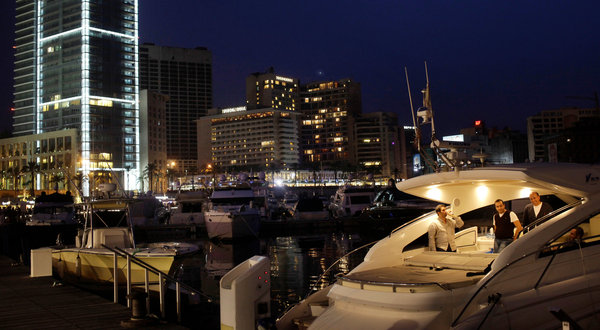
The New York Times & Beirut Love Affair – A New Article: Beirut, the Resurgent Haven for Arabs

The picture used by the NY Times

If you felt that the NY Times is writing way too many articles about Beirut lately, you’re not mistaken.

A new article which appeared online yesterday talks about a resurgent Beirut, becoming a haven for the whole region. The point of the article is to show Beirut as a safety zone for the Arabs of the region, escaping the woes of their own country.

Of course, the backdrop of this safety zone is a cosmopolitan city that’s reborn where women strut on yachts in heels and Louis Vitton bags – I’m not kidding, this is how the article starts.

Sure, Beirut is among the safest cities in the Middle East today. But does talking about the safety of Beirut necessitate briefly taking about the fragile political status quo of the country and focusing more on the importance of Zaitunay Bay and Cafe Younes in harboring those seeking shelter?

In a way, I think the article is too superficial, making the city look, from the perspective of Arabs this time, as a place where they can escape the torment of their regimes and the situation of their countries by sunbathing and going shopping and laughing about the situation where they’re form.

Call me critical but I think a Syrian spending her time in Zaitunay Bay and an Egyptian taking a break from the political suspense of her country are not representative of the people in their corresponding countries, most of whom cannot afford to call Beirut a haven. Perhaps if the NY Times had bothered extending its scope from the few rich Syrians enjoying la dolce vita in Beirut, ignoring whatever’s happening in their country, they’d look at the thousands in refugee camps in the North, afraid to go back to their country and not exactly sunbathing on a boardwalk?

I love that Beirut is a safe city. I love that we’ve been in a state of peace for more than 4 years now, with very minor hiccups along the way. But this very narrow journalism and drawing conclusions based on very limited observations isn’t the best way to showcase Beirut.

I guess it’s what people like. Either way, we are sure proud of our little safe haven here.

A Flashmob in Hamra, Beirut To Commemorate The Lebanese Civil War

You know what’s funny? The guy with the iPhone thinking he was filming a fight he’d be sharing with his friends afterwards. I’m sure he didn’t know he’d end up with something even better.

Check it out:

Also the look on that guy’s face in the car… priceless.

This was organized by the NGO CityAct.

IDM Unlimited Nights: Fail!

I had a DSL subscription with IDM for the whole year last year. I had to stop it during December because I moved out of my Achrafieh house and my grandparents didn’t need it.

I had unlimited hours from 11 pm to 7 am that I used extensively and it was great. However, I recently called IDM to install a subscription because the need for internet in the Achrafieh household arose. While discussing the details, I asked if I get unlimited nights and they said yes. So naturally, I subscribed to one of the smaller packages offered because I wouldn’t need a big quota if I can get unlimited quota at night.

5GB per month it was.

I activated the DSL this past Sunday and behold, I don’t get unlimited quota. IDM was closed on Monday so I called on Tuesday and apparently they hadn’t discussed unlimited nights with me. I was making stuff up. And if I had asked them, they would have told me they couldn’t offer it because the “central” didn’t have enough open ports anymore.

So now to get unlimited internet at night, I either have to wait two or three weeks until the governmental decree goes into effect. And if that doesn’t happen, which you know is very likely in Lebanon, I’ll have to cancel my subscription and re-apply again, hoping I’d get a port. It’s a matter of luck apparently.

The saga doesn’t end with me. Twitter user Rabih faced the same thing with IDM while installing DSL at his house in Bsalim. He filed in all the paperwork and went to make sure he got unlimited nights. They said no. So he told them he didn’t want a subscription anymore. They replied that they’d see what they can do.

A week later, IDM contacted Rabih telling him that they have secured a port for him and that he will be getting unlimited nights. However, once his DSL got installed, he didn’t get unlimited quota. The reason? They didn’t activate his port because everyone would be getting unlimited nights in a month.

No, we’re not nagging for the sake of nagging. When an area supposedly has the option to have unlimited night hours, you don’t expect some people to get such a thing and others not to, depending on how lucky they are. Either everyone gets unlimited night traffic in a certain area or no one does.

How much sense does it make that my neighbor in Achrafieh, who lives less than 20 meters away and who shares the same central has unlimited night hours and I don’t? How could they actually tell you: Oh we’ve run out of ports for you. Sorry. You pay the same amount as everyone else in your area except you don’t get to use the internet as much as they do?

Lebanese companies taking their customers lightly and treading on them needs to stop. What’s worse? They actually had the audacity to tell me that I haven’t really paid much so I shouldn’t nag. So dear IDM, if I had paid $1 to get a service you advertised, I expect to get that service. As a company that respects itself, you need to get a grip.

Stories of Lebanese on the Titanic – Part 4: Two Men from Toula & Zahle

For part 1, click here. Part 2, click here. Part 3, click here.

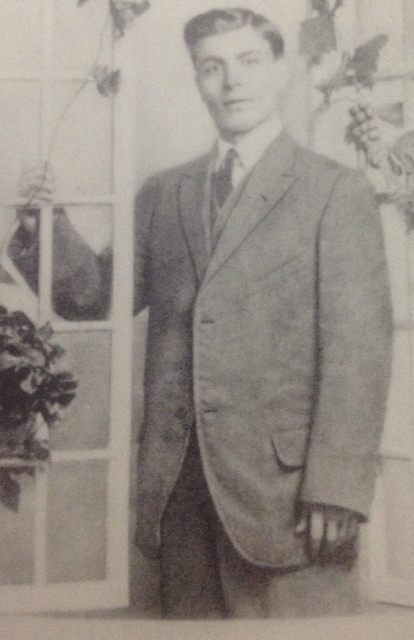
Toula is a small town in the Batroun region which had only one person aboard the Titanic, named Fahim el Zeanny. Seeing as his name is difficult for foreigners to pronounce, it was changed in Cherbourg to Fahim Kini before it changed, yet again, once he got to New York, to Philip el Zeanny.

Philip left Toula at the age of 23, leaving in Marseille his wife whom he married 4 months prior so he can settle down and start his own business in Cincinnati before she follows him. Philip wrote down what he went through on the Titanic.

Philip, 2 years before his death.

On the night the ship hit the iceberg, he was fast asleep. One of the passengers woke him up hastily and told him what was happening. So Philip started panicking, as was everyone around him. He then ran to the deck where, still panicking because of what he had heard moments ago, he got into a rescue boat. The officer, though, forced him off and threatened him with his gun, saying: women only.

Philip then used the chaos around deck to his favor and got into a second rescue boat. That same officer, however, saw him and forced him off again. Moments later, Philip got past that officer and hid under the seating flanks of one of the boats. That boat was lowered into the water. It only had two men who couldn’t row it away from the ship fast enough with more than twenty women on it. So Philip made his presence known and helped them take the boat away from the Titanic.

Then they waited and watched as the ship sank. The shrieks coming from the passengers who were thrown in the water were deafening.  Philip urged them go back but no one agreed. More lives could have been saved. As he looked around his rescue boat, Philip was apalled by one woman who brought her pet dog with her. The dog was big enough for another person to take its place.

Once the Carpathia arrived, the woman said sternly to Philip, whom she thought shouldn’t have been on board with them, to help her carry the dog as she got on the Carpathia. Philip refused, telling her that the souls of people are more important than those of animals.

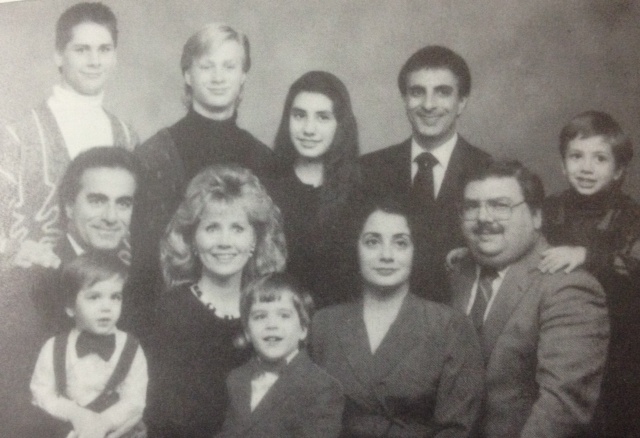
Philip ended up passing away on 1927, fifteen years later, leaving a family of four children behind.

The descendants of Philip

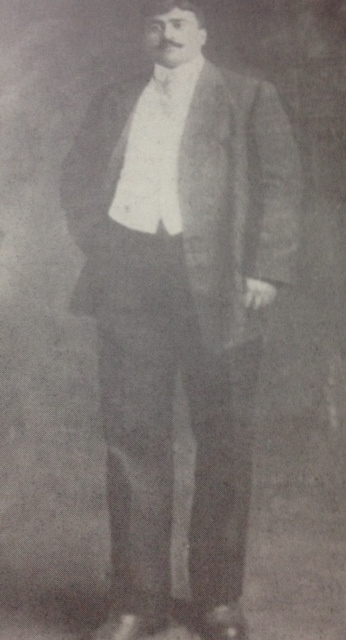
On the other side of Lebanon, Zahle had the only Lebanese passenger not in third class. Nqoula Nasrallah and his wife, Adele, were both second class passengers. Nqoula left Zahle at the age of 28, to go to San Francisco where his uncle had started a successful movie franchise.

Seeking the fame and fortune that his uncle had already found, Nqoula took his wife and got on the Titanic. On the night the ship sank, Nqoula got his wife on a rescue boat while he jumped into the water and started swimming away, hoping like other swimmers, that the vests they were wearing would keep them afloat until the rescue boats arrived. His hope was out of place.

As Adele’s rescue boat moved away from the ship, she saw her husband swimming away. So she stood up and started shouting with every bit of strength she had for him to come on board. But amid all the chaos of all the people in the water around her, Nqoula never heard her. He kept swimming and swimming until he could swim no more.

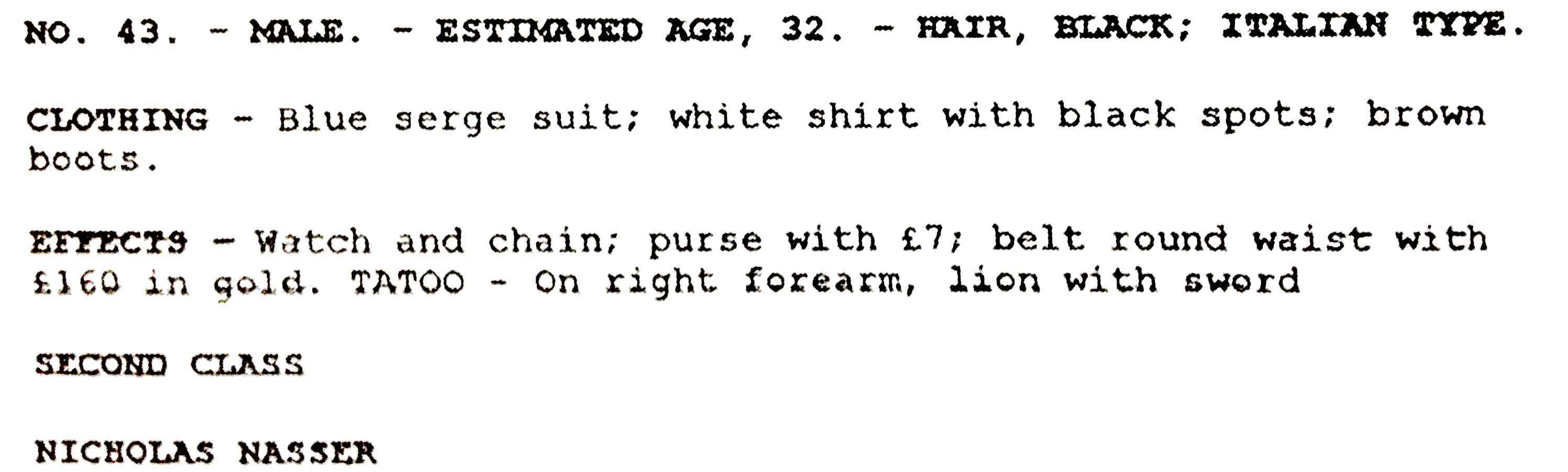
On April 24 th, 1912, the MacKay-Bennett found Nqoula’s body which was thought to belong to the millionaire John Jacob Astor. The following description of the body was given:

Nqoula’s mother, Wardeh, was devastated by the untimely passing of her son. So she went out on Zahle’s very cold winters outside and sat, as snow piled up on her, so she can have a taste of what her son went through in the freezing water of the Atlantic. Wardeh’s granddaughter Emily told how her grandmother used to go outside and put her hands in a frozen pond just so she can feel closer to her son.

Adele was pregnant when she was rescued. She gave birth to a baby boy on December 9th, 1912. The boy died soon afterwards. Adele remarried and had a family of four children. She died on January 20th, 1970.

Part 5 will be coming tomorrow.

Spare Us The Samir Geagea Hate

I told a civil war story last year that I made ambiguous on purpose to reach a certain conclusion, which was that everyone’s to blame for the Lebanese civil war if we really want to move the country forward.

However, I recently realized that Lebanese need a scapegoat for them killing each other. Their scapegoat was chosen to be Samir Geagea.

For some, Geagea killed them because they were of a certain religion, region, background, etc. For others, their sense of guilt kicks in and Geagea killed the aforementioned people because of their religion, region or background, as well as some of them who were “strong” enough to defy him.

The murderer! The liar! The assassin! The faithless! The abomination!

For many apparently, Samir Geagea was fighting the air during the Lebanese civil war. He was drawing his weapons against everyone but no one was drawing their weapons against him or his party.

For many it seems, Samir Geagea and his party were busy ruining the country all by themselves during the Lebanese civil war. No one else did anything worthy to be mentioned.

For many, the only war criminal of the Lebanese civil war is Samir Geagea. As if it’s possible for Samir Geagea to lead a whole civil war all by himself.

You defend Samir Geagea? You’re an accomplice to his murders. You complement him? They expected so much more of you. You admire him? You need to learn your history.

Because they know their history very well, I’m sure. Every single Lebanese now has a PhD in Lebanese civil war times and I was out of the loop. It’s sad.

The illusion that some people are innocent because they were legitimate needs to be removed. A bridge needs to be built and people need to get over that idea en masse. The fact that certain parties were violent to certain guests on our land can only be explained by the actions of those guests in a land that’s not theirs. The actions of certain parties cannot be taken out of the context during which they were carried out and treated as stand-alone events. It simply doesn’t make sense, regardless of how hideous those acts may be.

The civil war is an uncivil epoch.

No one in the civil war was a saint. If those involved had been as such, it wouldn’t be called a war and we would have had a very civil era. It’s far from being the case.

So let me put the situation today in the following manner.

If during the war your car was ruined? Blame Geagea. Your house was set on fire? Blame Geagea. You got stopped at a checkpoint? Blame Geagea. Your great-great-great-cousin, 2 degrees removed got killed? Blame Geagea.

Geagea barely escapes death? Blame Geagea. Anyone else barely escapes death? Blame Geagea.

Blame Geagea for everything – because that is the way we move forward.

If you’re one of those people who still consider the civil war in making their political choices today, then I pity you. If you’re one of those people who still need a scapegoat for your own mistakes just so you can please your conscience, I pity you.

Spare us the Geagea hate. Spare us the mindless, useless and retro attitude. If your mind is still in the civil war, perhaps getting it out of there is the first step towards building a country, instead of preaching about the importance of change and reform in moving Lebanon forwards.

Change and reform begin on the inside. Change your mentality. Reform your hate. And then come talk to me.

The ironic thing is that Geagea is the only one among all Lebanese political leaders today that went to jail for some of his supposed actions. Everyone else faced next to negligible consequences.

Tenzeker w ma ten3ad? At this rate, yeah right.