Lebanon Attempting Modernity: Cross vs Hijab At SABIS?

Of the many things Lebanese pretend to have is an open mind, notably when it comes to those who are of a different sect. The catchphrase goes: welcome to the country where 18 sects live together peacefully. The reality is anything but. We pretend otherwise anyway.

Lebanese peace, fragile as it is, is always at the breaking point of a sect feeling threatened. Sometimes the mayhem that ensues is tangible, with guns and arms and black shirts. Other times, the mayhem is a scandal at a local school.

You’ve probably heard of SABIS by now. They have a bunch of well-renowned schools across the country and the region. They will also soon open a university in my hometown in Batroun. Education is what they do. Their tuition fees are steep and their students receive the best facilities possible. What SABIS also does is enforce the notion of secularity at its establishments and in doing so, it has gotten itself in some deep trouble.

A Christian Problem:

Recently, SABIS Adma issued new regulations that forbade religious signs from being displayed among students, unless such a sign was an obligation. Parents and students have therefore risen in uproar against the regulations that they believe unfairly targets Christians who wear Crosses around their necks while allowing Muslim girls who adorn the Hijab to continue wearing their religious garment at school. Crosses are meant to be worn under the vest. Hijabs can’t obviously be hidden.

This comes a couple of months after another regulation by SABIS which forbade students with an ash cross on their foreheads from attending classes on Ash Monday, at the beginning of lent.

There’s even a news report about the matter for you to check:

Half-Assed Secularism?

In typical Lebanese Christian fashion, the problem at SABIS got turned into yet another existential crisis that targets their existence in Lebanon. Do Christian parents and students have a point in being angry? Perhaps they do. Do they have a point in feeling like their entire presence is targeted in Lebanon because their children can’t flaunt a $1000 golden Cross? I daresay they don’t. In fact, on that particular point there’s a substantial amount of chill pills which need to be taken.

The regulations at hand, in delineating a clear difference between obligatory religious rules and non-obligatory rules, seem to be aimed squarely at those Christian parents and students. But is the comparison between the Cross and a Hijab a fair one to begin with with one being facultative in its religion and the other being obligatory?

There are other items worn by Muslims that could be forbidden with such regulations such as a necklace with the word Allah or a necklace with Ali’s Sword. But is the point of enforcing secularism at SABIS, whatever that means, ending up with a list of what to wear and what not to wear that is well accustomed to the religion their students were born in?

The problem at hand is that this notion of secularism at SABIS is half-assed at best. It’s like someone who has a foot in the door of modernity with all their other limbs staying outside, clinging to familiarity. You either enforce full secularism at your schools, affecting all students regardless of their religious obligations, which is how it happens in some European countries, or you ignore your students’ religious views by simply not caring whether they wear a Cross or an Allah pendant or a Hijab while not providing them with religion classes, facilities for prayer and whatnot.

SABIS‘ half-measures when it comes to their secularism emanate from their regional context with their schools in the Gulf not facing such a problem due to those countries’ demographics. But is applying regulations emanating from the Khaleej in Lebanon a good idea? Christian anger seems to indicate otherwise.

The problem with applying half-assed measures, with subtle nuances ignored, to a well-rooted Lebanese problem such as sectarianism is that it always brings out sectarian anger, regardless of how well the original intention of the proposal is. It’s easy to say why bother and to just leave things the way they are, but wouldn’t secularism at the school level at least help towards alleviating sectarianism at the national level with subsequent generations taking charge? And would a lacking notion of secularism, which pushes people towards adopting a sectarian speech, lead to the change we hope to have in Lebanon?

It’s ironic that when Lebanon attempts modernity, with neo-regulations at new-styled schools, the overall outcome turns out to be the same-old, same-old regression towards the us versus them mentality: cross versus hijab all over again. It really shows, doesn’t it, how far we are from actually becoming a modern nation where our children don’t go to school to flaunt their religious views, whether knowingly or unknowingly, where a school enforcing such a regulation is met with actual dialogue and where that precise us versus them mentality is buried way too deep for it to pop up at any given moment.

Back in my days, the point of going to school was to get an education, plain and simple, not to learn the art of provocation. It seems the former has become too mainstream these days.

 

Lebanon’s First Elections in 5 Years Is Syrian

Let’s make a differential diagnosis of Lebanese traffic. The forthcoming list cannot be comprehensive as Lebanese traffic is incomprehensible, but here it goes anyway:

  1. Regular commute to work,
  2. Regular commute from work,
  3. Rain,
  4. Snow,
  5. Heat,
  6. Explosion,
  7. Road blocks,
  8. A nearby car accident or a nearby scene to behold,
  9. Someone’s 1946 model car breaking down in the middle of the highway,
  10. Someone or a dozen more double parking the entirety of a street,
  11. Lebanon’s year independence day parade,
  12. And just your average regular day mainly.

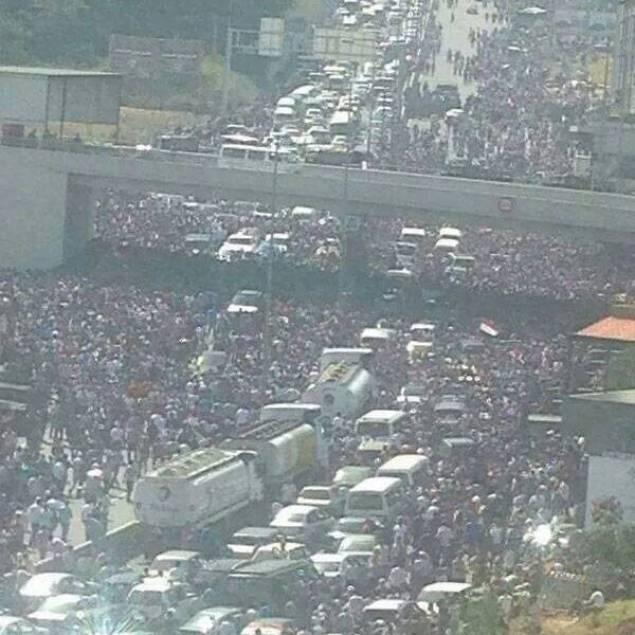
Today, the need to expand the list of Lebanese traffic causes to add lucky number 13 has befallen upon us:  Syria’s presidential elections. And here I was thinking the following crowds were here to enjoy our new internet bundles.

Syrians vote in Lebanon

What’s The Point?

Today, Lebanon’s Syrians drove (and walked) all the way to Yarzeh to participate in their democratic (also known as fictive) elections which will give Bashar el Assad another presidential mandate (with about 90% of the vote). Would we be going on a limb to assume some have even come here from Syria, all expenses paid? A little tourism never hurt anyone. It’s the Middle Eastern way of running elections.

As a consequence of the Syrian onslaught, some Lebanese have been stuck in traffic since morning as the road leading to the Syrian voting polls was turned into a massive car graveyard. How many had to waste their entire day today being stuck in their cars for absolutely no point whatsoever except for the Syrians who are actually secure enough to go to their country’s embassy can prove to the entire world that their Bashar is a man of peace (while still able to scare the bejeezus out of them)?

Is there anything more ironic than a Syrian refugee clutching a picture of Bashar el Assad to his heart, a Syrian flag in his right hand and a Hezbollah flag in his left, chanting “Bel rouh, bel dam, nafdik ya Bachar?” – I mean, why did you leave in the first place?

The Syrian embassy in Lebanon has had 100,000 Syrians pre-register to cast their ballots in today’s early vote. Some of the pre-registration process was carried out by Lebanese parties who are aligned with the Syrian regime. I guess those same parties were more pre-occupied with making sure their Damascus boss’ re-election goes along without a hitch than about trying to make sure the presidential vote over here goes through. Priorities people, that is the point.

Today, those voting have the entire Damascus road under an electoral siege for no point whatsoever. I guess that’s not too far off from what goes on in our elections as well.

Who’s To Blame?

The question being asked by people is the following: who is to blame for yet another wave of massive traffic in an event that has been foretold for a few weeks now?

Many Lebanese are blaming our government and its lack of preparations for the event, especially the ministry of interior. But I have to wonder: is it our government and ministry of interior’s job to run any foreign elections on our land? Doesn’t this fall under the auspices of the embassy at hand whose job is to make sure its citizens can reach its premises and vote? Didn’t the Syrian embassy in Lebanon have data at hand that the turnout would be as stratospheric as it turned out to be? Did the government know of such numbers and still fail to issue regulations to counter them? Besides, even if our government knew of the predicted numbers, could we have done anything to address this with our roads and whatnot?

Lebanon’s Syrian Election

You know what’s sad? The fact that Syria, at war and barely together, managed to do a presidential elections, regardless of it being pointless, and Lebanon – at peace (in theory) – failing to vote for a president over almost 3 months of ballots. What’s even sadder is that Syria, a country at war, will not spend a single day with a presidential void while we’re going on day number 4 without a president now with no resolution in sight. The upcoming/current Syrian president will then proceed to give the magic word for the election of ours.

Don’t make fun of the Syrians going to vote the way they do. We do the same when it’s our time to head to ballots except we’ve probably forgotten how it feels like to actually cast a vote. It’s been a long, long time. Today’s conclusion is the following: at least 2014 has witnessed elections in Lebanon. Only It’s Syrian.

The following are pictures from the current mayhem in Baabda:

When Your Facebook Account Is News Material: Lebanon’s “First” Same-Sex Marriage Is Anything But

Georges-Massaad Gay Marriage Lebanon

A few hours ago, the name Georges Massad meant nothing to the Lebanese populace. In the coming days, because we have nothing else to do, watch as he becomes the most discussed figure – save for an unlikely president – in the country. Why so? Because his Facebook account was news-material for local services who have nothing better to do than stalk profiles.

Georges Massad married his partner in a same-sex marriage ceremony in the United States. He posted wedding pictures on Facebook. His wedding is now Lebanese news. This isn’t the first time our personal and private Facebook accounts become the source for Lebanon’s news cycle.

A few months ago, an unknowing teenager found himself in deep trouble because of pictures he had posted to his Facebook account four years ago. You probably don’t remember him by name but Ali Itawi’s picture became a matter of national Christian dignity when the president decided to put pressure into throwing the young adult in jail after he posted pictures of him kissing the Virgin Mary. Regardless of whether what Itawi did is acceptable or not, what’s unacceptable either way is the fact that we have news services who have nothing better to do in this country than to stalk all of us and turn our private lives into their own income source.

This is unacceptable. Make sure you look at what you posted on Facebook back in 2007 because it can and it will be used against you in the court of public opinion.

I highly doubt Georges Massad wanted his private affair to become a source of Lebanese discussion. He probably shared his pictures so whichever family members and friends he has who accept him for who he is could see how happy he was that day and how glad he was to share his life with someone he loved.

Guess again. That private matter will now become the “it” news of Lebanon. Can you believe it? Lebanon has had its first gay person get married! Should we be outraged? Should we worry for our children’s future? Should we panic about what this means to our national values? Should we pretend to be civil and open a discussion about the matter?

George Massad’s marriage is being advertised as the first “announced” same-sex marriage of a Lebanese. This is far from the case. Posting  a picture on Facebook does not mean you are announcing your marriage on a national level. It’s anything but. If our news services actually dig deeper, they’ll find a lot of Lebanese who are living abroad who have tied the knot with their partners. Many of us even know people who have done so. Why don’t we make a big deal out of it? Because it’s none of our business.

I’d understand the news fervor if Lebanon had its first same-sex marriage in Lebanon, if ever. But a Lebanese man marrying an American man in the United States reflects on us how? How is it even important enough to be the “it” news of the day? I guess that’s what happens when we latch to the word “Lebanese” wherever it falls and believe it gives a higher sense of importance to whatever comes after it.

Congrats to Georges and his partner. Sorry in advance for the upcoming circus.

Lebanon’s Telecom Sector To Get A Much-Needed Overhaul

There was a time when Lebanon’s internet gave us more trouble than its intended purpose to make our lives easier, but would you believe me if I told you that the age of unlimited internet packages in Lebanon might be nearing?

Unlike Al Akhbar, who seem to be rather depressed by the notion that Lebanon’s Telecom services may end up cheaper to the consumer, the sector could actually be in to an overhaul that it hasn’t seen since Gebran Bassil reduced prices back in 2008. And this makes me very, very excited, and I think you should be excited too.

Our government is convening as we speak to discuss current minster Boutros Harb’s proposal of trying to get our telecom sector into areas of competitiveness we’ve only theoretically spoke about before.

Boutros Harb's tweet from 7:42PM on May 16th, 2014.

Boutros Harb’s tweet from 7:42PM on May 16th, 2014.


DSL:

Our current DSL is horrifying. While our phones enjoy 3G and 4G speeds, the highest speed an end user with ADSL can get is 2Mbps. Decent packages give you a 20GB quota per month for $50. When that package was first announced, I thought 20GB was huge. Nowadays, however, I think it’s pulling back my internet usage with increasing bandwidth demand across the globe as everything moves to cloud and files grow bigger.

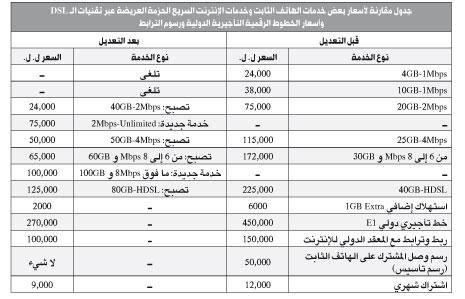
A leak from the proposal is the following table published (begrudgingly) by Al Akhbar:

New DSL Lebanon

If the above plans get approved, we would finally have an unlimited internet plan for the price of what I’m subscribed to right now. Moreover, quotas would be increased substantially and extra usage made even cheaper.

Would such plans pass? Well, information out of the current governmental meeting indicate that Gebran Bassil is battling Harb fiercely over the proposal at hand. I get it. Any party would want to take credit for such a voters-grabbing proposal.

Mobile Data:

Another facet of the telecom sector that desperately needed revisiting was our mobile data bundles. Neighboring countries have had bundles superior to ours in quantity for less prices for a very long time. Nicolas Sehnaoui enforced a 50% increase in early 2013 but even those new quotas are nowhere near enough with the increasing need for internet necessitated by current lifestyles and with the introduction of 4G to Lebanese customers.

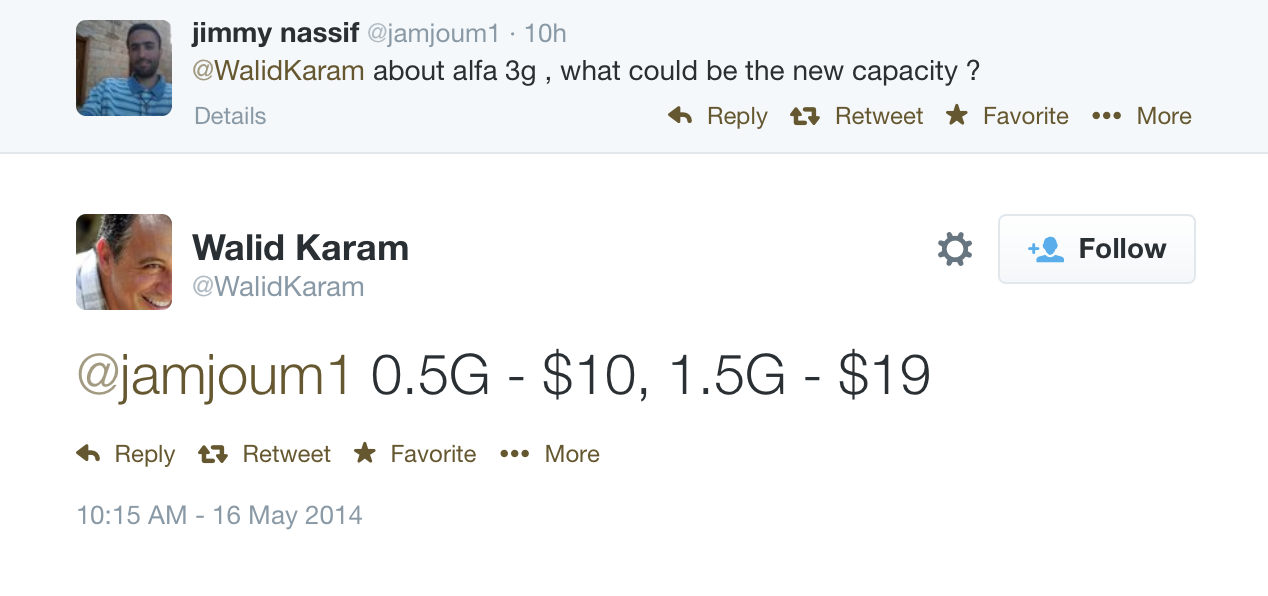
As such, it seems that starting Friday we might get new 3G bundles for our use. The details of those bundles have yet to be announced but a tweet from Boutros Harb’s assistant indicates the following:

Screen Shot 2014-05-16 at 8.04.27 PM


I daresay 1.5GB for $19 is quite a deal and very similar to rates in Europe that I’ve experienced firsthand during my visits there.

Phone Rates, SMS and whatnot:

Internet isn’t the only thing getting a massive update soon, if the proposals are to pass. A minute, currently costing $0.36 on prepaid lines, will be dropped to $0.25. A text message costing $0.09 will be reduced by 45%. The best news, however, is in the fact that the monthly fee of postpaid lines would now involve a set of 60 minutes for free talks, making the $20-something per month fee not completely useless.

The need to register phones at the airport or at Alfa/Touch has also been canceled. That alone makes me happy as the entire matter poorly conceived, horribly executed, as well as very limiting to the growth of the mobile phones sector.

Politics?

I wasn’t too keen on Boutros Harb being minister of telecom as he was out of place but he seems to be doing a great job so far so kudos to him. As an end user, however, I couldn’t care less who passes the aforementioned proposals as long as they are passed, and whoever passes them will simply be doing his job. Such a massive overhaul of the Lebanese telecom sector will serve as a stepping stone to further enhance a vital service that could help energize our economy and our footprint across the cyber world.

I can’t wait not to panic over downloading my favorite TV shows outside the 11PM-7AM timeslots of free quotas.

Avril Lavigne Coming To Lebanon For Byblos Festival?

Avril-Lavigne-1

In case this year’s summer festival lineups including Ellie Goulding, Beirut, Stromae and Massive Attack wasn’t impressive enough, it seems there’s another hotshot act who’s making a detour to this part of the world.

The buzz in some circles currently is of the possibility that Canadian singer Avril Lavigne will be announced as part of the lineup of the Byblos Festival, to be revealed this coming Tuesday.

This rumor is perhaps odd because Lavigne is not on tour in the region as other artists tend to be when they make a Lebanese stop. However, Lana Del Rey still managed to perform in Lebanon last July despite her not touring.

While the aforementioned rumor is not as set in stone as other recent leaks, notably Beirut’s upcoming gig, my sources have indicated that such a possibility is not too far-fetched.

Either way, Tuesday is right around the corner for the official full lineup to be revealed.