Saving The Jesuite Garden… because It’s Christian

20130620-100833.jpg

I always thought everyone knew that Beirut had a green space problem. The city has 3 parks that are open to the public. You can count the trees on the entire city’s sidewalks. There is no concept of urban planning. And there’s certainly no functional public transport system, which is one of the main flaws with the city structure.

Yet there are people who think all is fine with the city environmentally. Don’t be shocked, yes they exist.

The fight to save the Jesuite Garden, which culminated in a protest held at the garden in question slightly less than a week ago didn’t take much to go down sectarian lines. The representative of the Beirut municipality that showed up at the protest had one line of interrogation to throw at those who didn’t want the garden removed: what’s your name? Where are you from? Who’s politically backing you?

Because, you know, God forbid a fight to save a park is exactly just that: a fight to save a green space.

Interestingly, for many – the fight wasn’t to save a green space. Many protestors against the park’s removal don’t even care that this is one of the few areas of green space in Beirut. They care that there are ancient Christian ruins there… And that might be exactly what is needed to save the park.

It’s one thing to tear down a tree. It’s even one thing to tear down a Phoenician port, a Roman hippodrome or any other old structure. But once religion comes into play, all projects are off. Do not even attempt. It happened with the Beirut Downtown site recently and it might happen again here.

The bottom line when the religion card is played in such cases often turns out to be positive. It might be even smart to cash in that card whenever possible. But is it healthy to coerce a municipality to save a park just because they don’t dare to awaken a sleeping monster not because they, as a municipality, should become aware of the problems such a destruction would cause?

The municipality will end up not learning anything for future practices later on or even possibly thinking about some plans to really tackle the issues that necessitated the park’s destruction.

Till when will the focus of individuals in this country be religion-centric, ignoring other facets of society that affect their lives as well and which are worth speaking up for?

I don’t want the Jesuite Garden gone not because it has a derivative of Jesus in its name and on its grounds. But what do I know, I guess. Talking about a temporary fix for parking and destruction of green spaces sure pales in comparison to Jesus.

The Lebanese President & The Arrest of Jean Assy

It was July 2011.

Some local band had their song picked up by Lebanon’s “security” agencies and were investigated regarding its supposedly president-insuling content. Everyone got up in a fit. The law being employed to justify the arrest was an ancient one that forbids Lebanese citizens from insulting the president.

A few hours later, it was our president Michel Sleiman himself who ordered the band be released when he found out they were arrested due to insulting him.

It is now June 2013.

A local activist named Jean Assy, who also happens to be a staunch FPM supporter, is arrested for insulting the president. All hell broke loose on social media. The constitution’s preamble that guaranteers freedom of speech has been quoted so many times that I can almost recite it at this point had I been paying closer attention. Jean Assy will soon be released because these charges never, ever stick. And he will become a local hero for many who are beginning to idolize him.

But is July 2011 similar to June 2013?

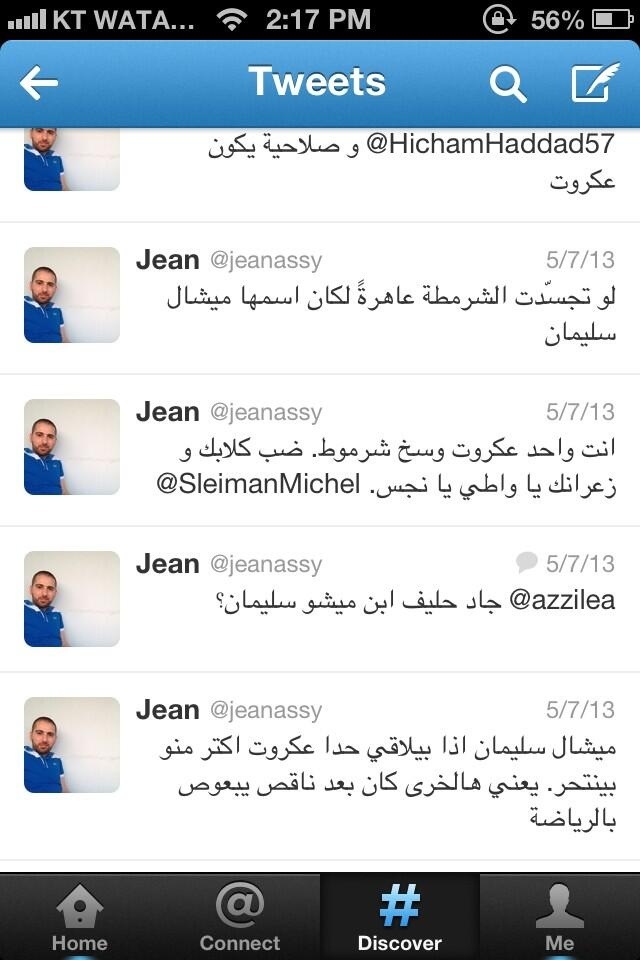
I do not follow Jean Assy on Twitter because I mostly disagree with content and find the tone unacceptable. But I occasionally get his tweets retweeted onto my timeline. Is this matter only because he “criticized” the president? I remember seeing many tweets in which the words “president” and “castrated” [in that order] were mentioned. Is that freedom of opinion or is it libel?

20130618-143049.jpg

Is the arrest of Jean Assy warranted? Possibly not. In an ideal situation, I can call my president anything and expect to get away unscathed. But this isn’t an ideal country. In fact, I can barely think of a few things that make standards of life here remotely acceptable. You only need to check the news – word of advice: do not – to know how deep in this hellhole we are. What Jean Assy’s arrest for investigation, however, is not a matter of political rhetorical martyrdom and the Lebanese president turning into a dictator when, for all matters and purposes, the Lebanese president may be perfectly unaware of this even happening and the whole arrest is carried out by some security men with a vendetta under the pretext of a law that needs to be changed and removed.

The other element of the Jean Assy arrest is some prominent FPM politicians running to his rescue with tweets and retweets of their own. I have to ask those politicians: where were you when Hachem Salman was killed at the front doors of the Iranian Embassy? Where are you now that Ramy and Marwa Olleik are forbidden from going back to their hometown due to their threats on their lives? Or are my liberties as a Lebanese contingent upon the political rhetoric they can spark?

It is a sad day when opinionated people get arrested due to silly outdated laws, regardless of how over-the-line those people may have gone. But look at the silver lining: at least Jean Assy has people to watch his back. Many other Lebanese do not.

The Destruction of Achrafieh’s Jesuite Garden

While walking around Rome with a friend yesterday, he said the following: “you know, it’s a beautiful city but I wish it had more trees like Paris.”
I replied: “We’re ones to talk. The only trees I’ve seen in Beirut are in the Jesuite Garden next to my apartment in Achrafieh.”

I guess I jinxed it.

A highway tearing Achrafieh in two, removing countless parking spaces and destroying greenery that is otherwise rare in Beirut was not an enough project for Beirut’s municipality.
They now want to destroy the Jesuite Garden in question, which I wrote about before, in order to build … *drumroll* … a parking space (link).

The municipality is trying to sugar-coat the deal by saying they will replant trees above the parking, which will be underground. But how is that acceptable when the park has been around for decades and has ruins in it that date back to ancient times as well?

Is there a parking problem in Achrafieh? Sure. Is the solution for that problem killing off one of the few rare green spaces in Beirut? Hell no. I have absolutely no idea who’s the urban planning expert working at that so-called municipality but how inept is he at his job?
But what can we expect, really, when experts from Ile-De-France try to convince the municipality that its practices are unacceptable and still they go through them?

It’ll be one sad day when this park where I broke my arm and where my grandpa used to take me to play becomes a mass of concrete rubbish. But isn’t that what Beirut really is?

Nemr Abou Nassar vs LBCI

A lot of people absolutely adored Nemr Abou Nassar’s recent 20 minute rant against LBC and the situation in Lebanon that LBC somehow represents through their misrepresentation of an award show.

After all, aren’t the best kinds of pep talks those carried about by people financially better than 95% of the Lebanese population and with a second nationality to fall back on, just in case?

LBC has now replied to Mr. Nassar with what I think is an absolutely brilliant example of professionalism. For the first time, you have a Lebanese TV station acknowledging a mistake happening and taking the blame for it. Now LBC, my hat is off to you.

Hello Everyone,

Many of you rightfully expect LBCI’s transparent and honest answer to Mr. Abou Nassar’s video.

Like most would agree, LBCI succeeded in exporting Lebanon to the world with unparalleled levels of professionalism. This did not happen by coincidence or magic, but as the result of the perseverant work of hundreds of professionals. And it happened because we believe in our country, in its talents, and in all men and women dedicating themselves for Lebanon, whom we reassure of our unwavering support.

We do not (thank God!) pretend to be perfect. Mistakes happen with all corporations, and we believe the successful institutions are those who draw lessons to avoid repeating them. Let us be clearer: LBCI takes full responsibility of the mishaps that took place and regrets their impact on all the people involved. We salute the efforts of Dr. Sfeir and For Lebanon and sincerely hope that our apologies will be accepted.

The performance, which is not reflective of our standards, was due to the fact that the filming was outsourced in all good faith by LBCI to an external team, which did not perform up to expectations. Again, we are not trying to put the blame on someone else as we fully acknowledge our lack of proper selection. And we are willing to do everything possible to repair the harm that was inadvertently made.

What is an unforeseen sub-performance should not be dealt with as a premeditated wrongdoing, or as a hidden agenda targeting local talents. Though we fully understand the frustration, linking this incident to malevolent intentions is taking things out of proportion. We cannot stress enough how much LBCI supports Lebanese talents from all genres and languages and our track record in this case cannot be brushed aside because of a blunder. An unjust accusation cannot be an answer to a non-premeditated mistake.

Many people can testify that LBCI has broken many partnerships with organizers who did not abide by our standards in term of respecting the people attending the event, thus speaking of intentional sabotage is simply not an option. Criticizing what is wrong is what we do, and we support numerous points that Mr. Abou Nassar has raised, but we are against dramatized criticism which turns into a witch hunt.

We hope that a new page will be opened, and that we will continue to collaborate with all our valued talents to serve our common cause which is Lebanon, as we are all fighting in the same ranks. Mr. Abou Nassar ensured a good coverage for the event and helped in clearing the organizers’ reputation which we also hold dear. We join our voice to his to also thank them for their efforts, hoping to put this unintentional incident behind us

If only other institutions in this country can be this professional in the way they handle criticism.

4G LTE in Lebanon – The Review: A Premature Venture?

I’ve been using 4G around Beirut for the past two weeks. Alfa were kind enough to give me a dongle and a line with a 10GB plan for that purpose.

The result, 2 weeks in, is that I am less impressed than when they first showed me the service back at some ministry events.

The coverage:

I personally didn’t use the dongle because it doesn’t allow me to really test coverage. Don’t expect me to hop around with it connected to my Macbook pro for testing purposes. So I used the line I got on my iPad mini, which I carried everywhere I went around Beirut, giving me a more or less similar impression of what to expect on mobile phones.

The maps being circulated around for Alfa’s coverage (MTC has similar coverage as well) show a very well covered Beirut. The reality, however, is much less optimal than that. For example, Alfa’s map shows that both Beirut Souks and ABC have LTE towers nearby to enable indoor coverage. I can count on one hand how many times I had indoor coverage in both of those places. Outdoor coverage is also spotty sometimes and you will find your device switching between 3G and LTE often. Coverage in Achrafieh stops around St. George Hospital. Anything East to that doesn’t have LTE. Coverage in Hamra, when I tested it, was borderline horrible. The LTE I got simply didn’t work and when it did was far less optimal than the 3G I was using on my iPhone 5.

The speed:

I had possibly Lebanon’s fastest internet in my pocket for a few weeks, though I guess that’s not saying much. In fact, while the bandwidth I was getting is possibly impressive in itself, it somehow becomes less stellar when you realize that this is less optimal for what 4G LTE should be giving you. My friends in the United States are used to an average of 20 Mbps with speeds reaching 60Mbps sometimes, something I haven’t seen in any of the many, many speedtests I’ve done, fully knowing that the 20Mbps figure was what an alfa spokesperson said to expect on average in Lebanon. Now I wonder, if we are still in the phase when there aren’t many users sharing the bandwidth and we’re not getting the average speed, what can we expect when 4G is rolled on phones?

The experience:

I enjoyed the fast speed that I got whenever I did. For instance, I downloaded The Perks of Being a Wallflower off iTunes, its size being about 1.4GB, in slightly less than 2 hours by creating a hotspot out of my connection. Songs that I purchased from the iTunes store would download in less than a minute. I didn’t need to worry about the time it would take an app to download or update – even if my iPad fell back on 3G more often than not in many of the tasks I mentioned earlier.

I also really enjoyed the leisure that the 10GB quota gives. It is, however, priced at $99 per month which means it’s definitely not within my range. The quotas, on the other hand, are not 4G-centric. There has been constant talk about how we have the best 4G prices. This isn’t true. You, as a user, are subscribing to a mobile data bundle, not a 4G bundle. If your phone supports 4G and you find yourself in a 4G area (only Beirut at this time), you automatically switch from 3G to 4G, which means you use the same bundle that you had all the time for 3G to use 4G when available. So if you find 3G quotas unacceptable, the same logic still applies.

Are the bundles enough? As it currently stands, I would still say they are overpriced. However, I believe the quota itself will suffice, even with 4G, because the speeds are not that much better than optimal 3G (I have seen 3G speedtests that are better than some 4G ones I did) and coverage isn’t good enough for you to burn through your MBs without noticing.

Moreover, LTE will absolutely demolish your battery life. I was literally able to see the battery percentage of my iPad mini dropping in front of my eyes the more I used LTE, which could be because coverage isn’t as good as advertised. So be prepared to have your chargers around when the service is rolled to mobile phones. Trust me. You will develop battery-phobia.

Conclusion:

I think 4G LTE currently in Lebanon is a premature venture that we’ve undertaken. Of course, things are bound to improve from now on and I have to say that my experience with the pilot phase of 4G has been better than the pilot phase of 3G which was all over the place. But do we really need 4G now when there are many facets of our internet sector that are in a much dire need of improvement?

Of course, 4G is great and all. And to further develop economically, our country desperately needs such measures. But couldn’t it have wait a year or so more pending bettering the service before rolling to the public and providing further improvement for our 3G services?

If it were up to me, I would have waited on 4G and developed Lebanon’s 3G even more because our 3G coverage, based on my experience abroad, is not the best that it could be yet in spite of all the tangible improvement we’ve seen recently.