Daniella Rahme Craves Hallab

One of the culinary landmarks of Tripoli is the sweets palace, known to most people as Hallab after the family that established and is currently running the place.

The place and its goods have many fans, of which is recent Dancing With The Stars winner Daniella Rahme who is now part of a new ad for the place, one in which her homesickness to the country manifests in her craving for Hallab’s sweets.

I found to be quite charming as well as true. How many of us have had relatives visit the country and stuff their suitcases with baklava and whatnot to give them a taste of home away from home?

Check out the ad:

Seeing as Tripoli has really calmed down after the truce and the latest security plan, I suggest you all give the city a visit and pass by the original Hallab, where I assure you the whole experience is different from picking up the goods from Jounieh or Jbeil or wherever.

And no, I am not getting free sweets in exchange for this blog post.

Is The iPhone Really Getting 4G From Alfa?

A couple of weeks ago, when Apple released its 7.1 update for iOS, it also brought with it an update that enabled Lebanese iPhones to access the country’s newly launched 4G network.

I brought the fact that the iPhone wouldn’t work on the country’s 4G network way back when it launched last year due to Apple’s approval of the network being a requirement. Our carriers then scrambled to work with Apple for that purpose. Now, more than a year later, the iPhone will be launched officially by our carriers here and Lebanon is on the list of countries that can get iOS features that were unavailable to us before, such as iCloud Keychain.

However, there is a discrepancy in the rollout of the service between Lebanon’s two carriers that I believe has to be outlined for transparency’s sake and it is the following.

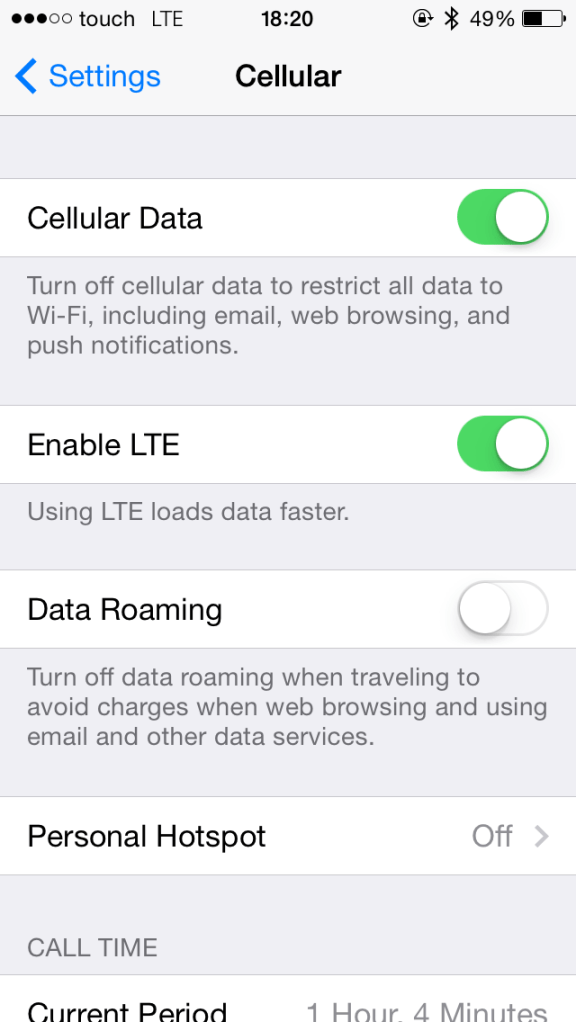
If you own an iPhone 5S on Touch’s network you’ll notice the following switch to enable or disable LTE.

iPhone 5S LTE Touch MTC Lebanon

If you own an iPhone on Alfa’s network you’ll notice the following button to enable or disable 4G.
Alfa iPhone 5 5G Lebanon

Both buttons are not exactly the same because in Apple’s standards, 4G is not exactly LTE. How so? Well, back in 2011 when the iPhone 4S was released, the 4G toggle was enabled for that phone fully knowing that it is not actually a 4G device. The move was criticized by many for being false-advertising. But the iPhone 4S in the United States, on AT&T’s network, clearly showed connectivity to a 4G network which wasn’t an actual 4G network, just a faster version of 3G, which was supported by the iPhone 4S at the time with speeds that can go up to 42Mbps.

iPhone 4S 4G AT&T

Are Lebanese customers also the victim of false advertising?

I doubt a company like Apple would give preferential treatment to a Lebanese network and give it a special “enable 4G” button when that same toggle has been “enable LTE” for every single other carrier around the world, including Lebanon’s other network.

To support the argument is a collection of speedtest results that show a discrepancy between the speed of the service offered by MTC and that of Alfa.

This might as well be considered as unimportant given everything the country is going through. Varying speeds of fast internet are not a priority. But the question still begets itself: why is there such a discrepancy between the country’s two carriers if they are supposedly offering the same service?

All in all, my experience with 4G so far has been subpar but those speeds, regardless of whether they’re actually 4G or not, are desperately needed for DSL. Someone out there take note and make it happen.

Aline Lahoud On The Voice France

It seems I was the last to know that a Lebanese would be competing again on France’s The Voice, but I daresay the Lebanese candidate this year is probably the best so far with Salwa el Katrib’s daughter, Aline Lahoud.

I was on hospital duty last night so I couldn’t watch her blind audition as it happened but Twitter was abuzz with her performance. Lebanese people were surprised that she sang a song they all knew, in her mother tongue. French people were bewitched by her good looks and charisma. The judges were all fighting to get ahold of her. She ended up choosing Florent Pagny, contrary to what everyone expected her to do by going with Mika, who’s of Lebanese origins.

Aline Lahoud sang her mother’s most famous song “Khedni Maak” and she did a great job at it, as you can see from the following video:

I guess it was a big risk for her to sing a style that none of the judges was familiar with, in a language that they didn’t understand, but it paid off big time with her as Aline Lahoud’s audition quickly became the most discussed The Voice audition this year with about 5000 tweets/minute.

It’s sad that a talent like Aline Lahoud has to leave Lebanon in order to find a proper place for her talent. I guess she’s not the only talent the country is losing with its current downward spiral. Either way, she made me proud yesterday and I hope you felt the same way about her representation. I can’t wait to see what she brings next.

Hopes For A Better Lebanon: I’m Not A Martyr

“I just heard. I hope you’re okay,”  is the text I sent to the people who mattered to me this past Friday, moments after I had seen a column of smoke erupt in the distance from the hospital floor I had been rounding on.

I stood in patients’ rooms, transfixed as residents inquired on those patients’ state while television screens were lit with the bodies of people who had just perished. I was angry. I’m always angry. I was sorry. I was disgusted. It was an all too familiar sensation.

“Let’s continue the round,” the chief resident told me. “But people just died,” I replied. “It’s okay, life goes on.” It had only been a few minutes.

I don’t have suicidal ideations, but I wondered that day about how it’d be to die like those poor people, a burning corpse on a careless tarmac that has seen more than its share of burning corpses. I wondered how people would react to me dying. Would they care? Would someone other than my mother and cat miss me? Would there be people secretly relieved that I had come to pass?

I saw my mother weeping by my white coffin while clutching the cold wood that hid my corpse from her as she cursed the God she deeply believed in. I saw priests of a religion I didn’t believe in chant and pray and burn incense while people who ran to the front row of my service try not to choke on the smoke. I saw my bed, forever kept as is, and my cat, sleeping next to my pillow unaware that I’d never be there again to pet her. I saw my friends trying to make sense of me not being there anymore.

And because I had died that way, I saw my demise being turned by our local media into a matter of national importance, fake-reporting and all. I saw them calling me a martyr. I saw them covering my funeral. I saw them interviewing people who barely knew me but who went on and on about my death being such a loss as they enjoyed their five minutes in the spotlight. 

Then I saw my memory fade away from the collective consciousness of the people who felt touched by it somehow, remaining but a collection of moments to the people to whom I truly mattered. I saw people partying the night away, a few hundred meters from the place where I had died, unaware that I had spent my last few minutes there. I also saw another chief resident telling another medical student to continue presenting his patient because life goes on.

Life would have went on without me.

And if I could shout from beyond the grave, I’d tell whoever listened that this wasn’t the way that I saw myself dying, even though I’d get no say in that. I’d tell them I was robbed of my chance to live, of my chance to make my own name, build my own family and memories. I’d tell them that the notion of “martyr” I had been branded with due to the sake of political correctness is false. My death wouldn’t change anything. I didn’t want to die that way. I had no cause that I found worth dying for. I’d just be another plus one on a growing list of victims in a country that is getting increasingly forgetful of its people who had actually perished outside of someone’s morbid imagination.

Being a victim means there’s a country that has wronged the person who has passed. It means there’s a country that couldn’t protect them and guarantee them the simplest of rights to die in peace not in pieces. It means there are people who have killed them and who should face justice. It means that their death does not get to become yet another part of a growingly ridiculous political rhetoric that knows no end.

Victims, not martyrs. And how widely different this distinction makes things.

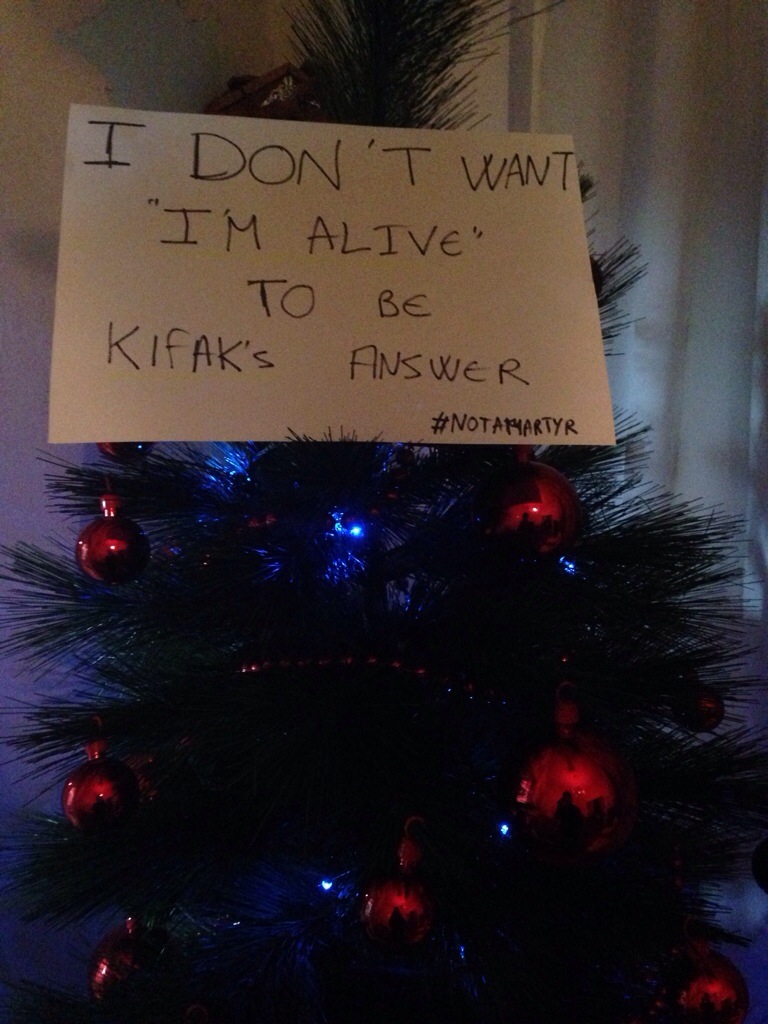
Today, a group of Lebanese enthusiasts have launched a Facebook page for people who are tired of surviving Lebanon of 2013, called I am NOT A Martyr. Like I’ve said before, they’re asking everyone to stop devaluating their life. They’re asking us to think about how we’d want things to change. People are posting selfies of their hopes of this country that is slowly but surely making everyone hopeless:

There are many things I’d want for my country. Some might say it’s silly or too simplistic to wish for such things in Lebanon.

I want accountability. I want rights. I want for my Northern border not to end at the Madfoun checkpoint. I want not to feel like a stranger among familiar faces. I want to say that I have lived as family surround me on my death bed.

And, perhaps more imminently:

20131230-224258.jpg

Rymco’s Big Twitter Mistake

We’ve all used our Twitter or Facebook accounts to communicate with some brands, restaurants and whatnot. The idea of that brand being a few characters away and possibly getting feedback from them is one of those paradigm shifts, at least in Lebanon, when it comes to the relation of companies with their customers. As a result, most of the country’s firms that want to keep up with the time have upped their social media presence and most know that there’s an etiquette with which you should abide, one that doesn’t apply to end users like us.

Patrick Chemali was one of those people contemplating buying a car. He had been considering the new Nissan but didn’t like the ad Rymco, the car’s dealer in Lebanon, had done, as is his right obviously. If you haven’t seen the ad, here it is:

So he took his dislike to Twitter and called the ad lame. Instead of having Rymco inquire more about why he thought the ad was as such in order for them to “improve their services” later on, he was basically told they didn’t care for his opinion while being called an attention seeker. Professionalism much?

Who knew not liking an ad could generate such a response from a supposedly professional firm?

Of course, you won’t find all the above screenshot tweets on Rymco’s timeline now as they have been deleted.

Instead of absorbing a customer who simply did not like the ad, not the car, and tell him that the car was still great or to inquire about what he didn’t like in the ad, Rymco went on the attack and lost him in the process as well as many other clients he would have referred had he received a decent service for the money he wanted to invest in their product. Big mistake.

But maybe they were just drunk on a Friday night?

Update: Rymco apologized and are saying the entire thing was staged with them aiming at bad publicity to get publicity. They’re now offering Patrick a car for the weekend.