Zaatar W Zeit’s Act of Kindness

I was walking around Beirut the other day, in neighborhoods I hadn’t been to in a long time, only to find streets that have drastically changed. The most poignant moment of my walk was when I saw an old woman, sitting by the corner of the road crying. She had her mattress next to her. She had nowhere to go. The walk up to that woman was full of people like her. Things are getting tougher and there’s nothing to make them easier.

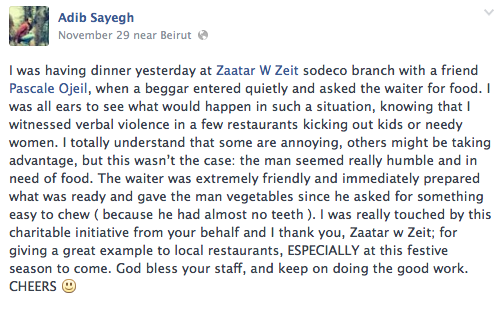
As a rule of thumb, it can be said that Lebanese restaurants are very disassociated with the general security of the country. As things get tougher, their prices get higher. I’ve rarely, if ever, heard of stories like the one below. But it is one of those rare instances that take you a few minutes to believe. 

Screen Shot 2013-12-01 at 1.46.06 PM

Of course, Zaatar w Zeit didn’t advertise this. It was simply an act of kindness on behalf of their branch in question. We all barraged Zaatar w Zeit for not serving alcohol at one of their branches this past year. It only felt fitting to highlight an act of kindness on their behalf towards those who are less fortunate in the midst of this non-festive holiday season.

Great job Zaatar w Zeit. Hopefully other restaurants follow suit in trying to make things easier for those who are overwhelmed by the harsh conditions of life in Lebanon.


Are We Seriously Getting Another Mall in Dbayyeh?

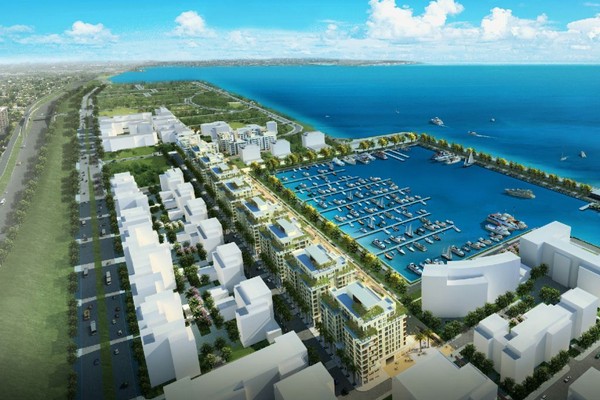
Future waterfront city beirut

Waterfront City is breaking ground. Parks are being built. New complexes have their plans set in motion. Previous projects are being continued.

That mass of “new” land bordering the Dbayyeh highway will turn into a whole new town in the coming few years, apartment buildings and all. Great news for Lebanon’s real estate market, definitely. Sad news for those who take the marine road to escape the insurmountable traffic during their commute.

Waterfront City is also getting its bonafide mall with City Centre, whose first branch opened up next to Beirut recently, beginning its constructions plans as per Gino’s Blog.

Of course, such a project wouldn’t be happening hadn’t malls been possibly the only thing, apart from restaurants, taking off in the country lately. They get business. People like to go to them. They open up and cater to the demand. Al Futtaim’s earlier Beirut City Centre, despite it being almost a carbon copy of an Emirati mall, is taking off well. Or at least that’s what the constant crowds in it suggest.

The question to ask, though, is when’s the time to say enough is enough, that malls taking off isn’t the only argument behind them springing up whenever, wherever, sporadically and without any form of organization and regulation?

Dbayyeh has reached a point that can be called: extreme mall saturation. Just look at that place. Next to future Dbayyeh City Centre, you can find LeMall, ABC Dbayyeh and Blueberry Square, which is basically a big food court. There’s also a huge Spinneys next to them. And they all exist in an area which is quite tiny. Stretching the scope just one bit reveals yet another huge mall, at one point Lebanon’s biggest.

All of these malls share access through the same highway. They serve a city and its suburbs which already have enough malls, clearly another example of the economic centralization the country has and which I’ve previously written about here.

With the advent of Waterfront City and all the new tenants that will inhabit it, as well as the “attractions” that will be available there, the bottleneck effect of the Lebanese infrastructure, especially when it comes to the Dbayyeh area, will become even tighter.  Waterfront City may be advertised as a futuristic approach to what Lebanon can offer, and perhaps it is, but – like much of those “futuristic” areas – the non-futirstic parts often have a reality to face. That reality is that of unbelievable traffic in and out of Beirut and I’m sure no studies will be done about how to work with the traffic that another addition to that area will bring. It’s a reality of poor infrastructure to support such projects – looking at a turned off ABC due to the electricity cut is proof enough. It’s a reality of shops that are closing down because they are being spread way too thin in a country whose economical situation isn’t that efficient. And this reality is the one at the top of my head.

The fact that malls take off in Lebanon is no longer a good enough argument to have them pop up so often in an area that is so restricted. Of course malls are going to take off it they’re the only thing being built to provide people with what they might need. Of course they will take off if all the country’s decent and new cinemas are in them. Of course they will take off if all new restaurants are opening in them. Of course they will take off when their advent kills all the other options that you can do.

People will take in what is given to them – why don’t investments in the country turn into elements that are more sustainable such as technology, industry, education, healthcare? Oh never mind – those are not as cool as a brand new flashy mall with an American food chain moving in next door.

We are slowly but surely morphing the Lebanese lifestyle into something that is pure khaleeji. Perhaps it’s high time we stop making fun of their habits because we won’t be much different soon enough. I’m not an anti-mall person. But we’re at a point where some contractor who gets the chance to do so will actually turn the area in Dbayyeh between ABC and LeMall into another mall while the entire country North of that is as dead as a brick.

I played a little game with my colleagues and friends today. I told them a new City Centre was being built and asked them to guess the area. They named Tripoli, Saida, Beirut, Batroun, Jbeil. When I told them it’s Dbayyeh, the unanimous response was: are they freaking kidding me?

I guess that’s that.


Lebanese Restaurants: What Will Your Price Limit Be?

I decided to go out with a few friends tonight for dinner. Pretty mundane stuff, right? Well, with med schools and all such dinners have become quite rare so I tend to jump on them whenever I can.

We went to a place we were all familiar with: nothing too fancy, supposedly, and prices that were acceptable, supposedly.
We were given the menus. I looked at my go-to item and it seems since I visited that place last back in September, prices had taken a hike.

That same hike also happened last year across many of the country’s restaurants. And then the year before that. And the year before that. And we can go on for several years more but the sentence would become too wordy and tedious.

As we made our way back home, my friends and I wondered: when will Lebanese restaurants realize that it’s unacceptable to have these yearly price hikes that come in like clockwork when there are very few reasons (read none at all) to warrant them?

Lebanese restaurants don’t exist in vacuum. They exist in a country where salaries have not increased since last year and where the economic situation has become very tough for many people who used to frequent such places.

Have they seen their business take a dip over the past year? I doubt. And I doubt they’ll be affected this year as well. But we’re fast reaching the point where burger joints will stamp the word gourmet next to their names and cater only to select clientele because, you know, Lebanese love their exclusivity.

I’m not saying restaurants shouldn’t open a charity-esque business or not work for profit because that defeats the purpose of their existence.  I’m just saying there comes a time when the price of a French fries platter that doesn’t contain that much fries almost hitting $5 is way too much.

Can We Get Over Beirut Being Among The World’s Best Cities?

20131019-190524.jpg

I’ve debated whether to write this or not. Then whether to publish it or not. Then I figured, screw it.

I am a proud Lebanese. And it’s because I like my country that I can’t sit aside and pretend that fake accolades mean more than they are, that void accomplishments are fuller than they actually are.

Beirut isn’t a bad city, sure. It’s perhaps the best city that we have given that our centralization policies have put everything only in and around it. But, forgive the bluntness, there’s no freaking way in hell Beirut can find itself on a world’s best cities list. Unless the person doing that list was high on some Bekaai hashish.

Beirut recently found itself to be on a list of the world’s top 25 cities, courtesy of CN Traveler. Those same people, for those who remember, voted Byblos as the #1 city in the region, with Beirut coming in second. Take that Dubai! We celebrated back then. That little triumph our cities had, although meaningless in itself, meant a lot to us.

Beirut is given the following description as per the CN Traveler website:

The capital of Lebanon has “much to offer the adventurous traveler.” Find “exotic cuisine and cocktails” at the “most exclusive clubs in the world” in what one reader calls “the Paris of the Middle East.” This city offers a “tapestry of sects, religions, and lifestyles that provide a feast for the mind of the intellectual.”

Visiting Lebanon is for the “adventurous,” it seems. I didn’t know my country was such a wild ride. Point me to the next safari why don’t you?

Perhaps Beirut is a great city for a visitor who came here to experience our unparalleled joie de vivre with someone who decided to show them Gemayzeh, Skybar and White, then spend a weekend in Faghaya, pretending that’s still Beirut, before spending the day at some beach that has more plastic than in the bodies of the women strutting their heels in its sands.

Yes, that sounds great indeed.

I don’t know what criteria were employed to rank the cities of that list. But the mark of the greatness of a city isn’t by how well and how great it treats a tourist coming to it for a week. It’s by how great it is for someone who lives there and calls that city home.

When I think of Beirut today, I think of unparalleled urbanization. I think of concrete masses upon concrete masses. I think of cultural demise that manifests in monument demolitions and old houses getting ripped off their foundations. I think of so little monuments that need to be seen in the city. I think of no public transportation. I think of no electricity, no water, of traffic, no public spaces and parks.

When I think of Beirut today, I’m being told I should think of Skybar and Dubai-esque malls because that’s what my city has to offer lately. I’m not sure how that qualifies as greatness honestly. Or I could just be the rare Lebanese who doesn’t like pubs and night clubs and all their derivatives.

Don’t let some silly list fool you into believing the city we call home doesn’t need massive plans, massive reforms, massive work, massive restructuring. Because what Beirut is today, a city living off the ghost of its luxurious past, is only great in the eyes of its beholders. And that’s not really great.

Following Up on Beirut’s Soon-To-Be Destroyed Roman Hippodrome and The Best Way To Save It

Lebanon isn’t a place where much changes in a year. Seriously, if you look at where we were last year around this time and where we are today, you’ll see a lot of similarities. The only exception, perhaps, to our Lebanese reality is real estate, especially when it comes to all the contracting taking place in Downtown Beirut.

More than year ago, I wrote about the Roman Hippodrome that was soon to be destroyed in Beirut (link), in Wadi Bou Jmil next to the Jewish Synagogue. A lot has happened in a year. So courtesy of a piece (link) by Habib Battah, an LAU professor, published by the BBC, an update on Beirut’s Roman Hippodrome is in order:

  • The developer who wants to use the land is Marwan Kheireddine. Sounds familiar? He is a minister in Lebanon’s current government. Way to go for transparency.
  • The project that will see the destruction of the hippodrome is a gated community where only “elite” Lebanese will enter. In other words: you and I are off limits. Unless you can afford paying millions for a Downtown Beirut apartment.
  • According to Kheireddine, the site is not worth preserving. How does he know this? He hired an archeologist who said so. Yes, because such matters are most transparently handled by the people you buy into your service.
  • Kheireddine is offering 4000 squared meters of the land to turn into a museum of sorts that people could access. Because a Roman Hippodrome was meant to be contained within the parking lot of a building, right?
  • Plots around the site in question are said to contain other parts of the stadium and need to be properly excavated as well.
  • There is an immense shortage of archeologists in the country. The job of those archeologists is to make sure such transgressions never happen. But the government doesn’t seem to care about such an issue.
  • Beirut is not the only place where Lebanese archeological heritage is being destroyed left and right carelessly. In fact, what’s happening outside of Beirut in lesser known areas might be worse.
  • Concerned activists are trying their best to halt the development. But there will come a time when they won’t be able to do much anymore.

I remember back in 2005-2006 when a local cafe in Batroun was being built. The initial digging site revealed a Phoenician burial site, sarcophagi and all. People flocked to see what the site was all about. The following day, nothing survived to tell the tale. Today, instead of that entire burial site lies a cafe known for its shisha and its July 2012 drug scandal.

The Best Way To Save The Hippodrome:

Earlier in 2013, hell broke loose twice over ancient ruins in Beirut. The first time was because some henchmen at District S assaulted the same person who wrote the aforementioned BBC article over him taking pictures of the ruins they were busy dismantling to open up Beirut into the new Dubai-esque age (link). The second time was due to Lebanon’s possibly oldest Church getting discovered at another site where a Jean Nouvel hotel was to be built (link).

The discrepancy between the fate of sites one and two is striking. The former is still operation. The latter has been halted. Churches can do miracles? Believe, people.

Arguments about how priceless a monument is, how irreplaceable it is, how silly it is to replace it with a building, how rare it is to find such a thing in Lebanon, how economically profitable it would be to keep it and turn it into an attraction are all useless simply because most people don’t connect to them on a primal level, enough to get them rallied up.

The only way, apparently, to get to a result, force government to get involved and save such sites in Lebanon is to infuse a dose of religion in the stones. The more religious those stones, the more people get rallied up, the less our government can stand quiet as bulldozers raze through the field. Unfortunately for the hippodrome, there doesn’t seem to be an ancient church in its ruins as of now. Let’s hope that changes soon.

The following pictures are all courtesy of the BBC: