A Lebanese Wasta

There’s nothing like a Lebanese wasta. Sure other countries have “connections” but we have perfected the art of getting places by virtue of who we know.

This won’t be long so sit back and read.

Rami and Fadi are both fresh high school graduates who both got over the required grade limit to apply to the Lebanese army and become officers.
Rami and Fadi both presented to the psychological evaluation part of the grueling entrance exams. Rami passed. Fadi failed. Rami continued his examination process while Fadi stayed home, his hopes of entry gone down the drain.

But behold. Fadi’s relative knows someone who’s ranked high up in the army. Two week after his failure in the psychological exam, Fadi got a phone call to go back and sit for the tests. He failed his medical test due to a deviated septum. It didn’t matter anyway, he was let through to the next phase.

Rami was still passing anyway.

Fadi then had to sit for the written exams required to assess high school knowledge. He got to the examination center without the required ID. As everyone else entered, he sat outside trying to reason with the officers in question but to no avail. 15 minutes passed as other applicants tackled their exams. A couple of phone calls later, he was inside, sitting in the back of the room with the officer observing the exam’s proceedings feeding him the required answers.

Both Rami and Fadi passed those written exams and advanced to the last stage – the personal interview required to get whoever decides to make their choice regarding the 200 or so people who will get all the perks that being a Lebanese officer entails.

A few days later, the news of who was accepted surfaced. Rami – who had passed his exams without the need for outside help – was thrown out. Fadi, who hadn’t passed an exam on his own merits was in. His family celebrated. They threw extravagant luncheons to celebrate the triumph of their son. They bragged about his merits, not knowing that everyone knew the story behind how he got in.

A few years from now, Fadi will become one of those men who – despite not being qualified in the least – can walk all over you.

The above story is 100% correct, apart from the names that have been altered.

Does it matter? Perhaps not. It’s sad though that all the people who are qualified in this country get lost in the shuffle of the lessers who are more connected. I used to think a Lebanese Wasta was the worst thing ever but with each passing day, I’m being forced to reconsider because it seems to be the only way to get a job, to get ahead and to make a life for yourself.

It’s either a wasta or the system shatters you.

The Lebanese Army We’re Required to Love and Support Unconditionally

They say a picture is worth a 1000 words. How about a video?

And the man was unarmed.

This is the other side of the Fadel Shaker video in which he, disgusting as he is, was proud of killing two army men.

This is to those who believe the Lebanese army should be beyond reproach, beyond questioning, beyond any form of accountability.

This is to those who believe Lebanon should become a military state because military rule is what we need.

There’s nothing that can justify the behavior in the above video. Absolutely nothing. There is a minimum of human rights that are guaranteed to every human being, whether that person was actually fighting with Al Assir or not and by the looks of it, the person in this video was not.

What’s next? Army men coming after us because they don’t agree with our brand of politics? Because we are not the people who immediately change their profile pictures and “like” the countless army support pages to express gratitude?

Will the officer and his subordinates in the above video be held accountable? Obviously not because even basic human rights are a matter of relativity in this country. There are many who believe the man they were busy stomping on shouldn’t get any.

The above behavior is expected from the likes of terrorists without morals and code such as Fadel Shaker and Ahmad el Assir. But is it acceptable to be emanating from a respectable institution tasked with protecting all of Lebanon’s population in similar ways?

Human Rights Watch published a 60 pages report on the behavior of Lebanon’s armed forces. Add this to the growing list of disgusting behavior that’s documented.

We will never know what really happened Sunday with that filth of an existence called Ahmad el Assir. The tough questions that have to be answered cannot be asked. Not that it matters anyway – all will be forgotten in a day or two.

One thing to say though is this: tfeh.

Update: the army men in the above video have been arrested.

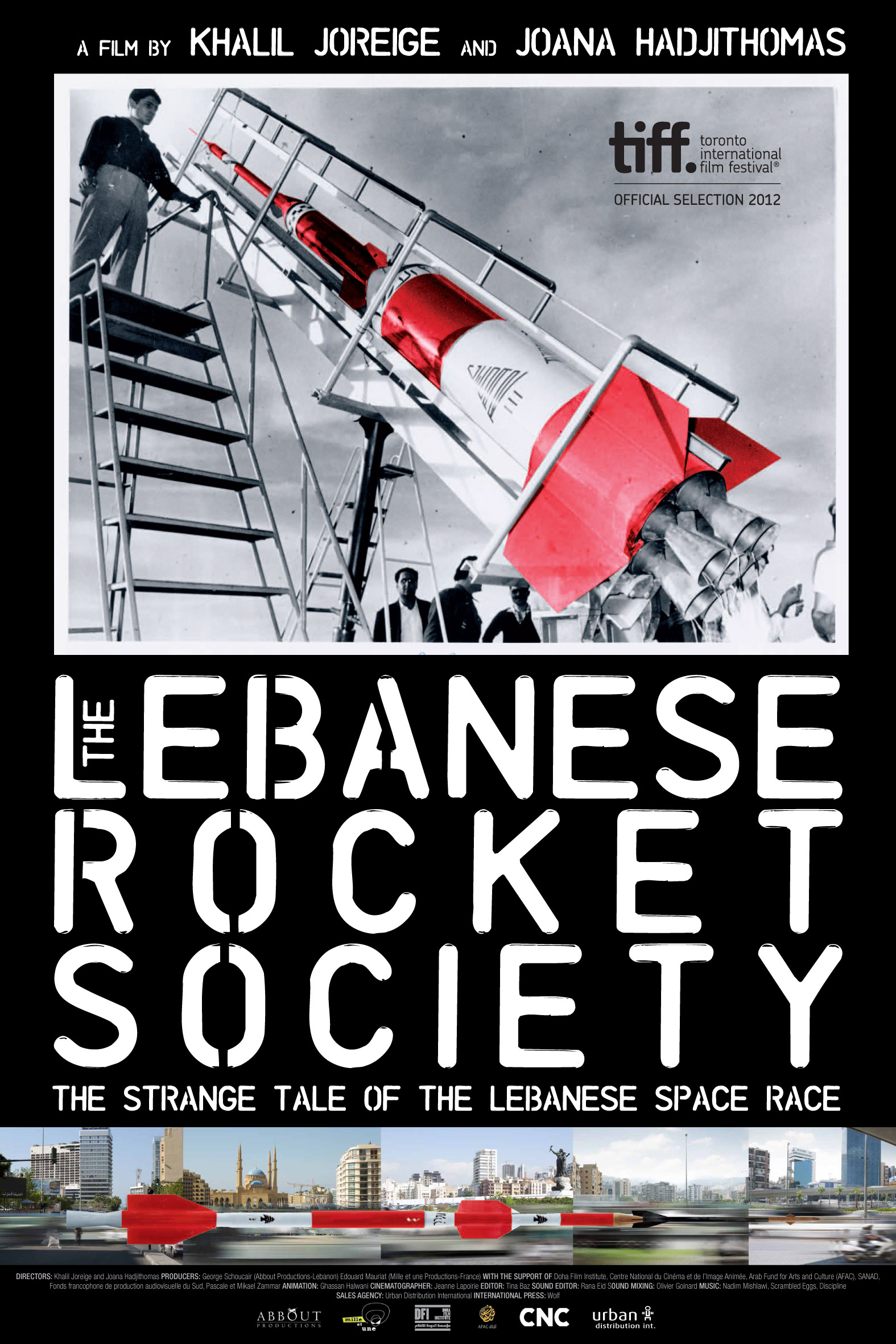
The Lebanese Rocket Society (Documentary) – Review

The Lebanese Rocket Society

Brought to us by Joana Hadjithomas and Khalil Joreige, The Lebanese Rocket Society is a documentary about a phase of Lebanese history that exists between both of our civil wars, from 1960 to approximately 1966, in which a group of Lebanese students at Haigazian University launched rockets as part of a series of scientific experiments.

The above is not science fiction, as I had thought on many occasions when many blogs and newspapers wrote about the society over the past few months, despite it being quite difficult to believe given where we are technologically in Lebanon today.

The Lebanese Rocket Society‘s premise is bittersweet. For its main purpose, it makes you proud that these students not only decided to build a rocket, but also chemically made the fuel the rocket is supposed to use because only superpowers possessed it and were not going to dispense quantities of it to Lebanon. The students even built the radar sensors that they equipped the rockets with after a brief miscalculation which sparked a UN-debaccle with our neighboring Cyprus. Yes, we haven’t been nice neighbors all the time apparently. The Lebanese Army eventually helped them in their scientific experiments for the students were heading into financial difficulties with their ambition growing bigger.

The mere fact that the Cedar-named rockets were all built from scratch is a testament to the ingenuity and the creativity of these young Lebanese students. Too bad such advances are purely science fiction not because such brains are lacking but because of our country’s circumstances.

The most interesting parts in the documentary were, without a doubt, the sections where real-life footage from the many launches that took place were incorporated. The archive is unimaginably great and seeing it is worth the price of admission alone. It’s always interesting to dig up 20th-century material about Lebanon that is not of tanks bombing buildings and of a torn-out Holiday Inn hotel.

The documentary seeks out Manoug Manougian, the student who started it all, currently a math professor at a university in Florida. Manougian shares the archive he kept of what he calls one his life’s proudest moments. You can check out his personal page here.

The directors also find Harry Koundakjian, the photographer who documented the Lebanese Rocket Society’s experiments, as well as former Haigazian president John Markarian. However, even though the other participants in the society’s experiments are mentioned, nothing is said about them nor are they mentioned again beyond the movie’s opening scene, which I thought did their work a disservice.

Moreover, The Lebanese Rocket Society goes off-topic often, notably with an entire sequence about the importance of the Arab Spring, as well as many other political subtle messages passed on notably about the importance of the Arab unity under Abdel Nasser. I still have no idea how the entire documentary’s premise fits in the mood of revolutions and freedom and whatnot spreading across Egypt, Libya, Tunisia and Syria but the notion is present.

I also felt it was very misleading that – despite their army source telling them the army had a panel discussing the possibility of turning the rockets into weapons by having one floor of the rocket filled with bombs – the directors were adamant that these rockets were a scientific experiment and build the entire documentary on that premise. It was quite clear that the rockets couldn’t have been possibly done if the army hadn’t helped and if the army wanted to make weapons out of them, they would have been turned into weapons.

The Lebanese Rocket Society ends with a 10 minute or so animated sequence which asks the question: what if Lebanon hadn’t stopped the rocket experiment?

To answer the question, the directors believe we would have a metro network running under Beirut, oil rigs off our shores, an entire space program rivaling that of the U.S.A. (down to basically ripping off Nasa’s logo), etc.

The sequence, in my opinion, did the movie a grave injustice and it shouldn’t have been included at all. It was already established that the rocket experiment was stopped because Lebanon was asked to by higher authorities in countries North, South, West and East. One of the documentary’s strongest scenes was one where a drafting compass drew a circle from Lebanon to where our rocket would have reached. Sinai was accessible. It was already established as well that the rockets were not, eventually, a mere scientific experiment as the students involved kept repeating. Those students didn’t know any better, obviously, but the army did. How does that set up for a future as bright as the one they tried to portray?

Nothing is better than some Lebanese future pick-me-up every once in a while, but at least don’t have it that separate from all the facts the documentary had presented over the course of the previous 80 minutes, especially that the presentation of those scientific facts was very systematic and documented.

I personally recommend people watch The Lebanese Rocket Society when it’s released in cinemas on April 11th despite its shortcomings because it is a documentary that showcases a different side of the Lebanon that we thought we knew, one that has been erased from the collective memory of the country as a whole – all supported by some old footage that will leave you baffled.

3.5/5

The Blinded Fools of Lebanon

Don’t you find some Lebanese reactions to things in this country overly odd?

I can somehow fathom some religious extremists taking it to the streets in order to protest the murder of their religious leaders even though I’m against it.
I can somehow fathom political militia groups blocking roads to get a boost in tactical power even though I’m definitely against it as well.

What I can’t fathom is how some people can be more than convinced that the best way to stand up for the Lebanese army is to block the road for everyone else and create a new mess for the army to clean up.

You try to tell them so. They say you’re not patriotic. I guess we can say now we’ve heard it all in this country.

Do you want to support the Lebanese army and have the urge to show it? How about you do so in productive ways like – say – enroll? But weren’t you the same people, like me, praying and crossing every single digit in your body so they cancel that mandatory army enrollment by the time you turn eighteen?

Those barricades blocking roads in support for our army are a mere pre-election political ploy and people eat them up. Politicians, notably Christian ones, can’t wait to come on TVs and point fingers and say: See those? Those are the people you shouldn’t trust. See us? You should vote for us all the time because with us the army is always protected.

The truth, though, couldn’t be farther away from that notion.

For instance, the people of my district, Batroun, decided that – similarly to the people of Sarba – they were going to block the highway yesterday in solidarity with the army and both its new martyrs Pierre Bechaalani and Ibrahim Zahraman.
I have to ask the people of my district one simple question: where was all this army love when one army man of our own, Samer Hanna, was gunned down and murdered like a dog, his killer never to see a jail cell?

Oh wait. What was Samer Hanna doing flying over parts of Lebanon?

Where was this fear for the army’s sake when people like Francois el Hajj, who defended the entire country during the clashes of Nahr el Bared uttering his infamous sentence: they either come out of that camp in body bags or in handcuffs. was blown up to little pieces?

Hold up again. What business was it for Francois el Hajj to snoop around?

Wasn’t the army threatened back then too? Is it truly us supporting our army when we are 1) hypocritical about it, 2) not knowing we are hypocritical about it and 3) not even knowing how to support the army?

Our army has been taught a few lessons over the past few years.

Chapter one: Samer Hanna – the South is off limits.
Chapter two: Francois el Hajj – the army is only allowed a very limited leeway.
Chapter three: The Sunni Mufti – parts of the North are off limits.
Chapter four: Pierre and Ibrahim – Arsal is another no-no.

Between chapters one, two, three and four, our politicians had differing opinions. Some of their supporters, who never see themselves as blinded because God forbid their politician of choice ever make a mistake, had differing opinions as well.

The army man who died in chapter one cannot compare to those who died in chapter four. And vice versa.

I’ve said it before and I’ll say it again: emotional upheaval towards the army in this country is an auction. Fools are those who actually fall for it – and fools are many. Because the blood of Samer Hanna doesn’t serve some people politically so it’s never – ever – mentioned.

But I will never forget that man and how some politicians who can’t wait to flaunt army love today were the first ones to dismiss his murder a few years ago.

And who’s the victim always in this? Our army. So you support him by blocking roads and feel good about it because your twisted imposed logic tells you so. Because protesting against those “extremists” by doing exactly what those “extremists” do is not extremism and terrorism at all.

The fact of the matter is “justice” in this country is only applied to those who are weak. So when our army barges into Arsal to capture those killers and justifiably so, I really hope someone out there remembers that there are other army killers out there and that there are army martyrs who are now forgotten, who didn’t have roads blocked for their sake and whose blood has gone cheaper than dirt.

Rest in peace Samer Hanna. Every day of hypocrisy, especially from the people of your region, is another nail in your coffin.

When Lebanese Army Martyrs Fall to Protected Terrorism

Pierre Bechaalani, one of the fallen men in Ersal

Pierre Bechaalani, one of the fallen men in Ersal

The news of the death of two Lebanese army members surfaced yesterday after a squad tried to capture a terrorist and outlaw in the Bekaai town of Ersal.

Pierre Bechaalani and Ibrahim Zahraman are two men who, by all standards, are heroes. They were both fathers in their early 30s. Who among us can really tell their sons and daughters that their fathers’ death truly didn’t go in vain in this country? We can’t.

It doesn’t matter what those terrorists are. I don’t care if they are Syrian rebels. I don’t care if they are Lebanese nobodies. I don’t care about their sect, their political affiliation, their family name. Whoever they are, whatever they do, the only thing befitting them is the death penalty.

Their stance from the Syrian revolution doesn’t even matter. I don’t care that they are rebels. Syria is slightly to the East. This is Lebanon. Go fight over there and leave us in peace here. Any Syrian rebel or regime-enthusiast who decides to enact their ideology on Lebanese soils should not be tolerated.

The even bigger problem is that their sect, their political affiliation and their family name will not only protect them from this, it will protect them for years to come. I hope I turn out to be mistaken.

That’s how cheap the blood of our army members goes these days. Pierre and Ibrahim, and many other them of our army’s fallen soldiers such as those of Nahr el Bared, are not just the fallen men of a Ersal clash. They are the fallen men of a state in our country that perpetuates a situation that allowed them to die and will allow other soldiers like them to die in the same exact way.

We all know how much outlaws are harbored in the town of Ersal. But they are allowed to remain there untouched. Perhaps it’s time for a major clean-up?

Whenever the Lebanese army faces such horrible situations and loses men, the eternal debate among Lebanese of who loves our army more erupts because we are only good at patronizing each other on that matter as if supporting our army is a national auction. The truth is that our army is in dire need for better weapons and equipments in order for things like the Ersal clash not to be repeated again and for children, like the sons and daughters of Pierre and Ibrahim, not to lose their fathers to some maniac who believes he will never face the law.

May all the fallen heroes of our army rest in peace.