Spare Us The Samir Geagea Hate

I told a civil war story last year that I made ambiguous on purpose to reach a certain conclusion, which was that everyone’s to blame for the Lebanese civil war if we really want to move the country forward.

However, I recently realized that Lebanese need a scapegoat for them killing each other. Their scapegoat was chosen to be Samir Geagea.

For some, Geagea killed them because they were of a certain religion, region, background, etc. For others, their sense of guilt kicks in and Geagea killed the aforementioned people because of their religion, region or background, as well as some of them who were “strong” enough to defy him.

The murderer! The liar! The assassin! The faithless! The abomination!

For many apparently, Samir Geagea was fighting the air during the Lebanese civil war. He was drawing his weapons against everyone but no one was drawing their weapons against him or his party.

For many it seems, Samir Geagea and his party were busy ruining the country all by themselves during the Lebanese civil war. No one else did anything worthy to be mentioned.

For many, the only war criminal of the Lebanese civil war is Samir Geagea. As if it’s possible for Samir Geagea to lead a whole civil war all by himself.

You defend Samir Geagea? You’re an accomplice to his murders. You complement him? They expected so much more of you. You admire him? You need to learn your history.

Because they know their history very well, I’m sure. Every single Lebanese now has a PhD in Lebanese civil war times and I was out of the loop. It’s sad.

The illusion that some people are innocent because they were legitimate needs to be removed. A bridge needs to be built and people need to get over that idea en masse. The fact that certain parties were violent to certain guests on our land can only be explained by the actions of those guests in a land that’s not theirs. The actions of certain parties cannot be taken out of the context during which they were carried out and treated as stand-alone events. It simply doesn’t make sense, regardless of how hideous those acts may be.

The civil war is an uncivil epoch.

No one in the civil war was a saint. If those involved had been as such, it wouldn’t be called a war and we would have had a very civil era. It’s far from being the case.

So let me put the situation today in the following manner.

If during the war your car was ruined? Blame Geagea. Your house was set on fire? Blame Geagea. You got stopped at a checkpoint? Blame Geagea. Your great-great-great-cousin, 2 degrees removed got killed? Blame Geagea.

Geagea barely escapes death? Blame Geagea. Anyone else barely escapes death? Blame Geagea.

Blame Geagea for everything – because that is the way we move forward.

If you’re one of those people who still consider the civil war in making their political choices today, then I pity you. If you’re one of those people who still need a scapegoat for your own mistakes just so you can please your conscience, I pity you.

Spare us the Geagea hate. Spare us the mindless, useless and retro attitude. If your mind is still in the civil war, perhaps getting it out of there is the first step towards building a country, instead of preaching about the importance of change and reform in moving Lebanon forwards.

Change and reform begin on the inside. Change your mentality. Reform your hate. And then come talk to me.

The ironic thing is that Geagea is the only one among all Lebanese political leaders today that went to jail for some of his supposed actions. Everyone else faced next to negligible consequences.

Tenzeker w ma ten3ad? At this rate, yeah right.

Stories of Lebanese on the Titanic – Part 3: The People of Kfarmishki

For part 1, click here. For part 2, click here.

Out of all the Lebanese villages that sent its sons and daughters to America on the Titanic, Kfarmishki has the highest death toll at 13, out of the 14 people that wanted to reach Ontario, Canada where most of the town’s expats reside.

Out of the 13 people that kfarmishki lost, only one body was recovered. Everyone else was lost, never to be seen again or given a proper burial. The abyss of the Atlantic became their final resting place.

Of those whose bodies were never found, there’s Assaf el Saykali who left his newly pregnant wife in order to find a way around the poverty in his hometown. Another is Mansour el Hajj, who left his 3 year old daughter and wife, only to be taken in by the sea.

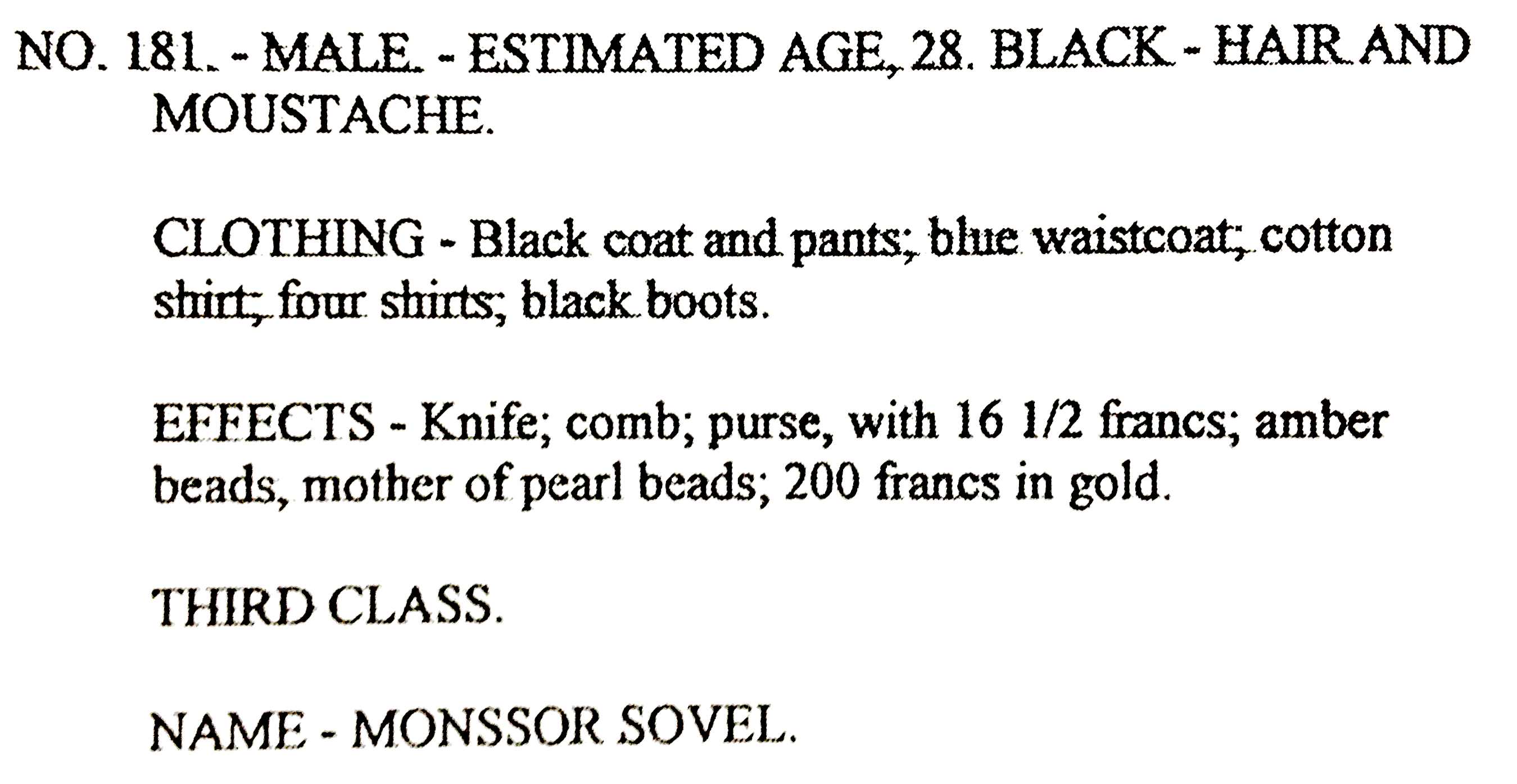
The only body that was recovered through the MacKay-Bennett belonged to Mansour Nawfal, a man in his late twenties who had left his hometown searching for a better life all by himself. Almost none of the people of Kfarmishki know about him. The MacKay-Bennett’s crew wrote his name as Mansour Sovel on the medical form they filled upon collecting him on April 24th, 1912.

The only survivor from Kfarmishki was a woman named Zad Assaf, who is more commonly known as Mariana Assaf. The name discrepancy arose when she was rescued and asked for her name. Being illiterate, she couldn’t inform the personnel of her proper name so on the lists of survivors, she became known as Mariana.

Zad was born in 1867 and got married in her hometown before leaving it and her two sons to follow her husband to Ontario. In 1912, she returned to Lebanon to see her sons and got on the Titanic, via Cherbourg in France, to go back to her husband. Her sons would soon follow her. It was a good thing they weren’t on the Titanic with her.

While being interviewed on April 24th, 1912, a traumatized Zad told the story of what happened on the day Titanic sank. She said when the ship first hit the iceberg, none of the passengers she was with, most of whom were Lebanese, got afraid. They had called it a night and went to bed. The lack of fear was due to them not knowing the gravity of the situation. It had been kept under wraps for as long as the crew could do so. Some of the Lebanese, however, wanted to go on deck to see what was happening. They were told nothing was wrong and no one felt any danger. So they stayed in their rooms.

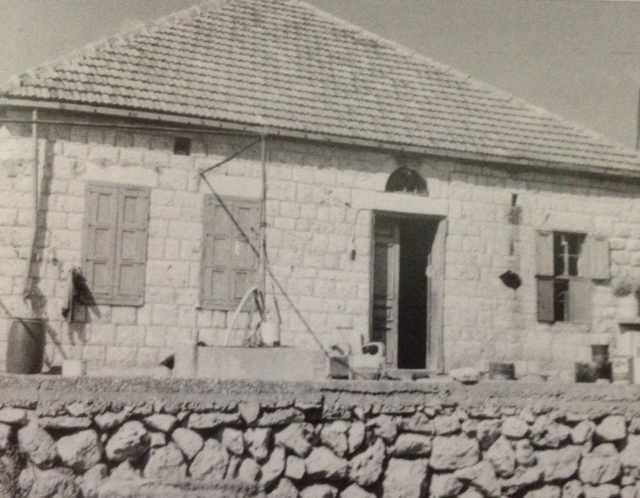
Zad Assaf's house in Kfarmishki.

As time went by and the ship didn’t move, their minds started racing and thinking about what the crew could be hiding from them. Some had started to think about the possibility that the ship might be sinking. Suddenly, one of the passengers shouted that the ship is sinking fast. That was then the chaos began and people started running frantically to the deck of the ship, not caring how they got there as long as they did.

Zad said her mind went numb. The only thing she was able to think about back then was to get to the deck where first class passengers had already been. She got to there with a man from her hometown named Elias Tannous Nasrallah, a 22 year old who had left his wife in Kfarmishki. He was going to Ontario to provide for her. As he neared the rescue boats, Elias tried to reason with an officer there to let him on. The officer wouldn’t let him. The chaos that ensued and Elias still pleading for his life got the officer to hold his gun at Elias and shoot him in the chest, killing him instantly, saying: women and children go first.

Shocked by what happened to Elias, Zad froze in her spot. She couldn’t move. The shock of the ship sinking was just made worse by seeing the man from her hometown murdered right in front of her. Without her being aware of it, a navy officer pushed her into a boat full of women and a few men. The boat was then lowered to the water and the men started rowing away as the ocean engulfed Titanic.

Some of the survivors had said the music band kept playing until the very last moments. Zad wasn’t aware of that. She was still in shock. She was among the last people to be lowered off the ship, an hour and thirty minutes after impact. Stranded at sea, they stayed there for hours, freezing in the cold. Six hours after leaving Titanic, the ship Carpathia came to their rescue. The only thing she was able to remember was them offering her warm clothes.

Once she got to New York, she was admitted to the hospital for observation. Once discharged, people from the area helped her get to Ontario where she met her husband. Her sons soon followed her. One of them later on went to Sao Paolo where he lived to be over 105 years old.

Elias Nasrallah’s wife got remarried in Kfarmishki after getting the news that her husband has passed away.

Stay tuned for part 4 tomorrow.

Stories of Lebanese on the Titanic – Part 2: The People of Hardin

For Part 1, click here.

Hardin is a town in the mountainous region of the Batroun caza, famous for St. Neaamtallah who is famous for his hometown and who made his hometown famous. During 1912, Hardin had 19 people on board of the Titanic. Only 7 of those made it, including a man, two children, an infant and three women.

One of those who survived, named Sileneh Dagher, was a newly wed who was traveling to the United States with her husband, Antoun Yazbeck. Their cabin was close to the water line of the ship so the collision was especially frightening for them. They went out into the hallway to see what was happening. Once they realized the gravity of the situation, they started moving towards the main deck. But many of the passageways, especially those that went through first class areas, were sealed off by passengers for fear of theft. Once they reached the deck, Sileneh and her husband both got into a rescue boat. But an officer held a gun to Antoun’s head and forced him to relinquish his seat, convincing Sileneh that her husband would follow her on another boat. That was the last time she saw him. She later on remarried and changed her name to Celine. She gave birth to 9 children and raised them before dying at the age of 69 on March 10th, 1966.

Sileneh Dagher remarried

Sileneh with her family

The only man from Hardin who survived did so because a foreign woman pitied him and got him to hide under her dress. The man in question, Moubarak Assi, was the deacon of Patriarch Elias Howayek, who’s currently laid to rest in the convent he built in my hometown. Assi went on to start a family and a business in Michigan. He died on February 3rd, 1952.

Mr. Moubarak Assi

Sileneh Dagher wrote to her brother, the former mekhtar of Hardin, about what she went through aboard the Titanic. She spoke about how cruel the officers were to the men who tried to get on the rescue boats. She spoke about how the men of Hardin who knew they wouldn’t be rescued knelt in their last moments and prayed to the Saint of Hardin.

Another story that came from Hardin is the story of Hanna Touma, a man who was in love with a girl from his hometown called Zahiyya Khalil. Both decided to travel to the United States to start a better life but Zahiyya’s parents refused for them to leave without getting married so they tied the knot hours before leaving Lebanon. Aboard the Titanic, a wedding party was thrown for the newlywed the night Titanic hit the iceberg. Once the news of the collision reached them, they continued their wedding party as if nothing happened. Later on, when death was looming, Zahiyya refused to leave her husband’s side despite the officers begging her to. And so they held to each other tight and bid farewell to their lives.

The people of Hardin clinged to their Lebanese heritage until the last moment. According to Moubarak Assi, as his rescue boat was being lowered off the ship, he saw the men of his hometown huddle around each other. Then one of them shouted: “Dabke ya chabeb!” And they faced death with a Lebanese dance, knowing they won’t be saved.

The zajal for the occasion that went on to commemorate the loss went as follows:

ابكي ونوحي يا حردين…..عالشباب الغرقانين
غرق منك حدعشر شاب….. بسن الخمسة وعشرين
منهم سبعة عزابي…..والبقية مزوجين
ما فيهم واحد شايب….. كلن بالخمس وعشرين

Cry and weep, Hardin for your men who drowned.

You lost 11 young men, aged 25.

7 of them are single, the rest are married.

None of them have gray hair, all were 25.

Stories of Lebanese on the Titanic – Part 1: Daher Abi Chedid from Ebrine

I’ve had these stories in mind for a while now, waiting for the week of the centennial anniversary of the Titanic sinking to post them. And I figured the best way to start is with the story from my very own hometown, Ebrine in North Lebanon.

Daher Abi Chedid happens to be the uncle of my cousins’ grandfather. My neighbor, the former mekhtar of my hometown, was eight year old at the time of the story’s events. Both of these men, now deceased, told anyone who’d hear the story of the man they knew, like no news service can now tell you.

Daher was a young man, very well-built and extremely tall. He was one of the people strong enough in my hometown to be called for building duties. This was 1912 – everything being built at the time required manpower. Daher Abi Chedid had it.

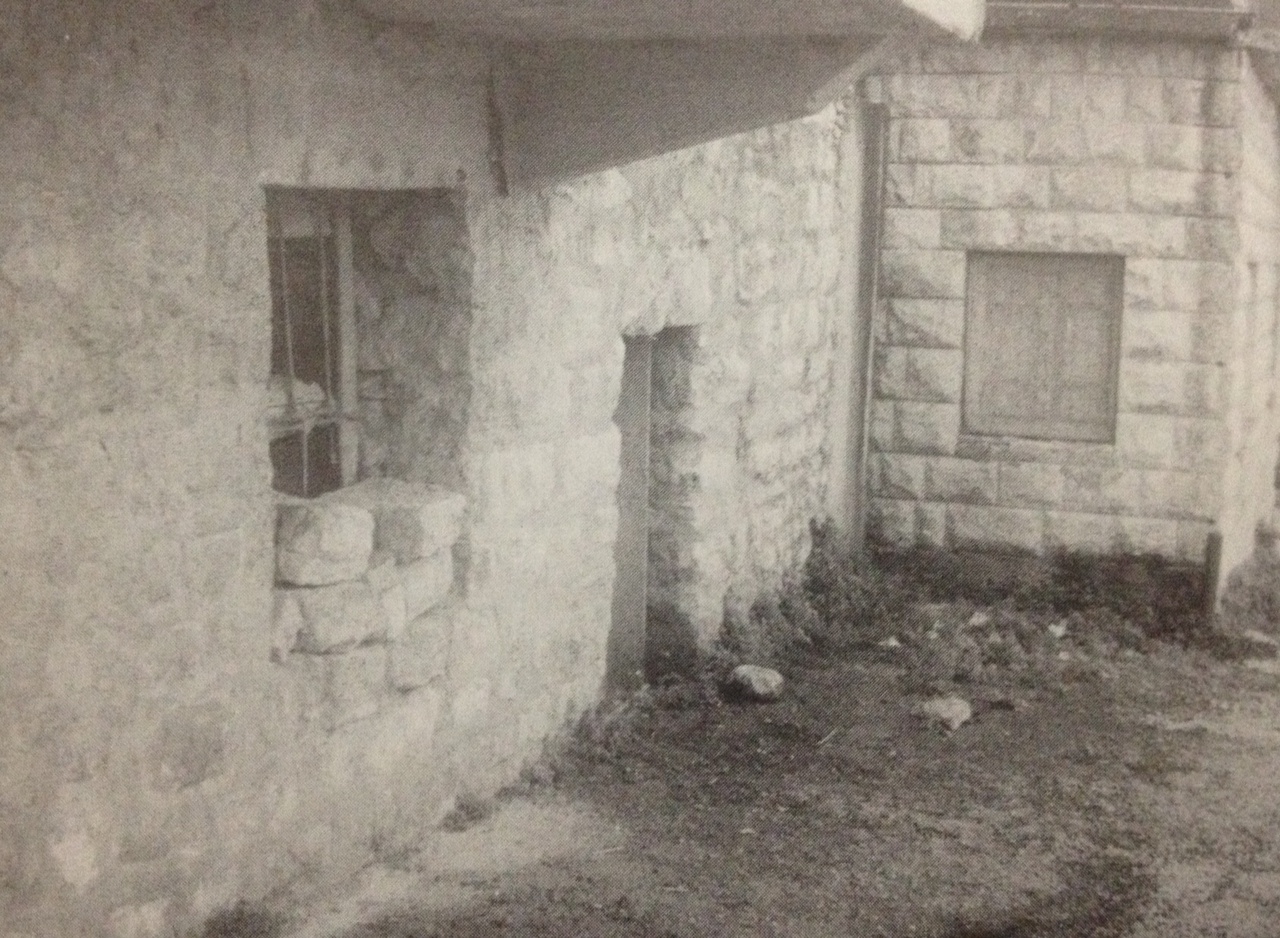
On one day in late March 1912, students of my hometown’s school heard a single gunshot and ran out of class, panicking. The sound had emanated from the basement of the Nakad family house, fairly close to the school and my hometown’s church – St. John the Baptist.

The Nakad basement

What had happened was the following: Daher Abi Chedid was in love with a girl named Marroun Sejaan. As the two were sitting together in the basement, Daher took a Martini rifle and pointed it as Marroun, asking her jokingly if she was in love with a guy named Maroun. She replied: I swear on the Virgin Mary that it’s not true. So he jokingly asked: “Do I shoot you?” Both had thought the rifle wasn’t loaded. Its tip was also corroded. Marroun replied with a yes. Daher pulled the trigger and the rifle fired, hitting Marroun in the neck and killing her immediately.

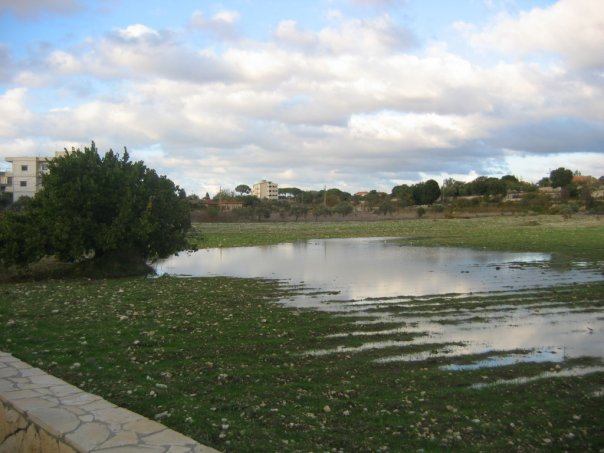
Once the people from nearby premises got to the location of the shooting and found Marroun dead, blood pouring out of her neck, no one dared to approach her as they waited for the Ottoman police officers to arrive. News of the shooting spread like wildfire around the area and Marroun’s cousin came from Batroun with a vengeful attitude towards Daher Abi Chedid who couldn’t but seek a hiding place at a relative’s place until he could sort out his affairs. At one point, the Ottoman policemen were close to rounding him up so he sought hiding in what we call the “Meghre2” today – a vast piece of land that fills with water during the winter, turning it into a big lake.

The meghre2 in late spring.

So Daher’s uncle, working with Daher’s mother in the United States, and through his connections with the Ottoman authorities, managed to get a boat for Daher readied at the port in Selaata, which then took Daher to Cyprus then to Cherbourg in France then to the Titanic.

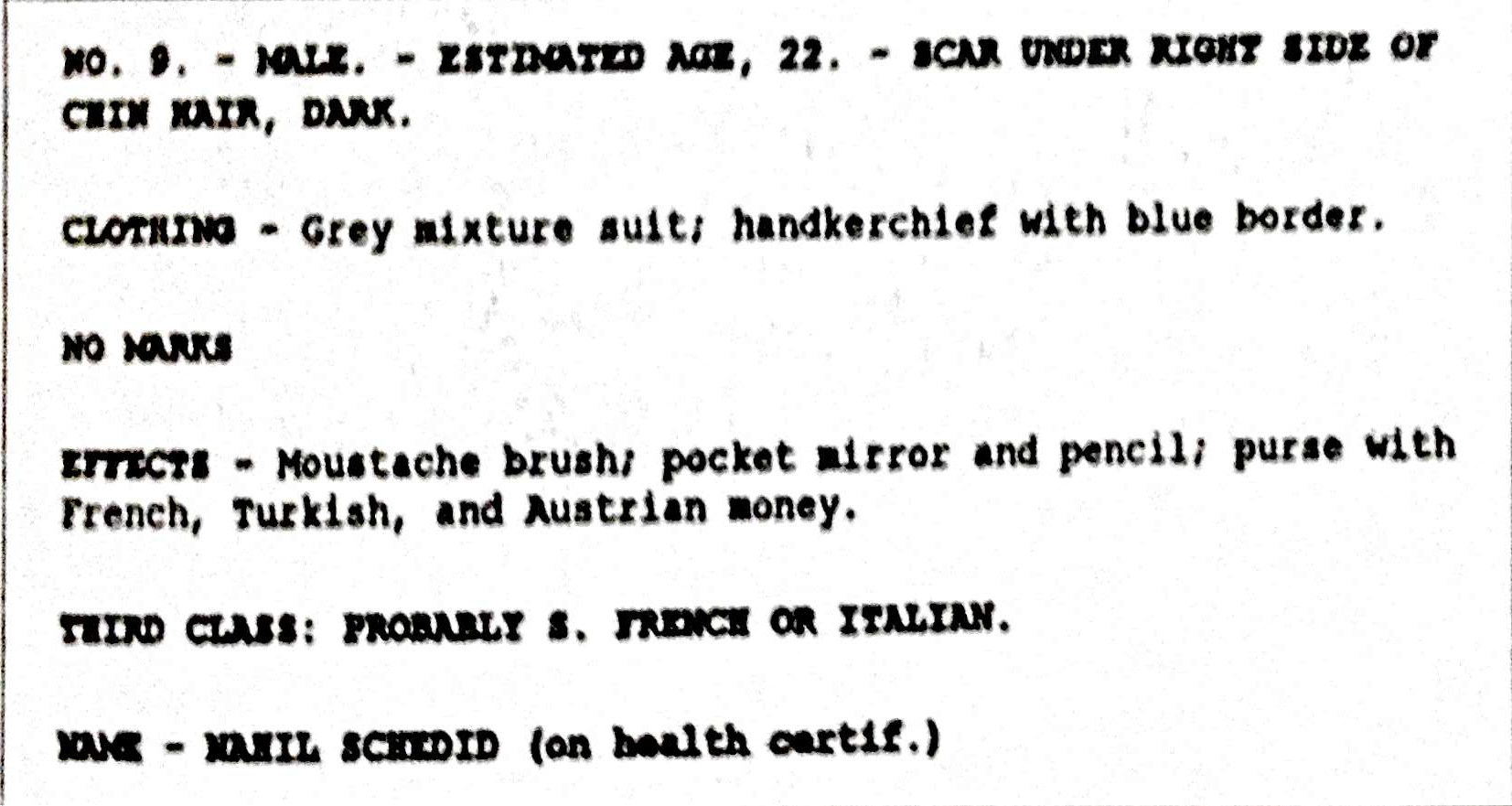
Daher Abi Chedid was not shot dead by the security personnel on the Titanic. He jumped off the ship and swam for more than an hour, trying to save himself, before he got to an ice mass and froze to death on it.

His body was recovered by the boat MackayBennett. It was sent to Halifax in Nova Scotia first then to Mount Carmel in Pennsylvania where Abi Chedid was laid to rest on May 4th 1912. The following description was given for the body:


As the poets and singers of traditional Lebanese zajal competed to describe the heroics of the Lebanese aboard the Titanic, the poetic rhyme was as follows:

غرق تنعشر شب من حردين

وزينتهم ضاهر شديد من عبرين

Twelve young men from Hardin drowned

But their crème de la crème was Daher Chedid from Ebrine.


Stay tuned for another Lebanese story tomorrow.

Lebanese iPhone Users: How To Get AT&T To Unlock It

This works for any iPhone 4, iPhone 3GS, iPhone 3G and original iPhone purchased for full-retail price from the US and it’s locked to AT&T, using hacks to make it work in Lebanon.

I currently have the iPhone 4S, which I got factory unlocked. However, I went through every iPhone update except the 3G so the first one I got, the original iPhone, was locked to AT&T and I managed to get an unlock process opened for it today going through the following route.

1 – Write down the phone’s IMEI number.

2 – Download the application “Vonage” on any smartphone that has it. This is an app that will allow you to call US numbers for free. You can get the iOS version here.

3 – Call the following AT&T number using Vonage: +18003310500 – wait for the operator to finish talking then press 1. When it starts talking again, press 0 immediately so you don’t go through the whole list and it will connect you to a customer care representative. Your waiting time shouldn’t be long. For me, it was less than a minute.

4 – The first thing the representative will ask of you is for your AT&T number. Tell them you don’t have have an AT&T contract and that you heard about the iPhone unlocks and would like to unlock your contract-free iPhone, which you bought for full retail price.

5 – At that point, they will take your name, last name, email address and ask you for a phone number. Let them know that you are currently outside of the United States so you prefer to be contacted via email, and make sure they spell out the email for you. However, they’re going to require a phone number to open a case for you so give them your Lebanese phone number in the following format: 961xxxxxxx .

6 – Then they will ask you for the IMEI number. Make sure you have it on you and read it to them. They will repeat it for you. Make sure they have it correctly. A one digit difference can mess things up.

7 – Soon after, they will put you on hold for a few minutes as they check the information you gave them. If all checks out, which it should, they will give you a case number. Make sure you have a paper and pen at your disposal to write it down. Then read it back to them to make sure you have it correctly.

8 – You’re done. Once you’re given a case number, it means your request has to go through the motions of reaching Apple and them sending you the unlock code. I was given a delay till April 17th but I expect to have my original iPhone unlocked sooner.

The whole process took about 20 minutes to finish. It’s pretty streamlined and straightforward. Don’t panic about your English – the customer care representative I spoke to was not American and my English was better than him. Make sure you have all the info you need prepped and you’re good to go.

Just an extra hint, American customer service is actually quite awesome. They care about their customers’ well-being, unlike many Lebanese companies. So be truthful, meaning don’t go all Lebanese-7arboo2 on them, and they’ll be more than glad to help you.

Hope this was of help.