Lebanon Described in 1982

I’m currently reading the book “From Beirut to Jerusalem” by Thomas Friedman, in which he tells parts of his stay in Beirut between 1979 and 1984, as our civil war raged on.
While some parts so far are not entirely correct or too autobiographical to be generalized, the read is very interesting to say the least.

The excerpt I’m quoting is the most interesting part of the book so far. What rang true in 1982 still resonates today – and Friedman has to be commended for having the mind to see it, especially as an American Jewish outsider whose stay in Beirut was nothing more than an experiment.

“The real problem with the Lebanese today is that they have gotten too good at this adapting game—so good that their cure and their disease have become one and the same. The Lebanese individual traditionally derived his social identity and psychological support from his primordial affiliations—family, neighborhood, or religious community, but rarely from the nation as a whole. He was always a Druse, a Maronite, or a Sunni before he was a Lebanese; and he was always a member of the Arslan or Jumblat Druse clans before he was a Druse, or a member of the Gemayel or Franjieh Maronite clans before he was a Maronite. The civil war and the Israeli invasion only reinforced this trend, dividing Lebanese into tighter-knit micro-families, or village and religious communities, but pulling them farther apart as a nation”

This goes well with a previous description from over 140 years ago. Some things look like they’ll never change.

Muslim Prayers At USJ

Everyone should be able to express their conviction in the right place at the right time. This is a conviction of mine. The right place and the right time may vary depending on where you stand regarding an issue but sometimes things are very clear cut and a stance needs to be taken.

A few months ago, the Antonine university had a tough situation with Muslims students who were adamant about praying at their university, which happened to be a Maronite Monastery, so they took the convent’s courtyard to do so. This sparked a debate in the country: should these students be allowed to pray or not at universities with obvious religious affiliations?

The point of view that I expressed back then and which I still stand by is the following: If a Muslim student (or a Christian student for that matter) believes it’s of utmost importance for him/her to pray, then that should go into their university selection criteria. If that student deems prayer not important enough and believes that getting the best education that can be provided, regardless of the university’s religious affiliation, is the way you to go, then that student doesn’t have the right to complain later on.

Université St. Joseph (USJ) had a similar incidence yesterday where more than twenty Muslim students decided to gather around and take a room without permission in order to pray. The incident was reported to the dean who rounded up the students only to have the situation swell by attracting more students to the place where the prayers were taking place. Some took the job of acting as guard to let the prayers continue.

The situation escalated to the maximum point without a confrontation happening and the incident has sparked some Christians at USJ to express outrage at what was happening. They believe that including a prayer room in the faculty of medicine was good enough – forcing every single faculty to adopt such policies is a step too far. The faculty in question was ESIB. For the Muslims who want to pray at USJ, it is their “right” to pray five times and they believe the university should provide them with a prayer room to do so.

It seems that such endless debates are our bread as Lebanese. But here’s what it breaks down into quite simply.

  1. USJ is a university that is obviously Christian. It is run by the Jesuites. It doesn’t hide its Christian affiliation and as such, those applying to study in it are well aware of that.
  2. Given that the nature of USJ is a general fact, weren’t those Muslim fully aware that attending USJ will bring them the best education possible and not spiritual fulfillment?
  3. When a prayer turns into proving a “principle” and rubbing it into other people’s faces, the question asks itself: what’s the point of praying in the first place?
  4. When a prayer becomes a point of conflict, the question also asks itself: are those students really seeking religious salvation or are they simply seeking trouble? I believe it’s obviously the latter.
  5. What forces universities with obvious religious affiliations to provide praying facilities for all its students? Is it something that they’re obliged to do? Absolutely not. If a university had been secular, the problem wouldn’t present itself. The American University of Beirut converted its chapel into an assembly hall and has denied requests for prayers rooms. AUB is secular. USJ is not.
  6. Universities abroad, which provide prayer rooms for students, are not religious in nature. And if the prayer rooms are provided, they are not for one religion and not the other – they are for all religions. Religious ones, on the other hand, are not forced to do so: Case in point: the Catholic Medicine faculty in Lille, France, does not provide prayer rooms for its Muslim students.
  7. Would a Lebanese Muslim university open a chapel for Christians to pray in it? The answer is obviously not. The argument that Christians don’t need to pray doesn’t hold. What if they want to?

Lebanese students in general, both Christian and Muslim, need to know that universities are not churches. They are not mosques. They are not synagogues. Universities are places where they pay in order to learn and build a future for themselves and their families. The fact that all of my Muslim friends at medical school, some of whom are extremely religious (they are Salafists and awesome), have no problem going through our long days without praying is testament enough that those “Muslims” wanting to “pray” at USJ are only seeking to create trouble and tension at a university that’s known of accepting people from all parts of Lebanese society, regardless of religion. But there are lines you cannot cross.

Nadine Labaki’s New Movie: Where Do We Go Now (W Halla2 Lawein) – Review

Lebanese cinematic talent has not been given much room to grow. In a country where art is the least concern, cinema has found it especially hard to take off. However, a stream of Lebanese movies has been finding its way to our theaters. Some like Nadine Labaki’s previous movie, Caramel, were a huge hit with viewers. Others were not as lucky.

But the fact remains that the Lebanese audience is hungry for movies that describe its society, its problems, its worries and woes.

And then comes Nadine Labaki’s new movie: Where Do We Go Now, with its Lebanese title: W Halla2 La wein (also in French: Et Maintenant, On Va Ou?)

The premise of the movie is quite simple – and for many Lebanese, worry-inducing for fear of overuse of cliches. The overall basis of the plot is the coexistence of Lebanese Muslims and Christians in one community, sometimes peacefully and other times not. Many, like yours truly, felt the issue was overdone. Maybe not in cinema but in everyday life. Most of us are sick of being bombarded with commentary about the struggles that face our very diverse community. But this is not the case in Where Do We Go Now.

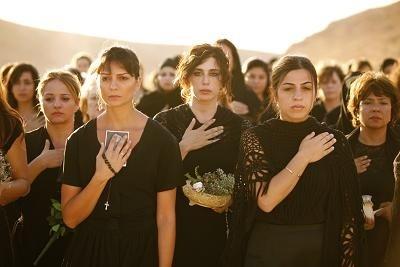
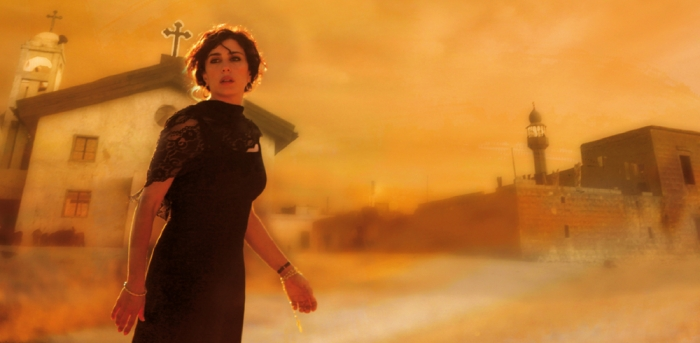
An unnamed village during the later part of the 20th century has its only connection with the outside world in the form of a very rudimentary bridge, around which landmines had been planted and never removed. Even TV reception is very poor to the village and the movie begins with a few youngsters searching for a broadcast signal to set up a TV night for the town-folks. This village is also a religiously divided community where the Church and the Mosque are only a house apart. And more often than not, the people live together happily.

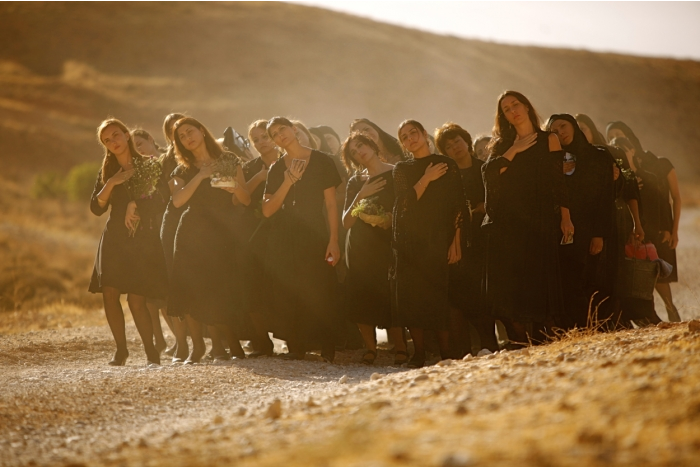
But as it is, and despite barely having any access to news from the outside world, the men of this village start to confront each other in violent ways. Little things that would pass unnoticed cause them to explode, signaling the anger they’ve been bottling in. And it is then that the few women of the village start to devise plots to keep the men busy, entertained and get their minds off being violent. These plans will vary from fake miracles to putting hashish in cakes. But these women will go to every measure possible and break every limit imposed on them by society to keep their town together. And it is for these women, representing a vast majority of our Lebanese mothers, that this movie is so aptly dedicated.

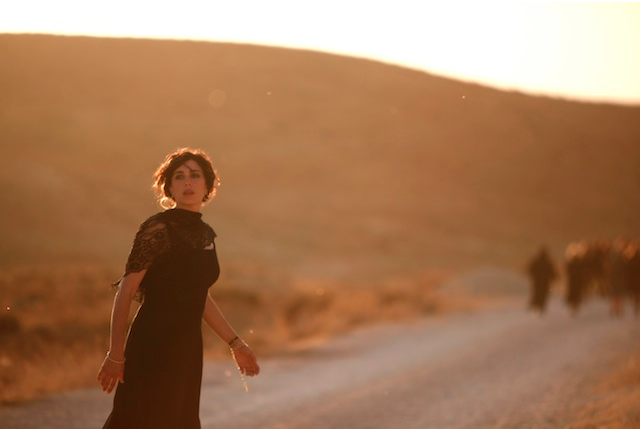
Nadine Labaki, director of the movie and starring as Amal, is astonishing as always. You, really, cannot see her eyes on screen and not be mesmerized. She’s simply entrancing, even when she doesn’t speak. Then how about when she delivers a tour de force performance as one of those women, who happens to be in love with a man from the town’s other religion. But to be perfectly honest, the accolades one ought to give Labaki are not for her acting but for her directing. Never have I imagined a Lebanese movie can turn out this good and she makes it seem effortless. Her camera shots, her focus on details, her keen eye… all of this combine to give you a cinematic experience that will entrance you.

This movie, like Caramel, features mostly unknown faces and all of them deliver as well. It is hard to believe – and yet in retrospect so evident – that such acting can come out of common people that we all meet on the street. Where Do We Go Now is a movie of such epic proportions that these “unknown” actors and actresses (mostly actresses) deliver performances that are so subtly nuanced, so exquisitely flavored and so astonishingly well-done that they would put the best actresses and actors of Hollywood to shame. Yes, I have said it.

The score of the movie is chilling and haunting and wonderfully executed by Nadine’s husband Khaled Mouzanar. The movie also features a few highly intelligent songs, written by Tania Saleh.

And let’s talk about the script. What an ingenious way to tackle the subject at hand. Not only did Nadine Labaki not fall to any cliche known to us as a Lebanese community, but she managed to introduce them in a subtle comical way that would make us laugh at ourselves for uttering or doing them in the first place. The script is so strong it will turn you bipolar. Yes, lithium is advised to be taken at the door while going in. Why? Never have I laughed so hysterically one moment and just wanted to cry the other. And then after being utterly devastated, it brings you back to laughter. The movie plays with you like a ping pong ball. And you cannot but love every moment of it.

I was talking to my friend Elia the day before we went to watch Where Do We Go Now, which happened to be the day it won the People’s Choice Award at the Toronto Film Festival, and she said: “Elie, I’m very cautiously optimistic about this. I’m not letting my expectations overreach because I don’t want to be disappointed.” Well, I’m pretty sure Elia agrees with me on this: Where Do We Go Now brings out things in you that you didn’t even know you had. It brings out the best in you, as a Lebanese, sitting in that cinema chair for ninety minutes. And you need the best of the best to do that. Nadine Labaki, you deserve more than the few minutes of applause the people in the movie theater gave you. You deserve a full blown standing ovation. You have done the impossible. Again. Lebanese cinema has no excuse but to overreach for excellence now. And this movie deserves an Oscar win. Cheers to our mothers.

Where Do We Go Now? – New Nadine Labaki Lebanese Movie

Brilliant Lebanese director/actress Nadine Labaki is set to debut her new movie, Where Do We Go Now? (و هلّأ لوين؟) at Cannes this week. And it is starting off to good reviews.

After the 2007 hit Caramel, Labaki returns with another movie she’s directing. Set in a religiously mixed village, the movie is about a group of people trying to preserve their town in the midst of inter-religious tension. The town’s location is never mentioned, probably wanting to make the movie apply to anywhere in the Middle East where you have diversity.

Labaki has said about the movie, “It’s not a story about war; on the contrary, it’s about how to avoid war. You can’t live in Lebanon without feeling this threat, which ends up coloring what we do and our ways of expression.”

I think the topic looks like a typical Lebanese storyline, sort of like Caramel, which should make the movie quite relatable. And after all, Nadine Labaki is a very good director so I believe she will pull it off. Will this be as big as Caramel, I guess we’ll just have to wait and see.

Check out a scene from the movie:

Check out my review of Where Do We Go Now.

The Church Explosion Derivation

On Sunday morning, an explosion rocked the Syriac church of Saydit Al Najat (Our Lady of Salvation) in Zahle. Every Lebanese official denounced the explosion, naturally, as a barbaric act, against the “example” of coexistence that is Lebanon, bla bla bla.

Now let us start our derivation of who is responsible for this attack.

Naturally, it can’t be a non-Lebanese because most Lebanese barely know of the existence of the targeted sect, let alone those who are foreigners and don’t know Lebanon has Maronites or any other major Christian sect to begin with.

Now that the non-Lebanese people have been taken out of the equation, this leaves us with those who hold the beloved and cherished citizenship. Of those, say 50% are Muslims and 50% are Christians. Now since we’d like to be optimistic, let us assume that our fellow Muslims would not do such a thing because it would break this example of coexistence.

Of the remaining 50% of Christians, no one would act except upon an act issued by their correspondent political leader. You have a bunch of irrelevant leaders who can’t get their followers to hurt a fly and then you have the big quartet.

Michel Aoun was probably still sleeping, long dreaming about him being Lebanon’s president, a dream that doesn’t seem to let him go. Add to that the fact that his supporters don’t know what a bomb is and you rule him out of the equation as well.

Sleiman Frangieh’s followers know very well what a bomb is. But Zahle is just too far away from his radar that you can’t make him a serious contender for the top prize. Add to it him being clueless most of the time and you definitely take his name off the list.

Amin Gemayel was still probably mourning his son. Or in the midst of the conversation that started on Friday evening. Either way, I don’t see him as someone who would issue the bombing as well.

Samir Geagea, however, *evil smile*, this man can definitely blow up a church. I mean, out of the whole bunch of politicians today, he is the only criminal, right? And he has blown up a church before. Granted, he was exonerated, but he did blow it up, no? His party is also made up of a bunch of high school dropouts who don’t know how to write their names, so naturally, they know how to handle bombs. Also, as a wise person from Bsharri would say: If Geagea thinks a church needs to be blown up, then the church needs to be blown up.

Meanwhile, the seven Estonians are still missing. Telecom minister Charbel Nahas is still in his cat-fight with Ogero CEO, Abdel Menhem, and the country is more prosperous than ever. Some Lebanese stupidheads took the headlines with their pro-Syria protests… why would anyone care about a silly Church getting blown up?

PS: In case you didn’t notice, let me hashtag it for you: #sarcasm.