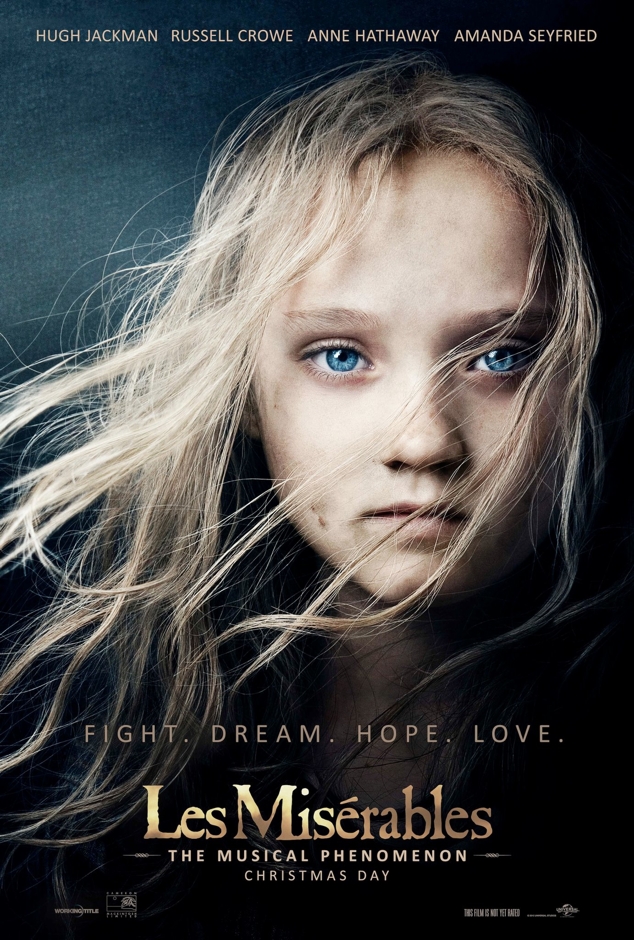
Les Misérables [2012] – Movie Review

les-miserables-movie-poster

As a person who grew up and went through a French curriculum with Victor Hugo’s novel as its centerpiece at many points, I’ve grown attached to the essence of the novel. I’ve also grown to understand it, know what it contains, understand the message that Hugo wanted to pass on. I’d even joke and say the novel’s impressive spine is a byproduct of Hugo being French – a lot of blabbing for nothing. I’ve taken some of that, as is evident by my wordy blogposts at times. This review will surely turn into one so just skip to the last paragraph if you don’t feel like reading.

My knowledge of Victor Hugo’s most famous 1500-pages novel has led me to conclude that it’s very difficult to turn it into a motion picture. If the previous attempts at this novel weren’t enough proof, Tom Hooper’s take on Les Misérables adds to the growing list of not-nearly-there trials.

The story is known for everyone by now. Jean Valjean (Hugh Jackman) is a French man living around the time of the French revolution and is forced to steal a loaf of bread to save a relative’s life. He is subsequently thrown in jail for 19 years at the end of which he’s released on parole. Valjean, however, breaks his parole and ends up making a decent life for himself as the mayor of a small French town in Northern France called Montreuil-sur-Mer. But Javert (Russell Crowe), the prison warden who was in charge of Valjean, appears back in his life during a visit to the factory run by Valjean, now working under a new name. In that factory works a single mother called Fantine (Anne Hathaway) who gets sacked from her job when her secret of having had a child out of wedlock, Cosette (eventually played by Amanda Seyfried), is discovered. Fantine eventually succumbs to becoming a prostitute and is saved by Valjean who promises to take care of her daughter as he runs away from Javert who’d do anything to catch him, to the backdrop of a growing revolution in the streets of the French youth.

Tom Hooper’s Les Misérables is a full-blown musical. No, it’s not a musical in the sense of a talking movie with a few songs interspersed here and there. It’s a musical in the sense of three hours non-stop singing where even “thank you”s are sung, where reading letters becomes melodic and where, if you’re not a fan of musicals to begin with or not entirely sure what you’re getting yourself into, you’d end up wanting to pull your own hair out. Yes, this version of Les Misérables is definitely not for everyone. Even if you love – scratch that – adore music, Les Misérables might prove a very tough pill to swallow. And at times it really, really is.

Hugh Jackman, who can sing, ends up grating around the 120th minute mark. Russell Crowe on the other hand entirely sheds his Gladiator image for a singing Javert and with his not-so-pleasant singing voice ends up entirely intolerable a few minutes in. Russell Crowe even looks entirely uncomfortable to be there and it reflects on his character, making Javert – a central figure to the story – comical at times. Hugh Jackman has to be commanded for a job well done as Valjean. Few actors can say they can deliver performances as he did with the close-ups he got throughout the movie.

In fact, the actors and actresses in Tom Hooper’s Les Misérables all performed their songs in the movie live. While a piano played in the background to guide them, they acted their songs instead of recording them months in advance and eventually lip-synching them to film.

The single acting performance in the movie that will absolutely blow your socks off is Anne Hathaway, who’s probably aided by the fact that her character isn’t there for long. Hathaway, as Fantine, is brilliant. She deserves all the praise she’s been getting. Her performance of the Susan-Boyle-made-famous song “I Dreamed A Dream” is gut-wrenchingly stunning. She brings the life into her character and gives Fantine a richness which other actors in this movie with more running time couldn’t bestow upon theirs. Hathaway steals every scene she’s in and ends up being the only reason you might walk out of this movie feeling like you hadn’t wasted three hours of your live. Just to watch her do what she does so beautifully. No one is raining on Hathaway’s parade come Award-season time.

Interesting casting choice include Samantha Barks as Eponine, the daughter of the Thénardiers, played by Helena Bonham Carter and Sasha Baron Cohen whose only purpose was to add some comic relief to some tense moments. Barks sings her songs really well and gets you to relate to her character, despite the background. She delivers a nice rendition of “On My Own.”

Les Misérables does have its strong moments, notably the opening scene, Hathaway’s minutes and the ending, but the movie accumulates a lot of off-moments as well that make the result very lopsided. The movie is also extremely long. Thirty minutes (of wailing – singing) could have easily been cut with the story not be affected because few of those songs tell us more about the character and its story, an example being I Dreamed A Dream in which Fantine tells the story of how she reached the misery she was in. The overall result is a movie that feels very in limbo: okay, not great, this is awesome, this is horrible, goosebumps, kill me now. These are all things you will feel while watching Les Misérables.

3.5/5 – – new rating system.

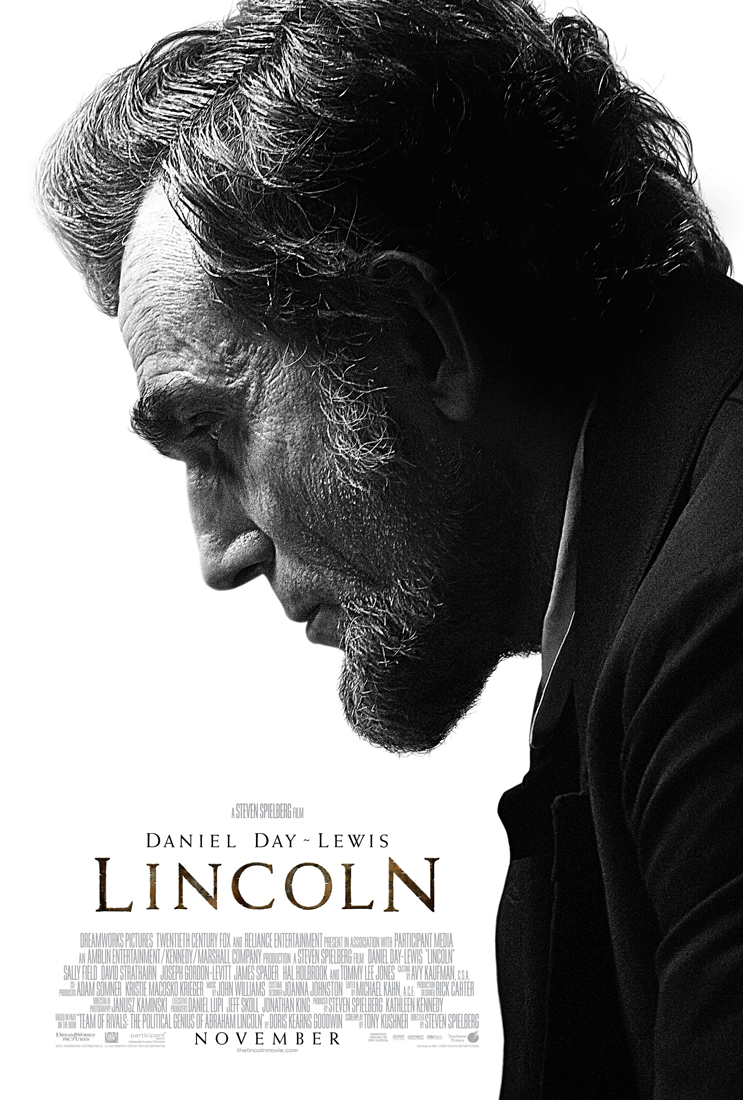
Lincoln [2012] – Movie Review

Lincoln Movie Poster

Steven Spielberg’s new movie, Lincoln, is the American Civil War-era story of the United States’ 16th president on his quest to get Congress to pass the 13th amendment to the constitution, effectively ending slavery, something he wants done before his inauguration ceremony for the second term which he had just won. In order to do this, he must gather a 2/3 majority in the House of Representatives – one that goes beyond the 56% majority that his Republican party held and into Democrat territory, a party that is staunchly against such a thing.

Lincoln is Spielberg’s best movie in a long time, something that is definitely helped by the fact that the director has been fascinated by Abraham Lincoln since he was a little boy. In this highly dignified portrait of the late American president, you are invited to delve into a world of charged polarizing politics on a story with an undertone of liberty and humanity. The movie can be divided into two halves: A strong first half sets the tone – the era, the characters, the entire situation and its framework.  The even stronger second half shows how the wheels set forth in the first half play out.

The true gem of Lincoln and what helps elevate this movie into a masterpiece is Daniel Day Lewis who incarnates the character he’s portraying to the letter – from the mannerism, to the tone. Lewis’ subtle, engaging, deep and highly emotional performance is one for the ages. His portrayal of the late American president is spot on in every sense. It never wavers, never falters, never drops from the standard that is set with the movie’s opening scene down to the last frame. He adds a sense of humanity to the commander in chief: a man who tells stories, laughs at his own jokes, cares deeply for his family. This sense of humanity gives the character an entirely new dimension.

Daniel Day Lewis is helped as well by chilling performances by Sally Fields and Tommy Lee Jones. Fields plays Mary Todd Lincoln. As a mother, she’s afraid for the life of the sons she still has and as wife, she’s growing more distant by her husband’s coldness towards her after the death of a child that she blames on him.

Tommy Lee Jones plays Thaddeus Stevens, a “Radical Republican” congressman whose goal in life is to establish equality between America’s black and white populations.  Jones is the only character in this movie that knows, deep down, that blacks are equal to whites in every way. The hurt that his character has to go through as he’s forced to tone down his convictions is passed on convincingly in a multi-layered and highly engaging performance.

However, not all acting performances in Lincoln are as great. Joseph Gordon Levitt, for instance, as Lincoln’s oldest son who wants to enroll in the army but is forbidden by his protective parents never quite finds his footing, causing the father/president-son story arc to falter and be less compelling than it could actually be. The father-son story that is interesting, however, is Lincoln’s relationship with his younger son Tad, played by Gulliver McGrath, as a young boy who wants his father to curl up next to him besides the fireplace and look at portraits of slaves who should be freed.

Tony Kushner, who wrote the screenplay for Lincoln, did a great job at turning a mostly dialogue-driven movie into something that doesn’t drag on and, despite the extensive running time, doesn’t feel overstuffed. His take on the story is very focused and specific which in itself is a very good thing if you’re familiar with the history behind the movie, which I believe every American viewer is and should be. In a way, it is the screenplay that sets Spielberg in a certain framework that helps him not turn the movie into an overly melodramatic mess but to give it a documentary grit. However, many non-American cinema enthusiasts, who will end up watching Lincoln because of the attention it’s garnering, might end up being overwhelmed by the details causing them to care less about the story which should be front and center and seek entertainment in the acting performances that I’ve previously mentioned or other attributes that I will mention subsequently.

What helps Daniel Day Lewis in his Lincoln incarnation is a stunning make-up work that transforms the actor’s face into that of the late president’s identical twin. In fact, Lincoln is bolstered by a technical team that spans from the aforementioned makeup to the cinematography to the sound mixing to the art direction. Almost every aspect of this movie is taken care of in a way to ensure authenticity.

Lincoln is a highly engaging and entertaining film, one that stops being a historical portrayal and becomes a character study of what many Americans believe is one of their best presidents. By becoming a character study, Lincoln also becomes a movie about politics which are the wheels that get the movie rolling: how these characters interact to make legislation, how these characters use each other’s flaws in order to advance their agendas, how this presidential character so deeply believes in the sanctity of freedom, how this presidential character wants peace for his nation and for himself.

If I were an American, I’d be proud to have a movie such as Lincoln portray one of my presidents.

9/10


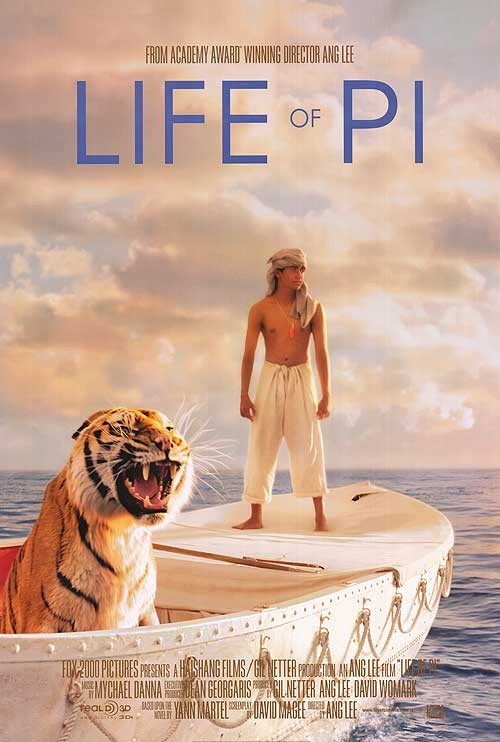
Life of Pi [2012] – Movie Review

Life of Pi movie poster

Ang Lee’s new movie, Life of Pi, is a take on a supposedly unfilmable book about a young Indian boy named Piscine Molitor Patel – Pi for short. Born in French India, Pi lived in a zoo run by his parents. Growing up, he experiments with different faiths and religions so he became Hindu, Christian and Muslim. The tough situation in India forces Pi’s family to relocate to Canada. They pack their animals and board a Japanese ship which sinks over the Mariana Trench, a few days off the coast of the Philippines leaving Pi stranded on a boat with a hyena, a zebra, an orangutang and a Bengali tiger called Richard Parker with nothing but a strong will to survive to help him.

Life of Pi is visually stunning, be it from Lee’s supreme camera work and keen attention to detail to the expert cinematography work, apparent through the extremely diverse color palette that’s accurately conveyed on screen. The 3D employed here gives a depth to the movie that few other 3D movies can boast about. In a way, the 3D helps in situating all characters involved in the restricted space they’re given: the tiger on a boat, Pi on a raft – and the Pacific ocean all around them.

The CGI imagery of ocean creatures is so believable that it becomes nothing short of magic, especially in scenes of nightly luminescence. Even the tiger Richard Parker is the work of a computer. The effect is extraordinary.

Mychael Danna’s score cannot be ignored as well. It infuses itself in the scenes it accompanies quite well. It’s a soothing, enchanting and entrancing musical body that serves as a fitting auditory counterpart to Life of Pi‘s visual mastery.

But Life of Pi can’t be simplified only by its visual aspect, Ang Lee’s camera, Claudio Miranda’s cinematography or Mychael Danna’s music. The movie’s inherent and main theme about faith is what the movie’s all about. But it’s conveyed in subtle ways so it doesn’t come off as preachy. It doesn’t come off as a “you need to believe in God ASAP” PSA – on the contrary, the metaphors the movie employs are left for the viewer to interpret.

Suraj Sharma, an inexperienced newcomer, does a great job at portraying Pi’s struggles, his life and his soul while a serene middle-aged Pi, Irfan Khan, narrates the story to a Canadian author portrayed by Rafe Spall.

Life of Pi‘s main problem, however, is that it invites you to so many things that at the end it leaves you with no clue as to what to make of it. The imagery may be the best thing that has happened to movies in years and the storytelling is definitely gripping but it’s spread too thin sometimes. The movie’s final twist is also handled in a grossly perfunctory manner, which compromises the movie’s foundation, leaving you feeling somewhat empty as you exit that movie theatre.

In a way, the heights that Life of Pi promises you for most of its run turn out much lower than originally perceived and that’s a shame for something so marvelously well-done.

8/10

The Hobbit: An Unexpected Journey [2012] – Movie Review

The Hobbit Movie Poster An Unexpected Journey Peter Jackson

Q: What do you, as Hollywood, do to a movie series that has garnered tremendous commercial success and massive critical acclaim?

A: You revisit it. Of course.

The Hobbit will surely be a massive commercial success. But it won’t garner any significant awards like its Middle Earth predecessors, which are its successors story-wise. The Return of the King has won a record 11 academy awards.

Set prior to the events of the Lord of the Rings trilogy, The Hobbit, their prequel, follows the story of Bilbo Baggins, Frodo’s uncle, as he travels with a group of dwarves who, with the help of Gandalf the wizard, will try to recuperate their kingdom Erebor from a dragon named Smaug that has overtaken it many years prior.

Peter Jackson, who also directed the Lord of the Rings trilogy, uses state of the art technology in shooting the movie.The first cinematic feature to be shot in 46 frames per second, The Hobbit is visually stunning. The art direction is impeccable. The colors feel richer and the scenes crisper to look at. The movie’s dwarves, orcs, goblins and hobbits are, of course, superbly executed. The battle scenes are gripping set-pieces. The locations in New Zealand, similarly to its predecessors in the series, chosen to shoot the movie are absolutely breathtaking, making for a Middle Earth that still feels enchanting although it’s not as absorbing as the one we had in the previous three movies.

At a running time of almost three hours, The Hobbit sports many side-plots that don’t serve the main story at all – and all these side-plots are dragged out in extensive scenes that only serve to increase the movie’s length without offering anything in value to it. The overall results becomes an overly stuffed movie that could have had so many absolutely useless moments removed, making the overall product tighter and more polished. Alas, that is not the case. Instead, you get prolonged long shots of our heroes as they travel through mountains, hills and lakes with many seconds and minutes added to scenes that have already ended for an extra artistic effect such as taking the camera slowly upwards to capture the head of a statue while the movie’s protagonists stand under it. It could be this overly slow pace at times that takes away from the movie’s grandeur and from the story’s spine.

What you are left with is an enjoyable movie – but nothing that reaches the levels of epic that oozed from every single moment of The Lord of the Rings. What you get is a movie that, while it manages stands on its own, can’t escape the comparisons from much worthier predecessors. The overall tone of the series has also changed into something less dramatic at times and more comical. That’s not necessarily a good thing.

The movie’s best scene, which, unlike many other moments, stays true to its equivalent in the book, is the first encounter ever between Gollum and Bilbo Baggins which grips at you and doesn’t let go. It doesn’t disappoint. And even though that scene’s outcome is already known, the emotional aspect that’s portrayed by a brilliant Andy Serkis as the emaciated hobbit Smeagol (Gollum) who’s even better than in Lord of the Rings and a great Martin Freeman (Baggins) still manages to resonate and pack a punch. That riddles game is just too good on paper not to be good cinema. And how could anyone resist my precious?

And just because it’s awesome, here it is again. My precious.

As the movie ends, Bilbo Baggins says “I do believe the worst is behind us.” I certainly hope that the upcoming two movies are better – but I’m not holding my breath. The problem is that the story on which this movie is based is not substantial enough for it to be turned into three movies. The add-ons which were brought from other Tolkien-related books aren’t giving the story depth but making it feel bloated. Some single sentences in the book were turned into full-blown scenes. The end result can be explained in the following way: The Hobbit is like an overly stuffed and overly cooked meal that you love. You can’t help but compare it to previous times when the meal wasn’t as stuffed and overcooked. And once it’s done, it leaves a bitter aftertaste that you can’t shake off. But there are still some bites there that make you go: man, this is good. It’s a damn shame.

6.5/10

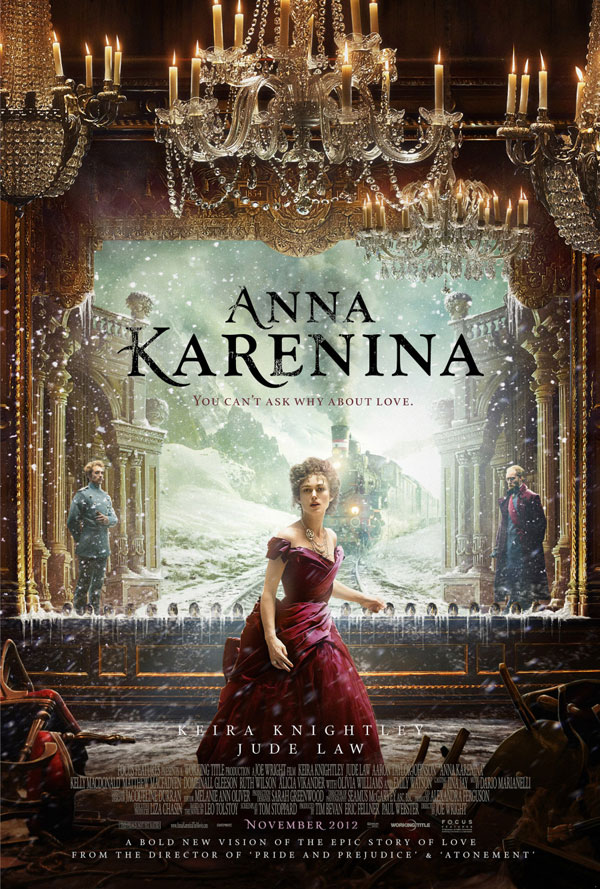
Anna Karenina [2012] – Movie Review

Anna Karenina Joe Wright 2012 movie poster

Joe Wright, the director who gave us “Atonement” and “Pride and Prejudice” tries his hand at one of Leo Tolstoy’s most popular novels and does so by going bold via a new cinematic vision that’s never be done before.

Anna Karenina, the story we all know of the woman who after being tormented by an uncaring husband seeks companionship in a much younger suitor, is given a fresh approach in Joe Wright’s version. The movie has a theatrical aspect that is most definitely quirky. If you are able to get past the weirdness of it, Anna Karenina will prove to be a highly enjoyable movie. If not, then it’s two dreary hours for you.

Keira Knightley gives a great performance as Anna and is definitely helped by the setting the director envisioned for the movie. She brings a ton of sensuality and sexuality to the table, as she has previously done with similar period pieces. Her best scenes, however, are as much a product of her own acting chops as they are of the art direction, camera angles and whole vision. Newcomer Aaron Taylor-Johnson, whom you’ve probably seen before in Kick-Ass and Nowhere Boy, gives a terrific performance as Count Vronsky, Anna’s younger lover. His performance is definitely years older than his young age of 22 and he delivers the right amount of emotion and subtlety that the character requires. Jude Law is almost unrecognizable as Anna’s husband Alexei Karenin. His role, however, borders on the irrelevant at times due to his grossly underdeveloped characters and that’s one of the major flaws in this adaptation.

Joe Wright’s Anna Karenina, while visually enchanting, is flawed when it comes to character development. If you haven’t read the book, Anna’s movie character comes off as a bored housewife whose husband couldn’t satisfy her anymore while, in fact, it was Anna’s husband who drove her to cheat on him but constantly shutting her out. This is not portrayed in the movie. Alexei Karenin is shown as a near saint who can’t understand why his wife would cheat on him and who’s ready to forgive her despite all odds so that by the time the end credits roll, your sympathy towards Anna, the movie’s main protagonist, is next to none.

This adaptation of Anna Karenina is fresh and energetic, risky and ambitious but it’s more about image than it is about content. What Joe Wright did was infuse some sense of modernity into this nineteenth century tale which might get it to connect with a younger demographic that’s not all too willing to read the keystone-sized book. Anna Karenina is one of the most visually inventive movies of the year and despite that taking out some substance, I was still taken away by the world portrayed on screen. However, all in all, the movie is nothing short polarizing, starting with Wright’s new take on the art direction to the way the screenplay was written, culminating in the finished product as a whole. I personally really liked it – but I can see why others would absolutely hate it. Anna Karenina is a movie that seduces you but ultimately fails to break your heart as the ice-cold train wheels break hers.

8/10