Johnnie Walker’s Keep Walking Project – Get Involved, Lebanon!

Soon after its ad featuring Nadine Labaki as the main face of the Keep Walking Lebanon campaign, Johnnie Walker has now launched a full fledged campaign called “The Keep Walking Campaign,” which is excellently explained by Nadine Labaki in the following video:

As you can see, there are three projects which you can support. Regardless of your preference, each of these projects is aiming to improve a part of our life in Lebanon which needs support. On the tourism side, I had blogged previously about how tourists need to see a side of Lebanon that goes beyond Beirut. On the business side, companies such as Seeqnce are helping startups get a foothold in the markets they are trying to get into and on the environmental aspect, Greenpeace Lebanon has recently launched a mission to increase awareness for our waters.

So as you can see, the three main projects supported by the Keep Walking project are all an essential part to improving Lebanon as a society: gain awareness for our nature, protect our nature and help our youth market themselves.

The project has five stages. The participants will be rewarded at the end of every stage with the top walkers earning a brand new 16GB iPad 2 and the two runners-up will receiving a bottle of Johnnie Walker Blue Label. I know some of you are vying for the runner up slot now. Voting will end on March 3rd, with the results being announced a few days later.

As Nadine said, you can support your favorite project by “walking the steps” for them. The more steps you walk, the higher the chance it gets to be selected as the winner. The steps include sharing videos, talking about the project, supporting it, etc… You can download the project’s iPhone app here or the Facebook app here.

Nadine Labaki asked a very poignant question in her movie. Where do we go now? Well, this is the direction you should take. Help Lebanon one step at a time. It’s not even that difficult. All it takes is the clicks of a few buttons.

The Achrafieh Building Collapse: An Observation

Meet Nasra. Named after her grandmother, Nasra is my grandfather’s niece. Coming from a Lebanese village in the North, your grandfather’s niece might as well be your aunt proper. Families are that close. Nasra also lived on the 7th floor in an Achrafieh building up until recently. The building in question is the one turned into rubbles in the following picture, taken a few hours ago:

(source)

Nasra had decided to leave her Achrafieh home because the building became filled with foreign nationalities that she wasn’t too keen on frequenting. However, recently, Nasra was faced with the news that her landlord has sold this Achrafieh building.

I am personally not a conspiracy theorist. But one can look at the building collapse in Achrafieh in one of two ways, both returning to the same conclusion which will be presented subsequently in this post.

1) The landlord didn’t want to pay his tenants in damages. So he managed to have the building collapse. After all, cracks couldn’t possibly have this building fall in the way pictures are describing it. Twitter user Layal, an architect, finds the whole collapse a bit fishy. As a medical student, concrete is nowhere near my specialty. So I cannot judge the physics of it all. But the idea cannot but cross your mind when you see the footage of the 7 story building having fallen like a cake taken out of the oven early, especially after news surfaced that the landlord had asked his tenants not to spend the night in the building. But where else would his tenants go? It’s not like everyone has a spare house in Beirut somewhere they can visit whenever in need.

2) The building was simply too old to function properly. The cracks were affecting the pillars or poles of the building, as engineer-to-be Twitter user Weam pointed out. According to Weam, cement ages. The fact that a building stands doesn’t mean an impeding failure is not inevitable. And this might have been the case here. The recent storm that overtook Lebanon for the past 7 days, bringing torrential amounts of rain, didn’t help the shaggy building either. A side-note here but if the recent storm helped a building collapse, then what can we expect from a serious earthquake that would hit the Lebanese capital? The answer is: a true catastrophe.

As a result of either 1 or 2, the building fell and families are now homeless, stranded. Injured people are being transferred to nearby hospitals. More than 20 people have died, including a 15 year old girl and 3 siblings who were trying to carry their sick father out of their apartment. 10 apartments were destroyed. It is truly a tragedy in the streets of Geitawi, the Achrafieh neighborhood where this is taking place as we speak/type/read.

Meanwhile, as people die under the rubble, you have a formidable amount of nosey Lebanese individuals wanting to appear on national TV. So they impede the work of medics and security individuals by their foolish, stupid faces, holding a phone to their ear and waving their hand so their equally silly families at home can see them on TV. Every time something of the sort happens, reasonable people start to call for those less reasonable to clear the scene. This is not the time to be sadistically intrusive. This is the time to take your uselessness back home and watch the proceedings on TV.

But I digress. 1 and 2 can be pointed back to one reason which caused them both: Lebanon’s old renting laws.

My name, as you know, is Elie and my grandparents have an apartment in Achrafieh, fairly close to where the building fell. My grandparents have been calling their apartment home for the past forty years. But as my grandparents pay a very insignificant amount of rent per year, the fact that the building they live in is literally falling apart or the fact that the ceiling of their apartment isn’t exactly in top shape suddenly become of second-rate importance. This house is not theirs. There will come a time where the family which owns the building they live in decides to sell it to some wealthy Lebanese or Arab businessman who decides to tear it down and replace it with a high-rise.

Meanwhile, the owners of my grandparents’ buildings are even more unlucky. Perhaps when their tenants first started renting, the amount they were paying per month was incredible. But as the years progressed and the Lebanese currency lost much of its value during the civil war, this amount became more and more insignificant. It reached a point where this person, who considers this building in Achrafieh, or any other part of Beirut and Lebanon for that matter, an investment, cannot make any significant amount of money from this investment. Why should he care about the state the building is in?

So in simple terms: the rental law in Lebanon is hurtful for both the tenant and the landlord. The former cannot really call the apartment his own and as such cannot really make it suitable for a 21st century lifestyle. With old electrical circuits and rusty plumbing, the buildings desperately need an overhaul. The landlord, having no room to make money from his building, simply lets it fall into disrepair and, sooner or later, the building will crumble like the one in Achrafieh did today.

If anything, this building collapse should be a wake up call to our politicians that the lives of the many Lebanese who live in these old, dying buildings are more important than the seats they wish to keep as elections cycle. Forty years later, Lebanon desperately needs a drastic overhaul of its landlord-tenant renting laws. Our dear politicians, however, vehemently stay away from discussing this law because no one wants the public opinion to say the law changed on their term. There’s no way the solution involves an immediate change between the old and new renting laws. No one would be able to afford rent in Achrafieh anymore. But a solution needs to be found as soon as possible.

You might say it wouldn’t be “fair” for the tenants, fair being not wanting them to pay higher. But let me tell you this. My Achrafieh home holds so many memories under its roof. I’d much rather pay extra for these memories to remain where they are, as they are, than to have the roof under which these memories were made fall on the heads on those included in the memories. I’d pay extra if it meant having a safe roof on top of my grandparents’ head. And after today, I think everyone would pay extra to have their loved ones kept safe.

Until then, my thoughts and prayers go the families of those affected in today’s building collapse.

Wine After Whiskey (Lyrics) – Carrie Underwood

These are the lyrics of Wine After Whiskey, off Carrie Underwood’s album “Blown Away.”  You can check out ALL the lyrics of the album here.

[Verse 1:]

Once upon a time our world was on fire and I loved to watch it burn

Wild and reckless, never any limits, guess I had a lot to learn

Cause fire turns to ember, embers to ashes that blow away too soon

[Chorus:]

Now everything’s after you is like having wine after whiskey

It went from do anything for you babe to you don’t even miss me

Once you’ve tasted a love that strong you can’t go back

And you can’t settle on anything less

And that’s what gets me. It’s like having wine after whiskey

[Verse 2:]

Looking back I guess it was really for the best, still you’re something that I crave

Even though I know it was right to let you go. You’re a habit hard to break

I got used to being high and nothing that I try seems good enough right now

[Chorus:]

It’s also watered down like having wine after whiskey

It went from do anything for you babe to you don’t even miss me

Once you’ve tasted a love that strong

You can’t go back and you can’t settle on anything less

And that’s what gets me. It’s like having wine after whiskey

[Outro:]

Once you’ve tasted a love that strong you can’t go back

And you can’t settle on anything less

And that’s what gets me. It’s like having wine after whiskey

Hugo – Movie Review

Based on the book “The Invention of Hugo Cabret” by Brian Selznick, Hugo is Martin Scorsese’s new feature film.

Hugo Cabret (Asa Butterfield) is a young boy whose father (Jude Law) died in a fire at a museum, leaving him to the care of his uncle Claude. The only possession left with Hugo is a machine called an automaton which he intends to fix. And so, Hugo is taken to work at tending to the clocks at a train station in 1930’s Paris. It is there that he has to rely on theft to survive and work on fixing the automaton, hoping it would give him some closure or information as to the death of his father. At that train station, he stumbles on a man named George (Ben Kingsley) who owns a toy shop. Hugo soon becomes friends with George’s niece, Isabelle (Chloë Grace Moretz), who strangely holds a key to fixing the automaton and open an adventure for the two of them – all as the station’s Inspector Gustav (Sacha Baron Cohen) goes after Hugo, in attempts to take him to the orphanage.

Hugo is a stunning movie. It is beautiful, gorgeous, mesmerizing. The cinematography, the visual effects, the direction, the music – all of these combine together to give you a very pretty movie to watch. It takes you in. It fascinates you at many points. It captivates you. It transcends out of the movie theatre, taking you to Paris, the city in which it was supposedly set.

But all of the above combined also need a good plot or story to help the fabric be tightly knit together into delivering a full-package movie. So the central question regarding Hugo arises: is the plot engaging enough?

The answer is a succinct miserable no.

Not only is the story so bland that it makes the movie altogether boring, it really puts a damper into all that the movie had going for it. The cinematography, though as I said is beautiful, becomes emotionally ineffective. The movie starts to go all over the place, not knowing really the point behind making it – is it a tribute to old cinema or is it an entertaining children’s movie? Is it a fantasy or it is pseudo-reality?

Hugo, being a movie revolved around machinery and clocks, has very machine-like acting as well. The actors – all of them – deliver strained performances that never really hit home, even when there’s enough emotional material for them to deliver. The comic timing in the movie is off that you find yourself rarely laughing even at its heartfelt moments. The action buildup is theoretically there but in reality never happens. You can tell what’s going to happen from a mile away and eventually, it happens. There are no surprises, no twists, nothing to mentally captivate you.

Hugo is more a vehicle for its director, Martin Scorsese, to share his passion for movies – especially historic movies – than to actually deliver a movie that is truly great in its own merits. If you compare Hugo with Scorsese’s previous works, Shutter Island for instance as to not stray far, you’d find the latter way out of Hugo‘s league in terms of overall effect on the viewer even though there’s obviously more work done in Hugo than Shutter Island.

The main difference between the two, apart from the fact that Hugo is mostly a Christmasy children’s movie and Shutter Island a dark adult thriller, is that the former has a very weak story while the latter has a stunningly intelligent plot – although it’s not as captivating visually. For a viewer with a taste like mine, Hugo feels very empty overall but a movie like Shutter Island would be very satisfying.

Being voted movie of the year by the National Board of Review and being nominated for almost every award imaginable, my expectations for Hugo were rather high. And frankly, it has all the ingredients to truly take your breath away: good actors, Paris, breathtaking visuals, a great director…. Sadly though, despite all of its potential, Hugo fails miserably. It remains flat, convoluted, very useless and emotionally flat. It may be breathtaking visually but on the overall, it’s a clockwork lemon.

Perhaps instead of having “one of the most legendary directors of our time takes you on an extraordinary adventure” on Hugo‘s poster, the sentence should have really said: “One of the most legendary directors of our time takes you on a uselessly stupid adventure” – for a movie concerned with storytelling, Hugo sure fails at telling a very simple story.

Don’t waste your money on this if you want a decent movie for your children this Christmas. Just buy the Harry Potter and the Deathly Hallows Part 2 DVD. At least you’d want to watch that movie again. And at least that movie is truly stunningly, gorgeously, marvelously epic all around.

5/10

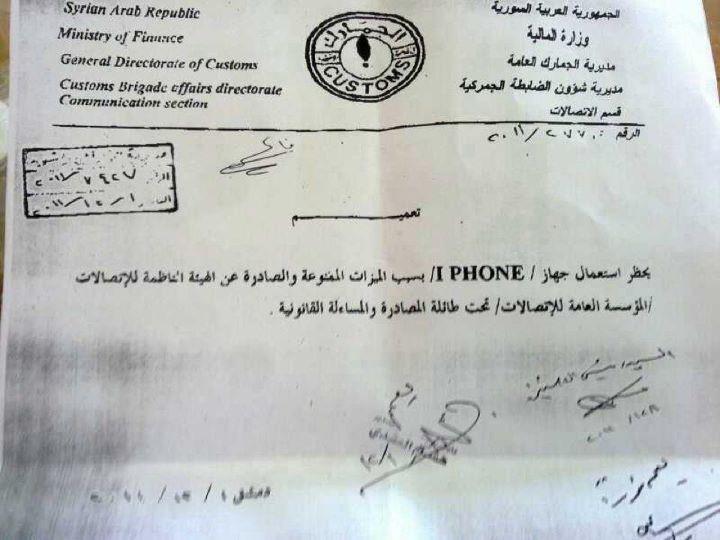
The iPhone is Banned in Syria

It looks like one of the new threats to burden the “lovely” Syrian regime is Apple’s iPhone. As if killing 4000 people, torturing countless more and terrorizing their whole country (and a neighboring country too) wasn’t enough.

But yes, according to this memo from the Syrian General Directorate of Customs, the iPhone has been banned because of its many features. I fail to see how a phone can threaten a political regime but I guess when you’re that insecure, anything goes. Or perhaps the iPhone has some hidden: Topple Regime app.

Check out the memo for yourself.