The Destruction of Achrafieh’s Jesuite Garden

While walking around Rome with a friend yesterday, he said the following: “you know, it’s a beautiful city but I wish it had more trees like Paris.”
I replied: “We’re ones to talk. The only trees I’ve seen in Beirut are in the Jesuite Garden next to my apartment in Achrafieh.”

I guess I jinxed it.

A highway tearing Achrafieh in two, removing countless parking spaces and destroying greenery that is otherwise rare in Beirut was not an enough project for Beirut’s municipality.
They now want to destroy the Jesuite Garden in question, which I wrote about before, in order to build … *drumroll* … a parking space (link).

The municipality is trying to sugar-coat the deal by saying they will replant trees above the parking, which will be underground. But how is that acceptable when the park has been around for decades and has ruins in it that date back to ancient times as well?

Is there a parking problem in Achrafieh? Sure. Is the solution for that problem killing off one of the few rare green spaces in Beirut? Hell no. I have absolutely no idea who’s the urban planning expert working at that so-called municipality but how inept is he at his job?
But what can we expect, really, when experts from Ile-De-France try to convince the municipality that its practices are unacceptable and still they go through them?

It’ll be one sad day when this park where I broke my arm and where my grandpa used to take me to play becomes a mass of concrete rubbish. But isn’t that what Beirut really is?

The Attack (2013) – Movie Review

20130609-055719.jpg

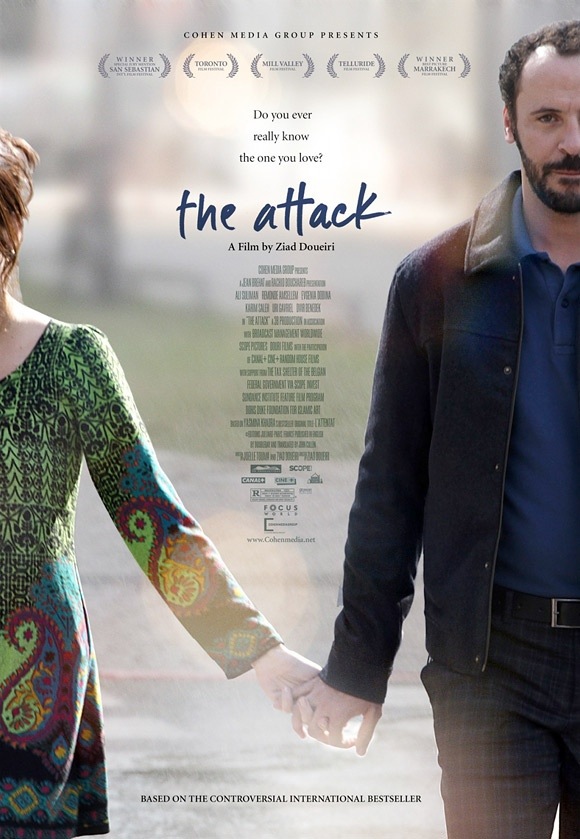
Ziad Doueiri’s The Attack might as well be considered as the most controversial “Lebanese” movie of recent times. But that’s not saying much. The hype surrounding the politics of the movie has been resounding. But does The Attack deliver on all the promises the director and the people who like him gave?

Amin (Ali Suliman) is an Arab-Israeli surgeon living and practicing medicine in Tel Aviv. While receiving some humanitarian award from the Israelis, Amin receives a call from his wife who sounds distressed. He doesn’t give it much attention, the focus is all on him. Soon enough, while having lunch at the rooftop of their Israeli hospital, the surgeons hear an explosion. 17 casualties ensue, 11 of which are children… And it’s Amin’s wife Siham (Raymond Amsalem) who committed the attack. Between the barrage of the Israelis who suddenly turn on the man they believe they sheltered into becoming one of them and the guard of the Arabs who believe Siham did a noble thing and are disgusted by the “bastard” who left his heritage and home to integrate in a place that is not his, Amin seeks out to find why his wife became a radical person who managed to get convinced to blow herself up for the Palestinian cause.

Sounds good, right? Well, in theory it does.

The Attack is divided into two parts. The first one is what can be called the Hebrew segment in which Tel Aviv is shown as a bustling cosmopolitan city whose people are as disassociated with the conflict raging outside their city’s confines while the other half is the Arab part, situated in Nablos, whose people struggle in their everyday life and revel in the idea of martyrdom, turning Siham into a local heroin. In a way, each part serves to pitch each side’s case.

I found the take on the issue, which the movie tries to do, shallow and borderline grating at times, even in its tackling of Siham’s radicalization which The Attack finds even more astonishing due to the fact she’s Christian. The Attack doesn’t go as deep as it should. it remains up there, flapping around the stereotypical stories of both sides – the action/reaction scenario that never ends. It never asks the tough questions: are the reactions warranted? Are they the best way to tackle the actions that led to them?

And I, for one, am glad and fully supportive of not choosing The Attack as Lebanon’s Oscar submission last year because there’s nothing Lebanese about the movie at all. In fact, the Lebanese elements of the movie are a mention of Hassan Nasrallah and Beirut – separately.

As a movie, The Attack works. It’s a decent thriller. There isn’t a dull moment, constantly keeping up the pace it sets from the get-go. The camera work, cinematography and locations are all well-done. But don’t expect it to blow you away. The acting, however, is superb. Both lead actors do a great job in their roles. Amsalem’s portrayal of Siham is gut-wrenching at times as is the life Ali Suliman gives her husband.

What The Attack manages to do, which might be the most important thing, is create a discussion. I watched the movie with 4 other Lebanese while on a stay in Paris – the movie will not be released in Lebanon – and we spent almost 40 minutes huddled outside the cinema center discussing what we had just seen. As a nation, though, Lebanon is possibly nowhere near ready for such a movie to be screened although the current state of Israel is eye-opening to what we, as a country, are so desperately lacking.

3/5

Nemr Abou Nassar vs LBCI

A lot of people absolutely adored Nemr Abou Nassar’s recent 20 minute rant against LBC and the situation in Lebanon that LBC somehow represents through their misrepresentation of an award show.

After all, aren’t the best kinds of pep talks those carried about by people financially better than 95% of the Lebanese population and with a second nationality to fall back on, just in case?

LBC has now replied to Mr. Nassar with what I think is an absolutely brilliant example of professionalism. For the first time, you have a Lebanese TV station acknowledging a mistake happening and taking the blame for it. Now LBC, my hat is off to you.

Hello Everyone,

Many of you rightfully expect LBCI’s transparent and honest answer to Mr. Abou Nassar’s video.

Like most would agree, LBCI succeeded in exporting Lebanon to the world with unparalleled levels of professionalism. This did not happen by coincidence or magic, but as the result of the perseverant work of hundreds of professionals. And it happened because we believe in our country, in its talents, and in all men and women dedicating themselves for Lebanon, whom we reassure of our unwavering support.

We do not (thank God!) pretend to be perfect. Mistakes happen with all corporations, and we believe the successful institutions are those who draw lessons to avoid repeating them. Let us be clearer: LBCI takes full responsibility of the mishaps that took place and regrets their impact on all the people involved. We salute the efforts of Dr. Sfeir and For Lebanon and sincerely hope that our apologies will be accepted.

The performance, which is not reflective of our standards, was due to the fact that the filming was outsourced in all good faith by LBCI to an external team, which did not perform up to expectations. Again, we are not trying to put the blame on someone else as we fully acknowledge our lack of proper selection. And we are willing to do everything possible to repair the harm that was inadvertently made.

What is an unforeseen sub-performance should not be dealt with as a premeditated wrongdoing, or as a hidden agenda targeting local talents. Though we fully understand the frustration, linking this incident to malevolent intentions is taking things out of proportion. We cannot stress enough how much LBCI supports Lebanese talents from all genres and languages and our track record in this case cannot be brushed aside because of a blunder. An unjust accusation cannot be an answer to a non-premeditated mistake.

Many people can testify that LBCI has broken many partnerships with organizers who did not abide by our standards in term of respecting the people attending the event, thus speaking of intentional sabotage is simply not an option. Criticizing what is wrong is what we do, and we support numerous points that Mr. Abou Nassar has raised, but we are against dramatized criticism which turns into a witch hunt.

We hope that a new page will be opened, and that we will continue to collaborate with all our valued talents to serve our common cause which is Lebanon, as we are all fighting in the same ranks. Mr. Abou Nassar ensured a good coverage for the event and helped in clearing the organizers’ reputation which we also hold dear. We join our voice to his to also thank them for their efforts, hoping to put this unintentional incident behind us

If only other institutions in this country can be this professional in the way they handle criticism.

4G LTE in Lebanon – The Review: A Premature Venture?

I’ve been using 4G around Beirut for the past two weeks. Alfa were kind enough to give me a dongle and a line with a 10GB plan for that purpose.

The result, 2 weeks in, is that I am less impressed than when they first showed me the service back at some ministry events.

The coverage:

I personally didn’t use the dongle because it doesn’t allow me to really test coverage. Don’t expect me to hop around with it connected to my Macbook pro for testing purposes. So I used the line I got on my iPad mini, which I carried everywhere I went around Beirut, giving me a more or less similar impression of what to expect on mobile phones.

The maps being circulated around for Alfa’s coverage (MTC has similar coverage as well) show a very well covered Beirut. The reality, however, is much less optimal than that. For example, Alfa’s map shows that both Beirut Souks and ABC have LTE towers nearby to enable indoor coverage. I can count on one hand how many times I had indoor coverage in both of those places. Outdoor coverage is also spotty sometimes and you will find your device switching between 3G and LTE often. Coverage in Achrafieh stops around St. George Hospital. Anything East to that doesn’t have LTE. Coverage in Hamra, when I tested it, was borderline horrible. The LTE I got simply didn’t work and when it did was far less optimal than the 3G I was using on my iPhone 5.

The speed:

I had possibly Lebanon’s fastest internet in my pocket for a few weeks, though I guess that’s not saying much. In fact, while the bandwidth I was getting is possibly impressive in itself, it somehow becomes less stellar when you realize that this is less optimal for what 4G LTE should be giving you. My friends in the United States are used to an average of 20 Mbps with speeds reaching 60Mbps sometimes, something I haven’t seen in any of the many, many speedtests I’ve done, fully knowing that the 20Mbps figure was what an alfa spokesperson said to expect on average in Lebanon. Now I wonder, if we are still in the phase when there aren’t many users sharing the bandwidth and we’re not getting the average speed, what can we expect when 4G is rolled on phones?

The experience:

I enjoyed the fast speed that I got whenever I did. For instance, I downloaded The Perks of Being a Wallflower off iTunes, its size being about 1.4GB, in slightly less than 2 hours by creating a hotspot out of my connection. Songs that I purchased from the iTunes store would download in less than a minute. I didn’t need to worry about the time it would take an app to download or update – even if my iPad fell back on 3G more often than not in many of the tasks I mentioned earlier.

I also really enjoyed the leisure that the 10GB quota gives. It is, however, priced at $99 per month which means it’s definitely not within my range. The quotas, on the other hand, are not 4G-centric. There has been constant talk about how we have the best 4G prices. This isn’t true. You, as a user, are subscribing to a mobile data bundle, not a 4G bundle. If your phone supports 4G and you find yourself in a 4G area (only Beirut at this time), you automatically switch from 3G to 4G, which means you use the same bundle that you had all the time for 3G to use 4G when available. So if you find 3G quotas unacceptable, the same logic still applies.

Are the bundles enough? As it currently stands, I would still say they are overpriced. However, I believe the quota itself will suffice, even with 4G, because the speeds are not that much better than optimal 3G (I have seen 3G speedtests that are better than some 4G ones I did) and coverage isn’t good enough for you to burn through your MBs without noticing.

Moreover, LTE will absolutely demolish your battery life. I was literally able to see the battery percentage of my iPad mini dropping in front of my eyes the more I used LTE, which could be because coverage isn’t as good as advertised. So be prepared to have your chargers around when the service is rolled to mobile phones. Trust me. You will develop battery-phobia.

Conclusion:

I think 4G LTE currently in Lebanon is a premature venture that we’ve undertaken. Of course, things are bound to improve from now on and I have to say that my experience with the pilot phase of 4G has been better than the pilot phase of 3G which was all over the place. But do we really need 4G now when there are many facets of our internet sector that are in a much dire need of improvement?

Of course, 4G is great and all. And to further develop economically, our country desperately needs such measures. But couldn’t it have wait a year or so more pending bettering the service before rolling to the public and providing further improvement for our 3G services?

If it were up to me, I would have waited on 4G and developed Lebanon’s 3G even more because our 3G coverage, based on my experience abroad, is not the best that it could be yet in spite of all the tangible improvement we’ve seen recently.

Smoking in Lebanon: World’s 2nd Highest Increase in Smoking Since 1990

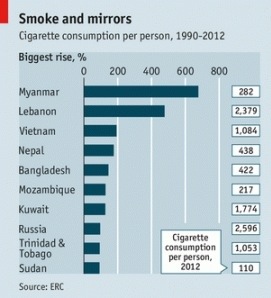
Perhaps this study published by the economist could be a wake up call to those who say there’s no need for regulations pertaining to the smoking situation in Lebanon.

We have the world’s second highest increase in smoking between 1990 and 2012. So while almost everywhere else was busy enforcing laws to improve the health of its people, especially when it comes to smoking rates, we’ve been sitting around doing nothing and watching.

20130531-114414.jpg

The healthcare situation in Lebanon is deplorable at best. We have no efficient primary health care in the country, a branch of medicine whose goal includes the prevention of such drastic increases.
The only form of law we have pertaining to smoking is the smoking ban which almost no one is abiding with these days, not that our security officers care. After all, there are worse things happening in the country, or so the argument goes.

Cigarette prices are still a dismal maximum of $2 per pack because God forbid we tax it and the mentality towards smoking hasn’t changed despite the timid efforts to tackle it.
As an example, I was asked by a patient while rotating at a Lebanese hospital, an IV in her arm with a hospital gown and all, if she can smoke indoors. I guess she wasn’t too pleased ordered her outside.

What hope for improvement can we have when there are physicians with absolutely no problem in chain-smoking while wearing the same white coat they will use to see patients a few minutes later?
What improvement can we seek when medical students, the people who should be advocating for this, smoke more than your average Lebanese despite every single medical literature telling them smoking isn’t good for them – beyond the typical picture of a smoker’s lung?

There are way too many interventions that this country needs. It’s time smoking goes up on the list of priorities as we slowly let the people of our country kill themselves and the people around them away.

But I guess who cares with the political deadlock we have, the elections we won’t be having and the parliament we will be having around for a year or so more.